
Loneliness is an emotion that is often felt deeply but explained poorly when described in plain words. Similes for loneliness help writers turn that abstract feeling into something readers can clearly imagine and emotionally connect with. By using comparisons rooted in nature, silence, distance, or everyday experiences, loneliness similes create vivid emotional imagery. This article focuses on explaining what similes for loneliness are, why they matter in creative writing, and how beginners can confidently use them. With simple explanations and clear examples, writers can better understand how figurative language strengthens emotional expression.
What Are Similes for Loneliness?
Similes for loneliness are comparisons that describe the feeling of loneliness by relating it to something else using words like “like” or “as.” They are a type of figurative language used to express emotional isolation, emptiness, or distance in a way readers can easily understand and feel. By comparing loneliness to familiar images or experiences, similes make emotions clearer and more impactful, especially for beginners.
Understanding Similes in Simple Terms
A simile is a figure of speech that compares two different things to highlight a shared feeling or quality. Instead of stating emotions directly, similes allow writers to suggest meaning through imagery.
- A simile uses the words “like” or “as”
- It differs from literal language by creating images instead of facts
- Similes help readers feel emotions rather than just recognize them
Example: Saying someone is lonely is literal, but comparing that loneliness to something familiar makes the feeling more vivid. - 10 Additional Powerful Similes for Similes For Loneliness
- Loneliness is like an empty train station at midnight
It shows a place that once had life but now feels still and silent.
Example: After everyone left the party early, the hall felt like an empty train station at midnight. - Loneliness is like a single chair in a dark room
It represents isolation and the feeling of being alone in one space.
Example: Sitting in my room after the argument, I felt like a single chair in a dark room. - Loneliness is like a lighthouse without passing ships
It suggests standing strong but having no one to connect with.
Example: Even with achievements, he felt like a lighthouse without passing ships. - Loneliness is like a phone with no signal in the mountains
It reflects disconnection from others and the world.
Example: Moving to a new city made her feel like a phone with no signal in the mountains. - Loneliness is like a winter tree without leaves
It symbolizes emptiness and emotional stillness.
Example: After his friends moved away, he felt like a winter tree without leaves. - Loneliness is like an echo in a hollow cave
It shows how your feelings return but no one else responds.
Example: Her thoughts felt like an echo in a hollow cave during long nights. - Loneliness is like a deserted playground at dusk
It represents once-active joy now turned quiet and empty.
Example: Without his childhood friends, life felt like a deserted playground at dusk. - Loneliness is like a bird flying without a flock
It shows independence mixed with isolation.
Example: Starting college abroad made him feel like a bird flying without a flock. - Loneliness is like a library where all books are closed
It suggests hidden thoughts with no one to share them with.
Example: Her mind felt like a library where all books are closed. - Loneliness is like a long road with no direction signs
It reflects confusion and emotional emptiness in life.
Example: After the breakup, his future felt like a long road with no direction signs. - Positive vs Negative Similes For Similes For Loneliness
- Positive similes describe loneliness as peaceful solitude or calm reflection, where being alone feels comforting or healing. Negative similes describe loneliness as painful isolation, emptiness, or emotional disconnection.
- Positive Similes:
- Loneliness is like a quiet lake at dawn
It shows peace and calmness in being alone.
Example: She enjoyed reading alone, feeling like a quiet lake at dawn. - Loneliness is like a cozy room with soft rain outside
It reflects comfort and warmth in solitude.
Example: Spending the evening alone felt like a cozy room with soft rain outside. - Negative Similes:
- Loneliness is like a broken compass in a desert
It shows confusion and lack of direction.
Example: After losing his job, he felt like a broken compass in a desert. - Loneliness is like a shadow that never speaks back
It represents emotional emptiness and lack of response.
Example: Without friends to talk to, her days felt like a shadow that never speaks back. - Real-Life Examples of Similes For Similes For Loneliness in Context
- After moving to a new school, I felt like an empty train station at midnight.
It means I felt completely alone without familiar faces around me. - When my phone stopped working during travel, I felt like a phone with no signal in the mountains.
It shows how disconnected I felt from everyone. - Sitting alone in the cafeteria made me feel like a single chair in a dark room.
It describes the feeling of being surrounded but still alone. - After my best friend moved away, life felt like a deserted playground at dusk.
It means everything once fun now felt quiet and empty. - During the long winter holidays, I felt like a winter tree without leaves.
It shows emotional emptiness and lack of activity or joy.
35 Similes Expressing Loneliness
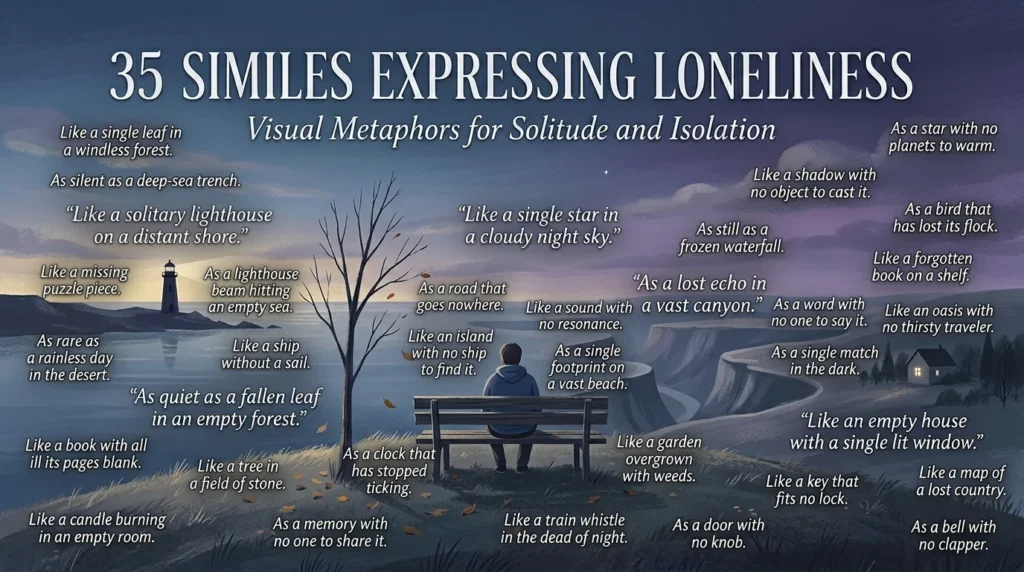
1. Lonely like a mountain peak
This loneliness simile shows emotional isolation through height, distance, and silence.
Example: She felt lonely like a mountain peak rising far above the world.
2. Alone as drifting sand
This simile for being alone reflects movement without connection or belonging.
Example: He wandered alone as drifting sand across empty streets.
3. Silent like an empty desert
This simile expresses vast emotional quietness and emptiness.
Example: The house felt silent like an empty desert at noon.
4. Lonely like a single star
This simile highlights isolation despite visibility.
Example: She shone lonely like a single star in the night sky.
5. Alone as a fallen leaf
This comparison reflects separation and abandonment.
Example: He felt alone as a fallen leaf on cold ground.
6. Quiet as snowfall at midnight
This simile captures soft, unnoticed loneliness.
Example: Her sadness was quiet as snowfall at midnight.
7. Lonely like an island in fog
This simile shows emotional distance and isolation.
Example: He stood lonely like an island hidden in fog.
8. Alone as a shadow at dusk
This comparison reflects fading presence.
Example: She walked alone as a shadow at dusk.
9. Empty like a dried riverbed
This simile emphasizes emotional exhaustion.
Example: His voice sounded empty like a dried riverbed.
10. Lonely like the last tree on a plain
This comparison shows standing alone without support.
Example: She waited lonely like the last tree on a plain.
11. Silent as a frozen lake
This simile reflects emotional stillness.
Example: The room fell silent as a frozen lake.
12. Alone as a bird without a flock
This simile shows loss of belonging.
Example: He traveled alone as a bird without a flock.
13. Lonely like a lighthouse in a storm
This comparison reflects endurance and isolation.
Example: She stood lonely like a lighthouse in a storm.
14. Alone as fallen snow at dawn
This simile suggests quiet emptiness.
Example: The street felt alone as fallen snow at dawn.
15. Lonely like a moonless night
This simile reflects darkness and absence.
Example: His thoughts felt lonely like a moonless night.
16. Lonely like unanswered letters
This simile shows ignored emotions.
Example: Her feelings were lonely like unanswered letters.
17. Alone as a forgotten memory
This comparison reflects being overlooked.
Example: He felt alone as a forgotten memory.
18. Empty like paused time
This simile expresses emotional stagnation.
Example: The moment felt empty like paused time.
19. Lonely as silence after laughter
This simile shows emotional contrast.
Example: The room felt lonely as silence after laughter.
20. Alone like an echo with no return
This comparison highlights emotional absence.
Example: His words were alone like an echo with no return.
21. Invisible as unspoken thoughts
This simile reflects being unseen.
Example: She felt invisible as unspoken thoughts.
22. Lonely like waiting without hope
This simile expresses prolonged emptiness.
Example: He sat lonely like waiting without hope.
23. Empty as an unfinished sentence
This simile shows emotional incompleteness.
Example: Her heart felt empty as an unfinished sentence.
24. Alone as distance between clocks
This comparison reflects separation in time.
Example: They felt alone as distance between clocks.
25. Lonely like time slowing down
This simile emphasizes emotional heaviness.
Example: The night stretched lonely like time slowing down.
26. Silent as unsent messages
This simile reflects withheld emotion.
Example: His phone felt silent as unsent messages.
27. Alone like a name never called
This comparison shows neglect.
Example: She felt alone like a name never called.
28. Lonely as breath in cold air
This simile shows brief, fragile presence.
Example: His loneliness rose like breath in cold air.
29. Empty like unused space
This simile reflects wasted emotional capacity.
Example: The house felt empty like unused space.
30. Alone as a pause in conversation
This comparison highlights awkward silence.
Example: The moment hung alone as a pause in conversation.
31. Lonely like fading music
This simile reflects gradual emotional loss.
Example: Her happiness felt lonely like fading music.
32. Isolated as unseen distance
This simile shows emotional separation.
Example: He stood isolated as unseen distance.
33. Alone like a thought at night
This simile reflects quiet introspection.
Example: She lay alone like a thought at night.
34. Lonely as forgotten time
This comparison shows emotional neglect.
Example: The afternoon passed lonely as forgotten time.
35. Empty like waiting rooms
This simile reflects emotional uncertainty.
Example: His heart felt empty like waiting rooms.
Table of Loneliness Similes and Meanings
This section provides a concise overview of selected similes for loneliness, clarifying their emotional meaning and suggesting where each comparison fits best. Writers can use this table to quickly match a loneliness simile with the right writing context and tone.
| Simile | Meaning | Best Used In |
| Lonely like a mountain peak | Emotional isolation and distance | Descriptive fiction |
| Silent like an empty desert | Vast emotional emptiness | Reflective writing |
| Alone as drifting sand | Disconnection and movement | Poetry |
| Invisible as unspoken thoughts | Feeling unseen | Personal narratives |
| Lonely like fading music | Gradual emotional loss | Emotional scenes |
Linguistic Insight: Why Loneliness Uses Nature Imagery
Nature imagery is widely used because it feels universal and emotionally accessible.
- Natural symbols are easily understood across cultures
- Landscapes mirror emotional states effectively
- Nature-based similes create strong emotional resonance
Expert Opinion: How Writers Use Loneliness Similes Effectively
Skilled writers use loneliness similes with intention and restraint.
- Match imagery to emotional intensity
Example: Subtle loneliness works best with quiet imagery. - Avoid overcrowding sentences with similes
Example: One strong simile is more effective than several weak ones. - Let the context support the comparison
Example: Build mood before introducing the simile.
How to Use Similes for Loneliness in Writing
Using similes effectively requires awareness of tone and audience.
- Place similes at emotional moments
Example: Use them during reflection or inner dialogue. - Match similes to genre expectations
Example: Abstract imagery suits poetry, while simple imagery suits prose. - Keep comparisons clear and natural
Example: Avoid forcing complex imagery.
Common Mistakes When Using Loneliness Similes
Writers often weaken their work through avoidable errors.
- Overusing similes
Example: Too many comparisons reduce emotional impact. - Relying on clichés
Example: Familiar imagery feels unoriginal. - Mixing unrelated images
Example: Conflicting imagery confuses readers.
Self-Assessment Checklist for Writers
- Is the simile easy to imagine
- Does it match the emotion
- Is it original and relevant
- Does it enhance the scene
Self-Assessment Answers
- Clear imagery improves reader connection
- Emotional accuracy builds trust
- Original similes strengthen writing
- Revision improves clarity
FAQs About Similes for Loneliness
What is the best simile for loneliness?
The best loneliness simile depends on the emotional context and tone.
Example: Quiet scenes benefit from subtle comparisons.
Are similes for loneliness used in poetry?
Yes, poetry frequently uses loneliness similes to express emotion.
Example: Poets rely on imagery to condense deep feelings.
Can similes for loneliness be used in essays?
They can be used in reflective or narrative essays where emotional language is appropriate.
How do similes improve emotional writing?
Similes help readers visualize emotions and feel empathy.
Example: A strong comparison makes feelings tangible.
What is the difference between metaphor and simile?
A simile uses “like” or “as,” while a metaphor states the comparison directly.
Example: A simile compares, a metaphor declares.
Final Conclusion
Similes for loneliness offer writers a powerful way to express emotional isolation through imagery instead of explanation. By comparing loneliness to silence, distance, nature, or time, writers help readers experience the emotion more deeply. Understanding how to choose clear, appropriate comparisons builds confidence, especially for beginners learning figurative language. The key is balance, clarity, and emotional accuracy. When used thoughtfully, loneliness similes enrich writing, strengthen emotional impact, and create meaningful connections between the writer’s feelings and the reader’s imagination.

Sarah Mitchell is an experienced writer and grammar teacher with over 10 years of expertise in English language education. She helps learners improve their grammar, writing, and communication skills through clear explanations and practical examples. Sarah creates learner-friendly content focused on real-life English, making language learning simple, effective, and confidence-building.