
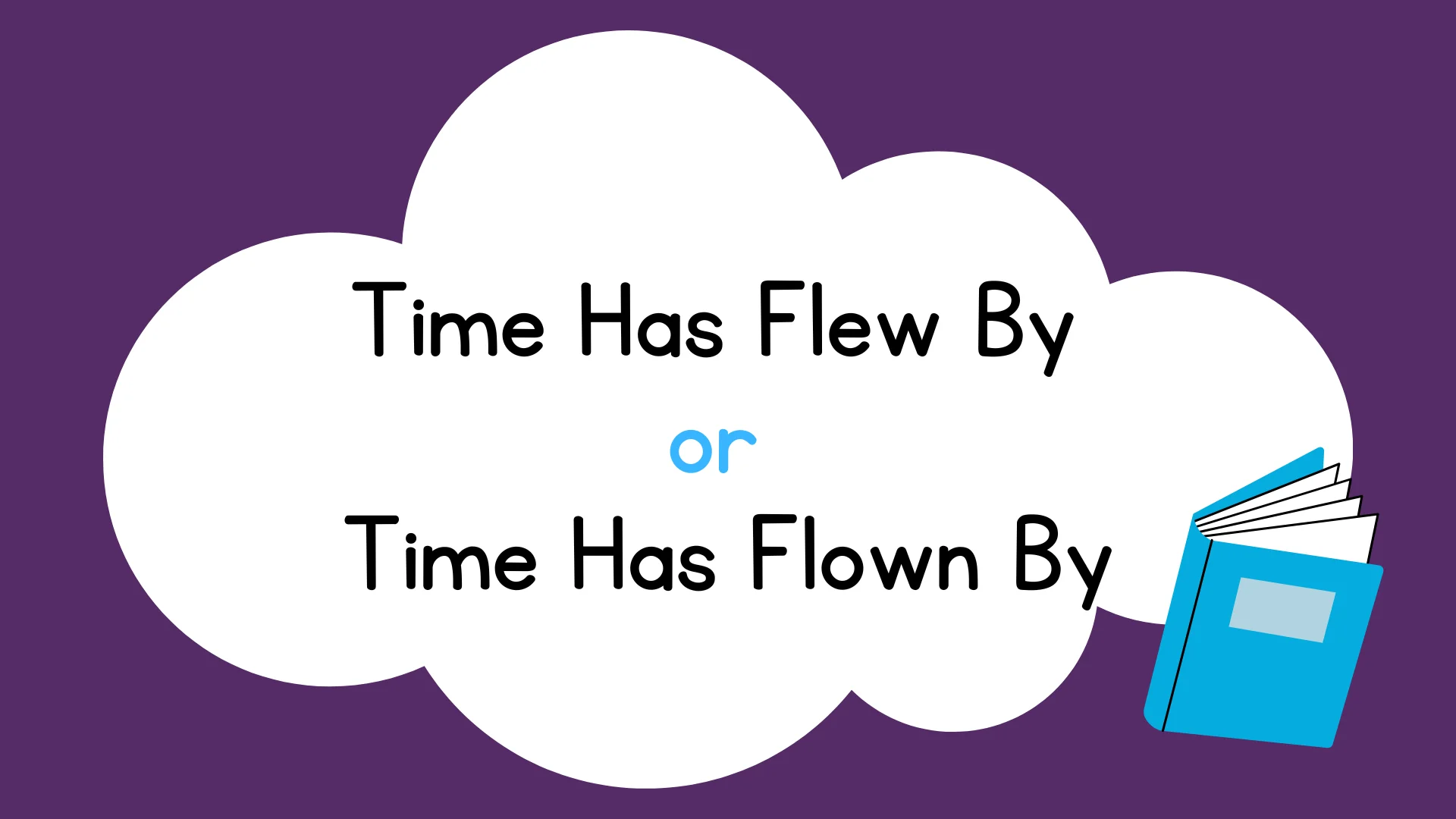
Many writers feel unsure whether to say “time has flew by” or “time has flown by.” The confusion usually comes from irregular verb forms and the way spoken English influences writing. Although both phrases sound natural in conversation, only one follows correct grammar rules. Understanding the difference helps you write clearly and confidently.
Why This Phrase Confuses So Many Writers
This phrase confuses writers because English irregular verbs do not follow predictable patterns. In casual speech, people often say “time has flew by,” and repeated exposure makes it seem correct. However, written English follows stricter grammar rules, especially when using perfect tenses. Knowing the structure behind the phrase clears up the confusion quickly.
Which Phrase Is Grammatically Correct
The correct phrase is “time has flown by.” It uses the present perfect tense, which requires the past participle “flown.” “Time has flew by” is grammatically incorrect because “flew” is the simple past form, not the past participle. Example: Time has flown by so quickly.
Grammar Basics Behind “Time Has Flown By”
The phrase follows the present perfect tense, which has a clear structure.
• Uses the helping verb “has”
• Requires a past participle, not simple past
• Shows an action completed up to the present
Example: Time has flown by since we last met.
Understanding the Verb “Fly”
“Fly” is an irregular verb, meaning it does not follow the standard -ed pattern.
Examples:
Base form: fly
Past tense: flew
Past participle: flown
Forms of “Fly” Explained Simply
The difference between “flew” and “flown” depends on tense and structure.
| Form | Usage | Example |
| Flew | Simple past | Time flew by yesterday. |
| Flown | Past participle | Time has flown by. |
Why “Time Has Flew By” Is Incorrect
The mistake happens because “has” cannot be followed by a simple past verb.
• “Has” needs a past participle
• “Flew” does not fit this structure
Incorrect: Time has flew by.
Correct: Time has flown by.
Common Reasons People Make This Error
• Influence of spoken English
• Familiarity with “flew”
• Uncertainty about irregular verbs
Comparison Table: Flew vs Flown in Real Sentences
| Verb Form | Tense | Correct Example | Incorrect Example |
| Flew | Simple past | Time flew by last night. | Time has flew by. |
| Flown | Past participle | Time has flown by. | Time flown by yesterday. |
Usage in Real Life: Where You’ll See This Phrase
You’ll see this phrase in many everyday contexts.
• Conversations
• Writing and storytelling
• Media and articles
Everyday Conversation
In speech, people often use the phrase casually.
Example: Wow, time has flown by today.
Writing and Formal Contexts
Correct grammar matters in professional and academic writing.
Example: Time has flown by since the project began.
Linguistic Insight: Why English Irregular Verbs Cause Confusion
Irregular verbs are challenging for learners.
• No consistent patterns
• Heavy reliance on memorization
• Influence of spoken habits
Expert Opinion: What Grammar Authorities Recommend
Grammar experts agree on one rule.
• Dictionaries list “flown” as the past participle
• Grammar guides reject “has flew” constructions
• Formal English always uses “has flown”
Common Mistakes and Confusions
Similar errors appear with other verbs.
• Has went instead of has gone
• Has ate instead of has eaten
Examples:
Correct: She has gone home.
Correct: He has eaten already.
Examples Section: Correct and Incorrect Sentences
• Correct: Time has flown by this year.
• Incorrect: Time has flew by this year.
• Correct: The weekend has flown by.
• Incorrect: The weekend has flew by.
Self Assessment: Test Your Understanding
Choose the correct option.
• Time has (flew / flown) by so fast.
• The years have (flew / flown) by.
• Yesterday, time (flew / flown) by.
Self Assessment Answers
• flown
• flown
• flew
- Read: Taken Vs Taking
- Read: Soo Vs So
- Read: Perspective or Prospective
- Read: Felt Or Feel
- Read: Year Old Vs Years Old
FAQs About “Time Has Flew By” vs “Time Has Flown By”
Which is correct: time has flew by or time has flown by?
Time has flown by is correct.
Why do people say time has flew by?
Because spoken English often ignores strict grammar rules.
Is time has flew by ever acceptable?
No, it is grammatically incorrect.
What does time has flown by mean?
It means time passed very quickly.
What’s the difference between flew and flown?
“Flew” is simple past, while “flown” is the past participle.
Is this phrase formal or informal?
It works in both, as long as it is grammatically correct.
Final Conclusion: Choosing the Correct Phrase with Confidence
The correct phrase is “time has flown by,” and the reason is simple grammar, not preference or style. English present perfect tense always requires a past participle, and for the verb “fly,” that form is “flown.” While “time has flew by” may sound familiar due to spoken habits, it does not follow standard English rules and should be avoided in writing. Once you remember that “has” pairs with past participles, many similar mistakes become easier to fix. This rule applies not only to “fly,” but also to other irregular verbs like “go,” “eat,” and “see.” Using the correct form improves clarity, credibility, and confidence in both formal and informal writing. With this understanding, you can now choose the right phrase instantly and avoid a very common grammar error.

Sarah Mitchell is an experienced writer and grammar teacher with over 10 years of expertise in English language education. She helps learners improve their grammar, writing, and communication skills through clear explanations and practical examples. Sarah creates learner-friendly content focused on real-life English, making language learning simple, effective, and confidence-building.
3 thoughts on “Time Has Flown By or Time Has Flew By? Meaning & Grammar Rule Explained”