
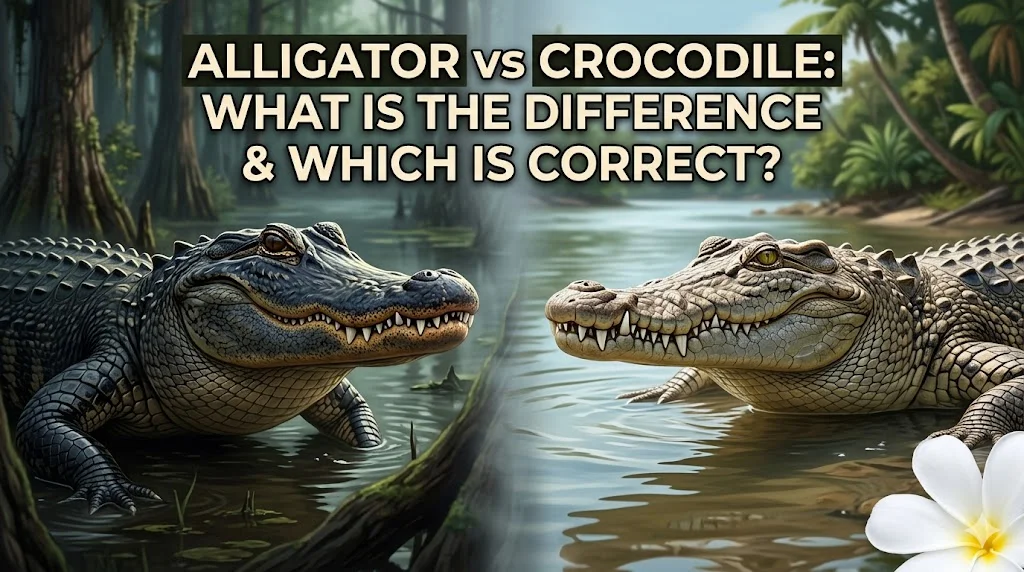
Alligators and crocodiles are often confused because they look very similar and both belong to the same reptile group. However, they have clear differences in appearance, habitat, and behavior. Understanding these differences helps you identify them correctly and use the right word in writing, speaking, and learning contexts.
Comparison Overview
Alligators and crocodiles are large, semi-aquatic reptiles from the same biological order. They share features like strong jaws, armored skin, and powerful tails. Despite these similarities, they differ in snout shape, environment, behavior, and where they are found around the world.
Definition of Alligator
An alligator is a large reptile with a broad, U-shaped snout and a darker body color. It mainly lives in freshwater habitats such as rivers, lakes, and swamps. Alligators are most commonly found in the United States and China.
Definition of Crocodile
A crocodile is a large reptile with a narrow, V-shaped snout and a lighter, olive or brown body. It can live in both freshwater and saltwater environments. Crocodiles are found in Africa, Australia, Asia, and the Americas.
Main Differences Between Alligator and Crocodile
The main difference lies in their snout shape: alligators have wide, rounded snouts, while crocodiles have narrow, pointed ones. Alligators prefer freshwater, whereas crocodiles can survive in saltwater. Crocodiles tend to be more aggressive than alligators. Another key difference is teeth visibility—crocodiles show more teeth when their mouths are closed, while alligators usually do not.
Grammar Guide
How each term is used in sentences
Both “alligator” and “crocodile” are countable nouns used to name specific animals.
Examples:
- The alligator rested near the swamp.
- We saw a crocodile in the river.
Common mistakes learners make
Many people use “alligator” and “crocodile” interchangeably without understanding their differences. Another common mistake is calling any large water reptile a crocodile.
Simple rules to remember
Think of “A” in alligator as “America” (where they are commonly found) and “C” in crocodile as “coastal” (since they can live in saltwater areas).
Quick tips for writing and speaking
Use “alligator” for freshwater reptiles with broad snouts. Use “crocodile” for reptiles with narrow snouts that may live in saltwater. Always consider location and physical traits.
When to Use Each One
Use “alligator” when talking about reptiles found in freshwater environments, especially in the U.S. or China. Use “crocodile” when referring to reptiles in tropical regions, particularly those living near coastal or saltwater areas.
When NOT to Use Each One
Do not use “alligator” for reptiles that live in saltwater or have narrow snouts. Avoid using “crocodile” for freshwater swamp reptiles in the U.S. unless you are sure they are crocodiles.
Which One to Use (Decision Guide)
If the reptile has a wide, rounded snout and lives in freshwater, choose “alligator.” If it has a narrow, pointed snout and can live in saltwater, choose “crocodile.” When unsure, focus on the animal’s appearance and habitat.
Real-World Practical Examples
Alligator Examples
- The alligator stayed hidden in the swamp during the day.
- Students studied alligators in their biology class.
- The zoo’s alligator exhibit is very popular.
- An alligator was spotted near a lake in Florida.
- Writers often include alligators in wetland stories.
Crocodile Examples
- The crocodile swam slowly in the river.
- Crocodiles are known for their powerful bite.
- The documentary showed crocodiles in Africa.
- A crocodile was seen near a coastal region.
- Crocodiles are often featured in wildlife photography.
Self-Assessment (Fill in the Blanks)
- I will use ______ when referring to a reptile in a freshwater swamp in Florida. The correct word is ______ because it lives in freshwater in the U.S.
- I will use ______ when referring to a reptile in a coastal river in Africa. The correct word is ______ because it can live in saltwater.
- I will use ______ when the animal has a wide snout. The correct word is ______ because of its physical feature.
- I will use ______ when the animal has a narrow snout. The correct word is ______ because of its shape.
- I will use ______ when describing a reptile in China. The correct word is ______ because of its location.
- I will use ______ when describing a reptile in Australia. The correct word is ______ because of its habitat.
- I will use ______ when the animal hides its teeth when the mouth is closed. The correct word is ______ because of this trait.
- I will use ______ when teeth are visible even when the mouth is closed. The correct word is ______ because of this feature.
- I will use ______ in a story set in a freshwater lake. The correct word is ______ because of the environment.
- I will use ______ in a jungle river story. The correct word is ______ because of the setting.
- I will use ______ when referring to a darker reptile. The correct word is ______ because of its color.
- I will use ______ when referring to a lighter reptile. The correct word is ______ because of its appearance.
- I will use ______ when talking about a less aggressive reptile. The correct word is ______ because of behavior.
- I will use ______ when talking about a more aggressive reptile. The correct word is ______ because of behavior.
- I will use ______ in an American wildlife article. The correct word is ______ because of region.
- I will use ______ in an African wildlife article. The correct word is ______ because of region.
- I will use ______ when describing swamp animals. The correct word is ______ because of habitat.
- I will use ______ when describing coastal predators. The correct word is ______ because of environment.
- I will use ______ when unsure but the snout is wide. The correct word is ______ because of shape.
- I will use ______ when unsure but the snout is narrow. The correct word is ______ because of shape.
Answers
- alligator, alligator
- crocodile, crocodile
- alligator, alligator
- crocodile, crocodile
- alligator, alligator
- crocodile, crocodile
- alligator, alligator
- crocodile, crocodile
- alligator, alligator
- crocodile, crocodile
- alligator, alligator
- crocodile, crocodile
- alligator, alligator
- crocodile, crocodile
- alligator, alligator
- crocodile, crocodile
- alligator, alligator
- crocodile, crocodile
- alligator, alligator
- crocodile, crocodile
Conclusion About Alligator vs Crocodile
Understanding the difference between alligators and crocodiles makes it much easier to identify these fascinating reptiles in nature and in language use. Although they may look similar at first glance, their snout shape, habitat, behavior, and geographical location clearly set them apart. Alligators are generally found in freshwater environments with broader snouts and a less aggressive nature, while crocodiles adapt to both freshwater and saltwater with narrower snouts and stronger territorial behavior. Learning these distinctions not only improves your general knowledge but also helps you use the correct term in writing, studies, and everyday conversation. With simple observation skills, anyone can confidently tell them apart and avoid common confusion between the two.
FAQs
What is the main difference between alligators and crocodiles
The main difference is their snout shape and habitat. Alligators have broad, U-shaped snouts and live mostly in freshwater. Crocodiles have narrow, V-shaped snouts and can survive in both freshwater and saltwater environments across different regions of the world.
Which is more aggressive, alligator or crocodile
Crocodiles are generally considered more aggressive than alligators. They are more territorial and can be more likely to attack if threatened. Alligators are usually less aggressive unless provoked or protecting their young.
Where are alligators commonly found
Alligators are mainly found in the southeastern United States, especially in Florida and Louisiana, as well as parts of China. They prefer freshwater environments like swamps, rivers, and lakes.
Where do crocodiles live
Crocodiles are found in Africa, Australia, Asia, and the Americas. Unlike alligators, they can live in both freshwater and saltwater habitats, including rivers, lakes, estuaries, and coastal areas.
Can alligators and crocodiles live together
In most cases, they do not naturally live together because they prefer different environments. However, in rare regions where their habitats overlap, they may coexist but usually avoid direct interaction due to competition and behavior differences.
How can you tell an alligator from a crocodile
You can tell them apart by looking at their snout and teeth. Alligators have wider, rounded snouts and hidden teeth when their mouth is closed. Crocodiles have narrower snouts and visible teeth even when their mouth is shut.
Are alligators or crocodiles bigger
Crocodiles are generally larger on average, especially saltwater crocodiles, which can grow extremely long. Alligators are usually smaller, though they can still reach impressive sizes depending on age and habitat.
What do alligators and crocodiles eat
Both are carnivorous and eat fish, birds, and small mammals. They are opportunistic hunters and use their strong jaws to catch prey. Their diet can vary based on habitat and food availability.
Are alligators and crocodiles dangerous to humans
Both can be dangerous if provoked or approached too closely. However, attacks are rare when humans keep a safe distance. Crocodiles are generally considered more dangerous due to their aggressive nature.
Why are alligators and crocodiles often confused
They are often confused because they look very similar and belong to the same reptile family. Without knowing their snout shape, habitat, and behavior, it can be difficult for people to tell them apart.

Amelia Wright focuses on making figurative language easy to understand. Her writing explains similes, metaphors, and word meanings using relatable examples. She aims to help readers recognize subtle differences in usage and apply them correctly in both academic and casual writing.