
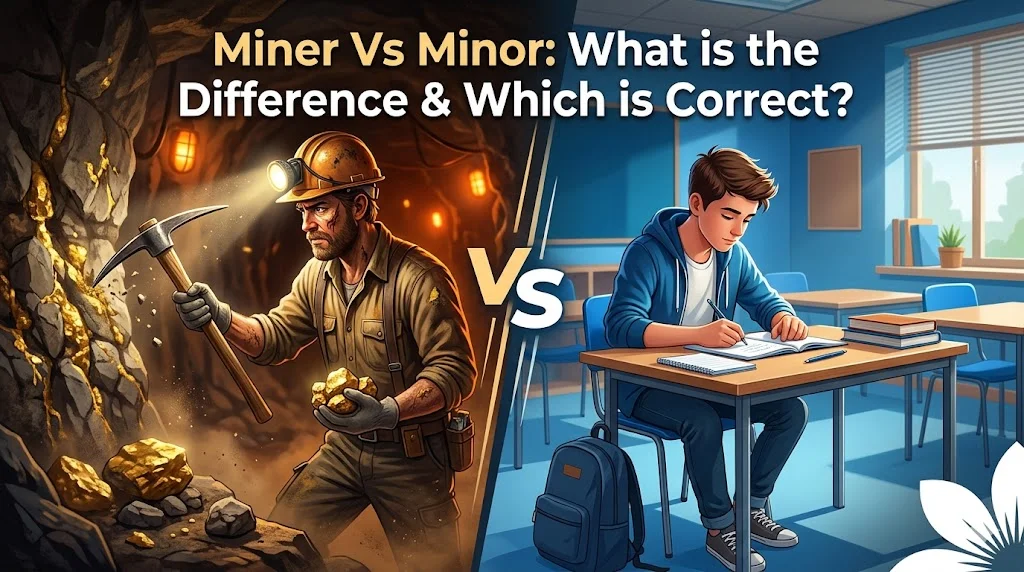
Miner and minor are two commonly confused English words that sound the same but have completely different meanings. Understanding the difference is important for clear communication, especially in writing. This guide explains both terms in a simple way, helping you use the correct word confidently in everyday situations.
Comparison Overview
Miner and minor are homophones, meaning they are pronounced the same but differ in spelling and meaning. Miner relates to a person who works with mines, while minor refers to something smaller, less important, or someone under a certain age. The confusion often happens because they sound identical in speech.
Definition of Miner
A miner is a person who works in a mine, extracting natural resources such as coal, gold, or minerals from the earth. The term is also used in modern contexts like cryptocurrency, where a miner verifies digital transactions.
Definition of Minor
Minor refers to something that is smaller, less important, or not serious. It can also describe a person who is under the legal age of adulthood, usually under 18 in many countries.
Main Differences Between Miner and Minor
The main difference lies in meaning and usage. Miner is a noun related to mining activities or professions. Minor can be a noun or adjective, referring to age, importance, or size. Miner is used in work and industry contexts, while minor appears in legal, general, and descriptive situations. Their meanings are unrelated despite identical pronunciation.
Grammar Guide
How each term is used in sentences
Miner is used as a noun: He is a miner working in a coal field.
Minor can be a noun: He is still a minor.
It can also be an adjective: This is a minor issue.
Common mistakes learners make
Many learners mistakenly write minor when referring to someone who works in mines. Another common mistake is using miner when talking about age or importance.
Simple rules to remember
Miner has “mine” in it, so it relates to mining.
Minor has “mini” in it, suggesting something small or less important.
Quick tips for writing and speaking
Think about context before choosing the word. If the topic is work or extraction, use miner. If the topic is age or importance, use minor.
When to Use Each One
Use miner when talking about someone who extracts resources or works in mining industries. Use minor when describing something small, unimportant, or referring to someone under legal age.
When NOT to Use Each One
Do not use miner when referring to a child or something unimportant. Do not use minor when talking about mining jobs or resource extraction. Avoid mixing them in formal writing where clarity matters.
Which One to Use (Decision Guide)
If the sentence involves mining, workers, or extraction, choose miner. If the sentence involves age, size, importance, or degree, choose minor. Always check the context carefully before deciding.
Real-World Practical Examples
Miner Examples
He works as a miner in a gold mine.
The miner discovered a new vein of coal.
My grandfather was a miner for 30 years.
A bitcoin miner processes digital transactions.
The miner wore protective gear underground.
Minor Examples
She is still a minor and cannot vote.
This is a minor mistake in the report.
He suffered only minor injuries.
The issue is too minor to worry about.
A minor cannot sign legal contracts alone.
Self-Assessment (Fill in the Blanks)
- I will use ______ when referring to someone working underground.
The correct word is ______ because it relates to mining work. - I will use ______ when referring to a child under 18.
The correct word is ______ because it relates to age. - I will use ______ when describing a small mistake.
The correct word is ______ because it means less important. - I will use ______ when talking about coal extraction.
The correct word is ______ because it involves mining. - I will use ______ when referring to a legal age limit.
The correct word is ______ because it relates to age. - I will use ______ when describing a gold worker.
The correct word is ______ because it relates to mining. - I will use ______ when describing a small issue.
The correct word is ______ because it means not serious. - I will use ______ when referring to underground labor.
The correct word is ______ because it involves mines. - I will use ______ when talking about a teenager legally.
The correct word is ______ because it refers to age. - I will use ______ when referring to resource extraction.
The correct word is ______ because it relates to mining. - I will use ______ when describing a small injury.
The correct word is ______ because it means less severe. - I will use ______ when referring to someone in a tunnel job.
The correct word is ______ because it involves mining. - I will use ______ when describing importance level.
The correct word is ______ because it means less important. - I will use ______ when discussing gold digging jobs.
The correct word is ______ because it relates to mining. - I will use ______ when referring to a child legally.
The correct word is ______ because it relates to age. - I will use ______ when talking about digital coin validation.
The correct word is ______ because it refers to crypto mining. - I will use ______ when describing something small in impact.
The correct word is ______ because it means minor importance. - I will use ______ when referring to someone extracting minerals.
The correct word is ______ because it involves mining. - I will use ______ when describing a small detail.
The correct word is ______ because it means not major. - I will use ______ when referring to a worker in a mine.
The correct word is ______ because it relates to mining.
Answers
- miner, miner
- minor, minor
- minor, minor
- miner, miner
- minor, minor
- miner, miner
- minor, minor
- miner, miner
- minor, minor
- miner, miner
- minor, minor
- miner, miner
- minor, minor
- miner, miner
- minor, minor
- miner, miner
- minor, minor
- miner, miner
- minor, minor
- miner, miner
Conclusion About Miner Vs Minor
Understanding the difference between miner and minor becomes simple once you focus on their meaning and context. Miner is always connected with mining work, industries, and even modern digital fields like cryptocurrency. On the other hand, minor relates to age, importance, or something smaller in scale. Although they sound the same, their usage never overlaps. This confusion is common in English learning, but with practice, it becomes easy to avoid mistakes. Remembering small tricks like “mine = miner” and “mini = minor” helps a lot in real-life writing and speaking. Whether you are studying grammar or improving communication skills, mastering such word differences makes your English clearer and more confident.
FAQs
What is the main difference between miner and minor?
The main difference is meaning. Miner refers to a person who works in mines or mining-related activities, while minor refers to something small, less important, or a person under legal adult age. Despite sounding the same, both words are used in completely different contexts in English grammar and everyday communication.
Is miner used only for jobs?
No, miner is not limited to traditional jobs. While it originally refers to someone who extracts minerals from the earth, it is also used in modern technology. For example, a crypto miner verifies and processes blockchain transactions. So, the word has both industrial and digital meanings depending on context.
What does minor mean in law?
In legal terms, minor refers to a person who has not reached the age of adulthood, usually under eighteen. Minors have limited legal rights and responsibilities. They often require parental or guardian permission for contracts, travel, or major decisions depending on the laws of their country.
Why do people confuse miner and minor?
People confuse these words because they are homophones, meaning they sound identical when spoken. However, their spelling and meanings are completely different. Without context, it becomes easy to mix them up, especially for English learners who rely more on pronunciation than spelling accuracy.
Can minor be used as an adjective?
Yes, minor is commonly used as an adjective to describe something small or not very important. For example, a minor issue, minor injury, or minor change. In these cases, it shows that something has low significance compared to more serious matters.
What are examples of miner in a sentence?
Examples include: The miner worked deep underground for coal. Another example is: A crypto miner validates blockchain transactions. These sentences show how miner is always connected to mining, extraction, or verification work in physical or digital environments.
What are examples of minor in a sentence?
Examples include: He suffered only minor injuries in the accident. She is still a minor and cannot vote. These sentences show how minor refers to small importance, low severity, or age-related legal status.
Is minor used in education?
Yes, in education, minor can refer to a secondary subject or specialization alongside a major. For example, a student may major in biology and minor in chemistry. It also refers to students who are under the legal age of adulthood in some contexts.
How can I remember miner vs minor easily?
A simple trick is to connect “mine” with miner, which relates to mining work. For minor, think of “mini,” meaning small or less important. These memory links help you quickly choose the correct word in writing and speaking.
Are miner and minor interchangeable?
No, miner and minor are never interchangeable. They have completely different meanings and uses. Miner always relates to mining or extraction work, while minor relates to age, importance, or size. Using them incorrectly can change the meaning of a sentence entirely.

Sarah Mitchell is an experienced writer and grammar teacher with over 10 years of expertise in English language education. She helps learners improve their grammar, writing, and communication skills through clear explanations and practical examples. Sarah creates learner-friendly content focused on real-life English, making language learning simple, effective, and confidence-building.