
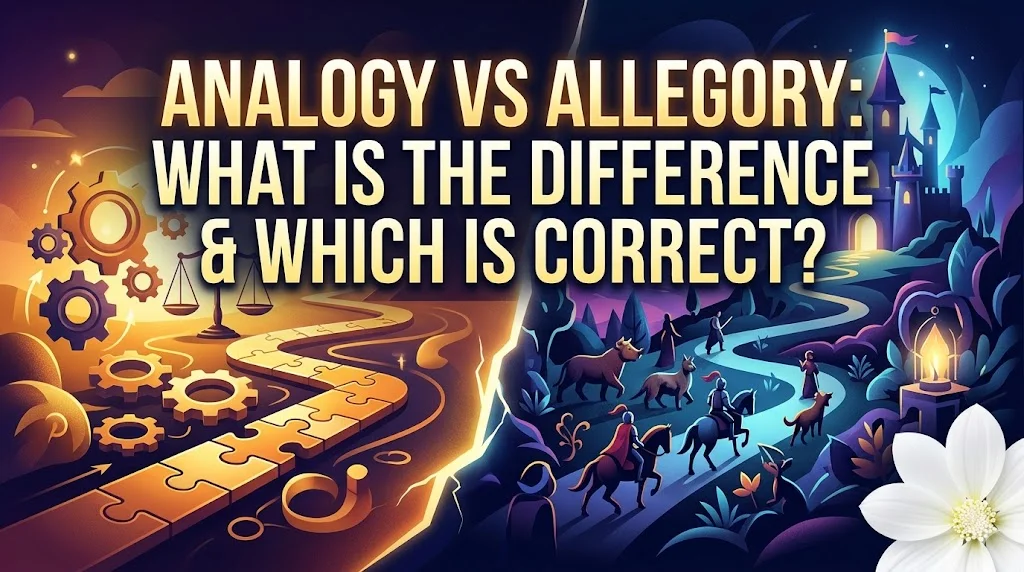
Understanding the difference between analogy and allegory can make your writing clearer and more powerful. Both are used to explain ideas, but they work in different ways and serve different purposes. Knowing when to use each one helps you communicate more effectively in essays, stories, and everyday conversations.
Comparison Overview
Analogy and allegory are both tools used to explain or represent ideas. An analogy compares two things to highlight similarities, often to clarify a concept. An allegory, on the other hand, is a full narrative where characters and events symbolize deeper meanings, often moral, social, or political.
Definition of Analogy
An analogy is a comparison between two different things to explain or clarify an idea. It helps make complex or unfamiliar concepts easier to understand by relating them to something known.
For example, saying “the brain is like a computer” is an analogy because it compares two different things to explain how the brain works.
Definition of Allegory
An allegory is a story, poem, or narrative in which characters, events, and settings represent abstract ideas or moral qualities. The entire story carries a deeper meaning beyond the surface.
For example, a story where animals represent human behaviors or political systems is an allegory.
Main Differences Between Analogy and Allegory
The key difference lies in scope and purpose. An analogy is usually short and direct, focusing on explaining one idea by comparing it to another. It is often used in teaching, explanations, and arguments.
An allegory is extended and symbolic. It tells a complete story where every element represents something deeper. It is commonly used in literature to convey moral or philosophical messages.
In simple terms, analogy explains, while allegory represents.
Grammar Guide
How each term is used in sentences
Analogy is used as a noun and often follows phrases like “an analogy between” or “an analogy for.”
Example: This example is an analogy for how teamwork works.
Allegory is also a noun and is used to describe a type of story or narrative.
Example: The novel is an allegory about freedom and control.
Common mistakes learners make
Many learners confuse analogy with metaphor or allegory. They may call a simple comparison an allegory, even when it is just a short explanation.
Another common mistake is thinking allegory is just a symbol, while in reality, it is a complete symbolic narrative.
Simple rules to remember
Use analogy when you are explaining something by comparing it to something else.
Use allegory when you are telling a story with a deeper hidden meaning.
Quick tips for writing and speaking
Keep analogies short and clear.
Use allegories when you want to deliver a message through storytelling.
Avoid overcomplicating analogies with too many details.
Make sure allegories maintain consistent symbolism throughout the narrative.
When to Use Each One
Use analogy when teaching, explaining ideas, simplifying complex topics, or making arguments more relatable.
Use allegory when writing stories, literature, or speeches that aim to communicate deeper meanings, moral lessons, or social commentary.
When NOT to Use Each One
Do not use analogy when you need a detailed narrative or symbolic story.
Do not use allegory when you only need a quick comparison or explanation.
Avoid using allegory in technical writing where clarity and directness are more important than symbolism.
Avoid using analogy if it confuses rather than clarifies the idea.
Which One to Use (Decision Guide)
If your goal is to explain something quickly and clearly, choose analogy.
If your goal is to tell a story that represents deeper meanings or ideas, choose allegory.
If it is a short comparison, it is an analogy. If it is a full symbolic story, it is an allegory.
Real-World Practical Examples
Analogy Examples
Learning a language is like building a muscle; it takes practice and consistency.
A teacher said the atom is like a solar system to explain its structure.
Managing money is like maintaining a garden; you must care for it regularly.
A company described its workflow as a well-oiled machine.
The internet is like a library full of information.
Allegory Examples
A story about a journey through a dark forest representing life struggles.
A novel where animals act like humans to show political systems.
A tale about a broken bridge symbolizing lost trust.
A story of a rising sun representing hope and new beginnings.
A narrative about a locked door representing missed opportunities.
Self-Assessment (Fill in the Blanks)
- I will use ______ when explaining a concept by comparison. The correct word is ______ because it clarifies ideas.
- I will use ______ when writing a symbolic story. The correct word is ______ because it represents deeper meaning.
- I will use ______ for quick explanations. The correct word is ______ because it is short and direct.
- I will use ______ for storytelling with hidden messages. The correct word is ______ because it is narrative-based.
- I will use ______ in teaching complex topics. The correct word is ______ because it simplifies ideas.
- I will use ______ in literature with symbolism. The correct word is ______ because it uses characters to represent ideas.
- I will use ______ when comparing two things. The correct word is ______ because it highlights similarities.
- I will use ______ when writing a moral story. The correct word is ______ because it conveys lessons.
- I will use ______ in explanations, not stories. The correct word is ______ because it is not narrative.
- I will use ______ when characters represent ideas. The correct word is ______ because it is symbolic.
- I will use ______ to explain science concepts. The correct word is ______ because it simplifies understanding.
- I will use ______ in fictional storytelling. The correct word is ______ because it carries deeper meaning.
- I will use ______ for short comparisons. The correct word is ______ because it is concise.
- I will use ______ when writing about social issues through stories. The correct word is ______ because it represents ideas.
- I will use ______ to make arguments clearer. The correct word is ______ because it explains effectively.
- I will use ______ when every part of a story has symbolic meaning. The correct word is ______ because it is layered.
- I will use ______ in classroom explanations. The correct word is ______ because it helps understanding.
- I will use ______ when writing a philosophical story. The correct word is ______ because it conveys deeper truths.
- I will use ______ to compare familiar and unfamiliar ideas. The correct word is ______ because it connects concepts.
- I will use ______ when meaning is hidden beneath the story. The correct word is ______ because it is symbolic.
Answers
- analogy, analogy
- allegory, allegory
- analogy, analogy
- allegory, allegory
- analogy, analogy
- allegory, allegory
- analogy, analogy
- allegory, allegory
- analogy, analogy
- allegory, allegory
- analogy, analogy
- allegory, allegory
- analogy, analogy
- allegory, allegory
- analogy, analogy
- allegory, allegory
- analogy, analogy
- allegory, allegory
- analogy, analogy
- allegory, allegory
Conclusion About Analogy Vs Allegory
Analogy and allegory are powerful tools in language, but they serve very different purposes. An analogy helps simplify complex ideas by comparing them to something familiar, making learning easier and communication clearer. Allegory, on the other hand, goes deeper by building entire stories that represent hidden meanings, often reflecting moral, social, or political ideas. Understanding the difference between them strengthens both writing and comprehension skills. Whether you are studying literature, improving writing, or just trying to express ideas more effectively, knowing when to use analogy or allegory makes your communication more precise, engaging, and impactful in everyday life.
FAQs
What is the main difference between analogy and allegory
An analogy is a short comparison used to explain an idea clearly, while an allegory is a complete story where characters and events represent deeper meanings. Analogy focuses on explanation, whereas allegory focuses on symbolism and storytelling with hidden moral, social, or philosophical messages throughout the narrative.
Is analogy the same as metaphor
No, analogy is not the same as a metaphor. An analogy explains relationships using comparisons, often in detail, while a metaphor directly states that one thing is another. Both are figures of speech, but analogy is more explanatory, whereas metaphor is more poetic and symbolic in nature.
Can an allegory contain analogies
Yes, an allegory can contain analogies within it. Since allegories are extended symbolic stories, they often use comparisons and illustrative examples to support their deeper meaning. However, the overall structure of an allegory is narrative, while analogies are usually brief and used for clarification.
Where is analogy commonly used
Analogy is commonly used in education, science, and everyday communication. Teachers use it to explain difficult topics, writers use it to clarify ideas, and speakers use it to make arguments easier to understand. It helps connect unfamiliar concepts with familiar experiences for better understanding.
What is a famous example of allegory
A well-known example of allegory is a story where animals represent human society and political behavior. Such stories use characters and events to symbolize real-world issues, making them powerful tools for criticism, moral teaching, and reflection on human nature and social systems.
Why is analogy important in learning
Analogy is important in learning because it simplifies complex ideas by linking them to familiar ones. This helps students understand difficult subjects more easily, improves memory retention, and makes abstract concepts more relatable. It is widely used in teaching science, math, and language skills.
How do you identify an allegory in a story
You can identify an allegory by looking for hidden meanings behind characters, events, or settings. If everything in the story seems to represent something beyond its literal meaning, it is likely an allegory. The entire narrative usually carries a deeper moral or symbolic message.
Can analogy be used in writing essays
Yes, analogy is often used in essays to explain complex ideas more clearly. It helps writers make arguments stronger by connecting unfamiliar concepts with familiar examples. This improves readability and makes the essay more engaging and easier for readers to understand.
Is allegory only used in literature
No, allegory is not only used in literature. It can also appear in films, speeches, art, and even political commentary. Anytime a story or representation carries deeper symbolic meaning beyond its surface, it can be considered an allegory in any creative or expressive medium.
Which is easier to understand, analogy or allegory
Analogy is generally easier to understand because it provides direct comparisons to explain ideas. Allegory can be more complex since it involves interpreting hidden meanings within a full story. Beginners usually find analogies simpler, while allegories require deeper thinking and interpretation skills.

Sarah Mitchell is an experienced writer and grammar teacher with over 10 years of expertise in English language education. She helps learners improve their grammar, writing, and communication skills through clear explanations and practical examples. Sarah creates learner-friendly content focused on real-life English, making language learning simple, effective, and confidence-building.