
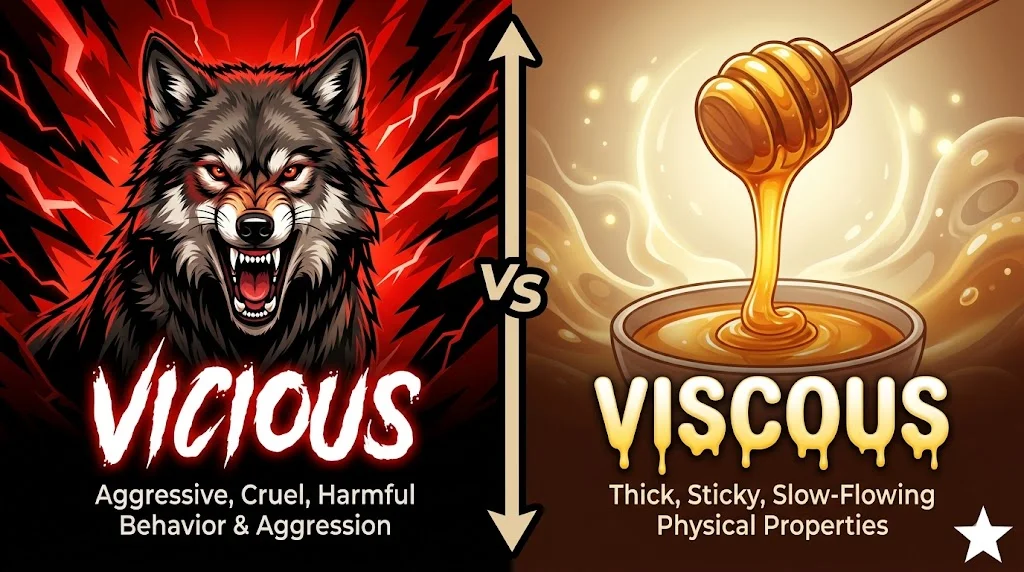
Confusing vicious and viscous is common because they sound similar, but their meanings are completely different. One relates to behavior and aggression, while the other describes texture and thickness. Understanding the difference is important for clear communication, especially in writing, speaking, and academic contexts.
Comparison Overview
Vicious and viscous are often mixed up due to their similar pronunciation, but they belong to entirely different contexts.
- Vicious describes something harmful, aggressive, or morally bad.
- Viscous refers to a thick, sticky substance that flows slowly.
Knowing which one to use depends on whether you’re describing behavior or physical properties.
Definition of Vicious
Vicious is an adjective used to describe something that is violent, aggressive, cruel, or harmful. It can refer to people, animals, actions, or even negative cycles or habits.
Example idea: A vicious dog, a vicious attack, or a vicious rumor.
Definition of Viscous
Viscous is an adjective used to describe a substance that is thick, sticky, and slow-flowing. It is commonly used in science, cooking, and everyday descriptions of liquids.
Example idea: Honey, oil, or syrup can be viscous.
Main Differences Between Vicious and Viscous
The key difference lies in meaning and usage:
- Vicious relates to behavior, actions, or character that is harmful or aggressive.
- Viscous relates to physical properties of liquids, especially thickness and resistance to flow.
In short:
- If you’re talking about violence or cruelty, use vicious.
- If you’re talking about thickness or stickiness, use viscous.
Grammar Guide
How each term is used in sentences
- Vicious is used as an adjective before nouns:
Example: The vicious storm caused damage. - Viscous is also an adjective, often used in scientific or descriptive contexts:
Example: The liquid is too viscous to pour easily.
Common mistakes learners make
- Using vicious instead of viscous when describing liquids.
- Confusing pronunciation and spelling due to similarity.
- Assuming both words are interchangeable (they are not).
Simple rules to remember
- Vicious = Violence (both start with “vi”)
- Viscous = Sticky Substance
Quick tips for writing and speaking
- Think about the context: behavior vs. texture.
- If you can replace the word with “cruel,” use vicious.
- If you can replace it with “thick,” use viscous.
When to Use Each One
Use vicious when describing:
- Aggressive behavior
- Harmful actions
- Negative cycles (e.g., vicious cycle)
Use viscous when describing:
- Thick liquids
- Scientific properties
- Substances that resist flow
When NOT to Use Each One
Avoid using vicious when describing:
- Liquids or textures
Incorrect: The sauce is vicious
Avoid using viscous when describing:
- People or actions
Incorrect: He gave a viscous reply
Which One to Use (Decision Guide)
Ask yourself:
- Am I describing behavior or harm? → Use vicious
- Am I describing texture or thickness? → Use viscous
If it’s about emotions, actions, or personality → vicious
If it’s about liquids or materials → viscous
Real-World Practical Examples
Vicious Examples
- The dog became vicious when threatened.
- She spread a vicious rumor at school.
- The company faced a vicious backlash online.
- He was caught in a vicious cycle of debt.
- The debate turned into a vicious argument.
Viscous Examples
- Honey is more viscous than water.
- The oil became viscous in cold weather.
- This chemical mixture is highly viscous.
- The sauce is too viscous to pour quickly.
- Lava is extremely viscous as it cools.
Self-Assessment (Fill in the Blanks)
- I will use ______ when referring to aggressive behavior.
- The correct word is ______ because it describes thickness.
- I will use ______ when talking about sticky liquids.
- The correct word is ______ because it means cruel.
- I will use ______ when describing a harmful action.
- The correct word is ______ because it flows slowly.
- I will use ______ when referring to a violent attack.
- The correct word is ______ because it describes texture.
- I will use ______ when describing a thick sauce.
- The correct word is ______ because it relates to behavior.
- I will use ______ when talking about a negative cycle.
- The correct word is ______ because it is used in science.
- I will use ______ when describing a rude comment.
- The correct word is ______ because it describes liquid resistance.
- I will use ______ when referring to cruelty.
- The correct word is ______ because it describes a sticky substance.
- I will use ______ when talking about an aggressive animal.
- The correct word is ______ because it relates to fluid properties.
- I will use ______ when describing harmful intent.
- The correct word is ______ because it means thick and slow-moving.
Answers
- vicious
- viscous
- viscous
- vicious
- vicious
- viscous
- vicious
- viscous
- viscous
- vicious
- vicious
- viscous
- vicious
- viscous
- vicious
- viscous
- vicious
- viscous
- vicious
- viscous
Conclusion About Vicious Vs Viscous
Understanding the difference between vicious and viscous makes communication much clearer and more accurate. While they may sound similar, their meanings belong to completely different worlds—one describing behavior and aggression, the other describing physical thickness and flow. Using them correctly helps avoid confusion in writing, speaking, and academic work. Whether you are describing a dangerous situation or a sticky liquid, choosing the right word shows strong language skills. Once you remember the simple idea that vicious relates to violence and viscous relates to viscosity, the confusion disappears. This small distinction can greatly improve clarity in everyday communication and professional writing.
FAQs
What is the main difference between vicious and viscous
Vicious refers to something cruel, aggressive, or harmful, while viscous describes a thick, sticky substance that flows slowly. The two words are unrelated in meaning despite sounding similar. One is used for behavior and emotions, while the other is used for liquids and physical properties in science, cooking, and everyday descriptions.
Is vicious used for animals or people
Yes, vicious is commonly used for both animals and people when describing aggressive or dangerous behavior. For example, a vicious dog may act violently, or a person may show vicious behavior in an argument. It always carries a negative meaning related to harm, cruelty, or intense hostility in actions.
What does viscous mean in simple words
Viscous means thick, sticky, and slow-moving. It is used to describe liquids that do not flow easily, such as honey, syrup, or oil. In science, viscosity measures how resistant a fluid is to movement. The higher the viscosity, the more viscous the substance is.
Can viscous describe behavior
No, viscous cannot describe behavior or emotions. It is strictly used for physical substances and their flow properties. Using viscous for people or actions is incorrect. Always remember that viscous is related to liquids, thickness, and science-based descriptions, not personality or actions.
Why do people confuse vicious and viscous
People confuse these words because they sound very similar when spoken. However, their meanings are completely different. Vicious relates to violence or cruelty, while viscous relates to thickness of liquids. The similarity in pronunciation is the main reason for this common language mistake.
Is honey viscous or vicious
Honey is viscous, not vicious. It is thick, sticky, and flows slowly, which perfectly matches the meaning of viscous. Vicious would not apply because honey has no relation to behavior or aggression. This is a common example used to understand the meaning of viscous easily.
What is a vicious cycle
A vicious cycle is a repeating pattern where one negative event leads to another, creating continuous problems. For example, stress can lead to poor sleep, which then increases stress again. It describes harmful situations that keep repeating and getting worse over time.
Can viscous be used in everyday language
Yes, viscous is often used in everyday language, especially when describing food, liquids, or substances. People may say sauce, oil, or syrup is viscous when it is thick and slow to pour. It is also widely used in science and cooking contexts.
What is a simple trick to remember vicious vs viscous
A simple trick is to link vicious with violence and viscous with viscosity. Vicious relates to harmful behavior, while viscous relates to sticky liquids. This memory shortcut helps avoid confusion and ensures correct usage in writing and speaking.
Are vicious and viscous interchangeable
No, they are not interchangeable at all. Vicious refers to aggression, cruelty, or harmful actions, while viscous refers to thickness and flow of liquids. Using them incorrectly can change the meaning completely and create confusion in communication.

Daniel Brooks is an English educator with a passion for explaining similes and word comparisons in plain language. He covers topics like versus meanings, correct usage, and figurative language to help writers avoid common mistakes and improve clarity in everyday writing.