
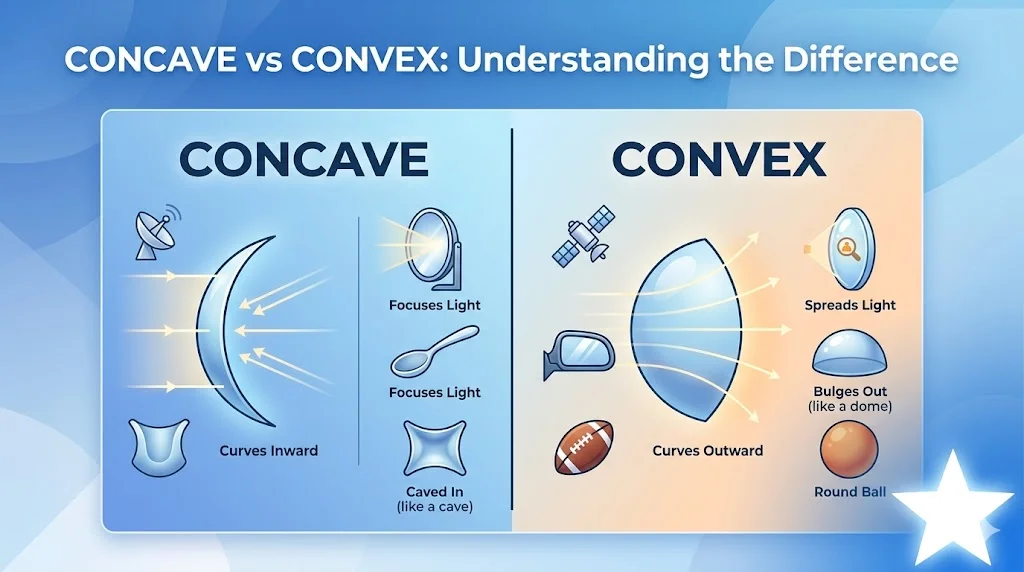
Concave and convex are two opposite terms that describe how a surface or shape bends. They are commonly used in geometry, optics, and everyday objects, yet many people confuse them. Understanding their difference helps you correctly identify shapes, lenses, and real-world structures with ease.
Comparison Overview
Concave and convex both describe curvature, but in opposite directions. A concave shape curves inward like a bowl, while a convex shape curves outward like a dome. These concepts are widely used in mathematics, physics, engineering, and visual design to explain how light, angles, and surfaces behave.
Definition of Concave
Concave refers to a shape or surface that curves inward, creating a hollow or sunken appearance. It looks like it has been “caved in.” Common examples include bowls, caves, and concave mirrors used to focus light inward.
Definition of Convex
Convex refers to a shape or surface that curves outward, forming a bulging or rounded appearance. It does not dip inward at any point. Examples include balls, domes, and convex mirrors used for wide-angle viewing.
Main Differences Between Concave and Convex
Concave curves inward, while convex curves outward. Concave shapes can collect or focus light and sound, whereas convex shapes spread them out. In geometry, concave shapes have inward dents or angles greater than 180°, while convex shapes have no inward dents and all angles are less than 180°. Concave often appears hollow; convex appears full or bulging.
Grammar Guide
How each term is used in sentences
Concave is used as an adjective to describe inward-curving objects.
Example: The mirror has a concave surface.
Convex is also an adjective describing outward-curving objects.
Example: The lens is convex and enlarges images.
Common mistakes learners make
Many learners confuse the direction of curvature. Another common mistake is thinking both words mean the same type of curve. Some also misapply them to flat surfaces, which is incorrect.
Simple rules to remember
Concave = cave = inward curve (think “cave goes inside”).
Convex = “vex” face puffed out = outward curve.
Quick tips for writing and speaking
Use concave when something bends inward like a bowl.
Use convex when something bulges outward like a ball.
Always visualize the direction of the curve before choosing the word.
When to Use Each One
Use concave when referring to inward curves such as mirrors, bowls, caves, and certain geometric shapes. Use convex when describing outward curves such as lenses, domes, balls, and wide-view mirrors.
When NOT to Use Each One
Do not use concave for outward bulging shapes. Do not use convex for inward dips. Also avoid using either term for completely flat surfaces.
Which One to Use (Decision Guide)
If the surface curves inward like a hollow space, use concave. If the surface curves outward like a dome or sphere, use convex. A simple way to decide is: does it “go inside” (concave) or “stick out” (convex)?
Real-World Practical Examples
Concave Examples
- A concave mirror is used in shaving mirrors to magnify reflections.
- A bowl has a concave inner surface.
- A satellite dish is concave to collect signals.
- A cave entrance often forms a concave shape.
- Some telescope mirrors are concave to focus light.
Convex Examples
- A convex mirror is used in vehicles for a wider field of view.
- A football has a convex surface.
- A magnifying glass uses a convex lens.
- A dome-shaped roof is convex.
- A convex lens helps enlarge images.
Self-Assessment (Fill in the Blanks)
- I will use ______ when describing a bowl shape. The correct word is ______ because it curves inward.
- I will use ______ for a football. The correct word is ______ because it bulges outward.
- I will use ______ for a cave-like structure. The correct word is ______ because it is hollow.
- I will use ______ for a dome roof. The correct word is ______ because it curves outward.
- I will use ______ for a shaving mirror. The correct word is ______ because it focuses inward.
- I will use ______ for a car side mirror. The correct word is ______ because it spreads light outward.
- I will use ______ when the surface dips inward. The correct word is ______ because it is concave.
- I will use ______ when the surface bulges outward. The correct word is ______ because it is convex.
- I will use ______ for a satellite dish. The correct word is ______ because it collects signals.
- I will use ______ for a magnifying lens. The correct word is ______ because it enlarges outward.
- I will use ______ for inward dents. The correct word is ______ because it curves in.
- I will use ______ for outward curves. The correct word is ______ because it curves out.
- I will use ______ for hollow objects. The correct word is ______ because of inward shape.
- I will use ______ for globes. The correct word is ______ because they are rounded outward.
- I will use ______ for spoon interiors. The correct word is ______ because it curves inward.
- I will use ______ for spoon exteriors. The correct word is ______ because it curves outward.
- I will use ______ for inward polygons. The correct word is ______ because of inward angles.
- I will use ______ for outward polygons. The correct word is ______ because angles are all less than 180°.
- I will use ______ for focusing mirrors. The correct word is ______ because it directs inward.
- I will use ______ for wide-view mirrors. The correct word is ______ because it spreads outward.
Answers
- concave, concave
- convex, convex
- concave, concave
- convex, convex
- concave, concave
- convex, convex
- concave, concave
- convex, convex
- concave, concave
- convex, convex
- concave, concave
- convex, convex
- concave, concave
- convex, convex
- concave, concave
- convex, convex
- concave, concave
- convex, convex
- concave, concave
- convex, convex
Conclusion About Concave Vs Convex
Concave and convex shapes are simple yet powerful concepts that help us understand how surfaces bend and behave in the real world. From mirrors and lenses to bowls and domes, these terms are everywhere in science, geometry, and daily life. Concave always refers to inward-curving shapes that appear hollow, while convex describes outward-curving shapes that look full or bulging. Once you clearly remember this basic difference, it becomes much easier to identify and use them correctly. Whether you are a student, teacher, or just curious about shapes, mastering concave and convex improves your understanding of how light, images, and structures work in practical situations.
FAQs About Concave Vs Convex
What is the main difference between concave and convex
The main difference is the direction of curvature. Concave curves inward like a bowl or cave, creating a hollow appearance. Convex curves outward like a ball or dome, forming a bulging shape. This simple distinction helps identify their behavior in geometry, optics, and real-world objects.
How can I easily remember concave and convex
A helpful trick is to link “concave” with “cave,” which goes inward. For “convex,” think of something pushed outward or expanded. Visual memory helps students quickly recall that concave is inward and convex is outward without confusion during exams or practical use.
Where are concave shapes used in real life
Concave shapes are used in satellite dishes, shaving mirrors, bowls, and telescope mirrors. These shapes are useful because they can collect or focus light, sound, or signals into a single point, making them important in science, technology, and daily life objects.
Where are convex shapes used in real life
Convex shapes are commonly found in car side mirrors, magnifying glasses, domes, and balls. They are useful because they spread light and provide a wider field of view, making them ideal for safety mirrors and optical devices.
Why are concave mirrors important
Concave mirrors are important because they can focus light to a single point or magnify images. This makes them useful in medical instruments, shaving mirrors, telescopes, and headlights, where precision and light concentration are required.
Why are convex mirrors used in vehicles
Convex mirrors are used in vehicles because they provide a wider field of view. They help drivers see more of the road and reduce blind spots. Although they make objects appear smaller, they improve safety and visibility during driving.
Are concave and convex only used in geometry
No, concave and convex are not limited to geometry. They are widely used in physics, optics, engineering, and design. These terms help describe how surfaces curve and how they interact with light, sound, and images in practical applications.
Can a shape be both concave and convex
A shape cannot be both concave and convex at the same point. However, complex objects may contain both types of curves in different areas. In geometry, a shape is classified based on whether it has inward dents or only outward curves.
What happens when light hits concave surfaces
When light hits a concave surface, it is reflected inward and can converge at a focal point. This property is used in focusing devices like telescopes and mirrors, where concentrated light is needed for better clarity or magnification.
What happens when light hits convex surfaces
When light hits a convex surface, it spreads outward after reflection or refraction. This creates a wider view but reduces magnification. That is why convex mirrors are used for surveillance and safety purposes.

Ethan Clarke is a language writer who specializes in breaking down similes, word meanings, and commonly confused terms. His work focuses on clear explanations, practical examples, and simple comparisons that help readers understand how English