
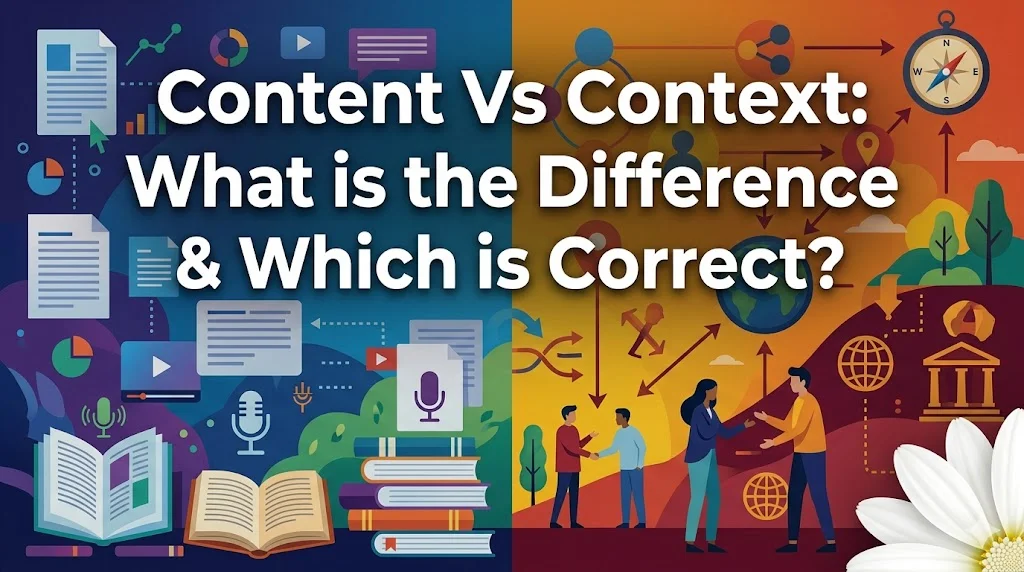
Understanding the difference between “content” and “context” is essential for clear communication. While both words are closely related, they serve very different purposes. “Content” focuses on what is being said or created, while “context” explains the situation around it. Knowing how to use each correctly helps you write, speak, and interpret information more effectively.
Comparison Overview
“Content” and “context” often appear together, especially in writing, communication, and media. Content refers to the actual material—words, images, or ideas—while context provides the background or setting that gives meaning to that content. Without context, content can be misunderstood; without content, context has nothing to support.
Definition of Content
Content refers to the information, material, or substance that is presented or communicated. It can be written text, images, videos, or any form of expression.
In simple terms, content is “what is being said or shown.”
It is commonly used in education, marketing, media, and digital platforms where information is created and shared.
Definition of Context
Context refers to the circumstances, background, or setting in which something exists or happens. It helps explain the meaning of content.
In simple terms, context is “the situation or background that explains the content.”
Context includes factors like time, place, culture, tone, and purpose.
Main Differences Between Content and Context
The main difference lies in their roles. Content is the actual message or material, while context explains how and why that message should be understood.
Content is direct and visible—it is what you read, watch, or hear. Context is indirect—it surrounds the content and gives it meaning.
For example, a sentence (content) can have different meanings depending on tone or situation (context). Content answers “what,” while context answers “why” and “how.”
Grammar Guide
How each term is used in sentences
“Content” is usually used as a noun:
- The content of the book is interesting.
- She creates educational content.
“Context” is also used as a noun:
- You must understand the context of the statement.
- The meaning changes in a different context.
Common mistakes learners make
Many learners confuse content with context because of their similar spelling.
A common mistake is using “content” when referring to background meaning:
- Incorrect: Understand the content of the situation.
- Correct: Understand the context of the situation.
Another mistake is ignoring context when interpreting content, leading to misunderstanding.
Simple rules to remember
Content = What is said or shown
Context = The situation around it
If you are talking about information itself, use “content.”
If you are explaining meaning or background, use “context.”
Quick tips for writing and speaking
Always consider both content and context when communicating. Write clear content, but also provide enough context so your message is understood correctly.
When to Use Each One
Use “content” when referring to:
- Articles, videos, or media material
- Information being shared
- Educational or marketing material
Use “context” when referring to:
- Background information
- Situations or circumstances
- Meaning behind words or actions
When NOT to Use Each One
Do not use “content” when you mean background or situation.
Do not use “context” when referring to actual material or information.
Avoid mixing them in sentences where their roles are clearly different.
Which One to Use (Decision Guide)
If you are describing the actual message, information, or material, choose “content.”
If you are explaining the meaning, situation, or background behind that message, choose “context.”
Ask yourself:
- Am I talking about what is being communicated? → Content
- Am I explaining why or how it is understood? → Context
Real-World Practical Examples
Content Examples
- The content of the lecture was easy to understand.
- She creates social media content daily.
- The website has high-quality content.
- The book’s content focuses on science topics.
- The video content is engaging and informative.
Context Examples
- You need to understand the context before judging his words.
- The meaning changes depending on the context.
- In a cultural context, the gesture has a different meaning.
- The teacher explained the historical context of the event.
- Without context, the sentence sounds confusing.
Self-Assessment (Fill in the Blanks)
- I will use ______ when referring to written material. The correct word is ______ because it describes information itself.
- I will use ______ when referring to background meaning. The correct word is ______ because it explains the situation.
- I will use ______ when talking about videos and articles. The correct word is ______ because it refers to media material.
- I will use ______ when explaining why something was said. The correct word is ______ because it shows circumstances.
- I will use ______ when discussing a blog post. The correct word is ______ because it is the actual material.
- I will use ______ when analyzing meaning in a situation. The correct word is ______ because it explains understanding.
- I will use ______ when referring to website information. The correct word is ______ because it is visible material.
- I will use ______ when discussing background details. The correct word is ______ because it provides explanation.
- I will use ______ when creating educational material. The correct word is ______ because it is information.
- I will use ______ when interpreting a sentence. The correct word is ______ because meaning depends on it.
- I will use ______ when talking about written text. The correct word is ______ because it is the message itself.
- I will use ______ when explaining tone and situation. The correct word is ______ because it gives meaning.
- I will use ______ when referring to course material. The correct word is ______ because it is study material.
- I will use ______ when understanding a conversation. The correct word is ______ because it involves background.
- I will use ______ when describing media output. The correct word is ______ because it is produced material.
- I will use ______ when explaining cultural meaning. The correct word is ______ because it involves surroundings.
- I will use ______ when discussing information in a book. The correct word is ______ because it is written material.
- I will use ______ when analyzing a situation. The correct word is ______ because it explains circumstances.
- I will use ______ when talking about digital media. The correct word is ______ because it is shared information.
- I will use ______ when clarifying meaning. The correct word is ______ because it provides explanation.
Answers
- content
- context
- content
- context
- content
- context
- content
- context
- content
- context
- content
- context
- content
- context
- content
- context
- content
- context
- content
- context
Final Verdict
“Content” and “context” may look similar, but they serve very different purposes. Content is the actual material or message being shared, while context is the background that helps us understand that message correctly. Both are equally important—content delivers information, and context ensures it is interpreted properly. By remembering this simple difference, you can improve both your communication and comprehension skills with confidence.
Conclusion About Content Vs Context
Understanding Content Vs Context is essential for clear and effective communication in every area of life, from writing and speaking to reading and interpreting information. Content represents the actual message, idea, or material being shared, while context provides the background that shapes its meaning. When both are used together, communication becomes accurate, meaningful, and easy to understand. Without content, there is no message to deliver, and without context, that message can easily be misunderstood. Whether you are studying, creating content, or having everyday conversations, recognizing the difference helps you express ideas more clearly and interpret others correctly. It also improves critical thinking, reduces confusion, and strengthens overall communication skills in both personal and professional settings. Mastering this simple distinction allows you to become more confident and precise in how you use language.
FAQs About Content Vs Context
What is Content Vs Context in simple words
Content is the actual message or information being shared, while context is the background that explains its meaning. Content shows what is being communicated, and context explains how or why it should be understood. Together, they ensure clear communication and help avoid misunderstandings in both writing and conversation.
Why is context important in communication
Context is important because it gives meaning to words and messages. Without it, the same content can be misunderstood in different ways. Context includes tone, situation, and background details, helping people interpret messages correctly and understand the real intention behind communication in daily life and professional settings.
Can content exist without context
Yes, content can exist without context, but it may not always be clear or meaningful. A sentence or message alone is content, but without background information, its true meaning can be confusing. Context helps connect ideas and ensures the message is interpreted correctly in any situation.
What is an example of content and context
An example of content is a sentence like “She is here.” The context explains whether it means she arrived, is present in a meeting, or just entered a place. Without context, the sentence is unclear, but with it, the meaning becomes fully understandable.
How do content and context work together
Content and context work together to create complete meaning. Content delivers the message, while context explains the situation behind it. This combination ensures that communication is clear, accurate, and easy to understand. Without one of them, the message may feel incomplete or confusing.
What happens if context is missing
If context is missing, content can be misunderstood or misinterpreted. People may assume different meanings based on their own understanding. This can lead to confusion, miscommunication, or incorrect conclusions, especially in written or digital communication where tone is not always clear.
Is content more important than context
Neither is more important on its own. Content and context are both essential for effective communication. Content provides the message, while context ensures it is understood correctly. Together, they create clarity and prevent confusion in writing, speaking, and interpretation.
Where is content and context used
Content and context are used in education, media, writing, business, and everyday communication. Content appears in books, articles, and videos, while context is found in explanations, situations, and background details. Both work together to ensure messages are meaningful and properly understood.
How can I improve understanding of content and context
You can improve understanding by paying attention to both the message and the situation around it. Practice reading carefully, analyzing tone, and considering background information. This helps you interpret meaning more accurately and communicate more effectively in different situations.
Why do people confuse content and context
People often confuse content and context because they are closely related and sound similar. However, they serve different purposes. Content is the message itself, while context is the background that explains it. Learning examples and practicing usage helps reduce this confusion.

Sophia Turner is a grammar-focused writer who covers similes, word-versus-word meanings, and correct English usage. Her content is designed for learners who want quick answers, logical explanations, and practical guidance for improving writing accuracy and style.