
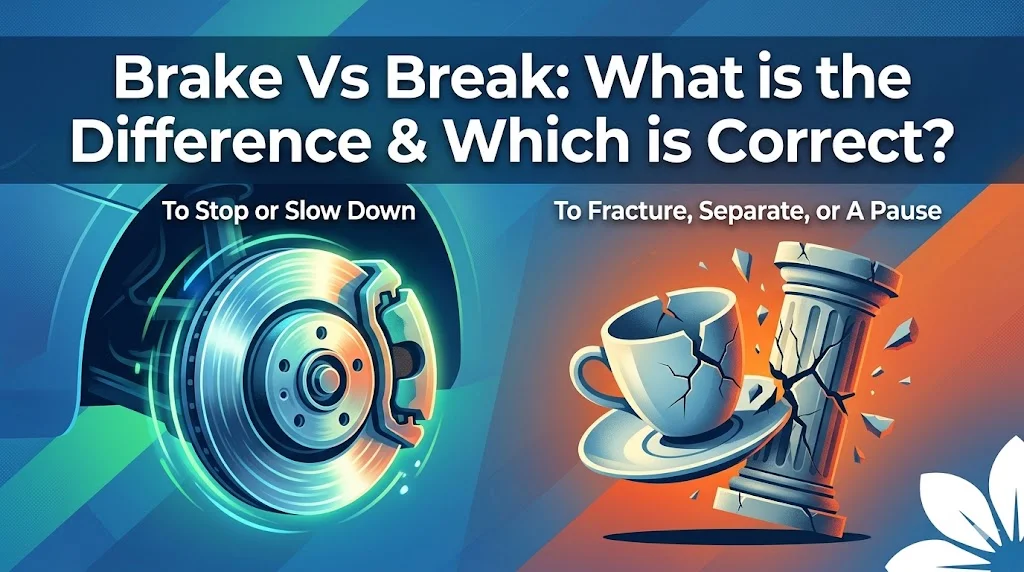
“Brake” and “break” may sound exactly the same, but they have completely different meanings and uses. This common confusion can lead to spelling mistakes in writing and misunderstandings in communication. In this guide, you’ll clearly learn what each word means, how they differ, and when to use the correct one with confidence.
Comparison Overview
“Brake” and “break” are homophones, meaning they sound alike but have different meanings and spellings. “Brake” is mainly related to stopping motion, especially in vehicles. “Break,” on the other hand, has a wider meaning, including separating something, pausing, or damaging something. Understanding their roles helps avoid common grammar errors.
Definition of Brake
“Brake” is a noun and a verb related to slowing down or stopping movement. It is most commonly used when talking about vehicles like cars, bicycles, or machines.
As a noun: A device used to stop motion.
As a verb: The action of slowing down or stopping.
Example: Press the brake to stop the car.
Definition of Break
“Break” is a verb and noun with several meanings, including separating something into pieces, stopping an activity, or interrupting a process. It is widely used in everyday language.
As a verb: To damage, separate, or interrupt.
As a noun: A pause or rest period.
Example: Be careful not to break the glass.
Main Differences Between Brake and Break
The main difference lies in meaning and usage. “Brake” is specifically related to stopping movement, especially in mechanical or physical contexts. “Break” is broader and refers to damage, separation, or pauses.
“Brake” is mostly used in driving or machinery contexts.
“Break” is used in daily conversations, writing, and various situations.
In simple terms, you use “brake” when stopping motion, and “break” when something is damaged, divided, or paused.
Grammar Guide
How each term is used in sentences
“Brake” is used when referring to stopping motion:
Example: He had to brake suddenly to avoid an accident.
“Break” is used in many contexts:
Example: She decided to take a break after studying.
Common mistakes learners make
Many learners confuse the spelling because both words sound the same.
Writing “break” instead of “brake” in driving contexts is a very common mistake.
Incorrect: Use the break to stop the car.
Correct: Use the brake to stop the car.
Simple rules to remember
“Brake” = stopping movement (think of cars).
“Break” = damage, pause, or separation.
A simple trick:
“Brake” has an “a” like “auto” (car).
Quick tips for writing and speaking
Always check context before choosing the word.
If you’re talking about stopping, use “brake.”
If you’re talking about damage or rest, use “break.”
When to Use Each One
Use “brake” when:
- Talking about vehicles or machines
- Referring to stopping or slowing down
Use “break” when:
- Something is damaged or separated
- You are referring to a pause or rest
- Talking about interruptions or changes
When NOT to Use Each One
Do not use “brake” when talking about rest or damage.
Incorrect: I need a brake from work.
Do not use “break” when referring to stopping a vehicle.
Incorrect: He hit the break quickly.
Understanding the context is key to avoiding these errors.
Which One to Use (Decision Guide)
Ask yourself:
Are you talking about stopping motion? → Use “brake.”
Are you talking about damage, pause, or separation? → Use “break.”
If it involves a car or machine, it’s almost always “brake.”
If it involves action, rest, or damage, it’s “break.”
Real-World Practical Examples
Brake Examples
- He pressed the brake to stop at the signal.
- The cyclist used the brake while going downhill.
- Always check your car’s brake system.
- She had to brake suddenly to avoid hitting the dog.
- The train operator applied the brake carefully.
Break Examples
- Don’t break the glass bottle.
- Let’s take a break after lunch.
- He managed to break the record.
- She needs a break from work stress.
- The machine will break if overused.
Self-Assessment (Fill in the Blanks)
- I will use ______ when referring to stopping a car. The correct word is ______ because it relates to motion control.
- I will use ______ when referring to a rest period. The correct word is ______ because it means pause.
- I will use ______ when talking about damaging something. The correct word is ______ because it means to destroy.
- I will use ______ when referring to a bicycle stopping system. The correct word is ______ because it controls speed.
- I will use ______ when talking about interrupting work. The correct word is ______ because it means pause.
- I will use ______ when referring to a car slowing down. The correct word is ______ because it stops movement.
- I will use ______ when something cracks. The correct word is ______ because it means damage.
- I will use ______ when referring to machine stopping. The correct word is ______ because it controls motion.
- I will use ______ when taking time off. The correct word is ______ because it means rest.
- I will use ______ when referring to stopping a train. The correct word is ______ because it relates to vehicles.
- I will use ______ when something splits. The correct word is ______ because it means separation.
- I will use ______ when referring to slowing a bike. The correct word is ______ because it stops movement.
- I will use ______ when pausing a game. The correct word is ______ because it means interruption.
- I will use ______ when referring to car control. The correct word is ______ because it stops motion.
- I will use ______ when damaging a phone. The correct word is ______ because it means destruction.
- I will use ______ when referring to stopping quickly. The correct word is ______ because it controls speed.
- I will use ______ when resting during work. The correct word is ______ because it means pause.
- I will use ______ when referring to vehicle safety. The correct word is ______ because it stops motion.
- I will use ______ when something is broken. The correct word is ______ because it means damaged.
- I will use ______ when stopping a moving object. The correct word is ______ because it controls motion.
Answers
- brake, brake
- break, break
- break, break
- brake, brake
- break, break
- brake, brake
- break, break
- brake, brake
- break, break
- brake, brake
- break, break
- brake, brake
- break, break
- brake, brake
- break, break
- brake, brake
- break, break
- brake, brake
- break, break
- brake, brake
Final Verdict
“Brake” and “break” may sound identical, but their meanings are completely different. “Brake” is all about stopping motion, especially in vehicles and machines, while “break” refers to damage, separation, or taking a pause. The easiest way to choose correctly is by checking the context. If it involves stopping, use “brake.” If it involves damage or rest, use “break.” Mastering this difference will improve both your writing accuracy and everyday communication.
Conclusion About Brake Vs Break
Understanding the difference between brake vs break is essential for clear and confident English communication. Although both words sound the same, their meanings are completely different and used in very specific contexts. “Brake” is always connected to stopping motion, especially in vehicles and machines, while “break” refers to damage, interruption, or taking a pause from something. Many learners confuse them in writing, but once you remember the simple rule of motion versus damage or rest, it becomes much easier. Using the correct word not only improves grammar accuracy but also makes your writing more professional and easy to understand in everyday life, studies, and workplace communication.
FAQs
What is the main difference between brake and break
The main difference is meaning. “Brake” refers to stopping or slowing down motion, usually in vehicles or machines. “Break” means to damage something, separate it into pieces, or take a pause. Both sound the same but are used in completely different contexts, so understanding their usage is important for correct English writing and communication.
When should I use brake in a sentence
You should use “brake” when talking about stopping or slowing movement, especially in vehicles like cars, bikes, or trains. It can also refer to mechanical stopping systems. Example: Press the brake to stop the car. It always relates to controlling motion or speed in physical or technical contexts.
When should I use break in a sentence
“Break” is used when something is damaged, divided, or interrupted. It can also mean taking rest or a pause. Example: Don’t break the glass or Let’s take a break. It is widely used in everyday English for physical, emotional, and time-related situations.
Why do brake and break confuse learners
They confuse learners because they are homophones, meaning they sound exactly the same when spoken. However, their spelling and meanings are different. This similarity in pronunciation often leads to spelling mistakes, especially in writing, where context must guide the correct choice between the two words.
Is brake only related to vehicles
Mostly yes, “brake” is strongly associated with vehicles and machines. It refers to the system used to stop or slow movement. However, it can also be used in technical or mechanical contexts beyond cars, but its core meaning always remains related to stopping motion.
Can break mean taking rest
Yes, “break” can mean taking a rest or pause from an activity. For example, students take a break between classes or workers take breaks during shifts. It is commonly used in daily life to describe temporary stops in work, study, or any activity.
What is a simple way to remember brake vs break
A simple trick is to link “brake” with vehicles and stopping motion, and “break” with damage or rest. Another memory aid is that “brake” has an “a” like “auto,” which helps associate it with cars and driving situations.
Are brake and break interchangeable
No, they are not interchangeable. Using one instead of the other changes the meaning of the sentence completely. “Brake” is for stopping motion, while “break” is for damage or pauses. Correct usage depends on context, not pronunciation, so they must be used carefully.
What happens if I misuse brake or break
Misusing these words can lead to confusion and incorrect meaning in writing. For example, saying “use the break” instead of “use the brake” in driving context can mislead readers. Proper usage ensures clarity, professionalism, and accurate communication in both spoken and written English.
How can I improve usage of brake and break
You can improve by practicing sentences, reading examples, and focusing on context. Always ask yourself whether the situation involves stopping motion or damage/rest. Regular practice and awareness of differences will help you use both words correctly and confidently in everyday communication.

Ethan Clarke is a language writer who specializes in breaking down similes, word meanings, and commonly confused terms. His work focuses on clear explanations, practical examples, and simple comparisons that help readers understand how English