
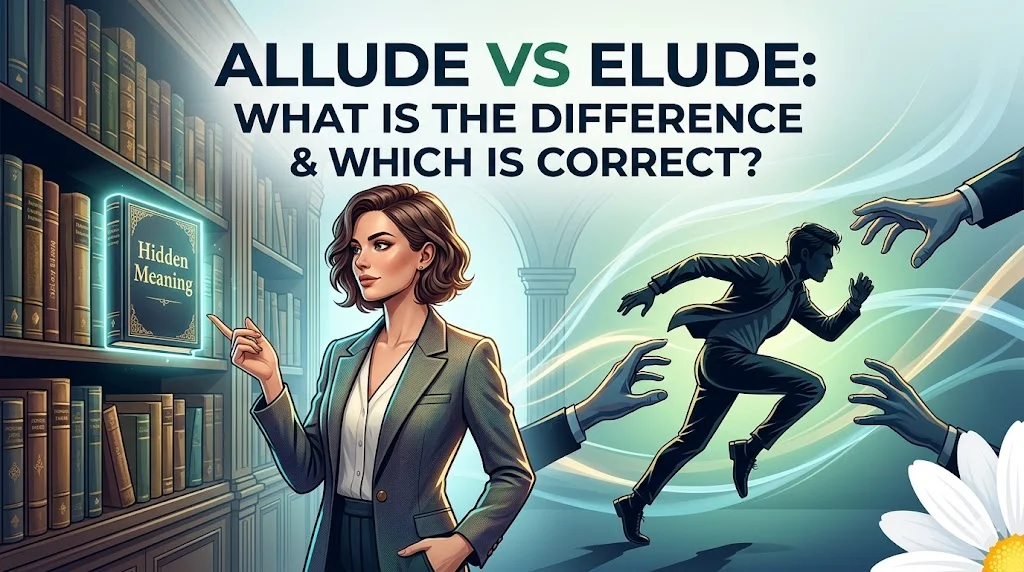
Understanding the difference between allude and elude is essential for clear and precise English. These two words sound similar, but their meanings are completely different. One relates to indirect reference, while the other involves escaping or avoiding something. Learning how to use them correctly will improve both your writing and speaking skills.
Comparison Overview
“Allude” and “elude” are often confused because of their similar pronunciation and spelling. However, they belong to entirely different contexts. “Allude” is used when referring indirectly to something, while “elude” describes escaping or avoiding something, either physically or mentally.
Definition of Allude
“Allude” means to refer to something indirectly or hint at it without stating it clearly. It is often used in writing, speeches, or conversations when the speaker wants to mention something subtly.
Definition of Elude
“Elude” means to escape, avoid, or evade something or someone. It can be used in both physical situations (escaping capture) and abstract ones (failing to understand something).
Main Differences Between Allude and Elude
The key difference lies in meaning and usage. “Allude” is about indirect reference, while “elude” is about avoidance or escape. “Allude” is commonly used in communication and writing, whereas “elude” is used in contexts involving difficulty, escape, or avoidance. Mixing them up can completely change the meaning of a sentence.
Grammar Guide
How each term is used in sentences
“Allude” is typically followed by “to” (e.g., allude to something). It functions as a verb used in communication contexts.
“Elude” is also a verb but does not require a preposition. It is used to describe escaping or avoiding.
Common mistakes learners make
Many learners confuse “allude” with “elude” because they sound alike. A common mistake is using “elude” when referring to something indirectly, or using “allude” when talking about escaping.
Simple rules to remember
“Allude” = hint or mention indirectly
“Elude” = escape or avoid
Quick tips for writing and speaking
Use “allude” when talking about ideas, references, or hints.
Use “elude” when talking about avoidance, escape, or something difficult to grasp.
When to Use Each One
Use “allude” when you want to refer to something without stating it directly, especially in formal writing or storytelling.
Use “elude” when describing something that escapes attention, understanding, or capture.
When NOT to Use Each One
Do not use “allude” when talking about escaping or avoiding something physically or mentally.
Do not use “elude” when referring to hinting at something in speech or writing.
Which One to Use (Decision Guide)
If your sentence involves hinting, referencing, or implying something, choose “allude.”
If your sentence involves escaping, avoiding, or failing to understand something, choose “elude.”
Real-World Practical Examples
Allude Examples
- The teacher alluded to a famous poem during the lecture.
- She alluded to her past experiences without giving details.
- The article alludes to political issues subtly.
- He alluded to a problem but didn’t explain it fully.
- The speaker alluded to historical events in his speech.
Elude Examples
- The thief managed to elude the police.
- The solution to the problem continues to elude me.
- The meaning of the poem eluded the students.
- She tried to catch the butterfly, but it eluded her.
- Success seemed to elude him for years.
Self-Assessment (Fill in the Blanks)
- I will use ______ when referring to hinting at something indirectly. The correct word is ______ because it involves indirect reference.
- I will use ______ when referring to escaping capture. The correct word is ______ because it means to avoid or escape.
- I will use ______ when mentioning something subtly. The correct word is ______ because it means to hint.
- I will use ______ when something is hard to understand. The correct word is ______ because it means to evade understanding.
- I will use ______ when referring to indirect communication. The correct word is ______ because it involves suggestion.
- I will use ______ when avoiding responsibility. The correct word is ______ because it means to evade.
- I will use ______ when hinting at a topic. The correct word is ______ because it implies indirectly.
- I will use ______ when something escapes memory. The correct word is ______ because it means to slip away.
- I will use ______ in formal writing when referencing indirectly. The correct word is ______ because it means to allude.
- I will use ______ when someone avoids capture. The correct word is ______ because it means to elude.
- I will use ______ when referring to hidden meaning. The correct word is ______ because it involves indirect mention.
- I will use ______ when something cannot be caught. The correct word is ______ because it means to escape.
- I will use ______ when implying an idea. The correct word is ______ because it involves suggestion.
- I will use ______ when a concept is difficult to grasp. The correct word is ______ because it means to evade understanding.
- I will use ______ when referencing literature subtly. The correct word is ______ because it means to hint.
- I will use ______ when someone avoids answering. The correct word is ______ because it means to evade.
- I will use ______ when mentioning something indirectly in speech. The correct word is ______ because it means to allude.
- I will use ______ when something escapes detection. The correct word is ______ because it means to elude.
- I will use ______ when suggesting an idea without stating it. The correct word is ______ because it implies indirectly.
- I will use ______ when something is out of reach or escapes. The correct word is ______ because it means to evade.
Answers
- allude, allude
- elude, elude
- allude, allude
- elude, elude
- allude, allude
- elude, elude
- allude, allude
- elude, elude
- allude, allude
- elude, elude
- allude, allude
- elude, elude
- allude, allude
- elude, elude
- allude, allude
- elude, elude
- allude, allude
- elude, elude
- allude, allude
- elude, elude
Final Verdict
“Allude” and “elude” may look and sound similar, but their meanings are very different. “Allude” is used when you want to hint at or indirectly mention something, while “elude” is used when something escapes or avoids capture or understanding. By focusing on their core meanings—hint versus escape—you can confidently choose the correct word every time and avoid common mistakes.
Conclusion About Allude Vs Elude
Understanding the difference between Allude Vs Elude helps you use English more accurately and confidently in both writing and speaking. While both words may look and sound similar, their meanings are completely different and should never be mixed. “Allude” is used when you want to hint at something indirectly without stating it clearly, often in conversations, writing, or storytelling. On the other hand, “elude” refers to escaping, avoiding, or something that is difficult to understand or catch. Mastering this distinction improves clarity and prevents common language mistakes. Whether you are writing essays, speaking in daily life, or improving your grammar for professional use, knowing when to use each word makes your communication more precise and effective. With practice and awareness, using “allude” and “elude” correctly becomes natural and effortless in real-world communication.
FAQs
What is the main difference between allude and elude
The main difference is meaning. “Allude” means to refer to something indirectly, while “elude” means to escape or avoid something. One is about hinting in communication, and the other is about evasion or difficulty in understanding or catching something.
When should I use allude in a sentence
Use “allude” when you want to indirectly mention something without stating it directly. It is commonly used in writing, speeches, and formal communication when a subtle reference is needed instead of a direct explanation.
When should I use elude in a sentence
Use “elude” when describing something that escapes, avoids, or cannot be easily understood or caught. It can refer to physical escape, such as a person running away, or abstract ideas like understanding a concept.
Are allude and elude interchangeable
No, they are not interchangeable. Even though they sound similar, their meanings are completely different. Using one in place of the other changes the entire meaning of the sentence and can cause confusion.
Why do people confuse allude and elude
People confuse them because they sound alike and have similar spellings. However, their meanings belong to completely different contexts, which leads to common grammar mistakes among learners.
Can allude be used in spoken English
Yes, “allude” can be used in spoken English, especially in formal or academic discussions. It is often used when someone wants to refer indirectly to a topic without stating it openly.
Does elude only mean physical escape
No, “elude” does not only refer to physical escape. It can also describe situations where understanding, memory, or meaning is difficult to grasp or constantly escapes someone’s mind.
Is allude always followed by to
Yes, “allude” is usually followed by “to” when used in a sentence. For example, you allude to something when making an indirect reference or hint.
Can elude be used for abstract ideas
Yes, “elude” is often used for abstract ideas. For example, a concept, solution, or meaning can elude someone if it is difficult to understand or grasp.
How can I easily remember the difference between allude and elude
A simple way is to remember that “allude” is related to “reference” or hinting, while “elude” is related to “escape” or avoidance. This association makes it easier to use them correctly.

Sophia Turner is a grammar-focused writer who covers similes, word-versus-word meanings, and correct English usage. Her content is designed for learners who want quick answers, logical explanations, and practical guidance for improving writing accuracy and style.