
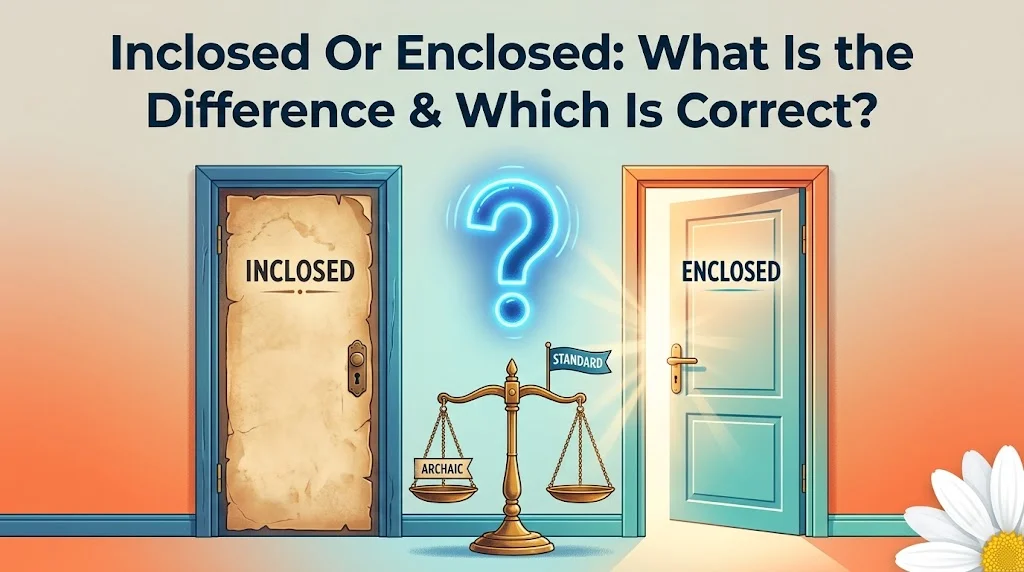
Many English learners confuse “inclosed” and “enclosed” because both words look similar and seem to carry the same meaning. However, one form is modern and commonly accepted, while the other is mostly outdated. Understanding the difference between these two terms helps improve grammar, writing accuracy, and professional communication in everyday English.
Comparison Overview
“Inclosed” and “enclosed” are related words that come from the same historical origin. Both refer to something being surrounded, contained, or included within something else. However, modern English strongly prefers “enclosed,” while “inclosed” is considered old-fashioned and rarely used today. Knowing which one fits modern grammar rules can help you avoid common writing mistakes.
Definition of Inclosed
“Inclosed” is an older spelling variation of “enclosed.” It was more common in historical English writing, especially in older books, letters, and legal documents.
The word generally means:
- Surrounded by something
- Contained within boundaries
- Included inside another item
Today, “inclosed” is rarely used in modern English. Most dictionaries label it as archaic or outdated.
Example:
- The garden was inclosed by a wooden fence.
Definition of Enclosed
“Enclosed” is the modern and correct spelling commonly used in English today. It refers to something that is:
- Surrounded or covered
- Included inside an envelope or package
- Protected within boundaries
This term is widely accepted in formal writing, emails, business communication, education, and daily conversation.
Example:
- Please find the enclosed document in the email attachment.
Main Differences Between Inclosed and Enclosed
| Feature | Inclosed | Enclosed |
| Modern Usage | Rarely used | Commonly used |
| Status | Archaic or outdated | Standard English |
| Accepted in Formal Writing | Usually avoided | Correct and preferred |
| Seen In | Historical texts | Modern communication |
| Meaning | Similar to enclosed | Standard meaning of surrounded or included |
The biggest difference is not meaning but usage. “Enclosed” is the correct modern choice, while “inclosed” mostly appears in old-fashioned writing.
Grammar Guide
How Each Term Is Used in Sentences
“Inclosed” is usually found in historical or literary contexts.
Examples:
- The property was inclosed by stone walls.
- An inclosed field stood behind the cottage.
“Enclosed” is used in modern English for both physical and abstract meanings.
Examples:
- I enclosed the receipt in the envelope.
- The animals lived in an enclosed area.
- Please see the enclosed report.
Common Mistakes Learners Make
Many learners:
- Think “inclosed” is the modern spelling
- Use “inclosed” in professional emails
- Assume both forms are equally common
- Misspell “enclosed” because of pronunciation confusion
Incorrect:
- Please find the inclosed file.
Correct:
- Please find the enclosed file.
Simple Rules to Remember
- Use “enclosed” in modern English.
- Avoid “inclosed” unless discussing historical writing.
- If you are writing emails, essays, or reports, always choose “enclosed.”
Easy memory trick:
- “Enclosed” begins with “en,” which is the modern standard prefix in English.
Quick Tips for Writing and Speaking
- Use “enclosed” for attachments and included items.
- Use “enclosed” when talking about fenced or protected spaces.
- Avoid “inclosed” in exams, business writing, and conversations.
- If you see “inclosed” in books, it is likely old English usage.
When to Use Each One
Use “inclosed” when:
- Reading historical literature
- Quoting old legal documents
- Discussing archaic English spellings
Use “enclosed” when:
- Writing emails
- Sending attachments
- Describing fenced areas
- Writing essays or reports
- Speaking modern English
Examples:
- Enclosed is the contract for your review.
- The playground is enclosed by metal fencing.
When NOT to Use Each One
Do not use “inclosed”:
- In professional communication
- In school assignments
- In modern grammar tests
- In formal business writing
Do not misuse “enclosed” when:
- You actually mean “attached”
- Referring to something not physically or logically contained
Incorrect:
- I enclosed my opinion yesterday.
Correct:
- I shared my opinion yesterday.
Which One to Use (Decision Guide)
Choose “enclosed” if:
- You are writing modern English
- You need grammatically correct wording
- You are communicating professionally
- You want natural-sounding English
Choose “inclosed” only if:
- You are referencing historical texts
- You intentionally want an old-fashioned style
Simple decision rule:
- Modern English = enclosed
- Historical English = inclosed
Real-World Practical Examples
Inclosed Examples
- The farmer inclosed the land with wooden barriers.
- The old manuscript described an inclosed courtyard.
- Several inclosed gardens appeared in the ancient village.
- The king owned large inclosed hunting grounds.
- The historian studied inclosed properties from the 1700s.
Enclosed Examples
- Please find the enclosed invoice for payment.
- The dog stayed in an enclosed backyard.
- The enclosed instructions explain the process clearly.
- Scientists observed the plants in an enclosed environment.
- The company sent an enclosed brochure with the package.
Self-Assessment (Fill in the Blanks)
- Please find the ______ document attached to the email.
- The ancient text described an ______ garden.
- Modern business writing prefers the word ______.
- The playground was fully ______ by fences.
- The correct modern spelling is ______.
- The historian found the word ______ in old records.
- We placed the papers in an ______ envelope.
- The animals lived in an ______ area.
- The outdated spelling is ______.
- The office memo included an ______ schedule.
- The castle had an ______ courtyard in the old story.
- I have ______ the contract with this letter.
- Teachers usually mark ______ as outdated.
- The package contained an ______ receipt.
- The farm was ______ by stone walls centuries ago.
- Professional emails should use ______ instead of inclosed.
- The scientist worked in an ______ laboratory.
- The legal document used the old spelling ______.
- The safest modern choice is ______.
- The report was ______ with the application form.
Answers
- enclosed
- inclosed
- enclosed
- enclosed
- enclosed
- inclosed
- enclosed
- enclosed
- inclosed
- enclosed
- inclosed
- enclosed
- inclosed
- enclosed
- inclosed
- enclosed
- enclosed
- inclosed
- enclosed
- enclosed
Final Verdict
“Inclosed” and “enclosed” share nearly the same meaning, but they are not equally used in modern English. “Enclosed” is the standard, correct, and widely accepted spelling today. It appears in professional writing, emails, academic work, and everyday communication. On the other hand, “inclosed” is an outdated form mostly found in historical or literary texts. If you want clear, modern, and grammatically correct English, “enclosed” is almost always the right choice. Understanding this difference helps improve writing confidence and prevents common spelling mistakes in formal and informal situations alike.
Conclusion About Inclosed Or Enclosed
Inclosed or enclosed may look almost identical, but their usage tells a very different story in modern English. While “inclosed” reflects an older style of writing found in historical texts, “enclosed” is the standard and widely accepted form used today. Choosing the correct version is important for clear communication, especially in emails, academic writing, and professional documents. Understanding this difference not only improves grammar accuracy but also helps you sound more natural and confident in English. In most real-world situations, “enclosed” is the correct and preferred choice, making it the safer option for everyday use.
FAQs About Inclosed Or Enclosed
Is inclosed the same as enclosed
“Inclosed” and “enclosed” share the same meaning, but they are not used equally today. “Inclosed” is an old spelling, while “enclosed” is the modern and correct version used in standard English writing.
Which is correct, inclosed or enclosed
“Enclosed” is correct in modern English. It is used in emails, business writing, and academic content. “Inclosed” is outdated and rarely used except in historical or literary contexts.
Why is inclosed no longer used
“Inclosed” fell out of common usage as English spelling became standardized. Over time, “enclosed” became the accepted form in dictionaries, grammar rules, and professional communication.
Can I use inclosed in formal writing
No, “inclosed” should not be used in formal writing. It is considered archaic. For professional, academic, or business documents, always use “enclosed” for correctness and clarity.
What does enclosed mean in emails
In emails, “enclosed” means that something is attached or included, such as documents, files, or reports. It helps the reader know that additional material is provided with the message.
Is enclosed only used for physical objects
No, “enclosed” can refer to both physical and abstract inclusion. It can describe documents in emails or physical spaces like enclosed areas, gardens, or structures.
How do I remember the correct spelling
A simple trick is to remember that “enclosed” is the modern form used in emails and writing today. If you are unsure, always choose “enclosed” as the safe option.
Is inclosed found in dictionaries
Yes, but most dictionaries label “inclosed” as archaic or outdated. It is included for historical reference rather than modern usage.
Can enclosed and attached mean the same thing
They are similar but not identical. “Enclosed” usually refers to something included in the same package or letter, while “attached” is more commonly used in digital emails.
What is the safest choice for writing
The safest and most correct choice in all modern contexts is “enclosed.” It ensures clarity, professionalism, and proper grammar in communication.

Sarah Mitchell is an experienced writer and grammar teacher with over 10 years of expertise in English language education. She helps learners improve their grammar, writing, and communication skills through clear explanations and practical examples. Sarah creates learner-friendly content focused on real-life English, making language learning simple, effective, and confidence-building.