
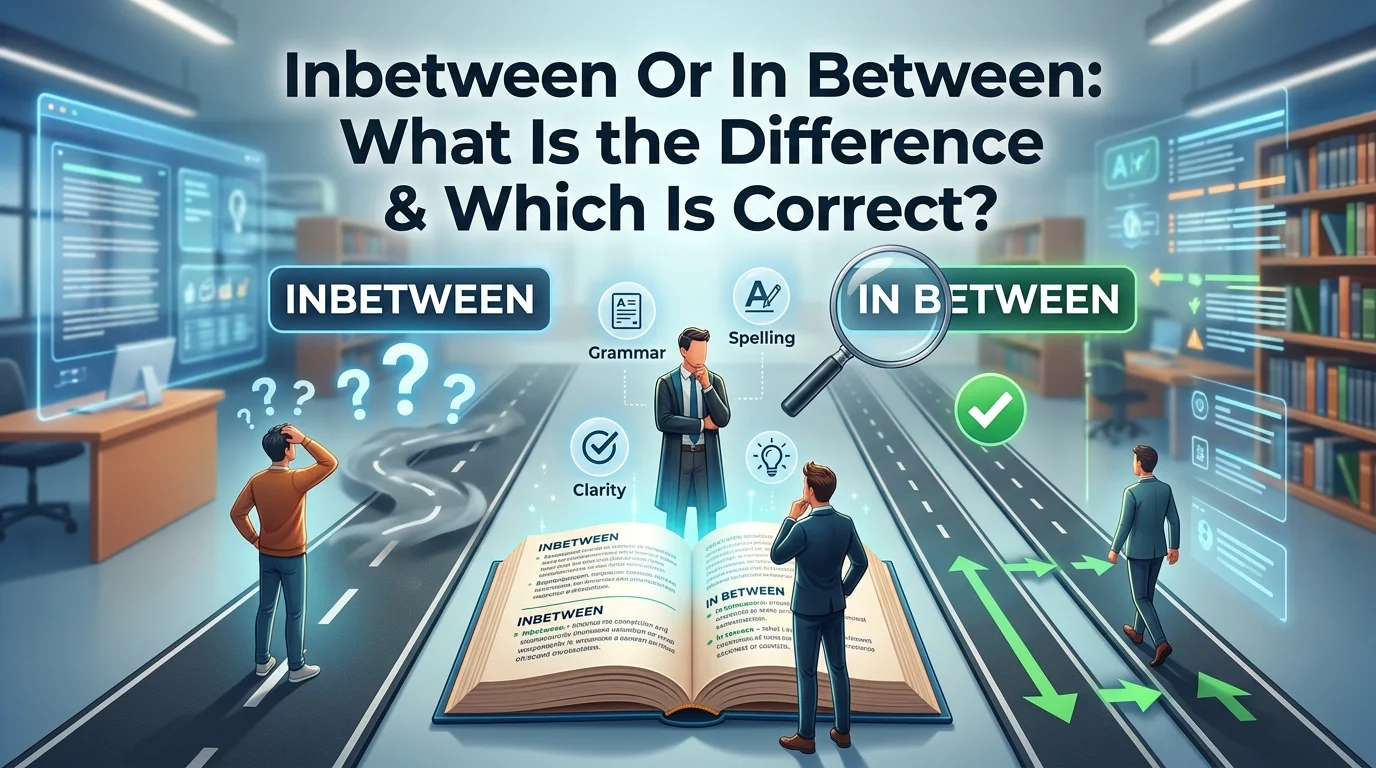
Many English learners get confused between “inbetween” and “in between” because they look very similar. However, only one form is considered standard and grammatically correct in modern English. Understanding the difference helps improve writing, speaking, grammar accuracy, and professional communication in everyday situations.
Comparison Overview
“Inbetween” and “in between” are often confused because both relate to something positioned in the middle of two things, places, ideas, or situations. The major difference is that “in between” is the accepted and correct English phrase, while “inbetween” is generally considered incorrect or nonstandard in most writing contexts.
Definition of Inbetween
“Inbetween” is usually viewed as a misspelling or incorrect variation of “in between.” It is not commonly accepted in formal English grammar, academic writing, business communication, or professional publications.
Some people use “inbetween” informally online or in casual texting, but dictionaries and grammar guides generally do not recognize it as a proper standalone word in standard English.
Core meaning:
- Intended to describe something located in the middle
- Informal or mistaken spelling
- Rarely accepted in formal usage
Definition of In Between
“In between” is the correct and standard English phrase. It is used to describe something located in the middle of two things, people, times, places, or ideas.
It functions as a prepositional phrase and is widely used in both spoken and written English.
Core meaning:
- Positioned in the middle
- Connecting or separating two things
- Grammatically correct phrase
Example:
- The park is in between the school and the library.
Main Differences Between Inbetween and In Between
| Feature | Inbetween | In Between |
| Grammar Status | Nonstandard or incorrect | Grammatically correct |
| Usage | Rare and informal | Common in all English contexts |
| Dictionary Acceptance | Usually not accepted | Fully accepted |
| Writing Style | Avoid in formal writing | Correct for formal and informal writing |
| Meaning | Intended same meaning | Correct expression of the meaning |
The biggest difference is grammatical correctness. “In between” is the proper phrase, while “inbetween” is generally treated as a spelling mistake.
Grammar Guide
How Each Term Is Used in Sentences
“In between” is used to show a middle position, relationship, or interval.
Examples:
- She sat in between her two friends.
- There is a short break in between classes.
- The discussion happened in between meetings.
“Inbetween” is generally avoided.
Incorrect:
- She sat inbetween her friends.
Correct:
- She sat in between her friends.
Common Mistakes Learners Make
Many learners combine the two words into one because they assume it works like compound words such as “inside” or “outside.”
Common mistakes:
- Writing “inbetween” in essays
- Using it in professional emails
- Confusing it with accepted compound words
- Assuming both forms are interchangeable
Simple Rules to Remember
- Use “in between” when referring to something in the middle.
- Keep “in” and “between” as two separate words.
- Avoid “inbetween” in formal and academic writing.
Easy memory trick:
- If you can replace it with “between two things,” use “in between.”
Quick Tips for Writing and Speaking
- Always separate the words in formal English.
- Proofread carefully because spellcheck may not always catch “inbetween.”
- Use “in between” in essays, reports, emails, and presentations.
- In conversation, pronounce it naturally as two connected words.
When to Use Each One
Use “in between” when:
- Talking about physical position
- Referring to time intervals
- Describing relationships or comparisons
- Writing formally or academically
- Communicating professionally
Examples:
- The hotel is in between the airport and downtown.
- I studied in between lunch and dinner.
“Inbetween” may appear:
- In informal internet writing
- In typing mistakes
- In nonstandard social media posts
However, it is best avoided.
When NOT to Use Each One
Do not use “inbetween”:
- In school assignments
- In business writing
- In professional communication
- In published articles
- In exams or academic papers
Do not misuse “in between” when another word fits better.
Incorrect:
- The colors are in between mixed.
Correct:
- The colors are mixed.
Which One to Use (Decision Guide)
Use this simple guide:
| Situation | Correct Choice |
| Academic writing | In between |
| Formal email | In between |
| Daily conversation | In between |
| Professional report | In between |
| Social media slang | Sometimes “inbetween,” but not recommended |
Decision rule:
- If you want grammatically correct English, always use “in between.”
Real-World Practical Examples
Inbetween Examples
These examples show how people incorrectly use the term:
- The shop is inbetween the bank and the café.
- I rested inbetween meetings.
- She stood inbetween her parents.
- There was silence inbetween conversations.
- The file disappeared somewhere inbetween folders.
Correct versions should use “in between.”
In Between Examples
- The teacher stood in between the students during the activity.
- I usually drink coffee in between work sessions.
- The river flows in between the mountains.
- The manager scheduled a break in between presentations.
- There was a misunderstanding in between the two departments.
Additional examples from different contexts:
- The scientist placed the sample in between two glass slides.
- We stopped for snacks in between our road trip destinations.
- The software update occurred in between system reboots.
- She felt stuck in between two career choices.
- The dialogue in between the characters sounded realistic.
Self-Assessment (Fill in the Blanks)
- The restaurant is ______ the bookstore and the cinema.
- I took a short nap ______ classes.
- The correct phrase in standard English is ______.
- She sat ______ her two sisters.
- Many students mistakenly write ______ as one word.
- The break happened ______ the two meetings.
- We walked ______ tall buildings downtown.
- The grammatically accepted form is ______.
- The cat hid ______ the chairs.
- There was silence ______ conversations.
- Avoid using ______ in formal writing.
- The garden lies ______ the house and garage.
- He completed homework ______ football practice.
- The correct spelling is ______ because it is a two-word phrase.
- The conversation happened ______ dinner and dessert.
- Writers should avoid ______ in essays.
- The park sits ______ two apartment buildings.
- I relaxed ______ work tasks.
- The correct word is ______ because dictionaries recognize it.
- She felt trapped ______ two difficult decisions.
Answers
- in between
- in between
- in between
- in between
- inbetween
- in between
- in between
- in between
- in between
- in between
- inbetween
- in between
- in between
- in between
- in between
- inbetween
- in between
- in between
- in between
- in between
Final Verdict
“In between” is the correct and standard English phrase used to describe something located in the middle of two things, places, times, or ideas. “Inbetween” is generally considered incorrect or nonstandard in modern English. For clear, professional, and grammatically accurate communication, always use “in between” as two separate words.
Conclusion About Inbetween Or In Between
Understanding the difference between “inbetween” and “in between” is essential for anyone who wants to write clear and correct English. While both look similar, only “in between” is accepted as standard English in grammar, academic writing, and professional communication. It correctly describes something located in the middle of two points, ideas, or situations. On the other hand, “inbetween” is generally considered a spelling error or informal misuse that should be avoided in formal contexts. By using “in between” correctly, you improve clarity, credibility, and fluency in both writing and speech. Whether you are writing essays, emails, or everyday messages, choosing the correct form helps you communicate more effectively and confidently. With simple practice and awareness, avoiding this common mistake becomes easy and natural over time.
FAQs
Is inbetween a correct English word?
“Inbetween” is generally not considered correct in standard English. It is often treated as a spelling mistake or informal usage. In formal writing, academic work, and professional communication, it should be avoided. The correct and widely accepted form is “in between,” which properly describes something located in the middle of two things or situations.
What does in between mean in English grammar?
“In between” is a prepositional phrase used to show that something is located in the middle of two objects, people, places, or ideas. It is grammatically correct and commonly used in both spoken and written English. It helps express position, comparison, or relationship clearly and accurately in sentences.
Why do people write inbetween instead of in between?
People often write “inbetween” because it feels like a single word and resembles other compound words in English. It is usually a spelling habit or typing shortcut. However, this form is not accepted in formal grammar. The correct structure separates the words into “in between” for proper usage.
Can inbetween be used in casual writing?
“Inbetween” may appear in casual texting or informal online posts, but it is not recommended even there. Using the correct form “in between” ensures clarity and avoids grammatical errors. Even in informal communication, proper usage helps maintain good writing habits and improves language accuracy over time.
What is the difference between inbetween and in between?
The main difference is grammatical correctness. “In between” is the standard and accepted English phrase used in all contexts. “Inbetween” is considered incorrect or informal. Both may try to express the same idea, but only “in between” should be used in proper writing and communication.
How do you use in between in a sentence?
“In between” is used to show a middle position or connection between two things. For example, “The park is in between the school and the library.” It can also describe time or situations, such as “I rested in between meetings.” It always functions as a two word phrase.
Is in between one word or two words?
“In between” is always written as two separate words in standard English. Writing it as one word, “inbetween,” is incorrect in formal grammar. Keeping it separate ensures proper sentence structure and clear communication in writing, speaking, and professional contexts.
What are common mistakes with in between?
A common mistake is combining the words into “inbetween.” Another error is using it when a different word would be more suitable. Learners also sometimes forget spacing or misuse it in formal writing. The correct usage always keeps the phrase as two separate words.
Can in between be used in academic writing?
Yes, “in between” is commonly used in academic writing when describing position, comparison, or intervals. It is grammatically correct and appropriate for essays, reports, and research papers. However, “inbetween” should never be used in academic contexts because it is not considered standard English.
How can I remember the correct form in between?
A simple way to remember is to think of it as “in the middle between two things.” Since it describes a relationship, it naturally stays as two words. Another trick is to remember that dictionaries list it as “in between,” not “inbetween,” making the correct form easier to recall.

Sophia Turner is a grammar-focused writer who covers similes, word-versus-word meanings, and correct English usage. Her content is designed for learners who want quick answers, logical explanations, and practical guidance for improving writing accuracy and style.