
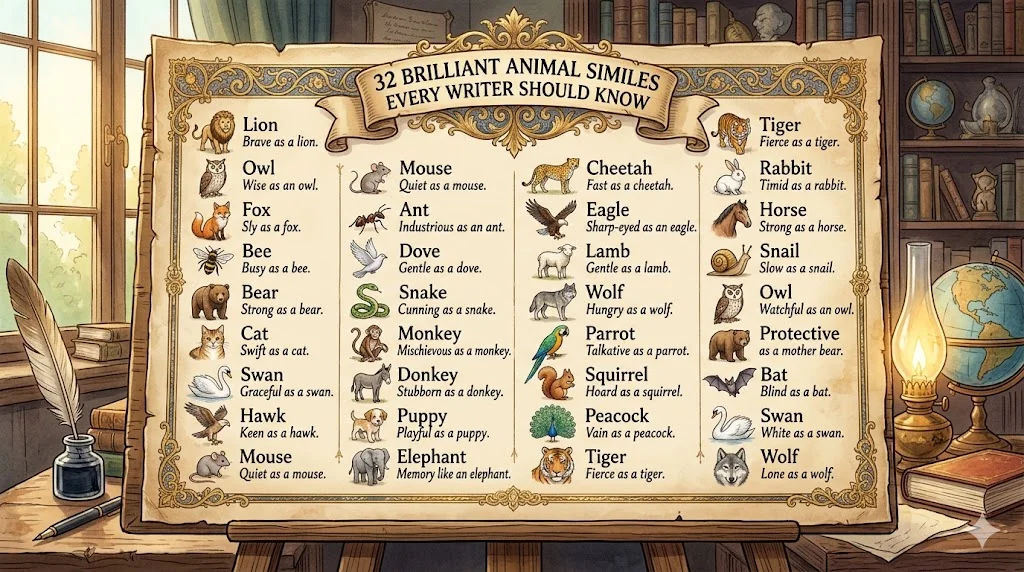
Similes are one of the most powerful tools in writing, helping you create vivid images and emotional depth by comparing one thing to another using “like” or “as.” Animal similes are especially effective because animals embody recognizable traits, from bravery and cunning to gentleness and speed. Whether you’re crafting poetry, short stories, or even casual writing, animal similes make your descriptions more engaging and memorable. In this guide, you’ll learn the meanings behind 32 brilliant animal similes, see clear examples of their use, understand common mistakes to avoid, and gain practical tips to apply them naturally in your writing. By the end, you’ll be able to enrich your work with comparisons that captivate and resonate with readers.
What Is a Simile?
A simile is a figure of speech that compares two different things using words such as “like” or “as.” Similes make abstract ideas concrete and help readers visualize concepts more vividly. Unlike metaphors, which state something is another, similes clearly show the comparison. For example, saying “She was as quiet as a mouse” helps readers immediately picture a soft, gentle presence. Similes enhance storytelling by adding clarity, emotional impact, and relatability.
Definition of Animal Similes
Animal similes are comparisons that use animals to represent human traits, emotions, or behaviors. They are widely used in literature to make descriptions more vivid and memorable. For example, describing someone as “as cunning as a fox” instantly conveys cleverness and strategic thinking. Animal similes combine familiar imagery with figurative language to enhance understanding and emotional resonance.
As Brave as a Lion
Meaning: Shows courage and fearlessness.
Explanation: This simile is used to describe someone who faces danger or challenges without fear.
Examples:
- The firefighter ran into the burning building, as brave as a lion.
- She defended her friend from bullies, as brave as a lion.
As Busy as a Bee
Meaning: Extremely industrious and active.
Explanation: Describes someone constantly working or moving.
Examples:
- He was as busy as a bee preparing for the festival.
- The students were as busy as bees organizing the charity event.
As Cunning as a Fox
Meaning: Clever, crafty, and sometimes sly.
Explanation: Highlights intelligence used strategically.
Examples:
- The detective was as cunning as a fox in solving the mystery.
- She navigated the negotiations as cunning as a fox.
As Gentle as a Lamb
Meaning: Very gentle, kind, and harmless.
Explanation: Used to describe a soft, tender personality.
Examples:
- The baby held the kitten, as gentle as a lamb.
- His voice was as gentle as a lamb when comforting the children.
As Free as a Bird
Meaning: Unrestricted, carefree, independent.
Explanation: Symbolizes freedom and lack of constraint.
Examples:
- After graduation, she felt as free as a bird.
- The horse ran across the meadow, as free as a bird.
As Proud as a Peacock
Meaning: Displaying confidence or vanity.
Explanation: Often describes someone showing off achievements or beauty.
Examples:
- He walked into the room, as proud as a peacock, after winning the award.
- She arranged the flowers, as proud as a peacock of her creation.
As Wise as an Owl
Meaning: Intelligent, insightful, knowledgeable.
Explanation: Highlights wisdom and good judgment.
Examples:
- The mentor was as wise as an owl, guiding everyone carefully.
- He solved the problem as wise as an owl.
As Quick as a Cat
Meaning: Fast, nimble, and alert.
Explanation: Refers to physical or mental agility.
Examples:
- She was as quick as a cat, catching the falling book.
- The player reacted as quick as a cat to intercept the ball.
As Strong as an Ox
Meaning: Very strong and capable of enduring hard work.
Explanation: Commonly used for physical strength and resilience.
Examples:
- The laborer lifted the beams, as strong as an ox.
- He remained as strong as an ox despite long hours of work.
As Stubborn as a Mule
Meaning: Very determined, refusing to change.
Explanation: Used to describe obstinacy or firm resistance.
Examples:
- She refused to leave, as stubborn as a mule.
- The child was as stubborn as a mule when asked to eat vegetables.
As Playful as a Kitten
Meaning: Fun-loving, lively, and mischievous.
Explanation: Highlights joy and playful energy.
Examples:
- The puppy ran around, as playful as a kitten.
- He teased his friends, as playful as a kitten.
As Slow as a Snail
Meaning: Extremely slow-moving.
Explanation: Used literally or figuratively to describe slowness.
Examples:
- The old computer processed files as slow as a snail.
- He walked through the park, as slow as a snail.
As Hungry as a Wolf
Meaning: Very hungry or eager.
Explanation: Can be used literally or metaphorically for strong desire.
Examples:
- After the hike, he was as hungry as a wolf.
- She was as hungry as a wolf for success.
As Happy as a Lark
Meaning: Extremely cheerful and joyful.
Explanation: Often conveys carefree happiness.
Examples:
- The children played in the garden, as happy as a lark.
- She felt as happy as a lark after hearing the good news.
As Silent as a Mouse
Meaning: Very quiet, almost unnoticed.
Explanation: Refers to soundless behavior or careful discretion.
Examples:
- He tiptoed through the room, as silent as a mouse.
- The cat moved as silent as a mouse during the hunt.
As Slippery as an Eel
Meaning: Hard to catch, deceptive, or elusive.
Explanation: Can describe physical agility or tricky behavior.
Examples:
- The thief was as slippery as an eel, escaping the guards.
- Negotiating with him was as slippery as an eel.
As Blind as a Bat
Meaning: Unable to see or perceive clearly.
Explanation: Sometimes used figuratively for lack of awareness.
Examples:
- Without his glasses, he was as blind as a bat.
- She was as blind as a bat to his intentions.
As Quiet as a Rabbit
Meaning: Extremely quiet and gentle.
Explanation: Highlights subtlety, gentleness, or shyness.
Examples:
- The student entered the room as quiet as a rabbit.
- He listened as quiet as a rabbit during the lecture.
As Graceful as a Swan
Meaning: Elegant, smooth, and beautiful in movement.
Explanation: Describes poise and refined motion.
Examples:
- She danced across the stage, as graceful as a swan.
- The gymnast moved as graceful as a swan.
As Fierce as a Tiger
Meaning: Aggressive, powerful, and dangerous.
Explanation: Often used for determination or intensity.
Examples:
- He defended his team as fierce as a tiger.
- The storm raged as fierce as a tiger.
As Faithful as a Dog
Meaning: Loyal and trustworthy.
Explanation: Highlights devotion and reliability.
Examples:
- She stood by her friends, as faithful as a dog.
- His companion remained as faithful as a dog.
As Cold as a Fish
Meaning: Emotionally distant or unfeeling.
Explanation: Can describe personality or physical sensation.
Examples:
- His response was as cold as a fish.
- The water felt as cold as a fish.
As Watchful as a Hawk
Meaning: Extremely alert and observant.
Explanation: Can describe vigilance or attentiveness.
Examples:
- The security guard was as watchful as a hawk.
- She monitored the project as watchful as a hawk.
As Restless as a Monkey
Meaning: Constantly moving, anxious, or fidgety.
Explanation: Conveys impatience or high energy.
Examples:
- The toddler was as restless as a monkey.
- He paced the room as restless as a monkey.
As Sly as a Snake
Meaning: Clever in a deceptive way.
Explanation: Used for cunning, often with a negative connotation.
Examples:
- He was as sly as a snake in securing the contract.
- The fox crept in, as sly as a snake.
As Innocent as a Dove
Meaning: Pure, harmless, and naive.
Explanation: Often conveys goodness and trustworthiness.
Examples:
- The child’s smile was as innocent as a dove.
- She entered the room, as innocent as a dove.
As Proud as a Rooster
Meaning: Confident, sometimes boastful.
Explanation: Can highlight self-importance or accomplishment.
Examples:
- He strutted into the room as proud as a rooster.
- The artist displayed his work as proud as a rooster.
As Quick as a Rabbit
Meaning: Fast and agile.
Explanation: Often describes speed or sudden movement.
Examples:
- The player moved as quick as a rabbit.
- She dodged the ball as quick as a rabbit.
As Strong as a Bear
Meaning: Immensely powerful or resilient.
Explanation: Describes both physical strength and endurance.
Examples:
- The wrestler was as strong as a bear.
- He carried the heavy boxes as strong as a bear.
As Gentle as a Dove
Meaning: Calm, kind, and harmless.
Explanation: Highlights softness and tenderness in behavior.
Examples:
- She handled the bird as gentle as a dove.
- His words were as gentle as a dove.
As Fierce as a Bull
Meaning: Extremely aggressive and forceful.
Explanation: Often indicates determination or anger.
Examples:
- The boxer attacked as fierce as a bull.
- The storm raged as fierce as a bull.
As Free as a Horse on a Field
Meaning: Completely unrestricted and independent.
Explanation: Symbolizes natural freedom and joy.
Examples:
- The horse galloped across the meadow as free as a horse on a field.
- She felt as free as a horse on a field after quitting her stressful job.
Table of Comparison: Similar Animal Traits
| Trait | Similes | Meaning | Example Use |
| Strength | As strong as an ox, as strong as a bear | Physical power | Carrying heavy loads, enduring challenges |
| Speed | As quick as a cat, as quick as a rabbit | Fast movement | Dodging, reacting quickly |
| Cleverness | As cunning as a fox, as sly as a snake | Strategic thinking | Problem solving, negotiations |
| Gentleness | As gentle as a lamb, as gentle as a dove | Soft and kind | Handling delicate objects or people |
| Freedom | As free as a bird, as free as a horse | Independence | Emotional release, natural behavior |
Linguistic Insights Behind Animal Similes
Animal similes are rooted in cultural associations. Lions symbolize bravery, owls wisdom, and doves innocence. Using these familiar traits allows readers to quickly understand the writer’s intent. Historically, these comparisons appear in fables, folklore, and poetry worldwide, creating universal recognition. For example, calling someone “as sly as a fox” conveys cunning immediately due to shared cultural knowledge. Understanding these patterns helps writers choose the most effective similes for their audience.
Common Mistakes Using Animal Similes
Overusing clichés like “as brave as a lion” or mixing incompatible traits can weaken writing. Avoid vague comparisons, redundant similes, or ones that don’t match context. For example, saying “as free as a fish on land” confuses the imagery. Always ensure the animal trait logically conveys the intended meaning, and vary similes to keep writing fresh and engaging.
How to Use Animal Similes in Creative Writing
Place similes to highlight key actions, emotions, or characteristics without overwhelming the narrative. Balance figurative language with clear storytelling. For instance, describing a character’s speed as “as quick as a cat” adds immediacy during an action scene. Use them in dialogue, narration, and descriptions to make your writing more vivid, relatable, and engaging.
Expert Opinions on Animal Similes
Literary experts emphasize the impact of similes in connecting readers emotionally to characters and scenes. According to experts, effective animal similes create memorable imagery, evoke emotions instantly, and strengthen narrative voice. Writers should focus on originality, context relevance, and clarity to maintain reader engagement.
Self-Assessment: Are Your Similes Effective?
Check if your similes are clear, emotionally impactful, original, and contextually appropriate. Avoid clichés, ensure they match the action or emotion, and verify readability for your audience. A self-review checklist may include: clarity, relevance, creativity, and emotional resonance. This ensures every simile enhances rather than distracts from your writing.
Final Thoughts
Animal similes are a versatile tool that brings life and color to writing. By linking familiar animal traits to human actions, writers create vivid imagery and emotional depth. Understanding the meanings, cultural associations, and appropriate contexts ensures your similes enhance storytelling without becoming clichéd. Avoid overuse and match the simile to the situation, whether highlighting courage, speed, or innocence. Using similes thoughtfully improves clarity, engagement, and reader enjoyment. With practice, you can craft comparisons that are fresh, accurate, and resonate emotionally, making your writing more memorable. Remember, every simile should serve the story, emphasizing traits naturally and creatively. Consistently reviewing your usage and experimenting with new animals or traits ensures your writing remains lively, relatable, and unique. Start integrating these 32 animal similes today, and your descriptions will instantly feel richer and more expressive. Mastery of similes not only strengthens your literary voice but also captivates readers, providing imagery that sticks long after they finish reading.
Frequently Asked Questions
What is an example of an animal simile?
Examples include “as brave as a lion” or “as gentle as a lamb,” conveying traits through animals.
Why do writers use animal similes?
They enhance imagery, make descriptions vivid, and help readers relate emotionally to characters or actions.
Can I use animal similes in formal writing?
Yes, but only when appropriate; avoid overly casual or humorous similes in academic or professional contexts.
Are animal similes the same as metaphors?
No, similes compare using “like” or “as,” while metaphors state one thing is another.
Which animal simile is most common?
“As brave as a lion” is widely recognized and often used to convey courage.
How can I create my own animal similes?
Identify a trait, pick a relevant animal, and compare using “as” or “like” for clarity.
Are animal similes culturally specific?
Yes, some animals symbolize different traits in various cultures, affecting interpretation.
How do animal similes improve storytelling?
They create visual imagery, convey emotions, and make actions and traits easier for readers to grasp.
Should I avoid overused animal similes?
Yes, overused similes can feel clichéd; try fresh comparisons to maintain originality.
Can animal similes describe emotions effectively?
Absolutely, they link human emotions to recognizable animal behaviors for clarity.
Can animal similes be humorous?
Yes, playful comparisons can add humor and lightness to writing.
Are all animal similes literal?
No, many are figurative, describing traits metaphorically rather than literally.
How many animal similes should I use in a story?
Use them selectively; too many can overwhelm, while a few well-placed similes enhance imagery.
Can animal similes describe physical traits?
Yes, they often describe speed, strength, size, or agility.
Do children understand animal similes easily?
Yes, simple animal similes are relatable and easy for young readers to visualize.
Are animal similes found in poetry?
Frequently, as they enhance rhythm, imagery, and emotional resonance.
Can I combine two animal similes in one sentence?
Yes, but ensure clarity and avoid conflicting traits.
Do animal similes need explanation?
Not always; most are widely recognized, but context can clarify obscure comparisons.
Can animal similes replace adjectives?
Often, they provide a more vivid alternative to plain adjectives.
How can I make animal similes original?
Experiment with uncommon animals or creative traits to avoid clichés.

Ethan Clarke is a language writer who specializes in breaking down similes, word meanings, and commonly confused terms. His work focuses on clear explanations, practical examples, and simple comparisons that help readers understand how English
