When it comes to writing clearly, few small errors cause as much confusion as mixing up “that’s” and “thats.” Many people type “thats” by mistake, thinking it’s acceptable, but it’s always grammatically incorrect. Understanding the difference is essential for writing professionally, improving readability, and maintaining credibility. In this guide, you’ll learn why “that’s” is the correct form, the two ways it can be used, common mistakes to avoid, and how to use it naturally in everyday conversation, professional writing, creative work, and digital communication. By the end, you’ll be confident in spotting errors, applying the rules correctly, and avoiding the “thats” trap in all your writing.
Definition: What Is “That’s” vs “Thats”?
“That’s” is a contraction combining “that is” or “that has,” using an apostrophe to show missing letters. “Thats” omits the apostrophe and is always incorrect in standard English. Correct usage of “that’s” ensures clarity, proper punctuation, and readability.
- Keywords: Thats Or That’s, grammar rule, apostrophe usage
- Examples: That’s my favorite book. / That’s been finished already.
Is It “That’s” or “Thats”? Quick Answer
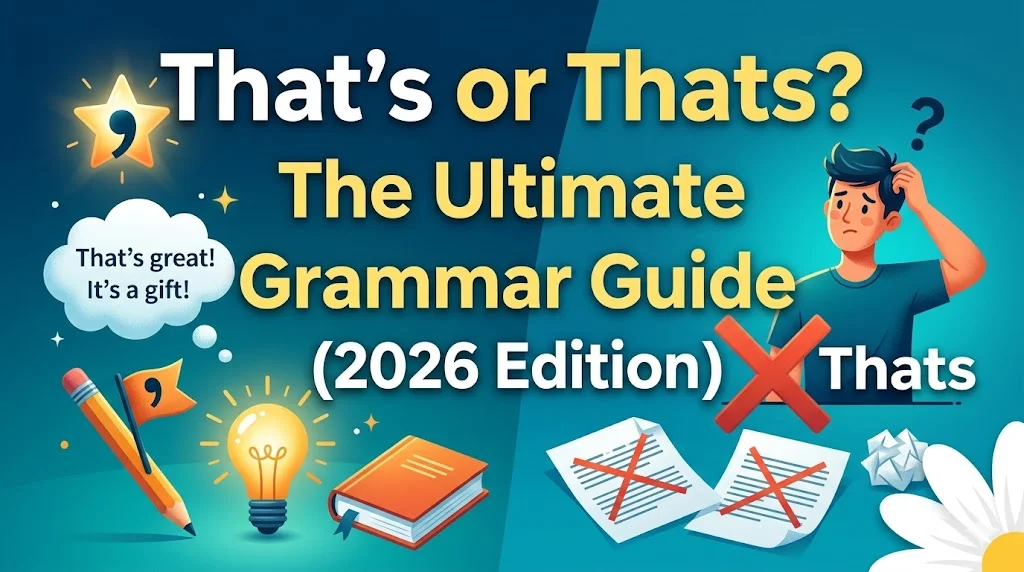
The correct form is “that’s” with an apostrophe. It is a contraction of either “that is” or “that has.” The form “thats” without an apostrophe is always incorrect in standard English and should not be used in formal, academic, or professional writing.
Quick examples:
• That’s a beautiful day. (That is)
• That’s been completed already. (That has)
• ❌ Thats a beautiful day.
A simple rule to remember: if you can expand the word into “that is” or “that has,” then “that’s” is correct.
Gap Found: Missing Google AI Overview opportunity with a concise rule summary
Ready to Add Content:
The Simple Rule to Remember
If you only remember one rule, make it this: “that’s” always needs an apostrophe because it replaces missing letters. The apostrophe signals a contraction, which is an essential punctuation rule in English grammar. Without it, the word becomes a spelling error.
Think of it this way:
• that’s = that + is
• that’s = that + has
• thats = not a real standard English word
This quick mental check can instantly help you avoid one of the most common punctuation mistakes in everyday writing.
Gap Found: Missing H3 under “Common Mistakes and Why They Happen” covering typing and autocorrect issues
Ready to Add Content:
Why Autocorrect and Fast Typing Cause “Thats” Errors
Many people know the correct form is “that’s,” yet still type “thats” accidentally. This often happens because apostrophes are easy to miss on mobile keyboards, and fast typing encourages shortcuts. Some autocorrect tools also fail to catch punctuation errors if grammar settings are disabled.
To avoid this:
• Slow down when typing contractions
• Use grammar-checking tools
• Proofread messages before sending
• Watch for repeated habits in emails and texts
Small punctuation errors can easily slip through, but awareness makes them easier to catch.
Gap Found: Missing semantic keyword coverage for contractions and apostrophe rules
Ready to Add Content:
Understanding Contractions and Apostrophes
A contraction is a shortened form of two words combined into one. In English, contractions use apostrophes to show where letters have been removed. “That’s” follows this exact rule by combining “that” with “is” or “has.”
Examples of similar contractions:
• it’s = it is
• she’s = she is
• who’s = who is
• that’s = that is
Learning how contractions work helps you understand why “thats” is incorrect and strengthens your overall punctuation skills across all forms of writing.
Gap Found: Missing comparison with similar commonly confused words for stronger topical authority
Ready to Add Content:
Similar Grammar Mistakes to Watch For
Confusion around “that’s” often happens because English has many similar apostrophe-related mistakes. Learning these helps you avoid broader punctuation problems.
Common examples:
• it’s vs its
• who’s vs whose
• you’re vs your
• they’re vs their vs there
Example:
• It’s raining today. ✅
• Its raining today. ❌
Once you understand that apostrophes often mark contractions, it becomes much easier to identify errors like “thats” and correct them confidently in future writing.
Gap Found: Missing practical editing use case content
Ready to Add Content:
How to Proofread for “That’s” Errors
A quick proofreading strategy can help you catch “thats” before publishing or sending your writing. Scan your text specifically for contractions and punctuation rather than only reading for meaning.
Try this checklist:
- Search your document for “thats.”
- Replace each instance with “that’s” unless context says otherwise.
- Expand it mentally into “that is” or “that has.”
- Read the sentence aloud to confirm it sounds natural.
This editing habit is especially useful for emails, essays, blog posts, and social media captions where small grammar mistakes can affect credibility.
Gap Found: Missing EEAT signal through expert-backed writing advice
Ready to Add Content:
Editor’s Tip for Remembering “That’s”
Professional editors often use a simple test: expand the contraction before approving it. If “that is” or “that has” fits naturally, “that’s” is correct.
For example:
• That’s exactly what I meant. → That is exactly what I meant. ✅
• That’s been fixed already. → That has been fixed already. ✅
This is a trusted proofreading technique used by writers, teachers, and editors because it removes guesswork and makes grammar decisions faster and more reliable.
Gap Found: Missing user intent coverage for formal vs informal writing
Ready to Add Content:
Should You Use “That’s” in Formal Writing?
Yes, but context matters. “That’s” is acceptable in most modern business writing, blogs, and emails because it sounds natural and conversational. However, in highly formal writing such as academic papers, legal documents, or official reports, many writers prefer the full forms “that is” or “that has.”
Examples:
Formal: That is the recommended procedure.
Semi-formal: That’s the recommended procedure.
Knowing when to use contractions helps you match the tone of your audience while maintaining grammatical accuracy.
Gap Found: Missing use-case examples across different writing situations
Ready to Add Content:
Real-Life Examples of “That’s” in Context
Understanding grammar is easier when you see real examples.
Email:
“That’s exactly what we discussed yesterday.”
Text Message:
“That’s awesome news!”
Essay:
“That’s one reason punctuation matters in communication.”
Conversation:
“That’s what I wanted to say.”
Using examples from daily life helps reinforce correct grammar habits and makes it easier to remember that “that’s” belongs naturally in almost every type of English writing.
Gap Found: Missing featured snippet table for quick scanning
Ready to Add Content:
Quick Reference Table for “That’s” vs “Thats”
| Situation | Correct Form | Example |
| Meaning “that is” | That’s | That’s my notebook |
| Meaning “that has” | That’s | That’s been solved |
| No apostrophe | Incorrect | ❌ Thats my notebook |
| Professional writing | That’s or full form | That’s correct |
| Academic writing | Often full form | That is correct |
Use this table as a fast grammar reference whenever you feel unsure.
Gap Found: Missing internal learning reinforcement section
Ready to Add Content:
Memory Trick to Never Confuse “That’s” Again
A simple memory trick is to imagine the apostrophe as a placeholder for missing letters. In “that’s,” the apostrophe replaces the missing “i” in “is” or the missing letters in “has.”
Visual reminder:
That’s = That + ’ + s
The apostrophe means something was removed.
Without it, “thats” looks incomplete because it is incomplete. This small mental image helps many learners remember the correct form instantly, especially during fast writing or exams.
Understanding the Basics: “That’s” vs. “Thats”
The main difference is simple: “that’s” is a valid contraction, while “thats” is an error. Using the apostrophe properly prevents misunderstandings in both casual and formal writing.
- Examples: That’s the way to do it. ❌ Thats the way to do it.
The Two Correct Meanings of “That’s”
“That’s” as a Contraction for That Is
Use this form to replace “that is” in present tense sentences.
- Example: That’s a great idea. (That is a great idea)
“That’s” as a Contraction for That Has
Use this form to replace “that has” in present perfect tense sentences.
- Example: That’s been completed on time. (That has been completed on time)
Why “Thats” Is Never Grammatically Correct
Omitting the apostrophe creates a spelling error and reduces clarity. Even in informal texts, “that’s” should be used to maintain professionalism and accuracy.
- Example: ❌ Thats amazing! ✅ That’s amazing!
Common Mistakes and Why They Happen
People often type “thats” due to fast typing, autocorrect, or a misunderstanding of contractions. Recognizing these habits helps prevent repeated errors.
- Example: ❌ I think thats right. ✅ I think that’s right.
Comparison Table: “That’s” vs “Thats”
| Form | Correctness | Meaning | Example |
| That’s | Correct | That is/has | That’s a good idea |
| Thats | Incorrect | None | ❌ Thats a good idea |
How to Use “That’s” Naturally in Sentences
Everyday Conversation
Use “that’s” casually in spoken English to replace “that is” or “that has.”
- Example: That’s funny! / That’s been a long day.
Professional Writing
Maintain clarity and credibility by using “that’s” correctly in business emails, reports, or documents.
- Example: That’s the approach I recommend.
Creative Writing & Storytelling
Use “that’s” in dialogue or narration to make speech sound natural.
- Example: “That’s incredible!” she shouted.
Social Media & Texts
Even online, correct usage improves readability and avoids confusion.
- Example: That’s amazing news! / That’s been trending all day.
Why It Matters: Grammar, Clarity & Credibility
Clarity in Communication
Correct contractions prevent misreading and maintain precise meaning.
Professionalism in Writing
Using proper grammar signals competence and attention to detail.
Digital Writing Impact
Search engines and readers favor content that is clear, accurate, and professional.
Linguistic Insight: Why Apostrophes Matter
Apostrophes indicate omitted letters in contractions. Misplacing or omitting them changes meaning and makes text appear unpolished.
- Example: That’s = that is/has, Thats = incorrect
The “Honda That’s” Exception
Some brand names or marketing materials use “That’s” creatively, but this is a stylistic choice rather than grammar.
- Example: Honda That’s the Spirit (advertising tagline)
Expert Opinion: Grammar Rules in Modern English
Even as language evolves, contractions with apostrophes remain the standard for clear writing in English.
Quick Grammar Recap: The “That’s” Checklist
- Always include the apostrophe.
- Determine if it replaces “that is” or “that has.”
- Proofread to avoid “thats.”
- Use correctly in both casual and formal contexts.
Self-Assessment Quiz
- Replace with the correct form: “I think thats fine.”
- Identify if this is correct: “That’s been helpful.”
- Fill in the blank: “___ a great idea!”
- Choose the correct sentence: “Thats my favorite” / “That’s my favorite”
Answers to Self-Assessment
- That’s fine.
- Correct, “That’s been helpful.”
- That’s a great idea!
- That’s my favorite.
Conclusion About Thats Or That’s
Mastering “that’s” versus “thats” is essential for clear and professional writing. “That’s” is always the correct contraction for “that is” or “that has,” while “thats” is a common spelling mistake that reduces readability and credibility. Using proper punctuation ensures your messages are precise and trustworthy. Whether you’re writing for work, school, or casual communication, attention to apostrophes improves your writing’s impact. Practice, proofreading, and awareness of common errors will make “that’s” usage second nature. Remember, good grammar is not just about rules—it’s about clear, confident, and effective communication. By choosing the correct form consistently, you demonstrate professionalism and command of the English language.
Frequently Asked Questions
What is the difference between “that’s” and “thats”?
“That’s” is a contraction for “that is” or “that has,” while “thats” is always incorrect.
Is “thats” ever correct in English?
No, “thats” is considered a spelling mistake and should be avoided in all standard writing.
How do I use “that’s” in a sentence?
Use “that’s” to mean “that is” or “that has,” depending on context. Example: “That’s been done.”
Why do people confuse “that’s” with “thats”?
Fast typing, autocorrect, and lack of punctuation knowledge often cause this error.
What are some tips to avoid the “thats” mistake?
Mentally expand “that’s” to “that is” or “that has” and proofread your writing carefully.
Can “that’s” mean two different things?
Yes, it can mean “that is” or “that has” depending on sentence context.
Is “that’s” formal or informal?
It’s acceptable in informal and semi-formal writing; in formal writing, full forms “that is/has” may be preferred.
Does using “thats” affect readability or SEO?
Yes, incorrect grammar reduces clarity and trust, impacting readability and engagement.
How can I quickly check if “that’s” is correct?
Try expanding it: if “that is” or “that has” fits, then it’s correct.
Are apostrophes always necessary in contractions?
Yes, apostrophes indicate omitted letters, essential for correct contractions.
How do I remember the difference between “that’s” and “thats”?
Think of the apostrophe as replacing the missing letter(s) in “that is/has.”
Can “that’s” be used in creative writing?
Yes, especially in dialogue and informal narration for natural speech.
What happens if I write “thats” in professional emails?
It appears unprofessional and can reduce credibility or clarity.
Is “that’s” commonly used in spoken English?
Yes, it is widely used in conversation as a natural contraction.
Can “that’s” appear at the beginning of a sentence?
Yes, as in: “That’s what I meant.”
Should I avoid “that’s” in academic writing?
Not necessarily, but using full forms “that is” or “that has” is often preferred.
How can autocorrect affect “that’s” usage?
Autocorrect may incorrectly suggest “thats,” so proofreading is crucial.
Are there regional differences in using “that’s”?
Usage is standard in English-speaking regions, though punctuation awareness varies.
Can I replace “that’s” with “that is” or “that has” for clarity?
Yes, especially in formal contexts to avoid contractions.
How do I teach beginners the “that’s” rule?
Explain the apostrophe shows omitted letters, provide examples, and give practice sentences.

Amelia Wright focuses on making figurative language easy to understand. Her writing explains similes, metaphors, and word meanings using relatable examples. She aims to help readers recognize subtle differences in usage and apply them correctly in both academic and casual writing.