
Many English learners confuse save and safe because they look and sound similar, but they have very different meanings and uses. Understanding the difference matters because using the wrong one can completely change your sentence. This guide explains Save vs Safe in a simple, beginner-friendly way so you can confidently use the correct word in speaking and writing.
Comparison Overview
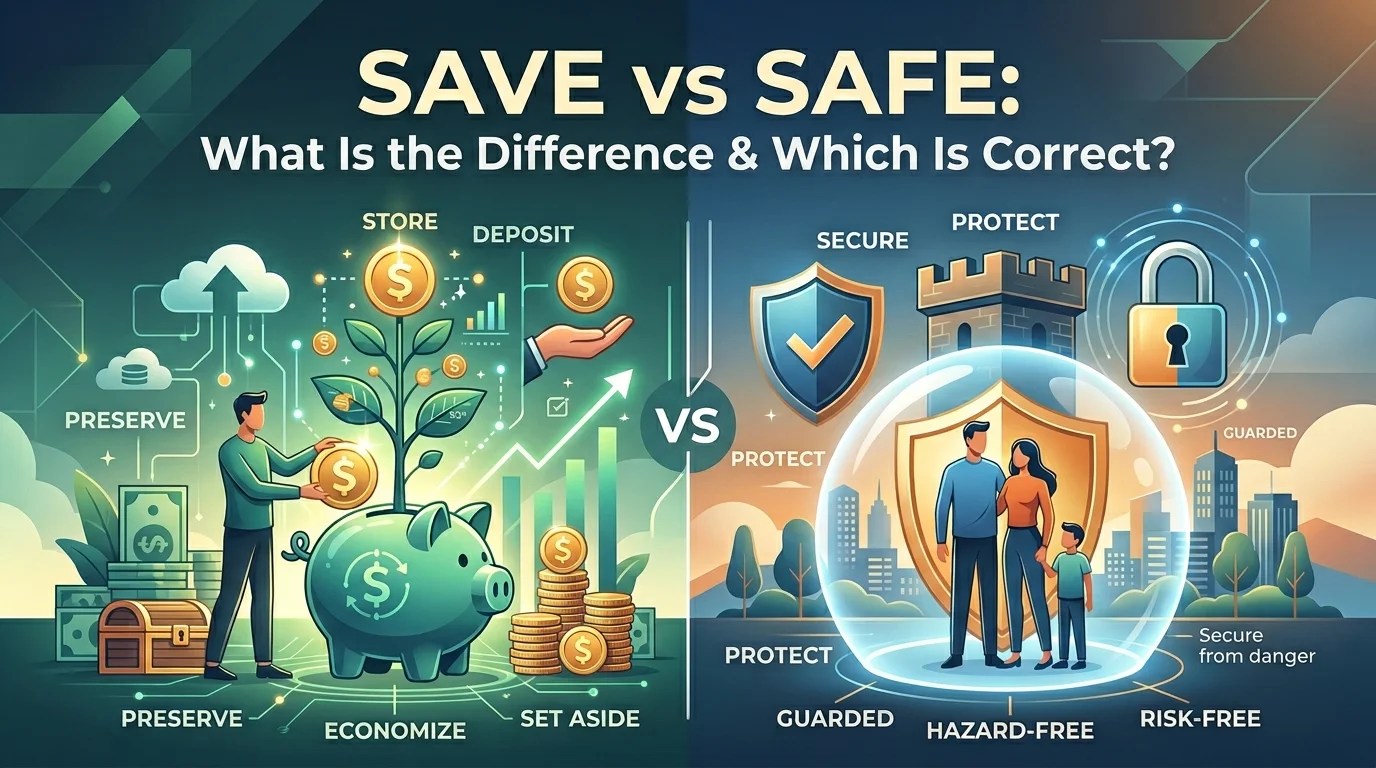
Save and safe are related in meaning because both often involve protection, but they function differently in English.
Save is usually a verb, meaning to protect, rescue, keep, or store something.
Safe is usually an adjective, meaning protected, secure, or not in danger.
For example:
• “I want to save my files.” (action)
• “My files are safe now.” (condition)
The key difference is simple: save is something you do, safe is a condition something is in.
Definition of Save
The word save is mainly used as a verb.
It means:
• to protect someone or something from harm
• to keep something for future use
• to store information or money
• to rescue someone
Examples:
• Please save your work before closing the computer.
• She wants to save money for college.
• The doctor helped save his life.
Core purpose: an action that protects, stores, or preserves something.
Definition of Safe
The word safe is mainly used as an adjective.
It means:
• protected from danger
• secure
• not harmful
• free from risk
Examples:
• Your password is safe with us.
• The children are safe at home.
• This neighborhood is very safe.
Core purpose: describing a secure condition.
Main Differences Between Save and Safe
| Feature | Save | Safe |
| Part of Speech | Verb | Adjective |
| Meaning | To protect/store/rescue | Protected or secure |
| Function | Action | State/condition |
| Example | Save the file | The file is safe |
| Common Use | Technology, money, rescue | Security, safety, protection |
Main idea: Save = action. Safe = result.
Grammar Guide
How each term is used in sentences
Save usually comes before an object.
Pattern: Save + object
Examples:
• Save your document.
• Save your money.
• Save the child.
Safe usually follows a linking verb like is, are, feel, stay.
Pattern: be + safe
Examples:
• The child is safe.
• Your data is safe.
• Stay safe.
Common mistakes learners make
Incorrect: Please safe your file.
Correct: Please save your file.
Incorrect: Your file is save.
Correct: Your file is safe.
Incorrect: Stay save.
Correct: Stay safe.
Simple rules to remember
Use save when someone is doing something.
Use safe when something is protected.
Memory trick:
Save = Verb = Action
Safe = Adjective = State
Quick tips for writing and speaking
Ask yourself: “Is this an action?”
If yes, use save.
Ask yourself: “Is this describing safety?”
If yes, use safe.
When to Use Each One
Use save when:
• storing a file
• rescuing someone
• keeping money
• preserving time or energy
Examples:
• Save your homework.
• Save money monthly.
• Firefighters saved the family.
Use safe when:
• describing security
• talking about protection
• talking about risk-free situations
Examples:
• Your home is safe.
• Keep your children safe.
• The website is safe.
When NOT to Use Each One
Do not use save when describing condition.
Wrong: The baby is save.
Correct: The baby is safe.
Do not use safe when describing action.
Wrong: Please safe the document.
Correct: Please save the document.
Avoid confusing “stay safe” with “stay save.”
Only stay safe is correct.
Which One to Use (Decision Guide)
Choose save if:
• an action is happening
• someone is storing, rescuing, or protecting
Choose safe if:
• you describe a condition
• something is secure or protected
Quick test:
“Can I replace it with protect/store?” → save
“Can I replace it with secure/protected?” → safe
Real-World Practical Examples
Save Examples
- Education: Please save your essay before logging out.
- Daily life: I want to save money this month.
- Science: This method helps save energy.
- Business: The company must save customer records.
- Technology: Click here to save your settings.
Safe Examples
- Education: Students feel safe in the classroom.
- Daily life: Keep your wallet safe.
- Science: This chemical is safe to use.
- Business: Your payment information is safe online.
- Technology: Your files are safe in cloud storage.
Self-Assessment (Fill in the Blanks)
- Please ______ your password before exiting.
- Your password is ______ now.
- Firefighters worked to ______ the family.
- The family is finally ______.
- I want to ______ money for travel.
- My money is ______ in the bank.
- Always ______ your work.
- Your work is ______ on the server.
- Doctors tried to ______ the patient.
- The patient is now ______.
- We must ______ energy.
- This building is ______ during storms.
- Please ______ the document.
- The document is ______ in the folder.
- Parents want to keep children ______.
- Teachers can ______ students from danger.
- Keep your phone ______ in your bag.
- Remember to ______ your game progress.
- This road is not ______ at night.
- Good habits can ______ time.
Answers
- save
- safe
- save
- safe
- save
- safe
- save
- safe
- save
- safe
- save
- safe
- save
- safe
- safe
- save
- safe
- save
- safe
- save
Final Verdict
The difference between save and safe is simple once you remember their roles. Save is a verb, so it shows an action like storing, protecting, or rescuing something. Safe is an adjective, so it describes a condition of being protected or secure. If you are doing something, choose save. If you are describing security, choose safe. Mastering this small difference will make your English clearer, more accurate, and much more natural.
Conclusion About Save vs Safe
Understanding Save vs Safe is essential for clear and correct English communication. Although the two words look similar, their meanings and usage are very different. Save is an action word used when you store, protect, or rescue something, while safe describes a condition where someone or something is secure and out of danger. Knowing this difference helps you avoid common grammar mistakes and express your ideas more accurately in writing and speaking. Whether you are saving a file, saving money, or ensuring someone is safe, using the right word improves clarity and confidence. With practice, the distinction becomes natural and easy to remember. Keep the simple rule in mind: save is what you do, safe is how things are. This small but important grammar understanding can significantly improve your English fluency and communication skills in everyday life. Consistent practice makes it even easier over time naturally.
FAQs
What is the main difference between save and safe
The main difference is that save is a verb that refers to an action such as storing, protecting, or rescuing something, while safe is an adjective that describes a condition of being secure or free from danger. In simple terms, save is something you do, and safe is the result or state after protection. This helps avoid confusion easily.
What is save used for in English
Save is used when you perform an action to keep, store, or protect something for future use or to prevent loss or damage. It is commonly used in technology, money management, and rescue situations. For example, you can save a file, save money, or save a person from danger. It shows practical everyday usage in different contexts.
What is safe used for in English
Safe is used to describe a situation where someone or something is protected from danger, harm, or risk. It is an adjective often used with the verb to be, such as is safe or are safe. For example, your home is safe, or the children are safe at school. It helps explain security and protection clearly in daily language.
Can save and safe be used interchangeably
No, save and safe cannot be used interchangeably because they belong to different parts of speech and have different meanings. Save is an action verb, while safe is an adjective. Using them incorrectly can change the meaning of a sentence and lead to grammar mistakes. Understanding context is important for accuracy.
How do I remember save vs safe easily
You can remember save vs safe by linking save with action because it is a verb, and safe with condition because it is an adjective. Think of save as something you do and safe as something you feel or are. This simple association makes it easier to avoid confusion while writing. Practice helps build strong memory over time naturally.
What are common mistakes with save and safe
Common mistakes include using safe as a verb and save as an adjective. For example, saying safe your file instead of save your file is incorrect. Another mistake is writing the baby is save instead of the baby is safe. Careful practice prevents these issues in everyday writing speaking skills.
Is safe always an adjective
In most cases, safe is used as an adjective to describe something that is not in danger or harm. It is commonly used with verbs like be, seem, or feel. While safe is primarily an adjective, its main function remains descriptive. This makes it easy to identify usage in sentences correctly context.
Is save always a verb
Yes, save is most commonly used as a verb meaning to store, protect, or rescue something. It shows an action performed by someone. In some rare cases, it may appear in noun form in computing, but its primary use is as a verb. This is important for learners to understand usage clearly grammar.
How do I know when to use save or safe
You can decide by checking whether the word shows action or description. If you are talking about doing something like storing or protecting, use save. If you are describing a condition of security or protection, use safe. It improves accuracy in communication both written and spoken English usage skills.
Why do people confuse save and safe
People confuse save and safe because the words look similar in spelling and sound close when spoken. However, they have different meanings and grammatical roles. Save refers to action, while safe refers to condition. Learning examples helps improve clarity in real situations effectively over time naturally.

Daniel Brooks is an English educator with a passion for explaining similes and word comparisons in plain language. He covers topics like versus meanings, correct usage, and figurative language to help writers avoid common mistakes and improve clarity in everyday writing.