
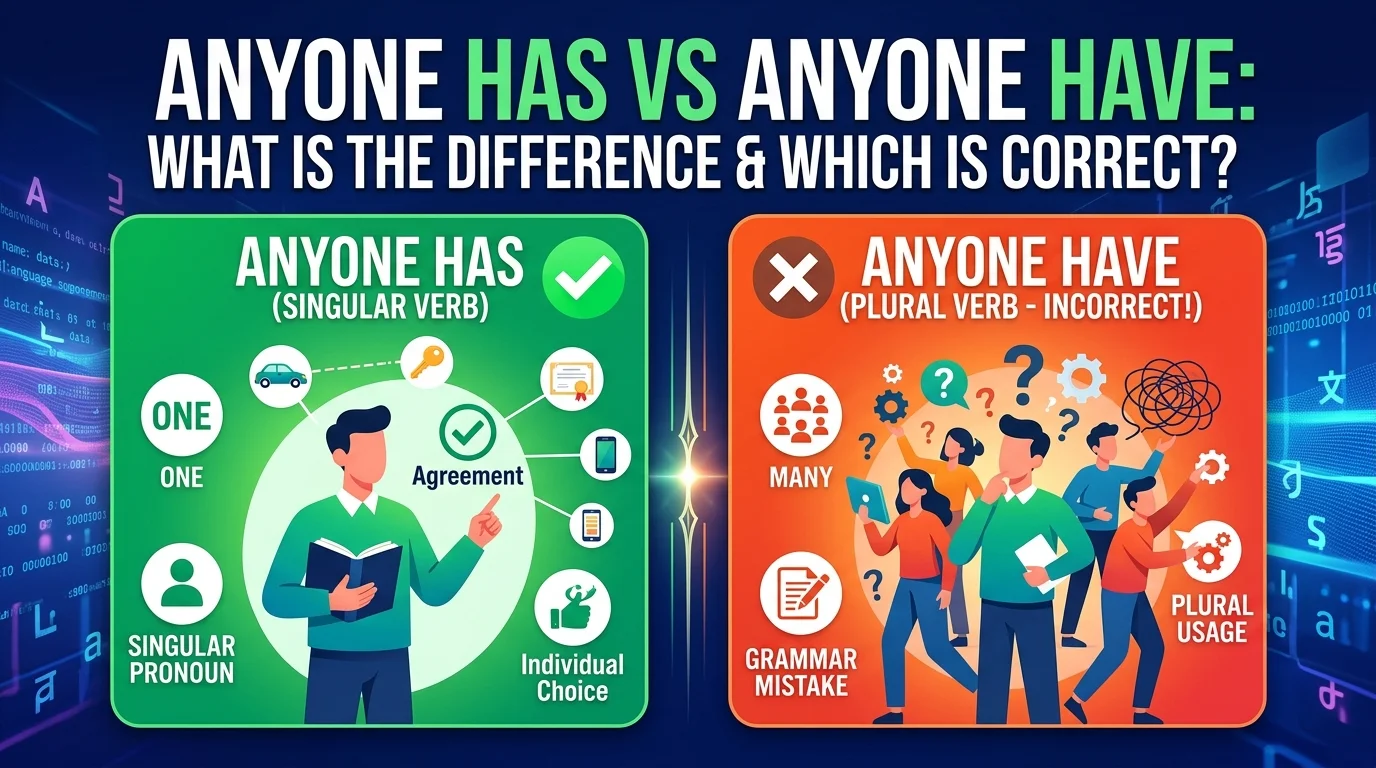
Understanding whether to use “anyone has” or “anyone have” is a common grammar confusion in English. Both phrases look similar, but only one is usually correct depending on sentence structure and grammar rules. This guide explains the difference in a simple, practical way so you can confidently use the correct form in speaking and writing.
Comparison Overview
“Anyone has” and “anyone have” are both verb phrases that depend on subject-verb agreement rules in English grammar. The word “anyone” is a singular indefinite pronoun, which normally takes a singular verb. However, context such as questions, clauses, and informal usage can sometimes cause confusion. Understanding how each form works helps you avoid common mistakes.
Definition of Anyone Has
“Anyone has” is the grammatically correct form in most affirmative sentences because “anyone” is treated as singular. The verb “has” agrees with a singular subject. It is commonly used in statements and indirect questions.
Meaning: It refers to whether a single unspecified person possesses, experiences, or does something.
Definition of Anyone Have
“Anyone have” is typically used in questions, especially in informal speech or certain inverted structures. Although “have” is plural in form, it can appear in questions where auxiliary verbs change sentence structure. In formal grammar, however, “has” is still preferred in many cases.
Meaning: It is used to ask whether any person has something, often in spoken English or question form.
Main Differences Between Anyone Has and Anyone Have
The key difference lies in grammar structure and sentence type.
“Anyone has” is used in statements and formal writing because it follows strict subject-verb agreement rules. “Anyone have” is mainly used in questions or informal speech where inversion changes the sentence structure.
In simple terms:
- “Anyone has” = correct in statements and formal usage
- “Anyone have” = common in questions or casual conversation
Comparison Table
| Feature | Anyone Has | Anyone Have |
| Grammar form | Singular agreement | Question/informal usage |
| Sentence type | Statements | Questions |
| Formal usage | Correct | Less formal |
| Example | Anyone has the answer | Does anyone have the answer |
Grammar Guide
The word “anyone” is an indefinite pronoun and is always treated as singular in standard English grammar. That means it should normally pair with singular verbs like “has,” “is,” or “does.”
However, in questions, English often uses auxiliary verbs like “do/does,” which changes how the main verb appears.
How each term is used in sentences
Correct patterns include:
- Anyone has + object or action
- Does anyone have + object or action (preferred question form)
Examples:
- Anyone has the key to this door.
- Does anyone have the key to this door?
Common mistakes learners make
- Using “anyone have” in statements (incorrect in formal grammar)
- Forgetting auxiliary verbs in questions
- Mixing singular and plural agreement incorrectly
Incorrect examples:
- Anyone have seen my book.
- Anyone have the answer.
Simple rules to remember
- Use “has” with “anyone” in statements.
- Use “does anyone have” in questions.
- Avoid using “anyone have” in formal writing.
Quick tips for writing and speaking
- Think of “anyone” as one person, not many.
- Add “does” when forming questions.
- Use “has” for clean, correct grammar in essays and formal text.
When to Use Each One
Use “anyone has” when making statements or reporting information.
Use “does anyone have” when asking questions politely or naturally.
“Anyone have” may appear in casual speech but should be avoided in formal writing.
When NOT to Use Each One
Do not use “anyone have” in formal statements or academic writing.
Avoid using “anyone has” in direct questions where auxiliary verbs are required.
Incorrect:
- Anyone have the report ready?
- Anyone has a pen?
Correct:
- Does anyone have the report ready?
- Anyone has completed the task.
Which One to Use (Decision Guide)
If you are writing a statement, choose “anyone has.”
If you are asking a question, use “does anyone have.”
If you are writing formally, always prefer “anyone has” or “does anyone have” depending on sentence type.
If you are speaking casually, “anyone have” may appear in speech, but it is not grammatically strict.
Real-World Practical Examples
Anyone Has Examples
- Anyone has the right to express their opinion in a democracy.
- Anyone has access to this library with a valid card.
- Anyone has the ability to learn a new language with practice.
- Anyone has experienced stress before exams.
- Anyone has the option to apply for this scholarship.
Anyone Have Examples
- Does anyone have a charger I can borrow?
- Does anyone have any questions before we finish the meeting?
- Does anyone have experience with this software?
- Does anyone have the time to help me today?
- Does anyone have suggestions for the project?
Self-Assessment (Fill in the Blanks)
- I will use ______ when making a formal statement about possession.
- The correct word is ______ because “anyone” is singular.
- In questions, we usually say does anyone ______ a pen?
- ______ has the authority to approve this request.
- The correct question form is does anyone ______ the report?
- ______ has already submitted their assignment.
- I am asking if anyone ______ seen my phone.
- The proper formal usage is ______ has the answer.
- In informal speech, people sometimes say anyone ______.
- ______ has the experience needed for this role.
- To form a question, we use does anyone ______ know the answer?
- ______ has the responsibility for this task.
- The correct structure in questions is does anyone ______ a key?
- ______ has completed the registration process.
- We should avoid using anyone ______ in formal writing.
- ______ has the permission to enter this area.
- Does anyone ______ a notebook I can use?
- ______ has the required documents.
- In correct grammar, anyone ______ is preferred in statements.
- Does anyone ______ any updates on the situation?
Answers
- anyone has
- has
- have
- anyone has
- have
- anyone has
- have
- anyone has
- have
- anyone has
- have
- anyone has
- have
- anyone has
- have
- anyone has
- have
- anyone has
- has
- have
Final Verdict
The difference between “anyone has” and “anyone have” comes down to grammar structure and sentence type. “Anyone has” is the correct form for statements because “anyone” is singular. “Anyone have” mainly appears in questions, especially in informal speech, but the more correct form is “does anyone have.” By remembering this simple rule, you can avoid one of the most common English grammar mistakes and use both forms correctly in real communication.
Conclusion About Anyone Has vs Anyone Have
Understanding the difference between “anyone has” and “anyone have” makes English grammar much clearer and more confident to use in daily communication. The key idea is that “anyone” is always singular, so it naturally pairs with “has” in statements. In questions, however, English often shifts structure, making “does anyone have” the most correct and widely accepted form. While “anyone have” may appear in casual speech, it is not preferred in formal writing. Once you recognize this pattern, choosing the correct form becomes effortless. With regular practice, you will notice your speaking and writing becoming more natural, accurate, and grammatically polished in real-life situations.
FAQs
Is “anyone has” grammatically correct?
Yes, “anyone has” is grammatically correct because “anyone” is a singular indefinite pronoun. It should be paired with a singular verb like “has” in statements. This form is commonly used in formal writing, essays, and reports to maintain proper subject-verb agreement in English grammar.
Why do people say “anyone have” in conversation?
People often say “anyone have” in casual speech because spoken English tends to simplify grammar rules. However, in standard grammar, this form is not correct in statements. In questions, the proper structure is usually “does anyone have,” which follows formal English rules more accurately.
Which is correct: anyone has or does anyone have?
Both can be correct depending on context. “Anyone has” is used in statements, while “does anyone have” is used in questions. The difference comes from sentence structure and auxiliary verbs, not meaning. Choosing the right form depends on whether you are asking or stating something.
Can “anyone have” ever be correct?
“Anyone have” can appear in informal speech, especially in spoken questions, but it is not considered grammatically standard in formal English. The correct form for questions is “does anyone have.” In writing, especially academic or professional contexts, it is best to avoid “anyone have.”
What is the rule for using anyone with verbs?
The rule is simple: “anyone” is singular, so it takes singular verbs like “has,” “is,” or “does.” In questions, auxiliary verbs like “does” are used, which changes the main verb form. This ensures proper subject-verb agreement in both spoken and written English.
Why is “anyone has” used in sentences?
“Anyone has” is used in sentences because “anyone” refers to a single unspecified person. English grammar requires singular subjects to pair with singular verbs. This structure helps maintain clarity and correctness in statements, making communication more precise and grammatically accurate.
Is it wrong to say anyone have a question?
Yes, in formal grammar it is incorrect to say “anyone have a question.” The correct form is “does anyone have a question.” This follows proper English question structure and ensures the verb agrees correctly with the singular subject “anyone.”
What is the difference between anyone and anyone have?
“Anyone” is a pronoun meaning any person, while “anyone have” is an informal and often incorrect phrase used in casual questions. The correct structure depends on grammar rules, where “anyone has” is used in statements and “does anyone have” is used in questions.
How can I remember the correct usage easily?
A simple trick is to remember that “anyone” equals one person, so it takes “has.” For questions, add “does” before “anyone have.” This pattern helps you quickly choose the correct form without confusion in both writing and speaking situations.
Is “does anyone has” correct?
No, “does anyone has” is incorrect because “does” already carries the singular verb form. The correct phrase is “does anyone have.” English grammar does not allow “does” and “has” to be used together in the same question structure.