
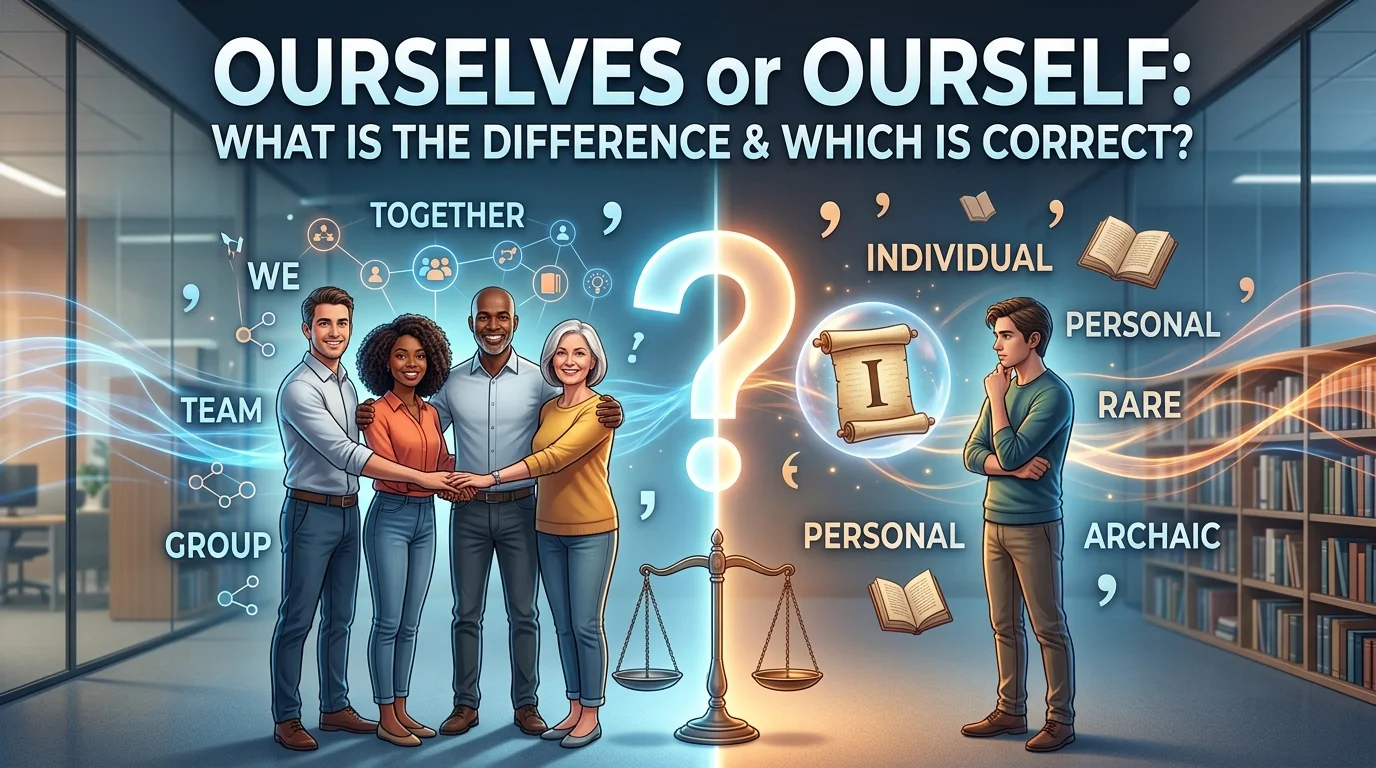
Understanding the difference between “ourselves” and “ourself” is important for clear and correct English usage. These words may look similar, but only one is widely accepted in modern grammar. This article explains their meanings, usage, and key differences in a simple way so learners can confidently choose the right form in speaking and writing.
Comparison Overview
“Ourselves” and “ourself” are reflexive pronouns connected to the word “our.” They are used to refer back to the subject of a sentence. However, they are not equally accepted in standard English. “Ourselves” is the correct and commonly used plural form, while “ourself” is rare and considered nonstandard in most modern grammar rules. Understanding this difference helps avoid common mistakes in everyday communication.
Definition of Ourselves
“Ourselves” is a reflexive pronoun used when the subject is “we” or “us.” It refers back to a group that includes the speaker. It is used when people in a group perform an action on themselves or emphasize their involvement.
In simple terms, “ourselves” means “we ourselves” or “us included as the doers and receivers of an action.”
Definition of Ourself
“Ourself” is a reflexive pronoun historically used when “our” referred to a single person representing a group, such as a royal or formal context. In modern English, it is considered nonstandard and is rarely used outside very specific stylistic or archaic writing.
In simple terms, “ourself” is not commonly accepted in everyday English and is usually replaced by “ourselves.”
Main Differences Between Ourselves and Ourself
The main difference lies in grammar acceptance and usage. “Ourselves” is the standard plural reflexive pronoun used in modern English, while “ourself” is outdated and rarely correct in formal communication.
“Ourselves” is used when referring to a group including the speaker. “Ourself” was traditionally used in singular or formal royal speech but is now mostly obsolete.
In writing, exams, business communication, and daily conversation, “ourselves” is always preferred.
Comparison Table
| Feature | Ourselves | Ourself |
| Grammar status | Standard | Nonstandard |
| Usage | Modern English | Archaic/rare |
| Number | Plural | Historically singular |
| Acceptance | Widely correct | Rare, mostly incorrect |
| Context | Everyday communication | Old literary or royal language |
Grammar Guide
How each term is used in sentences
“Ourselves” is used when the subject is “we.”
Examples:
We taught ourselves how to code.
We enjoyed ourselves at the party.
We built the project ourselves.
“Ourself” appears in older or stylistic writing, often replacing “ourselves,” but it is not recommended in modern grammar.
Common mistakes learners make
Many learners mistakenly use “ourself” instead of “ourselves” in formal writing. Another common error is using “ourselves” with singular subjects like “I” or “he,” which is grammatically incorrect.
Simple rules to remember
If the subject is “we,” always use “ourselves.”
Avoid “ourself” in modern writing.
Use reflexive pronouns only when the action reflects back on the subject.
Quick tips for writing and speaking
In exams and professional writing, always choose “ourselves.”
When unsure, replace “ourself” with “ourselves” for correctness.
Focus on subject-verb agreement to avoid confusion.
When to Use Each One
Use “ourselves” when referring to a group of people including yourself. It is correct in all modern contexts such as writing essays, emails, conversations, and professional communication.
“Ourself” should only be used when analyzing historical texts or poetic language where archaic grammar is intentionally preserved.
When NOT to Use Each One
Do not use “ourselves” with singular subjects like “I” or “he.”
Avoid using “ourself” in academic writing, business communication, or exams.
Do not interchange the two words, as it leads to grammatical errors.
Which One to Use (Decision Guide)
If you are referring to “we,” always choose “ourselves.”
If you see “ourself” in older text, understand it as outdated usage.
For any modern English situation, “ourselves” is the correct and safe choice.
Real-World Practical Examples
Ourselves Examples
We introduced ourselves to the new students.
We should prepare ourselves for the exam.
We found ourselves lost in the city.
We can manage the project ourselves.
We enjoyed ourselves during the holiday trip.
Ourself Examples
The king spoke of ourself in official terms (archaic usage).
In old texts, ourself was sometimes used instead of ourselves.
The author used ourself to reflect historical speech patterns.
Some poetic writings include ourself for stylistic effect.
Ourself appears in older English literature and manuscripts.
Self-Assessment (Fill in the Blanks)
I will use ______ when referring to a group including me.
The correct word is ______ in modern English grammar.
We enjoyed ______ at the celebration.
The correct reflexive pronoun for “we” is ______.
He mistakenly wrote ______ instead of ourselves.
In formal writing, ______ is always preferred.
We taught ______ how to solve the problem.
The archaic form ______ appears in old literature.
We found ______ in a difficult situation.
The teacher asked us to introduce ______.
Modern grammar avoids using ______.
We prepared ______ for the presentation.
The correct plural reflexive form is ______.
Some old texts use ______ instead of ourselves.
We can solve this problem by ______.
The team encouraged ______ to stay motivated.
We should believe in ______.
The outdated form is ______.
We challenged ______ to do better.
In essays, always write ______.
Answers
- ourselves
- ourselves
- ourselves
- ourselves
- ourselves
- ourselves
- ourselves
- ourself
- ourselves
- ourselves
- ourself
- ourselves
- ourselves
- ourself
- ourselves
- ourselves
- ourselves
- ourself
- ourselves
- ourselves
Final Verdict
“Ourselves” is the correct and standard reflexive pronoun used in modern English when referring to a group including the speaker. “Ourself” is largely outdated and not accepted in formal or everyday usage. For clear, correct, and professional communication, “ourselves” should always be your default choice.
Conclusion About Ourselves or Ourself
Understanding the difference between “ourselves” and “ourself” makes English communication clearer and more accurate. While both words may appear similar, only “ourselves” is widely accepted in modern grammar and everyday usage. It helps speakers and writers correctly refer to a group including themselves. On the other hand, “ourself” is mostly outdated and rarely used today. By learning this distinction, you can avoid common mistakes and improve both writing and speaking skills. Choosing the correct reflexive pronoun ensures your sentences sound natural, professional, and grammatically correct in any context.
FAQs
Is “ourselves” always correct in modern English?
Yes, “ourselves” is the standard reflexive pronoun used in modern English whenever the subject is “we.” It is correct in all formal, informal, academic, and professional situations. It refers back to a group including the speaker and is widely accepted in both writing and speech without exceptions.
Is “ourself” considered correct grammar?
“Ourself” is generally considered incorrect in modern English grammar. It appears only in very old or stylistic texts and is not used in standard communication today. In almost all situations, “ourselves” should be used instead to maintain grammatical accuracy and clarity in writing and speaking.
When should I use “ourselves” in a sentence?
You should use “ourselves” when the subject of the sentence is “we” and the action reflects back on the group. For example, when a group does something collectively or emphasizes their own involvement, “ourselves” is the correct reflexive pronoun to use in that context.
Why do people confuse “ourselves” and “ourself”?
People often confuse the two because they look similar and both relate to the word “our.” However, only “ourselves” follows modern grammar rules. “Ourself” is rarely taught in current language education, which leads to confusion among learners and incorrect usage in writing.
Can “ourself” be used in poetry or literature?
Yes, “ourself” may appear in older poetry or historical literature for stylistic or archaic effect. However, it is not recommended for modern writing unless intentionally imitating old English style. In normal communication, it should be avoided in favor of “ourselves.”
What type of pronoun is “ourselves”?
“Ourselves” is a reflexive pronoun. It is used when the subject and object of a sentence refer to the same group of people. It reflects the action back onto the subject, helping clarify that the group is both performing and receiving the action.
Is it wrong to say “we helped ourself”?
Yes, that sentence is incorrect in modern English. The correct form is “we helped ourselves.” Using “ourself” or “ourself” forms in this context is grammatically incorrect. Always use “ourselves” when referring to a group that includes the speaker.
How can I easily remember the correct form?
A simple way to remember is that “we” always pairs with “ourselves.” If the subject is plural and includes you, use “ourselves” automatically. Avoid “ourself” entirely in modern usage. Practicing common sentences helps reinforce this rule over time.
Is “ourselves” used in formal writing?
Yes, “ourselves” is fully acceptable and commonly used in formal writing, including academic essays, business communication, and professional documents. It is grammatically correct and helps maintain clarity and correctness in structured English writing.
What is the biggest mistake learners make with these words?
The most common mistake is using “ourself” instead of “ourselves.” Another frequent error is mixing reflexive pronouns with incorrect subjects. Understanding that “we” always requires “ourselves” helps avoid confusion and ensures grammatically correct sentence construction.

Amelia Wright focuses on making figurative language easy to understand. Her writing explains similes, metaphors, and word meanings using relatable examples. She aims to help readers recognize subtle differences in usage and apply them correctly in both academic and casual writing.