
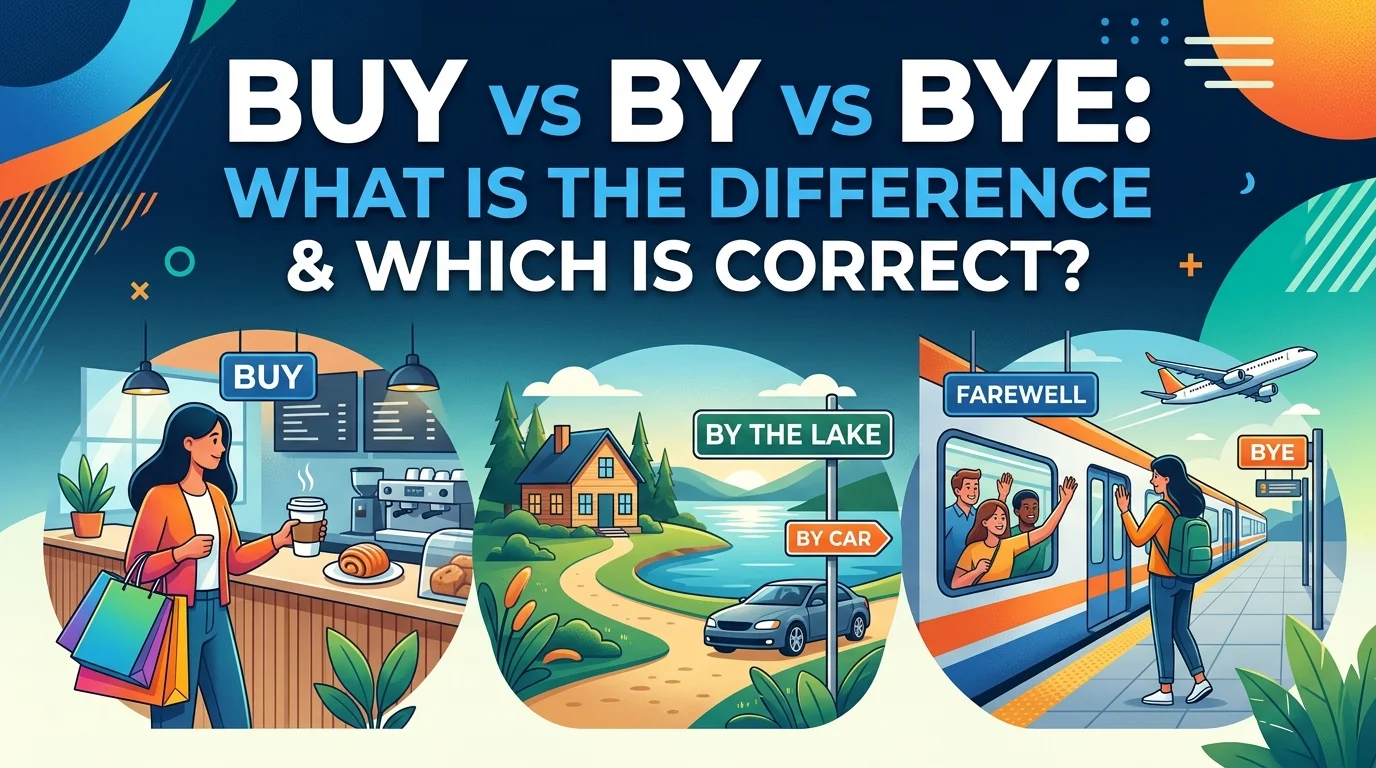
The words buy, by, and bye are among the most commonly confused homophones in English. They sound exactly the same when spoken, but they have completely different meanings, spellings, and grammatical functions. Understanding the difference between these three words is essential for clear writing, accurate communication, and avoiding common grammar mistakes in everyday English.
Comparison Overview
Buy, by, and bye are homophones, meaning they share the same pronunciation but have different meanings and uses.
| Word | Part of Speech | Main Meaning |
| Buy | Verb, Noun | To purchase something |
| By | Preposition, Adverb | Near, through, beside, or indicating an agent |
| Bye | Interjection, Noun | A way of saying goodbye |
Although they sound identical, each word serves a unique purpose in English grammar and communication.
Definition of Buy
Buy is primarily a verb that means to purchase something in exchange for money.
It can also be used as a noun to describe a purchase or a worthwhile deal.
Meaning of Buy
The word “buy” refers to obtaining goods, services, or property by paying for them.
Examples
- I want to buy a new laptop.
- She bought a dress yesterday.
- We buy groceries every weekend.
- This house is a great buy.
- They plan to buy tickets online.
Definition of By
By is usually a preposition that indicates location, method, authorship, or proximity.
It is one of the most frequently used words in English and has many grammatical functions.
Meaning of By
The word “by” can mean:
- Near or beside
- Through a method
- Before a certain time
- Created or performed by someone
Examples
- The school is by the river.
- The book was written by the author.
- Please finish the project by Friday.
- We traveled by train.
- She sat by the window.
Definition of Bye
Bye is an interjection used when saying farewell or ending a conversation.
It can also function as a noun in specific contexts such as sports competitions.
Meaning of Bye
The most common meaning of “bye” is a friendly expression used to say goodbye.
Examples
- Bye! See you tomorrow.
- She waved and said bye.
- The children shouted bye as they left.
- He quickly said bye before hanging up.
- We exchanged our final byes.
Main Differences Between Buy, By, and Bye
The primary difference lies in their meaning and grammatical role.
| Feature | Buy | By | Bye |
| Meaning | Purchase | Near, through, beside | Goodbye |
| Part of Speech | Verb, Noun | Preposition, Adverb | Interjection, Noun |
| Related to Money? | Yes | No | No |
| Related to Location? | No | Yes | No |
| Related to Farewell? | No | No | Yes |
| Example | Buy a book | Sit by me | Say bye |
Key Difference in Context
- Use buy when discussing purchasing.
- Use by when discussing position, method, authorship, or time.
- Use bye when ending a conversation or saying farewell.
Why These Words Are Often Confused
These words are commonly confused because they are pronounced the same way. When speaking, listeners rely on context to understand the intended meaning. In writing, however, choosing the correct spelling is essential because each word communicates a completely different idea.
For example:
- I will buy a car.
- The car is parked by the building.
- Bye, see you later.
Even though they sound identical, replacing one with another creates grammatical errors and confusion.
Comparison Table
| Situation | Correct Word |
| Purchasing a phone | Buy |
| Sitting near someone | By |
| Ending a phone call | Bye |
| Traveling using a bus | By |
| Purchasing groceries | Buy |
| Saying farewell | Bye |
| Written by an author | By |
| Buying a gift | Buy |
Grammar Guide
How Each Term Is Used in Sentences
Buy
Pattern:
- Subject + buy/buys + object
- Subject + bought + object
Examples:
- I buy books regularly.
- She buys fresh vegetables.
- They bought a new house.
By
Pattern:
- By + noun
- By + time
- By + method
Examples:
- Sit by me.
- Finish it by Monday.
- We traveled by plane.
Bye
Pattern:
- Bye!
- Say bye to someone.
Examples:
- Bye, everyone!
- Say bye to your teacher.
- He shouted bye from the doorway.
Common Mistakes Learners Make
- Writing “by” when they mean “buy.”
- Writing “bye” instead of “by.”
- Using “buy” when saying farewell.
- Confusing spoken homophones in written English.
- Forgetting that “by” has many grammatical functions.
Incorrect:
- I need to by a new phone.
- Bye a ticket before entering.
- The book was written buy Shakespeare.
Correct:
- I need to buy a new phone.
- Buy a ticket before entering.
- The book was written by Shakespeare.
Simple Rules to Remember
- Buy = Purchase
- By = Near, through, beside, before
- Bye = Goodbye
A simple memory trick:
- Buy contains “u” because you purchase things for yourself.
- By is the shortest and often shows position or method.
- Bye ends with “e,” just like the end of a conversation.
Quick Tips for Writing and Speaking
- Think about money? Use buy.
- Think about location or method? Use by.
- Think about leaving? Use bye.
- Proofread homophones carefully.
- Check whether the sentence refers to purchasing, position, or farewell.
When to Use Each One
Use Buy When
- Purchasing products
- Acquiring services
- Discussing shopping
- Talking about investments
- Referring to purchases
Examples:
- Buy groceries.
- Buy a car.
- Buy software.
- Buy a ticket.
- Buy insurance.
Use By When
- Referring to location
- Showing transportation methods
- Mentioning authorship
- Indicating deadlines
- Describing means of communication
Examples:
- By the lake.
- By train.
- By email.
- By Friday.
- By the teacher.
Use Bye When
- Ending conversations
- Saying farewell
- Leaving a gathering
- Ending phone calls
- Writing casual goodbyes
Examples:
- Bye for now.
- Bye everyone.
- Bye, see you soon.
- Say bye to grandma.
- Wave bye.
When NOT to Use Each One
Do Not Use Buy
Incorrect:
- Sit buy me.
- Buy everyone!
Correct:
- Sit by me.
- Bye everyone!
Do Not Use By
Incorrect:
- I want to by a bicycle.
- By everyone, see you tomorrow.
Correct:
- I want to buy a bicycle.
- Bye everyone, see you tomorrow.
Do Not Use Bye
Incorrect:
- I need to bye a ticket.
- The house is bye the river.
Correct:
- I need to buy a ticket.
- The house is by the river.
Which One to Use (Decision Guide)
Ask yourself these questions:
Are you talking about purchasing something?
Use buy.
Example:
- I will buy a computer.
Are you talking about location, method, authorship, or time?
Use by.
Example:
- The article was written by a journalist.
Are you saying goodbye?
Use bye.
Example:
- Bye, see you next week.
Real-World Practical Examples
Buy Examples
- I want to buy a textbook for school.
- The company plans to buy new equipment.
- We buy groceries every Saturday.
- She decided to buy a software subscription.
- Scientists buy specialized tools for research.
By Examples
- The student sat by the classroom door.
- The report was prepared by the manager.
- We traveled by airplane.
- Submit your assignment by noon.
- The database was updated by an automated system.
Bye Examples
- Bye, I’ll call you later.
- The children said bye to their friends.
- She waved bye before boarding the train.
- Everyone shouted bye after the meeting.
- He texted a quick bye before leaving.
Self-Assessment (Fill in the Blanks)
- I will use ______ when referring to purchasing a laptop. The correct word is ______ because it means making a purchase.
- I will use ______ when referring to a book written by an author. The correct word is ______ because it shows authorship.
- I will use ______ when ending a phone conversation. The correct word is ______ because it means goodbye.
- I will use ______ when purchasing groceries. The correct word is ______ because money is exchanged.
- I will use ______ when sitting near a window. The correct word is ______ because it indicates location.
- I will use ______ when saying farewell to friends. The correct word is ______ because it expresses goodbye.
- I will use ______ when purchasing a ticket. The correct word is ______ because it means to obtain something through payment.
- I will use ______ when traveling train. The correct word is ______ because it indicates a method of transportation.
- I will use ______ when ending a meeting. The correct word is ______ because it expresses departure.
- I will use ______ when shopping online. The correct word is ______ because it means purchasing.
- I will use ______ when referring to a deadline before Friday. The correct word is ______ because it indicates time.
- I will use ______ when saying goodbye after class. The correct word is ______ because it is a farewell expression.
- I will use ______ when acquiring a new smartphone. The correct word is ______ because it means purchase.
- I will use ______ when describing something beside a river. The correct word is ______ because it shows position.
- I will use ______ when ending a video call. The correct word is ______ because it means goodbye.
- I will use ______ when paying for a course. The correct word is ______ because it refers to purchasing.
- I will use ______ when referring to communication through email. The correct word is ______ because it shows method.
- I will use ______ when leaving a party. The correct word is ______ because it is a farewell.
- I will use ______ when purchasing business software. The correct word is ______ because it means buying.
- I will use ______ when identifying the creator of a painting. The correct word is ______ because it indicates authorship.
Answers
- Buy, Buy
- By, By
- Bye, Bye
- Buy, Buy
- By, By
- Bye, Bye
- Buy, Buy
- By, By
- Bye, Bye
- Buy, Buy
- By, By
- Bye, Bye
- Buy, Buy
- By, By
- Bye, Bye
- Buy, Buy
- By, By
- Bye, Bye
- Buy, Buy
- By, By
Final Verdict
Understanding buy vs by vs bye becomes much easier once you focus on their meanings rather than their pronunciation. Buy relates to purchasing something with money, by is used for location, method, time, or authorship, and bye is used when saying goodbye. Although these three words sound identical, they perform very different grammatical functions. Whenever you’re unsure, ask yourself whether you’re talking about purchasing, positioning, or parting ways. Using this simple approach will help you choose the correct word confidently in writing, speaking, academic work, professional communication, and everyday conversations. Mastering these homophones improves both grammar accuracy and overall English fluency.
Conclusion About Buy vs By vs Bye
Understanding the difference between buy, by, and bye is an important step toward improving your English grammar and writing skills. While these three words sound exactly the same, their meanings are completely different. Buy refers to purchasing something, by is commonly used to show location, method, authorship, or time, and bye is a friendly way to say goodbye. Because they are homophones, they can easily be confused, especially by English learners and even native speakers when writing quickly. The good news is that once you connect each word to its specific meaning, choosing the correct spelling becomes much easier. Whether you are writing emails, completing school assignments, creating business documents, or having everyday conversations, using the right word helps your message stay clear and professional. Remember the simple rule: purchase with buy, position or method with by, and farewell with bye. With practice, you’ll use all three confidently and correctly.
FAQs
What is the main difference between buy, by, and bye?
The main difference is their meaning. Buy means to purchase something, by usually indicates location, method, time, or authorship, and bye is used when saying goodbye. Although they sound the same, they serve completely different purposes in English grammar and communication.
Is buy a verb or a noun?
Buy is primarily a verb that means to purchase something. However, it can also function as a noun when referring to a purchase or a good deal. For example, “That laptop was a great buy” uses the word as a noun.
When should I use by in a sentence?
Use by when referring to location, transportation, deadlines, methods, or authorship. Examples include “sit by the window,” “travel by bus,” “finish by Monday,” and “written by the author.” Context helps determine its exact meaning.
Is bye only used when saying goodbye?
Most commonly, yes. Bye is an informal way to say goodbye when ending a conversation or leaving. It can also appear as a noun, such as in the phrase “final goodbyes,” but its primary purpose is expressing farewell.
Why are buy, by, and bye confusing?
These words are confusing because they are homophones. Homophones have the same pronunciation but different spellings and meanings. When speaking, context clarifies the meaning, but in writing, choosing the correct spelling is essential for accuracy.
Can I use by instead of buy?
No. Although they sound identical, they have different meanings. Buy relates to purchasing something, while by usually indicates location, method, time, or authorship. Replacing one with the other creates grammatical and meaning errors.
How can I remember the difference between buy, by, and bye?
A simple memory trick is to connect each word with its purpose. Buy means purchase, by shows position or method, and bye means goodbye. Thinking about the context of your sentence will usually reveal the correct choice.
Are buy, by, and bye considered homophones?
Yes, they are homophones because they are pronounced the same way but have different spellings and meanings. English contains many similar homophone groups that can cause confusion in writing if learners are not familiar with them.
Which word is correct in the sentence “I need to ___ a new phone”?
The correct word is buy because the sentence refers to purchasing a phone. Neither by nor bye would fit the meaning of the sentence, making buy the only grammatically correct option.
Do native English speakers confuse buy, by, and bye?
Yes, native speakers sometimes make mistakes with these words, especially when typing quickly or not proofreading. Since they sound identical, spelling errors can occur. Careful editing and understanding each word’s meaning help prevent confusion.