
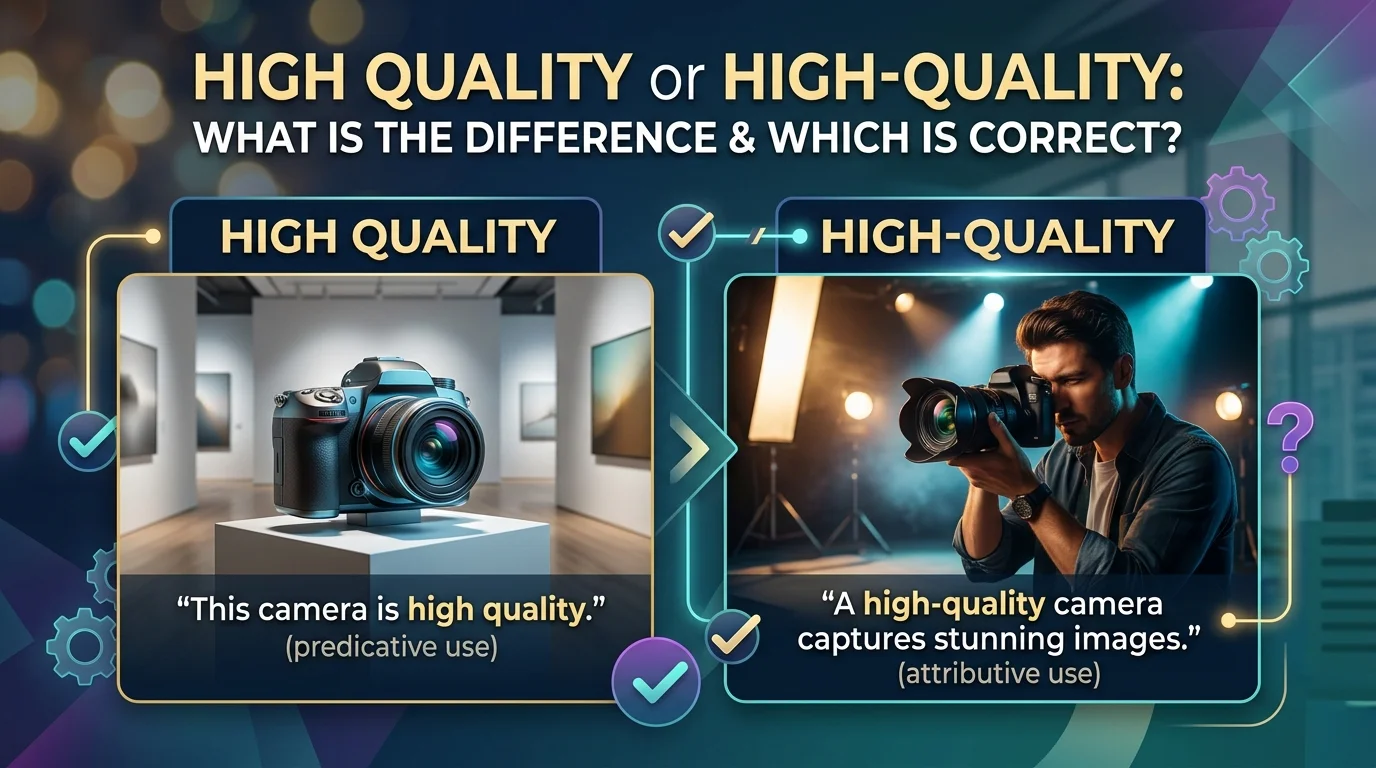
Understanding the difference between “high quality” and “high-quality” is important for writing clear and correct English. Many learners get confused about when to use the spaced form and when to use the hyphenated form. This guide explains both terms in simple language, showing their meanings, grammar rules, and correct usage in everyday writing.
Comparison Overview
“High quality” and “high-quality” are closely related expressions that describe something excellent or superior in standard. The main difference lies in grammar and usage. One works as a noun phrase, while the other functions as a compound adjective before a noun. Understanding this distinction helps you write more naturally and avoid common mistakes in English.
Definition of High Quality
“High quality” is a noun phrase used to describe the standard or level of excellence of something. It often appears after a verb such as “is,” “seems,” or “looks.” It refers to the general idea of excellence rather than directly describing another noun.
Definition of High-Quality
“High-quality” is a hyphenated compound adjective used before a noun. It directly describes something as being excellent or superior. The hyphen connects the words to show they function together as one descriptive unit.
Main Differences Between High Quality and High-Quality
The key difference is grammatical function. “High quality” is usually used after linking verbs and describes a general state or condition. “High-quality” is used before a noun to directly modify it. Both express excellence, but their placement in a sentence determines which form is correct.
| Feature | High Quality | High-Quality |
| Grammar role | Noun phrase | Compound adjective |
| Position in sentence | After verbs | Before nouns |
| Function | Describes level | Describes noun directly |
| Example | The product is of high quality | This is a high-quality product |
Grammar Guide
Understanding grammar rules helps you use both forms correctly in writing and speaking.
How each term is used in sentences
“High quality” is used when describing something in a general sense:
- The fabric is of high quality.
- His work is always high quality.
“High-quality” is used before nouns:
- She bought a high-quality bag.
- They offer high-quality services.
Common mistakes learners make
- Using hyphenated form after verbs (incorrect: The product is high-quality)
- Using spaced form before nouns (incorrect: a high quality product)
- Mixing both forms in the same sentence incorrectly
Simple rules to remember
- Use “high-quality” before a noun.
- Use “high quality” after a verb.
- If you can replace it with “excellent,” choose “high-quality.”
Quick tips for writing and speaking
- Check placement in the sentence first.
- Think: “Is it describing a noun directly?”
- If yes, use hyphen.
- If not, keep it separate.
When to Use Each One
Use “high quality” when talking about the overall standard of something. It is often used in evaluations or descriptions after verbs.
Use “high-quality” when directly describing a noun such as product, service, material, or experience. It is more common in marketing, writing, and product descriptions.
When NOT to Use Each One
Do not use “high quality” before a noun, as it sounds incorrect in formal writing. Similarly, avoid using “high-quality” after verbs where it is not directly modifying a noun. Mixing both forms incorrectly can make sentences unclear or grammatically weak.
Which One to Use (Decision Guide)
If the word comes before a noun, always choose “high-quality.” If it comes after a verb and describes a general idea, choose “high quality.” A quick test is to see whether the word is directly labeling something or describing its overall state.
Real-World Practical Examples
High Quality Examples
- The restaurant is known for its high quality.
- This phone delivers high quality in every aspect.
- We expect high quality from this brand.
- The material is of high quality.
- His painting reflects high quality craftsmanship.
High-Quality Examples
- She bought a high-quality laptop for work.
- They offer high-quality customer service.
- This is a high-quality educational program.
- He wears high-quality leather shoes.
- The company produces high-quality software solutions.
Self-Assessment (Fill in the Blanks)
- I want a ______ product for my business.
- The service provided was of ______.
- She prefers ______ clothing brands.
- This hotel offers ______ accommodation.
- The design shows ______ craftsmanship.
- We are looking for ______ materials.
- The food here is of ______.
- He bought a ______ camera.
- Our company ensures ______ results.
- The chair is made with ______ wood.
- They deliver ______ services to clients.
- The painting reflects ______ standards.
- I always choose ______ electronics.
- The hotel is known for ______ comfort.
- We expect ______ performance from employees.
- The fabric used is of ______.
- She selected a ______ dress for the event.
- This brand guarantees ______ output.
- The team produced ______ work.
- He purchased ______ equipment for the lab.
Answers
- high-quality
- high quality
- high-quality
- high-quality
- high-quality
- high-quality
- high quality
- high-quality
- high-quality
- high-quality
- high-quality
- high-quality
- high-quality
- high-quality
- high-quality
- high quality
- high-quality
- high-quality
- high-quality
- high-quality
Final Verdict
Both “high quality” and “high-quality” are correct, but they are used in different grammatical contexts. “High quality” describes a general standard after verbs, while “high-quality” works as a descriptive adjective before nouns. Knowing this simple distinction helps you write more accurately and professionally in everyday communication, academic writing, and business content.
Conclusion About High Quality or High-Quality
Understanding the difference between “high quality” and “high-quality” makes a noticeable improvement in your writing clarity and grammar accuracy. While both expressions describe excellence, their correct usage depends on sentence structure. “High quality” is used when referring to a general level or standard, usually after verbs, while “high-quality” works as a descriptive adjective placed before nouns. Mastering this small but important distinction helps you sound more natural and professional in both writing and speech. Whether you are writing essays, business content, or everyday messages, using these forms correctly ensures your communication is precise, polished, and easy to understand.
FAQs
Is high quality and high-quality the same?
Both phrases describe excellence, but they are not used in the same way. “High quality” is a noun phrase used after verbs, while “high-quality” is a compound adjective placed before nouns. The meaning is similar, but grammar rules decide which form is correct in a sentence.
When should I use high-quality in a sentence?
Use “high-quality” before a noun to directly describe it. For example, “high-quality product” or “high-quality service.” It works as an adjective that modifies the noun, making the description clear and grammatically correct in formal and informal writing.
Can I say the product is high-quality?
Yes, it is acceptable in modern usage, especially in informal English. However, traditionally “high quality” is preferred after verbs like “is” or “was.” Both forms are understood, but usage may depend on style and context.
Why is high-quality written with a hyphen?
The hyphen connects the words to show they function together as a single adjective. It helps avoid confusion and ensures clarity when describing a noun directly, especially in formal writing and professional communication.
Is high quality grammatically correct?
Yes, “high quality” is grammatically correct when used as a noun phrase. It usually appears after verbs and describes the overall standard of something, such as “The service is of high quality.”
What is the difference in usage between high quality and high-quality?
“High quality” is used after verbs to describe general excellence, while “high-quality” is used before nouns to directly modify them. The difference is mainly grammatical rather than meaning-based, as both express superior standards.
Can I use high-quality in academic writing?
Yes, “high-quality” is commonly used in academic and professional writing when placed before nouns. It is preferred for clarity and precision, especially when describing research, materials, or services.
Is high quality formal or informal?
“High quality” is neutral and can be used in both formal and informal contexts. It is often used in evaluations or descriptions where the focus is on overall standard rather than direct modification of a noun.
Do native speakers always use the hyphen?
Not always. Usage varies depending on style guides and context. However, in formal writing, the hyphenated form “high-quality” is generally preferred when it functions as an adjective before a noun.
Which form is better for writing?
Neither form is better overall; it depends on sentence structure. Use “high-quality” before nouns and “high quality” after verbs. Choosing correctly improves clarity, grammar accuracy, and readability in all types of writing.

Sarah Mitchell is an experienced writer and grammar teacher with over 10 years of expertise in English language education. She helps learners improve their grammar, writing, and communication skills through clear explanations and practical examples. Sarah creates learner-friendly content focused on real-life English, making language learning simple, effective, and confidence-building.