
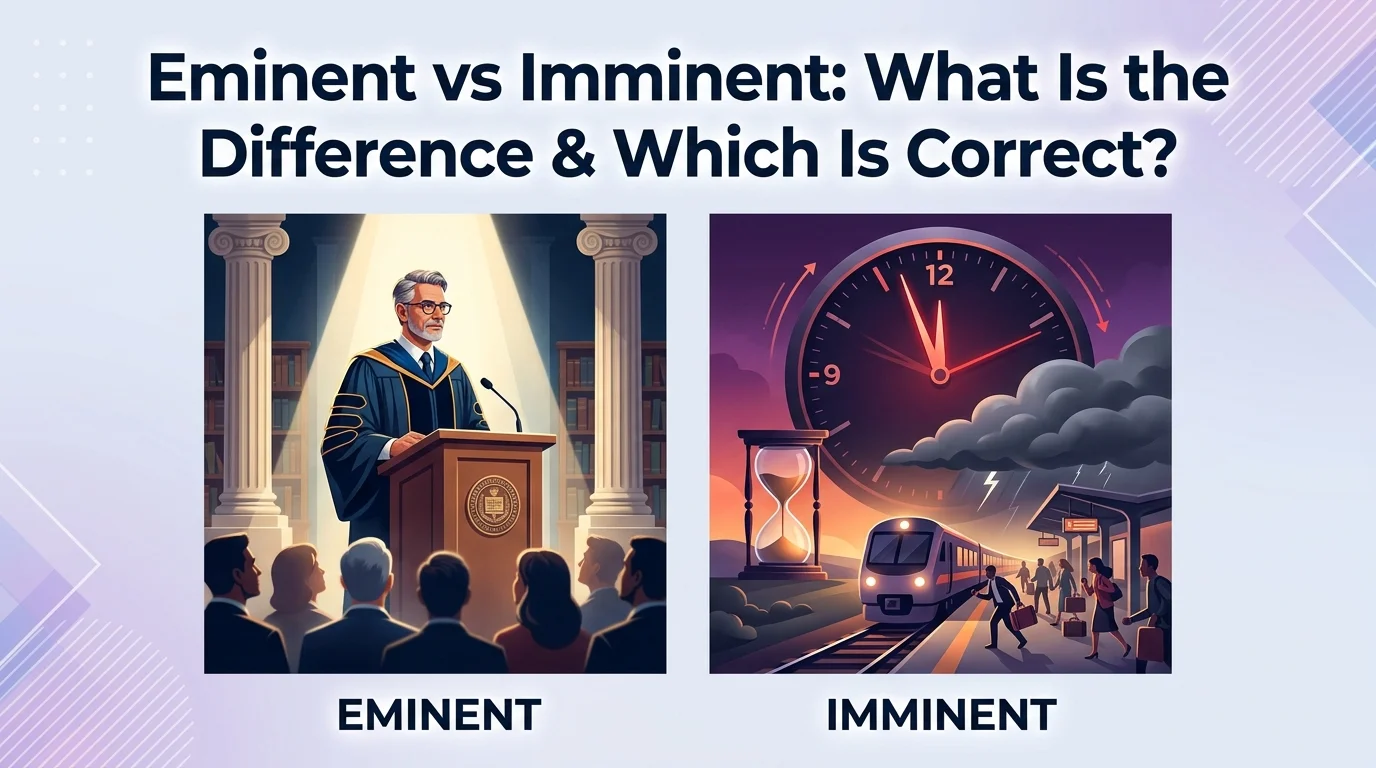
Many English learners confuse eminent and imminent because they sound similar and have nearly identical spellings. However, these two words have completely different meanings and are used in different contexts. Understanding the difference between eminent and imminent will help you write and speak more clearly. It will help you avoid common mistakes and improve your English communication skills.
Comparison Overview
Eminent and imminent are both adjectives, but they describe very different ideas.
| Word | Meaning | Common Context |
| Eminent | Famous, respected, distinguished | People, experts, leaders |
| Imminent | About to happen very soon | Events, situations, actions |
The confusion often occurs because only one letter differs between the two words. However, their meanings are unrelated.
Definition of Eminent
Eminent means highly respected, famous, distinguished, or recognized for excellence in a particular field.
It is usually used to describe people who have achieved a high level of success, authority, or reputation.
Examples
- She is an eminent scientist.
- The university invited an eminent professor.
- An eminent lawyer handled the case.
- The conference featured eminent researchers.
- He became an eminent leader in his industry.
Definition of Imminent
Imminent means something is about to happen very soon or is likely to occur in the near future.
It often refers to upcoming events, dangers, changes, or actions.
Examples
- A storm is imminent.
- The launch is imminent.
- The company announced imminent changes.
- The danger appeared imminent.
- An agreement seemed imminent.
Main Differences Between Eminent and Imminent
| Feature | Eminent | Imminent |
| Meaning | Famous or respected | About to happen soon |
| Part of Speech | Adjective | Adjective |
| Refers To | People or achievements | Events or situations |
| Focus | Reputation and distinction | Timing and expectation |
| Example | An eminent doctor | An imminent storm |
Key Difference
An eminent person is respected and distinguished.
An imminent event is expected to happen very soon.
Example Comparison
- The eminent professor gave a lecture.
- The professor announced an imminent policy change.
In the first sentence, the focus is on the professor’s reputation.
In the second sentence, the focus is on the timing of the change.
Why People Confuse Eminent and Imminent
Several factors contribute to confusion:
- They sound somewhat similar.
- Their spellings differ by only one letter.
- Both are formal English words.
- Both frequently appear in academic and professional writing.
- Learners may focus on pronunciation instead of meaning.
Memory Tricks to Remember the Difference
Remembering Eminent
Think of Eminent = Excellence.
Both begin with the letter E.
If someone is eminent, they are excellent, respected, or distinguished.
Remembering Imminent
Think of Imminent = Immediate.
Both begin with Immi-.
If something is imminent, it is about to happen immediately or very soon.
Comparison Table
| Aspect | Eminent | Imminent |
| Pronunciation | EM-in-ent | IM-in-ent |
| Meaning | Distinguished | Near at hand |
| Describes | People | Events |
| Related Idea | Fame, respect | Soonness, urgency |
| Opposite | Unknown, ordinary | Distant, unlikely |
| Common Use | Eminent scholar | Imminent danger |
Grammar Guide
Both eminent and imminent function primarily as adjectives.
How Each Term Is Used in Sentences
Eminent Pattern
Eminent + Person/Noun
Examples:
- An eminent author visited the school.
- She became an eminent physician.
- The eminent judge delivered a speech.
Imminent Pattern
Imminent + Event/Situation
Examples:
- The threat is imminent.
- An imminent deadline worried the team.
- The arrival was imminent.
Common Mistakes Learners Make
Mistake 1
❌ The eminent storm is approaching.
✅ The imminent storm is approaching.
Storms happen soon; they are not famous.
Mistake 2
❌ She is an imminent scientist.
✅ She is an eminent scientist.
Scientists can be respected and distinguished.
Mistake 3
❌ The eminent danger concerned residents.
✅ The imminent danger concerned residents.
Danger can be near, not famous.
Mistake 4
❌ An imminent professor spoke today.
✅ An eminent professor spoke today.
Professors can be distinguished.
Simple Rules to Remember
- Eminent = respected person.
- Imminent = upcoming event.
- Eminent relates to status.
- Imminent relates to timing.
- Eminent describes distinction.
- Imminent describes nearness.
Quick Tips for Writing and Speaking
- Use eminent when discussing reputation.
- Use imminent when discussing future events.
- Ask yourself whether you are describing a person or an event.
- If it means “highly respected,” choose eminent.
- If it means “about to happen,” choose imminent.
When to Use Each One
Use Eminent When
- Referring to respected professionals.
- Describing famous experts.
- Discussing recognized leaders.
- Writing academic content.
- Talking about distinguished achievements.
Examples:
- An eminent economist.
- An eminent historian.
- An eminent physician.
Use Imminent When
- Discussing approaching events.
- Describing expected changes.
- Referring to immediate threats.
- Talking about upcoming announcements.
- Discussing near-future actions.
Examples:
- Imminent departure.
- Imminent danger.
- Imminent success.
When NOT to Use Each One
Do Not Use Eminent
- For weather events.
- For deadlines.
- For approaching dangers.
- For upcoming meetings.
- For future changes.
Incorrect:
- Eminent rain
- Eminent deadline
- Eminent crisis
Do Not Use Imminent
- For respected people.
- For famous scholars.
- For distinguished leaders.
- For experts.
- For celebrated professionals.
Incorrect:
- Imminent professor
- Imminent doctor
- Imminent scientist
Which One to Use (Decision Guide)
Ask yourself these questions:
Are You Talking About a Person’s Reputation?
Yes → Use Eminent
Example:
- An eminent engineer.
Are You Talking About Something Happening Soon?
Yes → Use Imminent
Example:
- An imminent launch.
Quick Decision Chart
| Situation | Correct Word |
| Famous researcher | Eminent |
| Approaching storm | Imminent |
| Distinguished lawyer | Eminent |
| Upcoming deadline | Imminent |
| Respected professor | Eminent |
| Expected announcement | Imminent |
Real-World Practical Examples
Eminent Examples
- The eminent professor published groundbreaking research.
- An eminent doctor spoke at the medical conference.
- The eminent author released a new book.
- The company hired an eminent business consultant.
- An eminent engineer designed the bridge.
Imminent Examples
- Scientists warned that flooding was imminent.
- The project’s completion is imminent.
- An imminent software update will improve security.
- The team prepared for an imminent product launch.
- The weather forecast predicted imminent rainfall.
Self-Assessment (Fill in the Blanks)
- I will use ______ when referring to a respected scientist.
- The correct word is ______ because the storm is about to arrive.
- I will use ______ when discussing a famous professor.
- The correct word is ______ because the deadline is very close.
- I will use ______ when referring to a distinguished lawyer.
- The correct word is ______ because danger may occur soon.
- I will use ______ when discussing a highly respected author.
- The correct word is ______ because the announcement will happen shortly.
- I will use ______ when referring to a celebrated physician.
- The correct word is ______ because the launch is approaching.
- I will use ______ when discussing a recognized expert.
- The correct word is ______ because the company’s merger is expected soon.
- I will use ______ when referring to an award-winning researcher.
- The correct word is ______ because severe weather is approaching.
- I will use ______ when discussing a distinguished judge.
- The correct word is ______ because a crisis may occur soon.
- I will use ______ when referring to a respected historian.
- The correct word is ______ because the decision will be announced shortly.
- I will use ______ when discussing a notable academic.
- The correct word is ______ because an event is expected very soon.
Answers
- Eminent
- Imminent
- Eminent
- Imminent
- Eminent
- Imminent
- Eminent
- Imminent
- Eminent
- Imminent
- Eminent
- Imminent
- Eminent
- Imminent
- Eminent
- Imminent
- Eminent
- Imminent
- Eminent
- Imminent
Final Verdict
The difference between eminent and imminent is straightforward once you understand their core meanings. Eminent refers to someone who is respected, distinguished, or highly accomplished, while imminent refers to something that is about to happen very soon. Although the words look and sound similar, they belong in completely different contexts. When talking about reputation, expertise, or recognition, choose eminent. When discussing approaching events, deadlines, dangers, or changes, choose imminent. Remember the simple rule: eminent equals excellence and distinction, while imminent equals immediate occurrence. By applying this rule consistently, you can confidently select the correct word in both writing and conversation.
Conclusion About Eminent vs Imminent
Understanding the difference between eminent vs imminent can greatly improve your writing, speaking, and overall confidence in English. Although these two words look and sound similar, they express completely different ideas. Eminent is used to describe someone who is respected, distinguished, or highly accomplished in a particular field, while imminent refers to something that is about to happen very soon. Mixing them up can change the meaning of a sentence and create confusion for readers or listeners.
A simple way to remember the difference is to associate eminent with excellence and reputation, and imminent with immediate or upcoming events. Whether you are writing academic papers, business documents, professional emails, or everyday messages, choosing the correct word helps communicate your meaning clearly. By understanding their definitions, grammar rules, and real-world usage, you can confidently decide when to use eminent and when to use imminent in any situation.
FAQs
What does eminent mean?
Eminent means highly respected, distinguished, or famous because of achievements, knowledge, or professional success. It is most commonly used to describe people who have earned recognition in their field, such as eminent scientists, doctors, professors, authors, or leaders.
What does imminent mean?
Imminent means something is about to happen very soon. It often describes upcoming events, dangers, changes, announcements, or situations that are expected in the near future. The word emphasizes nearness in time rather than importance or reputation.
What is the main difference between eminent and imminent?
The main difference is that eminent refers to a person’s reputation or distinction, while imminent refers to an event or situation that is expected to occur soon. One describes status and achievement, and the other describes timing.
Can eminent and imminent be used interchangeably?
No, eminent and imminent cannot be used interchangeably. Even though they have similar spellings and pronunciations, their meanings are completely different. Using one in place of the other can make a sentence incorrect or confusing.
Is eminent a positive word?
Yes, eminent is generally considered a positive word. It is used to praise or recognize people who are respected, accomplished, knowledgeable, or influential in their profession, community, or area of expertise.
Is imminent always related to danger?
No, imminent is not limited to danger. While it is often used in phrases like imminent threat or imminent risk, it can also describe positive events such as an imminent promotion, launch, celebration, or successful outcome.
How can I remember the difference between eminent and imminent?
A useful memory trick is to connect eminent with excellence and achievement, while imminent can be connected with immediate and upcoming events. This simple association helps distinguish their meanings quickly when writing or speaking.
Can eminent describe things instead of people?
Eminent is primarily used to describe people, but it can occasionally describe achievements, contributions, or qualities associated with respected individuals. However, it is most commonly used for notable experts and distinguished professionals.
Can imminent describe people?
Generally, no. Imminent is usually used for events, actions, situations, or developments that are about to happen. It is not normally used to describe people because it refers to timing rather than personal characteristics.
Why do learners confuse eminent and imminent?
Learners often confuse these words because they are spelled similarly and sound alike when spoken. Since only one letter differs between them, many people mistakenly assume they have related meanings, even though their definitions are entirely different.

Daniel Brooks is an English educator with a passion for explaining similes and word comparisons in plain language. He covers topics like versus meanings, correct usage, and figurative language to help writers avoid common mistakes and improve clarity in everyday writing.