
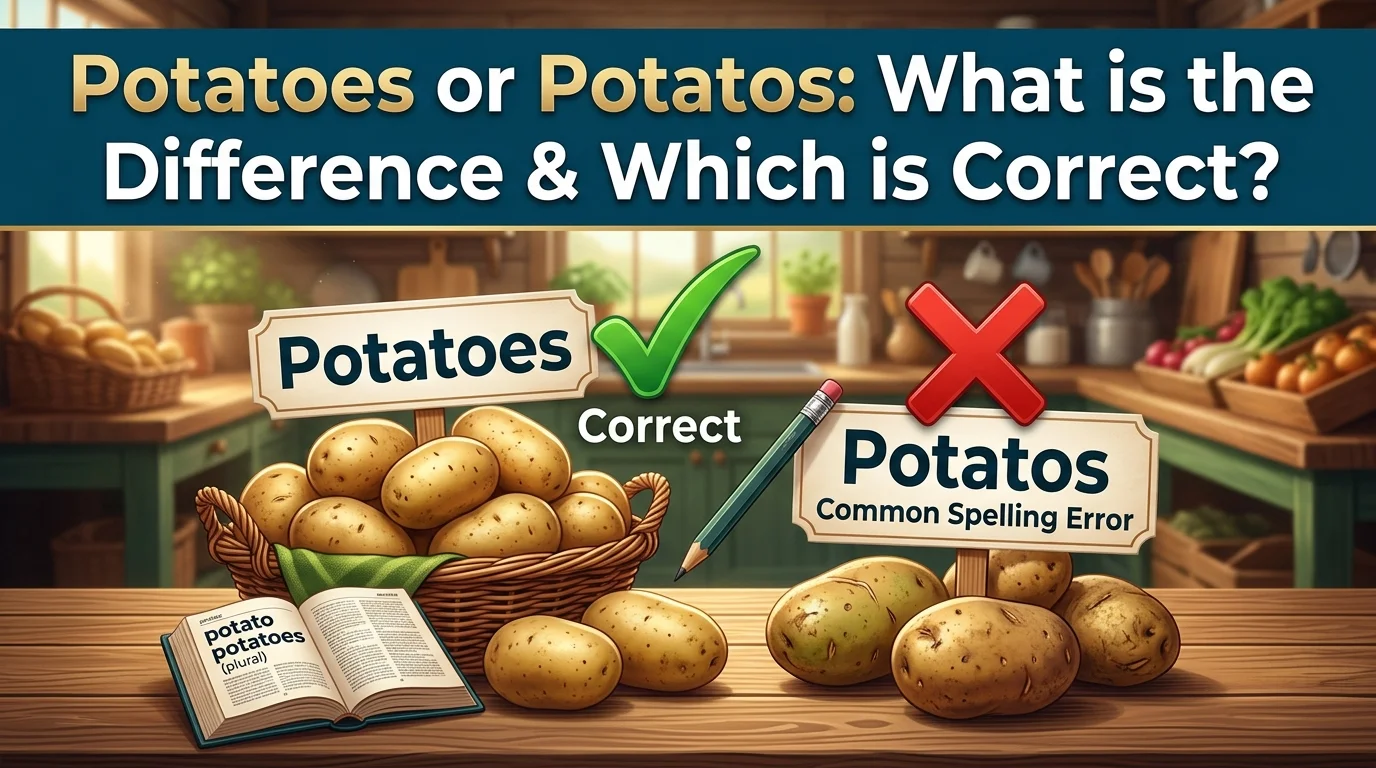
The confusion between “potatoes” and “potatos” is common in writing, especially for learners of English and casual speakers. This comparison clears up the correct spelling, explains why one form is incorrect, and helps you understand how to use the word properly in everyday communication and writing.
Comparison Overview
“Potatoes” and “potatos” look similar, but only one is correct in standard English. The word refers to a widely consumed vegetable used in cooking across the world. The difference between these two forms comes down to spelling rules in English pluralization. Understanding this helps improve writing accuracy and avoids common grammatical mistakes.
Definition of Potatoes
Potatoes is the correct plural form of the word “potato.” It refers to more than one potato, which is a starchy root vegetable commonly used in dishes like fries, chips, curries, and mashed potatoes. The word follows English spelling rules where nouns ending in “-o” often take “-es” in plural form.
Definition of Potatos
Potatos is an incorrect spelling of the word “potatoes.” It is commonly seen in informal writing or among learners who are not familiar with English plural rules. Although it may appear understandable in context, it is not accepted in standard English grammar or formal communication.
Main Differences Between Potatoes and Potatos
The main difference lies in correctness and grammar usage. “Potatoes” is the accepted plural form used in all formal and informal contexts. “Potatos” is a spelling error and should be avoided in writing, exams, business communication, and professional documents.
Another key difference is linguistic structure. English pluralization rules require adding “-es” to certain nouns ending in “o,” which makes “potatoes” grammatically correct. “Potatos” ignores this rule, making it invalid in standard usage.
Comparison Table
| Feature | Potatoes | Potatos |
| Correctness | Correct | Incorrect |
| Grammar usage | Standard plural form | Spelling mistake |
| Acceptance | Formal and informal English | Not accepted |
| Meaning | Multiple potatoes | No valid meaning |
| Usage | Writing, speech, education | Only incorrect usage |
Grammar Guide
The word “potatoes” follows a specific pluralization rule in English grammar. Nouns ending in “-o” often form their plural by adding “-es,” especially when they are commonly used everyday words.
How each term is used in sentences
Correct usage includes sentences like:
- I bought five potatoes from the market.
- Potatoes are rich in carbohydrates.
- She is peeling the potatoes for dinner.
- Mashed potatoes are my favorite dish.
- They grow potatoes on their farm.
Incorrect usage:
- I bought five potatos (wrong spelling).
Common mistakes learners make
Many learners assume that adding just “-s” is enough for all plural forms. This leads to mistakes like “potatos.” Another mistake is relying on pronunciation instead of spelling rules, which causes confusion in writing.
Simple rules to remember
If a word ends in “-o” and is a common English noun, it often becomes plural by adding “-es.” Therefore:
potato becomes potatoes, not potatos.
Quick tips for writing and speaking
Always double-check spelling in formal writing. When in doubt, refer to dictionary usage or think of similar words like “tomato → tomatoes” to remember the correct pattern.
When to Use Each One
Use “potatoes” whenever you are referring to more than one potato in any context, whether speaking, writing, or academic work. Use “potatos” only as an example of incorrect spelling when discussing grammar mistakes or learning English rules.
When NOT to Use Each One
Never use “potatos” in essays, exams, professional emails, recipes, or formal communication. It is always considered incorrect. Avoid relying on phonetic spelling because English often does not follow pronunciation-based rules.
Which One to Use (Decision Guide)
If you are writing or speaking in English and referring to the vegetable in plural form, always choose “potatoes.” If you see “potatos,” treat it as a spelling mistake. A simple decision rule is: if you need correct grammar, use “potatoes” without exception.
Real-World Practical Examples
Potatoes Examples
- I made roasted potatoes for dinner.
- Farmers harvest potatoes in autumn.
- The recipe requires boiled potatoes.
- Potatoes can be stored for months if kept dry.
- She prefers spicy potato curry with fresh potatoes.
Potatos Examples
- This spelling is incorrect: potatos is not accepted in English.
- Students often mistakenly write potatos instead of potatoes.
- The teacher corrected “potatos” in the essay.
- Spellcheck highlights potatos as an error.
- Writing potatos can reduce marks in exams.
Self-Assessment (Fill in the Blanks)
- I cooked fried ______ for breakfast.
- The correct spelling is ______ not potatos.
- Farmers grow ______ in large fields.
- She peeled the ______ before boiling them.
- Writing ______ is considered incorrect.
- ______ are used in many global dishes.
- I made mashed ______ for dinner.
- The word ______ follows a plural rule.
- Students should avoid spelling ______.
- ______ are rich in nutrients.
- The recipe calls for three ______.
- My mother bought fresh ______ from the market.
- The teacher corrected the word ______.
- ______ can be baked or boiled.
- Many learners confuse potatoes with ______.
- He stored the ______ in a cool place.
- The plural form of potato is ______.
- ______ are widely consumed worldwide.
- I saw a bag of ______ in the kitchen.
- Using ______ in writing is a spelling mistake.
Answers
- potatoes
- potatoes
- potatoes
- potatoes
- potatos
- potatoes
- potatoes
- potatoes
- potatos
- potatoes
- potatoes
- potatoes
- potatos
- potatoes
- potatos
- potatoes
- potatoes
- potatoes
- potatoes
- potatos
Final Verdict
The correct and only accepted spelling in English is “potatoes.” The form “potatos” is a common spelling mistake and should be avoided in all formal and informal writing. Understanding this difference helps improve grammar accuracy and writing confidence. Always remember that proper pluralization matters, especially in academic and professional communication, where spelling errors can affect clarity and credibility.
Conclusion About Potatoes or Potatos
In conclusion, understanding the difference between “potatoes” and “potatos” helps improve both writing accuracy and confidence in English. The correct form, “potatoes,” is the only accepted plural spelling and is used in everyday communication, education, recipes, and professional writing. On the other hand, “potatos” is simply a common spelling mistake that appears when learners apply incorrect plural rules. By learning the proper pattern, similar to words like “tomatoes,” you can avoid repeated errors and strengthen your grammar skills. Whether you are writing an essay, cooking instructions, or casual messages, using the correct spelling ensures clarity and credibility. Over time, remembering this small rule becomes easy and natural. With consistent practice and attention to detail, you can eliminate confusion and write more confidently in English across all contexts. Mastering this small difference ultimately makes your writing more polished and professional in any situation you may encounter.
FAQs about Potatoes or Potatos
What is the correct spelling, potatoes or potatos?
The correct spelling is “potatoes.” It follows standard English pluralization rules where nouns ending in “o” often take “-es.” “Potatos” is considered incorrect in formal and informal writing and should always be avoided in academic, professional, and everyday communication.
Why is potatos considered wrong spelling?
“Potatos” is incorrect because it ignores English grammar rules for forming plurals of certain nouns. The proper form adds “-es” to become “potatoes.” Using “potatos” can lead to spelling errors in writing and is not accepted in dictionaries or standard English usage.
Do potatoes follow a plural grammar rule?
Yes, “potatoes” follows a common plural rule in English where nouns ending in “o” take “-es.” This rule applies to several words like “tomatoes” as well. It ensures consistency in spelling and helps maintain correct written communication in English.
Is potatos accepted in any dialect of English?
No, “potatos” is not accepted in any standard English dialect, including British or American English. It is universally considered a spelling mistake. All formal writing systems and educational materials recognize “potatoes” as the correct plural form.
How can I remember the correct spelling easily?
A helpful trick is to remember similar words like “tomatoes” and “potatoes,” both ending in “-es.” Associating these patterns makes it easier to recall the correct spelling and avoid common mistakes when writing in English.
Is potato singular or plural?
“Potato” is the singular form, while “potatoes” is the plural form. One potato refers to a single vegetable, and multiple potatoes refer to more than one. Understanding this distinction helps improve grammar accuracy in both speaking and writing.
Why do some words end with “es” in plural form?
Some English words end with “es” in plural form due to pronunciation and grammar rules. This helps maintain readability and correct sound structure in the language. Words ending in “o,” “s,” or “ch” often follow this pattern.
Can spelling mistakes affect academic performance?
Yes, spelling mistakes like writing “potatos” instead of “potatoes” can affect grades in essays, exams, and assignments. Correct spelling shows strong language skills and attention to detail, which are important in academic and professional settings.
What are common spelling mistakes with vegetable names?
Common mistakes include “potatos” instead of “potatoes” and sometimes “tomatos” instead of “tomatoes.” These errors happen when learners apply incorrect plural rules. Learning proper spelling patterns helps avoid confusion and improves writing quality.
How can I improve English spelling skills?
Improving spelling requires regular reading, writing practice, and memorizing common grammar patterns. Using dictionaries, spellcheck tools, and practicing frequently confused words like “potatoes” helps build long-term accuracy and confidence in English writing.