
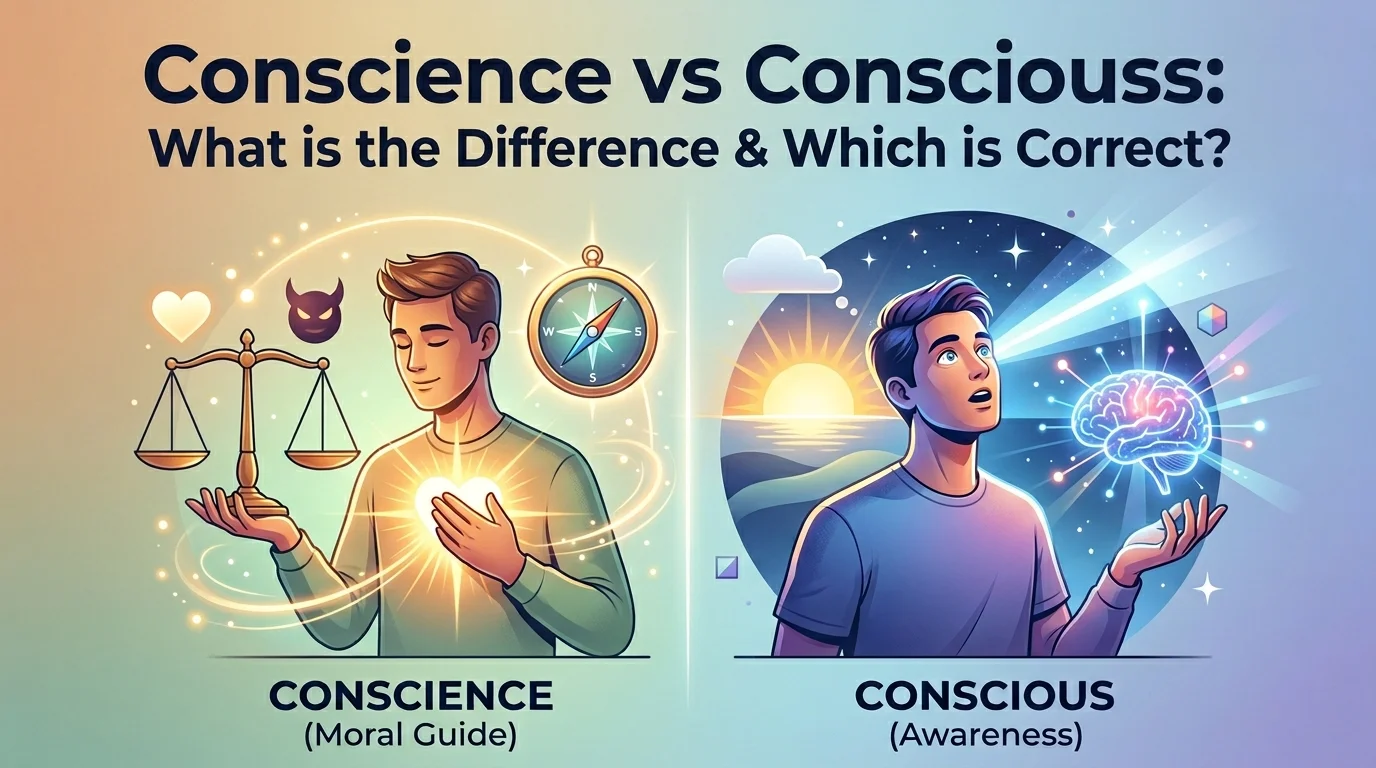
Many English learners confuse conscience and consciouss because they look and sound somewhat similar. However, these words are not interchangeable. In fact, one is a valid English word, while the other is generally considered a spelling mistake. Understanding the difference helps improve grammar, writing accuracy, and communication skills in both academic and everyday situations.
Comparison Overview
The comparison between conscience and consciouss is unique because only one of these terms is recognized as a standard English word.
| Term | Part of Speech | Meaning | Correct English Word? |
| Conscience | Noun | A person’s inner sense of right and wrong | Yes |
| Consciouss | Not a standard word | Usually a misspelling of “conscious” | No |
While conscience refers to morality and ethical judgment, consciouss is not accepted in standard English dictionaries. Most people who write “consciouss” actually mean conscious, which means aware or awake.
Definition of Conscience
Conscience is a noun that refers to a person’s internal moral guide. It helps individuals distinguish between right and wrong and often influences decisions and behavior.
A conscience may make someone feel guilty after doing something wrong or proud after doing something ethical.
Examples
- Her conscience would not allow her to lie.
- He followed his conscience and told the truth.
- A clear conscience brings peace of mind.
- The judge acted according to her conscience.
- My conscience tells me to help others.
Definition of Consciouss
Consciouss is not a standard English word.
In most cases, it appears because someone mistakenly adds an extra “s” to the adjective conscious. The correct word is usually conscious, which means aware, awake, or mindful.
Incorrect Usage
- ❌ I am consciouss of the problem.
- ❌ She became consciouss after the accident.
Correct Usage
- ✔ I am conscious of the problem.
- ✔ She became conscious after the accident.
Therefore, consciouss should generally be avoided in formal and informal writing.
Main Differences Between Conscience and Consciouss
| Feature | Conscience | Consciouss |
| Word Type | Noun | Not a standard word |
| Meaning | Moral sense of right and wrong | Usually a misspelling |
| Dictionary Recognition | Yes | No |
| Usage | Ethical decisions and morality | Incorrect in standard English |
| Example | My conscience is clear. | Incorrect spelling |
Key Difference
A conscience helps you decide whether something is morally right or wrong.
Consciouss is not recognized as a proper English word and should typically be replaced with conscious.
Why People Confuse These Words
The confusion often occurs because:
- Both words begin with “consc”.
- Their pronunciation is somewhat similar.
- Learners may confuse conscience with conscious.
- Typing errors can create the incorrect form “consciouss.”
Remember that conscience relates to morality, while conscious relates to awareness.
Commonly Confused Pair: Conscience vs Conscious
Since many people actually mean conscious when writing consciouss, it helps to understand the distinction.
| Word | Meaning |
| Conscience | Moral judgment |
| Conscious | Aware or awake |
Examples
- My conscience tells me not to cheat.
- I am conscious of my responsibilities.
- Her conscience bothered her.
- He remained conscious throughout the procedure.
Grammar Guide
How each term is used in sentences
Conscience
Pattern:
Subject + conscience + verb
Examples:
- My conscience tells me the truth.
- His conscience troubled him.
- A guilty conscience can be stressful.
Consciouss
This form should not be used.
Incorrect:
- ❌ She is consciouss of the issue.
Correct:
- ✔ She is conscious of the issue.
Common mistakes learners make
- Using “consciouss” instead of “conscious.”
- Confusing conscience with conscious.
- Assuming conscience means awareness.
- Misspelling conscience as conscious.
- Adding unnecessary letters to conscious.
Simple rules to remember
- Conscience = moral compass.
- Conscious = aware or awake.
- Consciouss = incorrect spelling.
- If the sentence involves ethics, use conscience.
- If the sentence involves awareness, use conscious.
Quick tips for writing and speaking
- Think of science inside conscience. A conscience guides behavior.
- Use conscious when discussing awareness.
- Proofread carefully for extra letters.
- Check dictionaries if unsure.
- Avoid using “consciouss” in formal writing.
When to Use Each One
Use Conscience When
- Discussing ethics.
- Talking about guilt.
- Referring to moral choices.
- Describing right and wrong.
- Mentioning personal values.
Examples:
- My conscience is clear.
- She listened to her conscience.
- His conscience prevented him from cheating.
Use Consciouss When
You generally should not use it.
Instead, determine whether you mean:
- Conscience (moral sense)
- Conscious (awareness)
When NOT to Use Each One
Do Not Use Conscience When
- Talking about being awake.
- Discussing awareness.
- Referring to alertness.
Incorrect:
- ❌ I was conscience during surgery.
Correct:
- ✔ I was conscious during surgery.
Do Not Use Consciouss When
- Writing essays.
- Sending business emails.
- Completing academic assignments.
- Publishing articles.
- Writing professional documents.
It is considered a spelling error.
Which One to Use (Decision Guide)
Ask yourself the following questions:
Are you talking about right and wrong?
Use conscience.
Example:
- My conscience told me to apologize.
Are you talking about awareness?
Use conscious instead of “consciouss.”
Example:
- I am conscious of the risks.
Are you writing “consciouss”?
Check your spelling because the word is likely incorrect.
Real-World Practical Examples
Conscience Examples
- Education: The student followed his conscience and reported cheating.
- Daily Life: Her conscience encouraged her to return the lost wallet.
- Business: The manager acted according to his conscience.
- Writing: The character struggled with her conscience.
- Conversation: My conscience won’t let me ignore the problem.
Consciouss Examples
Since this is not a standard word, the examples below demonstrate incorrect usage.
- ❌ I am consciouss of the deadline.
- ❌ She became consciouss after resting.
- ❌ They were consciouss of the danger.
- ❌ He remained consciouss throughout the event.
- ❌ We are consciouss of our responsibilities.
Correct forms:
- ✔ I am conscious of the deadline.
- ✔ She became conscious after resting.
- ✔ They were conscious of the danger.
- ✔ He remained conscious throughout the event.
- ✔ We are conscious of our responsibilities.
Self-Assessment (Fill in the Blanks)
- I will use ______ when referring to moral judgment.
- The correct word is ______ because it means an inner sense of right and wrong.
- I will use ______ when discussing ethical decisions.
- The correct word is ______ because “consciouss” is not a standard word.
- I followed my ______ and told the truth.
- A guilty ______ can make someone feel bad.
- The correct word is ______ because morality is involved.
- My ______ would not let me cheat.
- The correct word is ______ because it is recognized in dictionaries.
- She listened to her ______ before making a decision.
- I will use ______ when talking about ethics.
- The correct word is ______ because it refers to personal values.
- His ______ bothered him after the lie.
- A clear ______ brings peace of mind.
- The correct word is ______ because “consciouss” is incorrect.
- She acted according to her ______.
- My ______ tells me to do the right thing.
- The correct word is ______ because it describes moral guidance.
- The judge relied on her ______.
- A person’s ______ influences ethical behavior.
Answers
- conscience
- conscience
- conscience
- conscience
- conscience
- conscience
- conscience
- conscience
- conscience
- conscience
- conscience
- conscience
- conscience
- conscience
- conscience
- conscience
- conscience
- conscience
- conscience
- conscience
Final Verdict
Conscience and consciouss are not equivalent terms. Conscience is a legitimate English noun that refers to a person’s moral sense of right and wrong. It is commonly used when discussing ethics, guilt, honesty, and personal values. Consciouss, on the other hand, is not recognized as a standard English word and is usually a misspelling of conscious, which means aware or awake. If your sentence relates to morality, choose conscience. If it relates to awareness, use conscious. Avoid using consciouss in any formal or informal writing. Understanding this distinction will help you communicate more clearly, write more accurately, and avoid one of the most common spelling and vocabulary mistakes in English.
Conclusion About Conscience vs Consciouss
Understanding the difference between conscience and consciouss can help you avoid a common English language mistake. The word conscience refers to your inner sense of right and wrong, making it an important term when discussing ethics, morality, honesty, and personal values. In contrast, consciouss is not considered a standard English word and is usually the result of a spelling error. In most situations, writers who use “consciouss” actually mean conscious, which relates to awareness or being awake. By remembering this distinction, you can improve both your writing accuracy and communication skills. Whether you are writing an essay, sending a professional email, or having an everyday conversation, choosing the correct word helps your message remain clear and effective. When morality is involved, use conscience. If awareness is the intended meaning, use conscious instead of the incorrect form consciouss.
FAQs
What does conscience mean?
Conscience is a noun that refers to a person’s inner moral sense of right and wrong. It helps guide decisions, behavior, and ethical choices. People often mention their conscience when discussing honesty, guilt, responsibility, or moral judgment.
Is consciouss a real word?
No, consciouss is not recognized as a standard English word. It is usually a misspelling of the adjective conscious. In formal and informal writing, you should avoid using consciouss and replace it with the correct word when appropriate.
What is the difference between conscience and conscious?
Conscience relates to morality and ethical decision making, while conscious means aware, awake, or mindful of something. Although the words look similar, they have completely different meanings and are used in different contexts.
Why do people confuse conscience and consciouss?
People often confuse these words because they share similar spelling patterns and pronunciation. In many cases, writers accidentally add an extra letter to conscious, creating the incorrect form consciouss. Careful proofreading can help prevent this mistake.
Can conscience be used as a verb?
No, conscience is primarily used as a noun in modern English. It represents a person’s moral awareness or ethical judgment. Other sentence structures may use related words, but conscience itself is generally not used as a verb.
How can I remember the meaning of conscience?
A simple way to remember conscience is to associate it with moral decisions and doing what is right. Whenever a sentence involves guilt, honesty, ethics, or responsibility, conscience is usually the correct word to choose.
Is conscience positive or negative?
Conscience can be associated with both positive and negative feelings. A clear conscience often brings peace and confidence, while a guilty conscience may create regret or discomfort after someone believes they have done something wrong.
Should I ever use the word consciouss in writing?
No. Since consciouss is not a standard English word, it should generally not appear in academic, professional, or casual writing. Review your sentence and determine whether you mean conscience or conscious instead.
What are common examples of conscience in sentences?
Examples include: “My conscience told me to tell the truth,” “She followed her conscience and helped the stranger,” and “A guilty conscience kept him awake all night.” Each example relates to moral judgment or ethical behavior.
Why is learning this difference important?
Knowing the difference helps improve grammar, spelling, and communication. Using conscience correctly shows an understanding of English vocabulary, while avoiding the incorrect form consciouss makes your writing appear more accurate and professional.

Sophia Turner is a grammar-focused writer who covers similes, word-versus-word meanings, and correct English usage. Her content is designed for learners who want quick answers, logical explanations, and practical guidance for improving writing accuracy and style.