
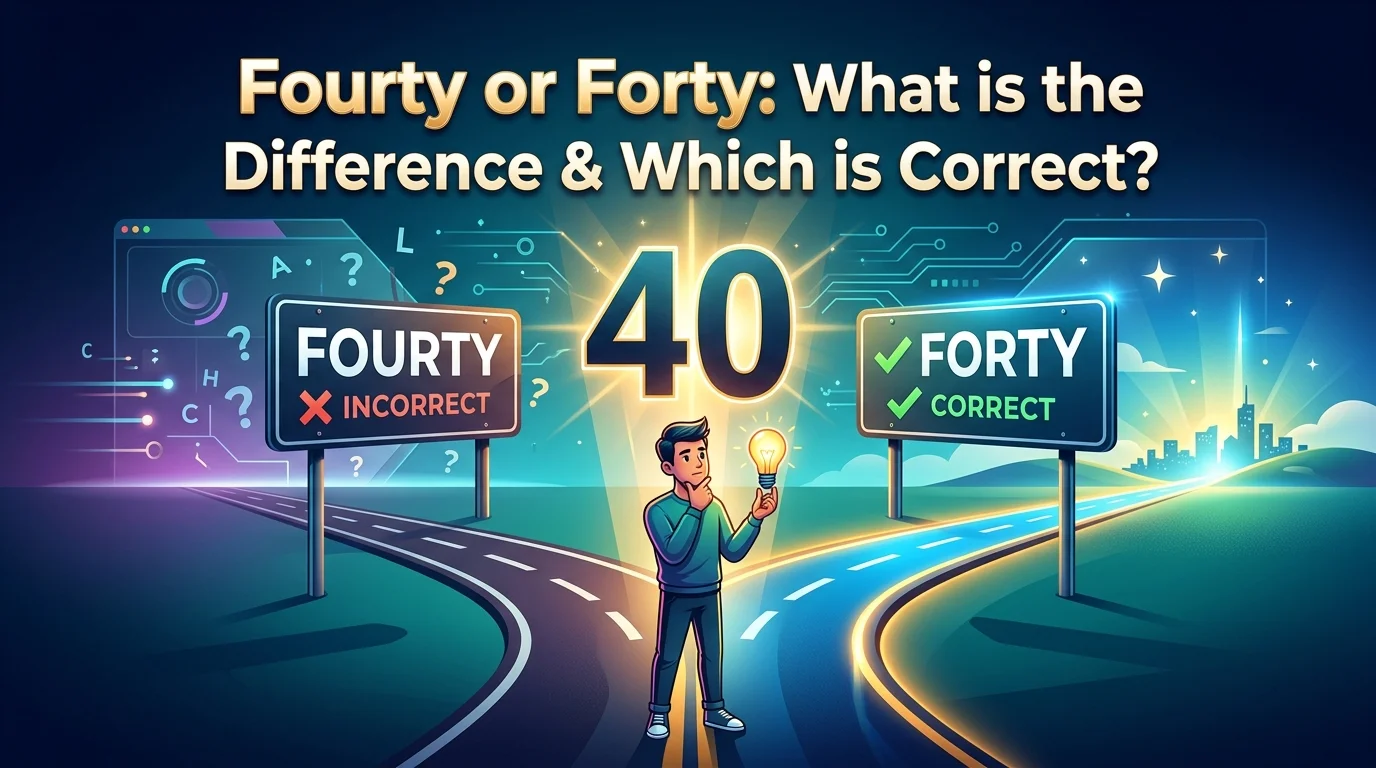
The confusion between “Fourty” and “Forty” is common in English writing, especially among learners. Both look similar, but only one is correct in standard English. Understanding the difference helps improve spelling accuracy, writing confidence, and grammar skills. This guide explains their meanings, usage, and how to avoid one of the most frequent number spelling mistakes.
Comparison Overview
“Fourty” and “Forty” are often compared because they represent the same number when spoken, but only one is accepted in correct English spelling. The difference comes from historical language evolution and standardization in modern English. While “Fourty” appears in informal mistakes, “Forty” is the correct and widely accepted form used in education, business, and formal communication.
Definition of Fourty
“Fourty” is an incorrect spelling of the number 40. It is commonly seen in informal writing errors, beginner spelling mistakes, or autocorrect issues. Although it reflects how the word sounds when spoken, it does not follow standard English spelling rules and is not accepted in dictionaries or formal usage.
Definition of Forty
“Forty” is the correct spelling of the number 40 in English. It is used in all formal writing, academic contexts, financial documents, and everyday communication. The spelling follows standard English conventions where the vowel “u” is omitted, making it consistent with related number words like “four” and “fourth.”
Main Differences Between Fourty and Forty
The main difference lies in correctness and acceptance in English usage. “Forty” is the standard spelling, while “Fourty” is a common misspelling. The correct form is used in education, professional writing, and official documents, whereas the incorrect form is generally considered a spelling error.
| Aspect | Fourty | Forty |
| Correctness | Incorrect spelling | Correct spelling |
| Dictionary status | Not accepted | Officially accepted |
| Usage | Common mistake | Standard usage |
| Context | Informal errors | Formal and informal writing |
| Origin | Based on pronunciation error | Standard English evolution |
Grammar Guide
How each term is used in sentences
“Forty” is used as a number adjective or noun depending on context, while “Fourty” should not be used in correct grammar.
Examples:
- I have forty students in my class.
- The temperature is forty degrees today.
- She waited forty minutes for the bus.
Common mistakes learners make
Many learners add “u” in “forty” because of the word “four.” This phonetic confusion leads to the incorrect spelling “fourty.” Another common mistake is using autocorrect suggestions without verification.
Simple rules to remember
- Always remove “u” when writing 40.
- Think: four becomes forty, not fourty.
- Memorize that only “forty” is valid in English.
Quick tips for writing and speaking
- Link “forty” with “fourteen minus teen confusion rule.”
- Practice writing numbers 30, 40, 50 together to reinforce spelling.
- Use spelling check tools but also memorize the correct form.
When to Use Each One
“Forty” should be used in all contexts including academic writing, professional communication, and casual speech. “Fourty” should not be used in any formal or correct writing, as it is considered a spelling error.
When NOT to Use Each One
Do not use “fourty” in essays, exams, official documents, emails, or published content. It should also be avoided in digital communication when accuracy matters. Only “forty” is appropriate in all standard English contexts.
Which One to Use (Decision Guide)
If you are writing the number 40 in English, always choose “forty.” If you are unsure, remember that dictionaries and grammar standards do not recognize “fourty.” The safest and correct choice in every situation is “forty.”
Real-World Practical Examples
Fourty Examples
- I have fourty apples in the basket.
- She is fourty years old today.
- The room holds fourty people.
- He ran fourty kilometers yesterday.
- The book costs fourty dollars.
Forty Examples
- I have forty apples in the basket.
- She is forty years old today.
- The room holds forty people.
- He ran forty kilometers yesterday.
- The book costs forty dollars.
- There are forty students in the class.
- The meeting lasted forty minutes.
- The package weighs forty kilograms.
- The building has forty floors.
- We traveled forty miles to reach the city.
Self-Assessment (Fill in the Blanks)
- I have ______ students in my class.
- She is ______ years old.
- The train arrived after ______ minutes.
- He ran ______ kilometers today.
- The box weighs ______ kilograms.
- There are ______ people in the hall.
- The book costs ______ dollars.
- We walked ______ miles.
- The tower has ______ floors.
- The meeting lasted ______ minutes.
- I bought ______ oranges.
- The journey took ______ hours.
- There were ______ chairs in the room.
- The shop sold ______ items.
- The class has ______ students.
- He earned ______ dollars.
- The trip covered ______ kilometers.
- She waited ______ minutes.
- The bag contains ______ books.
- The event had ______ guests.
Answers
- forty
- forty
- forty
- forty
- forty
- forty
- forty
- forty
- forty
- forty
- forty
- forty
- forty
- forty
- forty
- forty
- forty
- forty
- forty
- forty
Final Verdict
The correct and only accepted spelling is “forty.” “Fourty” is a common but incorrect variation that should be avoided in all forms of writing. Mastering this simple spelling helps improve accuracy and builds stronger English writing skills.
Conclusion About Fourty or Forty
The difference between “Fourty” and “Forty” may seem small, but it plays a big role in correct English writing. “Forty” is the only accepted spelling, while “Fourty” is a frequent mistake caused by pronunciation confusion. Once you remember that the “u” disappears in this number, spelling becomes much easier. Using the correct form improves clarity, professionalism, and overall writing accuracy in school, work, and daily communication. Whether you are writing numbers in words or improving grammar skills, choosing “forty” ensures your English stays correct and credible.
FAQs
Is Fourty a correct spelling of 40?
“Fourty” is not correct in standard English. It is a common spelling mistake influenced by pronunciation, but dictionaries and grammar rules recognize only “forty” as the correct form.
Why is Forty spelled without a u?
The spelling “forty” evolved from historical English usage where the vowel “u” was dropped for consistency. This makes it different from “four,” even though they sound related.
What is the correct way to write 40 in words?
The correct way to write the number 40 in English is “forty.” It is used in academic writing, business communication, and everyday speech.
Why do people write Fourty by mistake?
Many people write “fourty” because they associate it with the word “four.” The pronunciation also leads to confusion, but it is not grammatically correct.
Is Forty used in formal writing?
Yes, “forty” is used in all formal writing, including exams, reports, financial documents, and professional communication. It is the standard accepted spelling.
Does Fourty appear in any dictionary?
No, “fourty” does not appear in standard English dictionaries as a correct word. It is only listed as a common misspelling of “forty.”
How can I remember the correct spelling of Forty?
A simple trick is to remember that “four” loses the “u” when forming “forty.” Repetition and practice help reinforce the correct spelling.
Is Forty used differently in British and American English?
No, both British and American English use “forty” as the correct spelling. There is no variation between them for this number.
Can Fourty be used in informal writing?
Even in informal writing, “fourty” is considered incorrect. It is always better to use “forty” to maintain proper spelling and clarity.
What is the easiest way to avoid spelling Forty wrong?
The easiest way is to memorize it as an exception. Unlike “four,” the number 40 always drops the “u,” so practicing the correct form helps avoid mistakes.

Sophia Turner is a grammar-focused writer who covers similes, word-versus-word meanings, and correct English usage. Her content is designed for learners who want quick answers, logical explanations, and practical guidance for improving writing accuracy and style.