
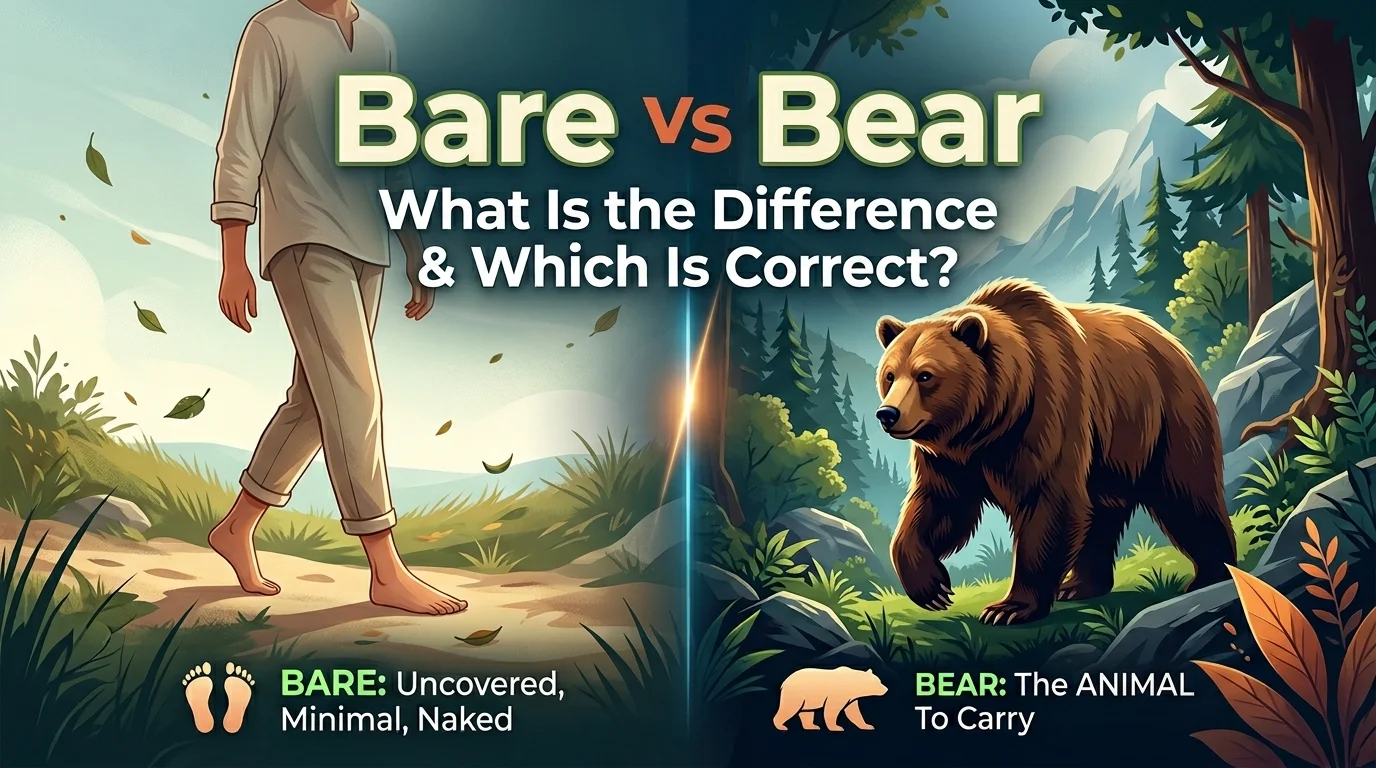
The words bare and bear are among the most commonly confused words in English because they sound exactly the same but have completely different meanings. Understanding the difference between these two words is important for accurate writing, speaking, and communication. Whether you are a student, writer, professional, or English learner, knowing when to use bare and when to use bear will help you avoid common mistakes and improve your language skills.
Comparison Overview
Bare and bear are homophones, meaning they are pronounced the same way but have different meanings and spellings.
Bare generally relates to being uncovered, exposed, empty, or plain.
Bear usually refers to carrying, enduring, supporting, producing, or the large furry animal known as a bear.
Because they sound identical, many writers accidentally choose the wrong word. Learning their meanings and uses makes it much easier to select the correct term.
| Feature | Bare | Bear |
| Part of Speech | Adjective, Verb | Noun, Verb |
| Main Meaning | Uncovered or exposed | Carry, endure, support, or animal |
| Example | Bare feet | Bear the weight |
| Common Context | Clothing, appearance, exposure | Responsibility, emotions, animals |
| Pronunciation | Bair | Bair |
Definition of Bare
Bare means uncovered, exposed, empty, simple, or lacking something.
It is often used when describing something without covering, protection, decoration, or extra features.
Examples:
- Bare feet
- Bare walls
- Bare hands
- Bare minimum
- Bare ground
As a verb, bare means to reveal or uncover something.
Example:
- He decided to bare his feelings.
Definition of Bear
Bear can be a noun or a verb.
As a noun, it refers to the large wild mammal.
Examples:
- Polar bear
- Brown bear
- Black bear
As a verb, bear means to carry, support, endure, tolerate, accept, or produce.
Examples:
- Bear responsibility.
- Bear the burden.
- Bear a child.
- Bear the cost.
Main Differences Between Bare and Bear
The primary difference is that bare relates to exposure or uncovering, while bear relates to carrying, enduring, supporting, producing, or the animal.
| Aspect | Bare | Bear |
| Meaning | Uncovered or exposed | Carry, support, endure |
| Usage | Appearance and exposure | Responsibility and action |
| Verb Meaning | Reveal or uncover | Carry or tolerate |
| Noun Meaning | Not commonly used | Large animal |
| Example | Bare skin | Bear the pain |
Meaning Difference
- Bare = exposed
- Bear = carry or endure
Function Difference
- Bare describes a condition.
- Bear usually describes an action.
Context Difference
- Bare is common in physical descriptions.
- Bear is common in responsibilities, emotions, and nature.
Common Expressions Using Bare and Bear
Expressions with Bare
- Bare minimum
- Bare necessities
- Bare hands
- Bare feet
- Bare essentials
Expressions with Bear
- Bear in mind
- Bear responsibility
- Bear the cost
- Bear the burden
- Bear with me
Bare vs Bear in Everyday English
Many English learners struggle because both words sound identical.
Consider these examples:
- She walked across the beach with bare feet.
- She could not bear the pain.
The first sentence talks about uncovered feet.
The second sentence talks about enduring pain.
Grammar Guide
How Each Term Is Used in Sentences
Bare as an Adjective
Pattern:
Subject + be + bare
Examples:
- The walls are bare.
- His feet were bare.
- The room looked bare.
Bare as a Verb
Pattern:
Subject + bare + object
Examples:
- She bared her teeth.
- He bared his emotions.
- The dog bared its fangs.
Bear as a Verb
Pattern:
Subject + bear + object
Examples:
- I cannot bear the noise.
- She bears responsibility.
- They bear the expenses.
Bear as a Noun
Pattern:
Article + bear
Examples:
- A bear crossed the road.
- The bear lives in the forest.
Common Mistakes Learners Make
Mistake 1
❌ I can’t bare this pain.
✅ I can’t bear this pain.
Mistake 2
❌ He walked with bear feet.
✅ He walked with bare feet.
Mistake 3
❌ Please bare with me.
✅ Please bear with me.
Mistake 4
❌ The room was bear.
✅ The room was bare.
Simple Rules to Remember
- Bare = exposed or uncovered.
- Bear = carry or endure.
- Bare feet = uncovered feet.
- Bear with me = be patient with me.
- A bear is also an animal.
Quick Tips for Writing and Speaking
- Think of bare skin when you see “bare.”
- Think of bearing a load when you see “bear.”
- Remember that animals are always spelled bear.
- If patience or endurance is involved, choose bear.
- If exposure is involved, choose bare.
When to Use Each One
Use Bare When
- Something is uncovered.
- Something is empty.
- Something lacks decoration.
- You mean reveal or uncover.
- You describe physical exposure.
Examples:
- Bare feet
- Bare walls
- Bare hands
- Bare ground
- Bare facts
Use Bear When
- Carrying something.
- Enduring something.
- Supporting responsibility.
- Producing offspring.
- Referring to the animal.
Examples:
- Bear a burden.
- Bear the cost.
- Bear the pressure.
- Bear children.
- A grizzly bear.
When NOT to Use Each One
Do Not Use Bare When
- Talking about tolerance.
- Discussing responsibility.
- Referring to animals.
- Mentioning patience.
- Talking about carrying something.
Incorrect:
- Bare with me.
- Bare the burden.
Correct:
- Bear with me.
- Bear the burden.
Do Not Use Bear When
- Describing uncovered body parts.
- Discussing exposure.
- Referring to emptiness.
- Talking about revealing something.
Incorrect:
- Bear feet.
- Bear walls.
Correct:
- Bare feet.
- Bare walls.
Which One to Use (Decision Guide)
Ask yourself the following questions:
Is something uncovered or exposed?
Use bare.
Example:
- Bare shoulders.
Is someone carrying, enduring, or tolerating something?
Use bear.
Example:
- Bear the responsibility.
Are you talking about the animal?
Use bear.
Example:
- A polar bear.
Are you talking about revealing something?
Use bare.
Example:
- Bare your soul.
Real-World Practical Examples
Bare Examples
- The children ran across the grass with bare feet.
- The apartment had bare walls after moving day.
- Scientists examined the bare rock surface.
- The writer shared the bare facts in the article.
- He carried the hot pan with his bare hands.
Bear Examples
- Students must bear responsibility for their assignments.
- The company will bear the repair costs.
- The bridge can bear heavy traffic.
- I cannot bear loud noises during work.
- A bear was spotted near the national park.
Self-Assessment (Fill in the Blanks)
- I will use ______ when referring to uncovered feet.
- The correct word is ______ because it means tolerate.
- I walked on the beach with ______ feet.
- She could not ______ the stress.
- The walls were completely ______.
- The company will ______ the expenses.
- The dog began to ______ its teeth.
- I cannot ______ the loud music.
- The room looked ______ after renovation.
- Please ______ with me for a moment.
- The hikers saw a ______ in the forest.
- The athlete trained with ______ hands.
- We must ______ responsibility for our actions.
- The report contains only the ______ facts.
- The bridge can ______ a heavy load.
- The child had ______ knees after falling.
- I cannot ______ such behavior.
- The lawyer chose to ______ the truth.
- The tree can no longer ______ fruit.
- The floor was completely ______.
Answers
- Bare
- Bear
- Bare
- Bear
- Bare
- Bear
- Bare
- Bear
- Bare
- Bear
- Bear
- Bare
- Bear
- Bare
- Bear
- Bare
- Bear
- Bare
- Bear
- Bare
Final Verdict
The difference between bare and bear is straightforward once you understand their meanings. Bare refers to something uncovered, exposed, empty, or revealed, while bear refers to carrying, supporting, enduring, producing, or the large animal known as a bear. Although the two words sound identical, their meanings are completely different. When you think about exposure, use bare. When you think about carrying, tolerating, responsibility, or animals, use bear. By remembering these simple distinctions and practicing with real examples, you can confidently choose the correct word every time and avoid one of the most common homophone mistakes in English.
Conclusion About Bare vs Bear
Understanding the difference between bare vs bear is essential for clear and accurate communication. Although these two words sound exactly alike, their meanings are completely different. Bare is used when talking about something uncovered, exposed, empty, or revealed, while bear refers to carrying, supporting, enduring, producing, or the well-known animal. Because they are homophones, many writers and English learners accidentally confuse them, especially in common phrases like “bear with me” or “bare feet.”
The easiest way to remember the distinction is to think about the context. If something is uncovered or exposed, choose bare. If someone is carrying a responsibility, tolerating a situation, or referring to the animal, choose bear. By learning these simple rules and practicing with examples, you can confidently use both words correctly in everyday writing, conversations, academic work, and professional communication.
FAQs
What is the main difference between bare and bear?
The main difference is meaning. Bare refers to something uncovered, exposed, empty, or revealed. Bear means to carry, support, endure, tolerate, produce, or refers to the large mammal. Even though they sound the same, they are used in completely different contexts and should not be interchanged.
Is bare a noun or a verb?
Bare is most commonly used as an adjective describing something exposed or uncovered. It can also function as a verb meaning to reveal or uncover something. For example, “bare feet” uses it as an adjective, while “bare your feelings” uses it as a verb.
Is bear a noun or a verb?
Bear can be both a noun and a verb. As a noun, it refers to the animal. As a verb, it means to carry, endure, support, accept, or produce. The intended meaning depends on the context of the sentence.
Why do people confuse bare and bear?
People confuse bare and bear because they are homophones, meaning they have the same pronunciation but different spellings and meanings. Since they sound identical when spoken, writers often choose the wrong spelling if they are unfamiliar with the correct usage.
Is “bear with me” correct?
Yes, “bear with me” is correct. The phrase means “be patient with me” or “tolerate a delay.” Since the meaning involves enduring or tolerating something, the correct word is bear, not bare.
Is “bare feet” correct?
Yes, “bare feet” is correct because the feet are uncovered and not wearing shoes or socks. Since the meaning relates to exposure or being uncovered, bare is the proper word to use.
Can bare mean reveal?
Yes, bare can mean to reveal, expose, or uncover something. For example, a person may “bare their soul” by openly sharing personal thoughts or emotions. In this usage, bare functions as a verb rather than an adjective.
Can bear mean tolerate?
Yes, one of the most common meanings of bear as a verb is to tolerate or endure something. For example, “I cannot bear the noise” means that the noise is difficult to tolerate or endure.
Which word is used when talking about responsibility?
When discussing responsibility, the correct word is bear. Common examples include “bear responsibility,” “bear the cost,” and “bear the burden.” In each case, the word expresses carrying or accepting something.
How can I easily remember bare vs bear?
A simple memory trick is to connect bare with exposure and bear with carrying or enduring. If something is uncovered, use bare. If someone is supporting, tolerating, or carrying something, use bear. Remember that the animal is always spelled bear.

Ethan Clarke is a language writer who specializes in breaking down similes, word meanings, and commonly confused terms. His work focuses on clear explanations, practical examples, and simple comparisons that help readers understand how English