
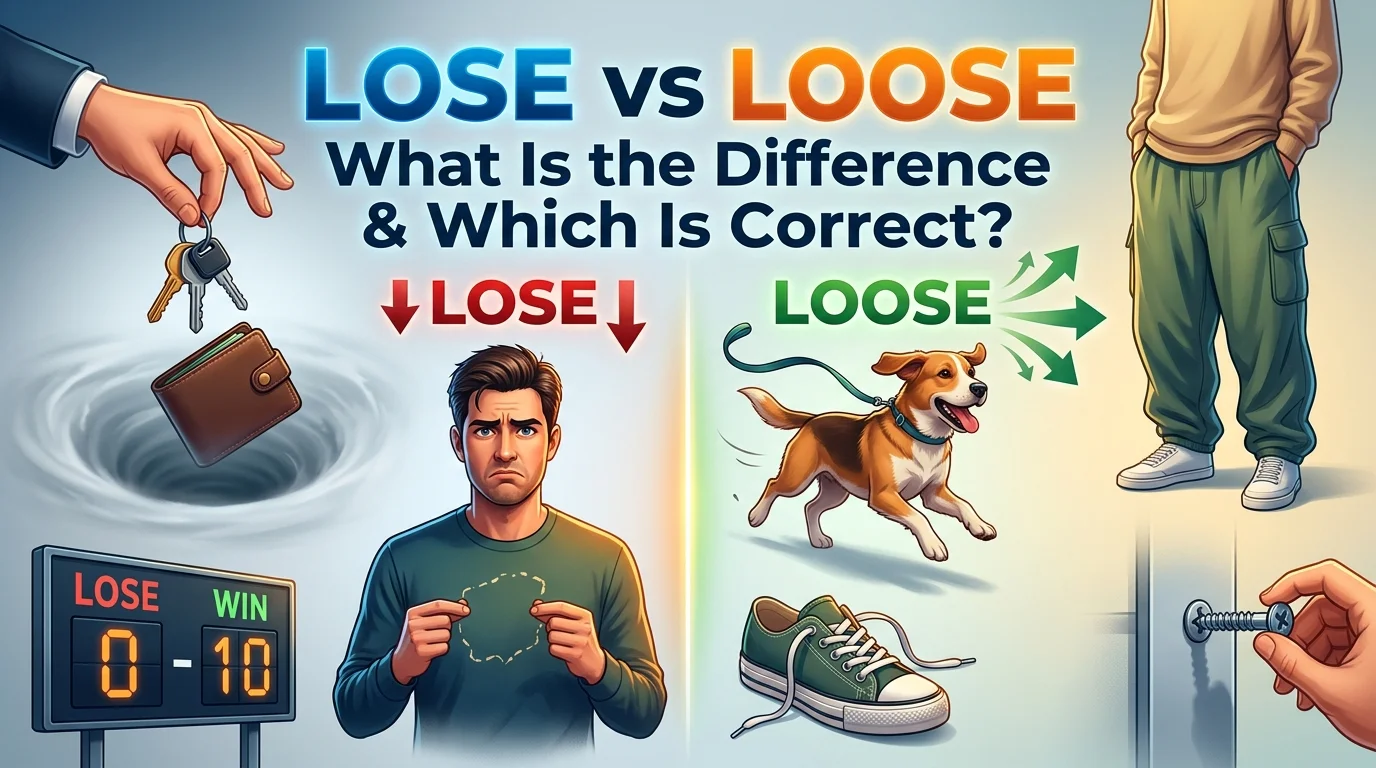
Many English learners and even native speakers confuse lose and loose because they look similar and sound somewhat alike. However, these two words have completely different meanings and grammatical functions. Understanding the difference between lose vs loose will help you write and speak more accurately while avoiding one of the most common spelling mistakes in English.
Comparison Overview
Lose and loose are different words with different meanings.
| Feature | Lose | Loose |
| Part of Speech | Verb | Adjective (sometimes verb) |
| Meaning | To fail to keep, win, or retain something | Not tight, free, relaxed |
| Example | I don’t want to lose my keys. | My shirt is too loose. |
| Common Usage | Losing games, items, opportunities | Describing fit, tension, or movement |
| Pronunciation | /luːz/ | /luːs/ |
The confusion often happens because both words contain the letters l-o-o-s, but their meanings and grammatical roles are completely different.
Definition of Lose
Lose is a verb that means to no longer have something, fail to win, become unable to find something, or miss an opportunity.
Core Meaning
When you lose something, it is gone, misplaced, missed, or not won.
Examples
- I do not want to lose my phone.
- Our team may lose the match.
- She could lose her job.
- Don’t lose hope.
- He lost his wallet yesterday.
Definition of Loose
Loose is primarily an adjective that means not tight, not firmly attached, free-moving, or relaxed.
Core Meaning
When something is loose, it is not tightly secured or fitted.
Examples
- This shirt is too loose.
- The screw is loose.
- Her hair was loose.
- The dog got loose from the yard.
- Wear loose clothing in hot weather.
Main Differences Between Lose and Loose
The biggest difference is that lose is usually a verb, while loose is usually an adjective.
| Aspect | Lose | Loose |
| Function | Action word | Describing word |
| Meaning | Fail to keep or win | Not tight |
| Grammar | Verb | Adjective |
| Example | Don’t lose the ticket. | The ticket is loose in my pocket. |
Meaning Difference
- Lose refers to losing possession, a competition, or an opportunity.
- Loose refers to something that lacks tightness or restraint.
Usage Difference
- Use lose when talking about an action.
- Use loose when describing a condition.
Context Difference
- Lose money.
- Lose a game.
- Lose your keys.
But:
- Loose pants.
- Loose wire.
- Loose knot.
Commonly Confused Situations
Lose Weight vs Loose Weight
✅ Correct: Lose weight
❌ Incorrect: Loose weight
Weight is something you can lose, not something that becomes loose.
Lose a Game vs Loose a Game
✅ Correct: Lose a game
❌ Incorrect: Loose a game
A game can be lost, not loose.
Loose Clothing vs Lose Clothing
✅ Correct: Loose clothing
❌ Incorrect: Lose clothing
Clothing can be loose if it does not fit tightly.
Grammar Guide
How Each Term Is Used in Sentences
Lose Sentence Patterns
- Subject + lose + object
- Subject + lost + object
- Subject + will lose + object
Examples:
- I lose my focus easily.
- She lost her keys.
- They may lose the competition.
Loose Sentence Patterns
- Subject + be + loose
- Loose + noun
Examples:
- The bolt is loose.
- He wore loose jeans.
- The rope became loose.
Common Mistakes Learners Make
Mistake 1
❌ I don’t want to loose my phone.
✅ I don’t want to lose my phone.
Mistake 2
❌ These pants are lose.
✅ These pants are loose.
Mistake 3
❌ We might loose the game.
✅ We might lose the game.
Mistake 4
❌ The screw is lose.
✅ The screw is loose.
Simple Rules to Remember
- Lose = opposite of win.
- Loose = opposite of tight.
- If you can replace it with “misplace” or “fail to win,” use lose.
- If you can replace it with “not tight,” use loose.
- Think: Loose has an extra “o” because it has extra room.
Quick Tips for Writing and Speaking
- Check whether the word is an action or a description.
- If it describes something, use loose.
- If it shows an action, use lose.
- Remember that games are lost, not loose.
- Clothing can be loose, but you can lose clothing.
When to Use Each One
Use Lose When
- Talking about competitions.
- Talking about misplaced objects.
- Talking about opportunities.
- Talking about money.
- Talking about failure to keep something.
Examples:
- Lose a race.
- Lose your wallet.
- Lose a customer.
- Lose confidence.
- Lose interest.
Use Loose When
- Describing clothing.
- Describing objects that are not tight.
- Describing free movement.
- Describing relaxed styles.
- Describing unattached items.
Examples:
- Loose shirt.
- Loose screw.
- Loose knot.
- Loose hair.
- Loose connection.
When NOT to Use Each One
Do Not Use Lose
- To describe clothing fit.
- To describe something that is not tight.
- To describe physical looseness.
Incorrect:
- These shoes are lose.
Correct:
- These shoes are loose.
Do Not Use Loose
- To describe losing a competition.
- To describe misplacing something.
- To describe failure.
Incorrect:
- We will loose the match.
Correct:
- We will lose the match.
Which One to Use (Decision Guide)
Ask yourself these questions:
Are you talking about an action?
If yes, use lose.
Examples:
- Lose money.
- Lose time.
- Lose a game.
Are you describing something?
If yes, use loose.
Examples:
- Loose shirt.
- Loose wire.
- Loose knot.
Quick Decision Chart
| Question | Correct Word |
| Did someone fail to win? | Lose |
| Did someone misplace something? | Lose |
| Is something not tight? | Loose |
| Is clothing too big? | Loose |
| Is a connection unsecured? | Loose |
Real-World Practical Examples
Lose Examples
Education
- Students may lose marks for incorrect answers.
Daily Life
- Be careful not to lose your keys.
Business
- Companies can lose customers through poor service.
Technology
- You may lose data if you do not save your work.
Conversation
- I do not want to lose this opportunity.
Loose Examples
Education
- The binder rings are loose.
Daily Life
- My jacket feels loose today.
Science
- A loose connection can affect an experiment.
Technology
- The cable became loose from the port.
Conversation
- Her hair was loose after the event.
Self-Assessment (Fill in the Blanks)
- I will use ______ when referring to failing to win a competition.
- The correct word is ______ because the shirt is not tight.
- I will use ______ when referring to misplacing my wallet.
- The correct word is ______ because the screw is not firmly attached.
- I do not want to ______ my phone.
- These pants are too ______.
- We might ______ the championship.
- The rope became ______ after the storm.
- She does not want to ______ her job.
- The cable is ______.
- I may ______ my chance if I wait too long.
- His jacket feels ______ around the shoulders.
- They could ______ the match.
- The wheel nut is ______.
- Do not ______ your passport.
- The knot became ______.
- Investors can ______ money.
- Her sweater is very ______.
- We cannot afford to ______ customers.
- The dog got ______ from the yard.
Answers
- Lose
- Loose
- Lose
- Loose
- Lose
- Loose
- Lose
- Loose
- Lose
- Loose
- Lose
- Loose
- Lose
- Loose
- Lose
- Loose
- Lose
- Loose
- Lose
- Loose
Final Verdict
The difference between lose vs loose is simple once you understand their roles. Lose is a verb that means to misplace something, fail to win, or no longer possess something. Loose is usually an adjective that describes something that is not tight, secure, or firmly attached. A helpful memory trick is that lose is the opposite of win, while loose is the opposite of tight. Whenever you’re unsure, ask whether you’re describing an action or a condition. If it’s an action, choose lose. If it’s describing something’s fit or tightness, choose loose. Mastering this distinction will eliminate one of the most common English spelling mistakes and improve both your writing and speaking accuracy.
Conclusion About Lose vs Loose
Understanding the difference between lose vs loose is essential for clear and accurate communication. Although these two words look very similar, they serve completely different purposes in English. Lose is a verb that means to misplace something, fail to keep it, or fail to win. Loose, on the other hand, is usually an adjective that describes something that is not tight, secure, or firmly attached. This small spelling difference often causes confusion, but remembering that lose relates to loss and loose relates to looseness can make choosing the correct word much easier. Whether you are writing emails, school assignments, business documents, or everyday messages, using the right term helps improve clarity and professionalism. By practicing their meanings, grammar rules, and real-world examples, you can confidently use both words correctly and avoid one of the most common mistakes in the English language.
FAQs
What is the main difference between lose and loose?
The main difference is that lose is a verb meaning to misplace something or fail to win, while loose is an adjective meaning not tight or securely attached. They have different meanings, pronunciations, and grammatical functions.
Is lose or loose correct when talking about misplacing something?
Lose is the correct word when referring to misplacing something. For example, you can lose your keys, phone, or wallet. Loose would be incorrect because it describes something that is not tight.
Why do people confuse lose and loose?
People often confuse these words because their spellings are very similar. However, they have different pronunciations and meanings. The extra “o” in loose makes it a completely different word from lose.
Is lose a verb or an adjective?
Lose is a verb. It describes an action, such as losing a game, losing money, or losing an opportunity. It is not commonly used as an adjective.
Is loose a verb or an adjective?
Loose is most commonly used as an adjective. It describes something that is not tight, such as loose clothing, loose screws, or loose hair.
Which word should I use when talking about weight?
You should use lose when talking about weight. The correct phrase is “lose weight” because it refers to reducing or getting rid of weight. “Loose weight” is incorrect.
How can I remember the difference between lose and loose?
A simple trick is to remember that lose means the opposite of win, while loose means the opposite of tight. This memory aid helps many learners choose the correct word quickly.
Can loose be used as a verb?
Yes, loose can occasionally be used as a verb meaning to release or set free. However, this usage is less common than its adjective form in everyday English.
What are some examples of lose in a sentence?
Examples include: “I do not want to lose my phone,” “They may lose the match,” and “She could lose her job.” In each case, the word refers to losing possession or failing to keep something.
What are some examples of loose in a sentence?
Examples include: “My shirt is loose,” “The screw is loose,” and “The dog got loose from the yard.” In these sentences, the word describes something that is not tight or restricted.

Ethan Clarke is a language writer who specializes in breaking down similes, word meanings, and commonly confused terms. His work focuses on clear explanations, practical examples, and simple comparisons that help readers understand how English
