
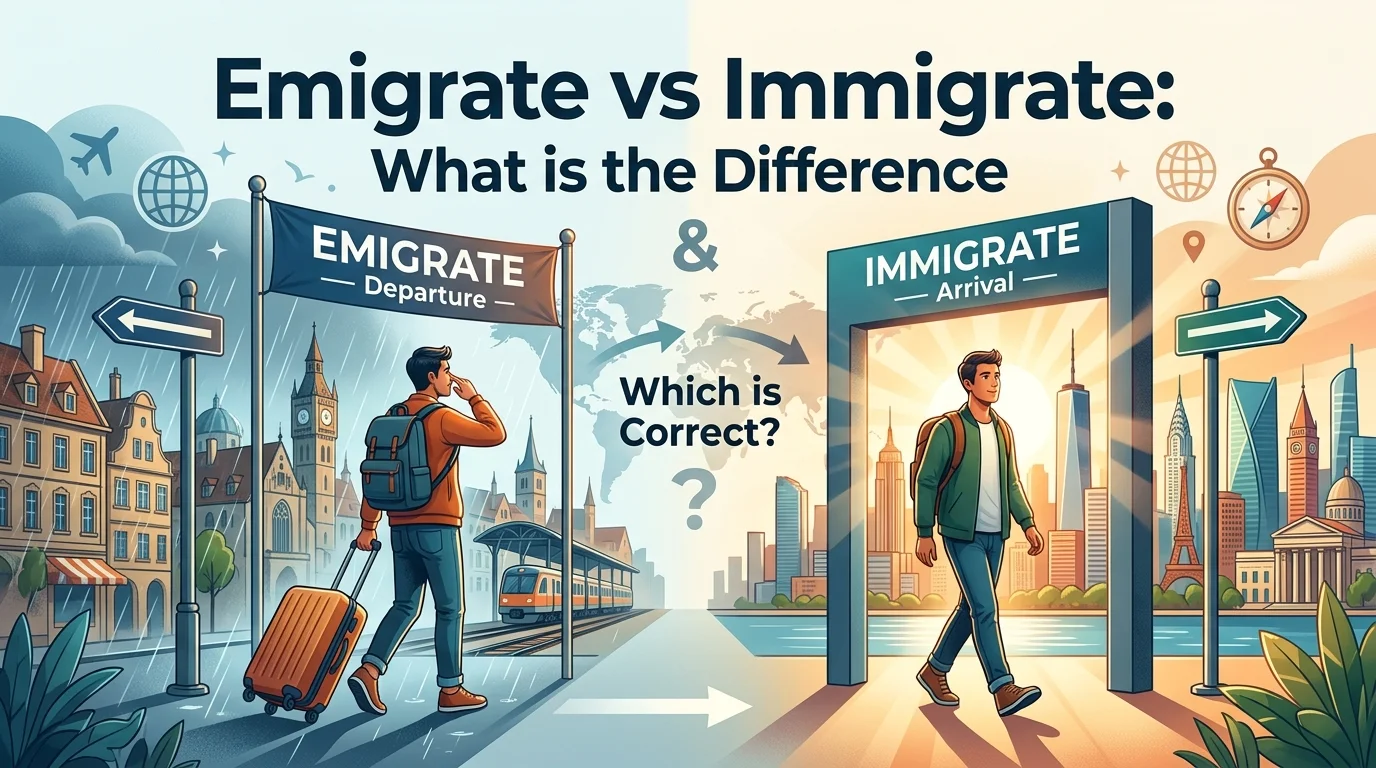
Many English learners confuse emigrate and immigrate because both words relate to moving from one country to another. While they describe the same movement, they focus on different perspectives. Understanding the difference between emigrate vs immigrate helps improve grammar, writing accuracy, and everyday communication.
Comparison Overview
Both emigrate and immigrate are verbs used when people move permanently from one country to another. The key difference is the viewpoint.
| Term | Meaning | Focus |
| Emigrate | To leave a country to live elsewhere | Leaving a country |
| Immigrate | To enter a new country to live permanently | Arriving in a country |
For example, if someone leaves Pakistan and moves to Canada, they emigrate from Pakistan and immigrate to Canada.
Definition of Emigrate
Emigrate means to leave your home country and settle permanently in another country.
The word focuses on the place a person is departing from.
Examples:
- Many families emigrate from their homeland for better opportunities.
- She emigrated from Pakistan in 2018.
- Thousands emigrated from Europe during the nineteenth century.
The keyword to remember is from.
Definition of Immigrate
Immigrate means to come into a new country to live permanently.
The word focuses on the destination country.
Examples:
- They immigrated to Canada last year.
- His family immigrated to Australia for work.
- Many people immigrate to the United States every year.
The keyword to remember is to.
Main Differences Between Emigrate and Immigrate
| Feature | Emigrate | Immigrate |
| Meaning | Leave a country | Enter a country |
| Perspective | Departure | Arrival |
| Common Preposition | From | To |
| Focus | Country left behind | New country entered |
| Example | Emigrate from Pakistan | Immigrate to Canada |
Key Difference in Perspective
A person moving from Pakistan to Canada can be described in two ways:
- They emigrated from Pakistan.
- They immigrated to Canada.
Both statements are correct because they describe the same move from different viewpoints.
Origin and Meaning of the Words
Understanding the prefixes makes the difference easier.
- E- / Ex- means “out of” or “from.”
- Im- means “into” or “in.”
Therefore:
- Emigrate = move out of a country.
- Immigrate = move into a country.
Common Situations Where These Words Appear
You may encounter these terms in:
- Immigration law
- Government documents
- News reports
- History books
- International business
- Academic writing
- Travel and relocation discussions
Grammar Guide
Both emigrate and immigrate are verbs.
| Word | Part of Speech |
| Emigrate | Verb |
| Immigrate | Verb |
Related nouns include:
| Verb | Noun |
| Emigrate | Emigration |
| Immigrate | Immigration |
Examples:
- Emigration increased during the economic crisis.
- Immigration contributed to population growth.
How Each Term Is Used in Sentences
Emigrate Pattern
Subject + emigrate + from + country
Examples:
- They emigrated from Pakistan.
- My grandparents emigrated from Italy.
- She plans to emigrate from her country.
Immigrate Pattern
Subject + immigrate + to + country
Examples:
- They immigrated to Canada.
- He immigrated to Germany.
- Many workers immigrate to developed countries.
Common Mistakes Learners Make
Mistake 1
❌ He emigrated to Canada.
While often understood, the emphasis should be:
✔ He immigrated to Canada.
Mistake 2
❌ She immigrated from Pakistan.
Better:
✔ She emigrated from Pakistan.
Mistake 3
Mixing the perspectives in the same sentence incorrectly.
❌ They immigrated from Canada.
✔ They emigrated from Canada.
Simple Rules to Remember
- Emigrate = Exit
- Immigrate = Into
- Emigrate goes with from
- Immigrate goes with to
- Think of departure versus arrival
Quick Tips for Writing and Speaking
- Use emigrate when discussing the country being left.
- Use immigrate when discussing the destination country.
- Check whether the sentence focuses on departure or arrival.
- Remember “E” for Exit and “I” for Into.
- In formal writing, always use the correct preposition.
When to Use Each One
Use Emigrate When
- Talking about leaving a country
- Discussing historical population movements
- Referring to departure from a homeland
- Describing relocation from a nation
- Writing about people moving away
Examples:
- Millions emigrated from Europe.
- She emigrated from Pakistan.
Use Immigrate When
- Talking about entering a new country
- Discussing immigration policies
- Referring to arrival in a destination nation
- Describing settlement in another country
- Writing about newcomers
Examples:
- They immigrated to Canada.
- Many professionals immigrate to Australia.
When NOT to Use Each One
Do Not Use Emigrate
- When focusing on the destination country
- When discussing arrival into a country
- When talking about immigration programs
Incorrect:
- She emigrated to Canada.
Preferred:
- She immigrated to Canada.
Do Not Use Immigrate
- When focusing on the country being left
- When discussing departure from a nation
Incorrect:
- He immigrated from Pakistan.
Preferred:
- He emigrated from Pakistan.
Which One to Use (Decision Guide)
Ask yourself one simple question:
Are you talking about leaving or arriving?
If talking about leaving a country:
➡ Use Emigrate
If talking about entering a country:
➡ Use Immigrate
Quick Decision Chart:
| Situation | Correct Word |
| Leaving Pakistan | Emigrate |
| Arriving in Canada | Immigrate |
| Focus on departure | Emigrate |
| Focus on destination | Immigrate |
| Moving out of a country | Emigrate |
| Moving into a country | Immigrate |
Real-World Practical Examples
Emigrate Examples
- My grandparents emigrated from Italy after World War II.
- Many workers emigrate from developing countries for better jobs.
- The scientist emigrated from Germany to continue research abroad.
- Several entrepreneurs emigrated from their homeland to expand businesses.
- Thousands emigrated from rural regions seeking opportunities overseas.
Immigrate Examples
- Her family immigrated to Canada in 2020.
- Skilled workers often immigrate to Australia.
- Many students later immigrate to the countries where they study.
- The engineer immigrated to Germany for employment opportunities.
- Thousands immigrate to major economic centers every year.
Self-Assessment (Fill in the Blanks)
- I will use ______ when referring to leaving a country permanently.
- The correct word is ______ because the person moved to Canada.
- I will use ______ when discussing departure from Pakistan.
- The correct word is ______ because the focus is entering Australia.
- I will use ______ when referring to moving out of a homeland.
- The correct word is ______ because the person arrived in Germany.
- I will use ______ when discussing people leaving Europe.
- The correct word is ______ because the sentence focuses on arrival.
- I will use ______ when talking about departure from India.
- The correct word is ______ because the destination is Canada.
- I will use ______ when focusing on the country being left.
- The correct word is ______ because the person entered a new nation.
- I will use ______ when discussing emigration history.
- The correct word is ______ because the family settled in Australia.
- I will use ______ when describing leaving one’s native country.
- The correct word is ______ because the person arrived in the United States.
- I will use ______ when discussing movement away from a homeland.
- The correct word is ______ because the destination country is emphasized.
- I will use ______ when focusing on departure rather than arrival.
- The correct word is ______ because the person moved into a new country.
Answers
- Emigrate
- Immigrate
- Emigrate
- Immigrate
- Emigrate
- Immigrate
- Emigrate
- Immigrate
- Emigrate
- Immigrate
- Emigrate
- Immigrate
- Emigrate
- Immigrate
- Emigrate
- Immigrate
- Emigrate
- Immigrate
- Emigrate
- Immigrate
Final Verdict
The difference between emigrate and immigrate is all about perspective. Emigrate means leaving one country to live in another, while immigrate means entering a new country to live there permanently. Although both words describe the same relocation, they focus on different sides of the journey. Use emigrate when discussing where someone came from and immigrate when discussing where someone went. Remember the simple rule: emigrate from and immigrate to. Once you understand this distinction, choosing the correct word becomes easy in writing, speaking, academic work, and everyday conversations.
Conclusion About Emigrate vs Immigrate
Understanding the difference between emigrate vs immigrate becomes much easier once you focus on the direction of movement. Both words describe the same life-changing process of moving from one country to another, but they highlight different perspectives. Emigrate refers to leaving a country, while immigrate refers to arriving in a new one. This small distinction is important in academic writing, professional communication, immigration discussions, and everyday conversations.
Many learners mix these terms because they often appear together when discussing international relocation. However, remembering the simple rule of emigrate from and immigrate to can help you use them correctly every time. Whether you are writing an essay, reading a news article, or discussing global migration, choosing the right word makes your message clearer and more accurate. By mastering the difference between emigrate and immigrate, you can communicate with greater confidence and avoid one of the most common English vocabulary mistakes.
FAQs
What is the main difference between emigrate and immigrate?
The main difference is perspective. Emigrate means leaving a country to live somewhere else, while immigrate means entering a new country to live there permanently. The same person can both emigrate from one country and immigrate to another.
Can a person be both an emigrant and an immigrant?
Yes. A person who leaves one country is an emigrant from that country and an immigrant in the country where they settle. Both terms can describe the same individual depending on the viewpoint being discussed.
Is emigrate used with from or to?
Emigrate is most commonly used with the preposition “from.” It emphasizes the country being left behind. For example, someone may emigrate from Pakistan, Italy, or Canada when moving permanently to another nation.
Is immigrate used with from or to?
Immigrate is usually used with the preposition “to.” It focuses on the destination country. For example, a family may immigrate to Australia, Germany, or Canada to begin a new life there.
Are emigrate and immigrate verbs or nouns?
Both emigrate and immigrate are verbs. Their noun forms are emigration and immigration. The verb describes the action of moving, while the noun refers to the process or concept of migration itself.
Why do people confuse emigrate and immigrate?
People often confuse these words because they describe the same relocation event. The difference is that one focuses on departure and the other focuses on arrival. Since both involve moving between countries, they are frequently mixed up.
Can emigrate and immigrate be used interchangeably?
Not exactly. Although they relate to the same move, they are not interchangeable because they emphasize different perspectives. Choosing the correct term depends on whether you are discussing the country being left or the country being entered.
What is an easy way to remember emigrate vs immigrate?
A simple memory trick is to think of “E” in emigrate as exit and “I” in immigrate as into. Emigrate means exiting a country, while immigrate means moving into a new country.
Are these words only used for permanent moves?
In most cases, yes. Emigrate and immigrate generally refer to moving permanently or for a very long period. Temporary travel, tourism, or short-term work assignments are usually described with different terms.
Which word should I use when talking about moving to Canada?
Use immigrate if you are focusing on arriving in Canada. Use emigrate if you are focusing on leaving your original country. Both may be correct depending on which part of the move you are describing.

Sarah Mitchell is an experienced writer and grammar teacher with over 10 years of expertise in English language education. She helps learners improve their grammar, writing, and communication skills through clear explanations and practical examples. Sarah creates learner-friendly content focused on real-life English, making language learning simple, effective, and confidence-building.