
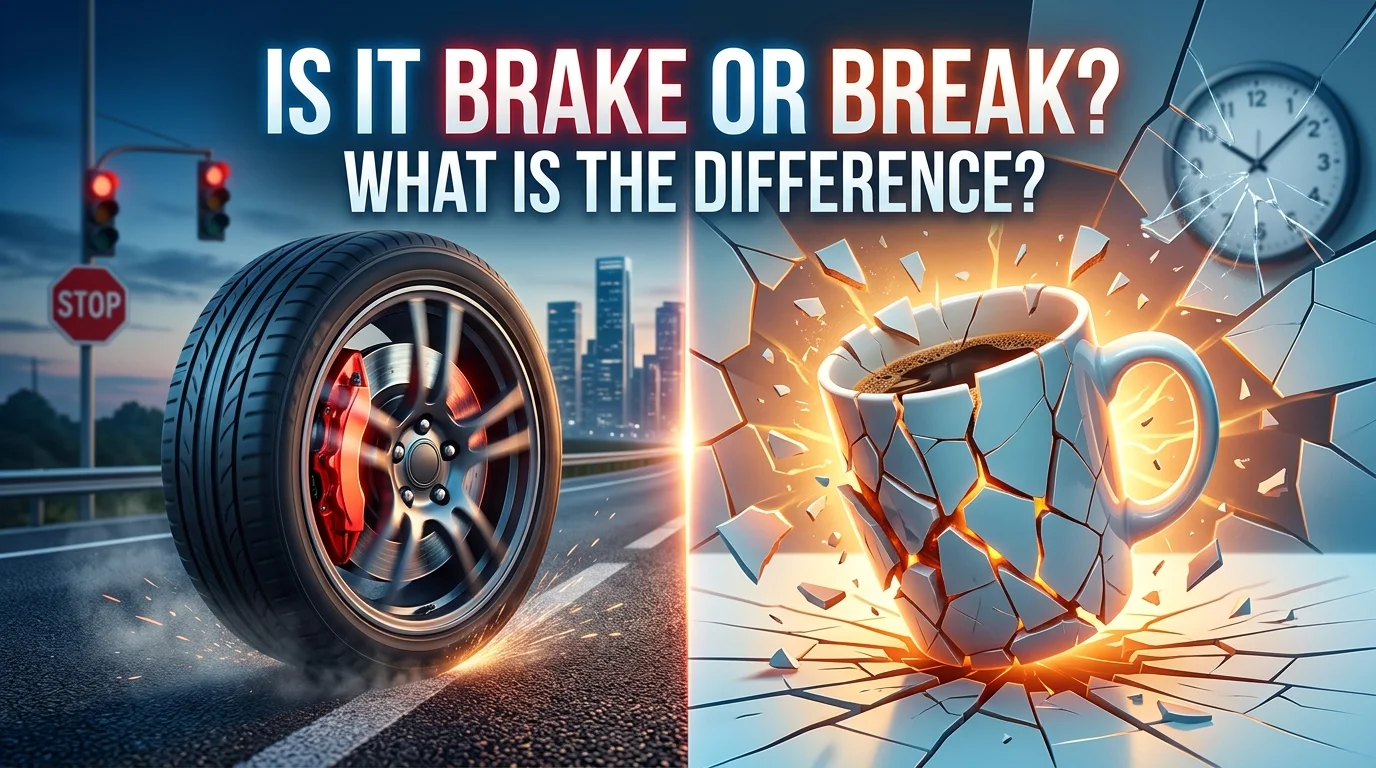
Many English learners confuse brake and break because they sound exactly alike. These two words are homophones, meaning they have the same pronunciation but different meanings and spellings. Understanding the difference between brake and break is important for writing, speaking, and avoiding common grammar mistakes in everyday communication.
Comparison Overview
Brake and break may sound identical, but they serve completely different purposes in English.
- Brake is mainly related to slowing down or stopping movement, especially in vehicles.
- Break generally means to separate, damage, interrupt, pause, or divide something.
Because their spellings and meanings differ, choosing the correct word depends entirely on the context of the sentence.
| Feature | Brake | Break |
| Part of Speech | Noun, Verb | Noun, Verb |
| Main Meaning | Stop or slow movement | Separate, damage, interrupt, pause |
| Common Context | Driving, vehicles, machinery | Daily life, work, school, conversation |
| Example | Press the brake pedal. | Be careful not to break the glass. |
| Pronunciation | /breɪk/ | /breɪk/ |
Definition of Brake
Brake refers to a device used for slowing down or stopping a vehicle or machine. It can also function as a verb meaning to reduce speed or stop movement.
As a noun:
- The brake stopped the car safely.
As a verb:
- The driver braked suddenly.
The word is commonly used in transportation, engineering, cycling, and automotive contexts.
Definition of Break
Break means to separate into pieces, damage something, interrupt an activity, pause, or stop a process.
As a verb:
- Don’t break the window.
As a noun:
- We took a break after lunch.
The word has many meanings and is widely used in everyday English.
Main Differences Between Brake and Break
The primary difference is their meaning and usage.
| Aspect | Brake | Break |
| Meaning | To stop or slow movement | To damage, separate, pause, or interrupt |
| Common Usage | Cars, bikes, machines | Objects, activities, schedules, relationships |
| Verb Example | Brake before the turn. | Break the stick in half. |
| Noun Example | The brake needs repair. | We need a short break. |
| Context | Transportation | General life situations |
A simple way to remember:
- Brake = Stop
- Break = Damage or Pause
Why Are Brake and Break Confusing?
These words are confusing because:
- They sound exactly the same.
- Both can be nouns and verbs.
- They appear frequently in everyday English.
- Spell-checkers may not catch mistakes if the wrong word is still spelled correctly.
For example:
❌ I need to break the car.
✅ I need to brake the car.
❌ Let’s take a brake.
✅ Let’s take a break.
Brake as a Noun vs Verb
Brake as a Noun
A device that slows or stops movement.
Examples:
- The bicycle brake is broken.
- Check the brake before driving.
Brake as a Verb
The action of slowing down.
Examples:
- Brake carefully on wet roads.
- The driver braked suddenly.
Break as a Noun vs Verb
Break as a Noun
A pause or interruption.
Examples:
- We had a coffee break.
- Take a short break.
Break as a Verb
To separate, damage, interrupt, or stop.
Examples:
- Don’t break the vase.
- He broke the record.
Grammar Guide
Both words can function as nouns and verbs, but their meanings remain different.
| Word | Noun | Verb |
| Brake | A stopping device | To slow or stop |
| Break | A pause or interruption | To separate, damage, interrupt |
How Each Term Is Used in Sentences
Brake
Pattern:
- Brake + vehicle
- Apply the brake
- Brake suddenly
Examples:
- Please brake before the stop sign.
- The brake pedal feels loose.
- He braked to avoid an accident.
Break
Pattern:
- Break + object
- Take a break
- Break a rule
Examples:
- Don’t break the plate.
- We took a break from studying.
- She broke the company record.
Common Mistakes Learners Make
Mistake 1:
❌ Take a brake.
✅ Take a break.
Mistake 2:
❌ Break the car before turning.
✅ Brake the car before turning.
Mistake 3:
❌ The break pedal is damaged.
✅ The brake pedal is damaged.
Mistake 4:
❌ He needed a brake from work.
✅ He needed a break from work.
Simple Rules to Remember
- If it involves stopping a vehicle, use brake.
- If it involves damage, separation, interruption, or rest, use break.
- Think of a brake pedal in a car.
- Think of a coffee break at work.
Quick Tips for Writing and Speaking
- Associate brake with driving.
- Associate break with damage or rest.
- Double-check homophones while proofreading.
- Read sentences in context before choosing the word.
When to Use Each One
Use Brake When:
- Talking about cars.
- Talking about bicycles.
- Discussing vehicle safety.
- Referring to slowing down.
- Describing stopping movement.
Examples:
- Press the brake gently.
- The truck braked quickly.
Use Break When:
- Referring to damage.
- Talking about rest periods.
- Describing interruptions.
- Discussing records or rules.
- Mentioning separation into pieces.
Examples:
- Let’s take a break.
- Don’t break the toy.
When NOT to Use Each One
Do Not Use Brake When:
- Referring to rest periods.
- Talking about broken objects.
- Discussing interruptions.
- Describing damaged items.
Incorrect:
- We need a brake from work.
Correct:
- We need a break from work.
Do Not Use Break When:
- Referring to vehicle stopping systems.
- Discussing brake pedals.
- Talking about slowing down a vehicle.
Incorrect:
- Hit the break pedal.
Correct:
- Hit the brake pedal.
Which One to Use (Decision Guide)
Ask yourself this question:
Are you talking about stopping or slowing movement?
- Yes → Use Brake
- No → Continue
Are you talking about damage, separation, interruption, or rest?
- Yes → Use Break
Quick Decision Chart:
| Situation | Correct Word |
| Stopping a car | Brake |
| Bicycle control | Brake |
| Damaging a glass | Break |
| Coffee pause | Break |
| Interrupting work | Break |
| Slowing down | Brake |
Real-World Practical Examples
Brake Examples
- The driver pressed the brake at the traffic light.
- The mechanic inspected the brake system.
- Cyclists should test the brake before riding.
- The train braked smoothly at the station.
- Engineers designed a more effective brake mechanism.
Break Examples
- Students took a break between classes.
- Be careful not to break your phone.
- Scientists observed a break in the chemical process.
- The company gave employees a lunch break.
- She managed to break the previous sales record.
Self-Assessment (Fill in the Blanks)
- I will use ______ when referring to stopping a car.
- The correct word is ______ because it means a pause from work.
- I pressed the ______ pedal before the traffic light.
- Be careful not to ______ the glass.
- We took a short ______ after the meeting.
- Drivers should ______ slowly on icy roads.
- The bicycle ______ needs adjustment.
- Don’t ______ company rules.
- The mechanic repaired the ______ system.
- Let’s take a ______ before continuing.
- She might ______ the vase if she drops it.
- The driver had to ______ suddenly.
- The truck’s ______ failed during inspection.
- We need a lunch ______ today.
- Don’t ______ the laptop.
- The cyclist used the rear ______.
- He decided to ______ the stick into two pieces.
- The car’s ______ pedal felt stiff.
- Employees receive a short ______ every afternoon.
- You should ______ before entering the sharp turn.
Answers
- Brake
- Break
- Brake
- Break
- Break
- Brake
- Brake
- Break
- Brake
- Break
- Break
- Brake
- Brake
- Break
- Break
- Brake
- Break
- Brake
- Break
- Brake
Final Verdict
Although brake and break sound exactly alike, their meanings are completely different. Brake is connected to slowing down or stopping movement and is commonly used when talking about vehicles, bicycles, and machinery. Break, on the other hand, refers to damaging something, separating it into parts, interrupting an activity, or taking a period of rest. The easiest way to remember the difference is to associate brake with driving and break with damage or pauses. Whenever you are unsure, look at the context of the sentence. If stopping movement is involved, choose brake. If the meaning involves rest, interruption, separation, or damage, choose break. Understanding this distinction will help you write more accurately, speak more confidently, and avoid one of the most common homophone mistakes in English.
Conclusion About Brake vs Break
Understanding the difference between brake and break is essential for clear and accurate communication. Although these words sound exactly the same, they have very different meanings and are used in completely different situations. Brake relates to slowing down or stopping movement, especially when talking about vehicles, bicycles, or machinery. Break, on the other hand, refers to damaging something, separating it into pieces, interrupting an activity, or taking a period of rest.
Because they are homophones, many writers and learners accidentally confuse them. However, remembering that a brake helps stop motion while a break usually means damage, separation, or a pause can make choosing the correct word much easier. By paying attention to context and practicing real-life examples, you can confidently use both words correctly in writing and conversation. Mastering the distinction between brake vs break will improve your grammar, reduce common mistakes, and help you communicate more effectively in everyday English.
FAQs
What is the main difference between brake and break?
The main difference is that brake refers to slowing down or stopping movement, while break means to damage, separate, interrupt, or pause something. Even though they sound the same, their meanings and uses are completely different.
Is brake a noun or a verb?
Yes, brake can be both a noun and a verb. As a noun, it refers to a device that stops movement. As a verb, it means to slow down or stop a vehicle or machine.
Is break a noun or a verb?
Yes, break can function as both a noun and a verb. As a noun, it often means a pause or interruption. As a verb, it means to damage, separate, interrupt, or stop something.
Why do people confuse brake and break?
People often confuse them because they are homophones, meaning they have the same pronunciation. Since they sound identical in speech, writers sometimes choose the wrong spelling when writing.
How can I remember the difference between brake and break?
A simple trick is to associate brake with vehicles and stopping. Associate break with damage, separation, or rest. Thinking about a brake pedal and a coffee break can help reinforce the distinction.
Which word is correct for stopping a car?
The correct word is brake. When referring to slowing down or stopping a vehicle, brake is always the appropriate choice because it relates directly to vehicle control and safety.
Is it correct to say take a brake?
No, that phrase is incorrect. The correct expression is take a break because the word refers to a pause or rest period rather than a device used for stopping movement.
Can break mean a rest period?
Yes, break commonly refers to a rest period. Examples include lunch breaks, coffee breaks, study breaks, and work breaks. In these situations, it means a temporary pause from an activity.
What are some common examples of brake?
Common examples include a car brake, bicycle brake, train brake, brake pedal, and emergency brake. All of these examples relate to controlling speed or stopping movement safely.
Are brake and break pronounced differently?
No, they are pronounced exactly the same way in standard English. They are homophones, which means they share the same pronunciation but have different spellings and meanings.

Sarah Mitchell is an experienced writer and grammar teacher with over 10 years of expertise in English language education. She helps learners improve their grammar, writing, and communication skills through clear explanations and practical examples. Sarah creates learner-friendly content focused on real-life English, making language learning simple, effective, and confidence-building.