
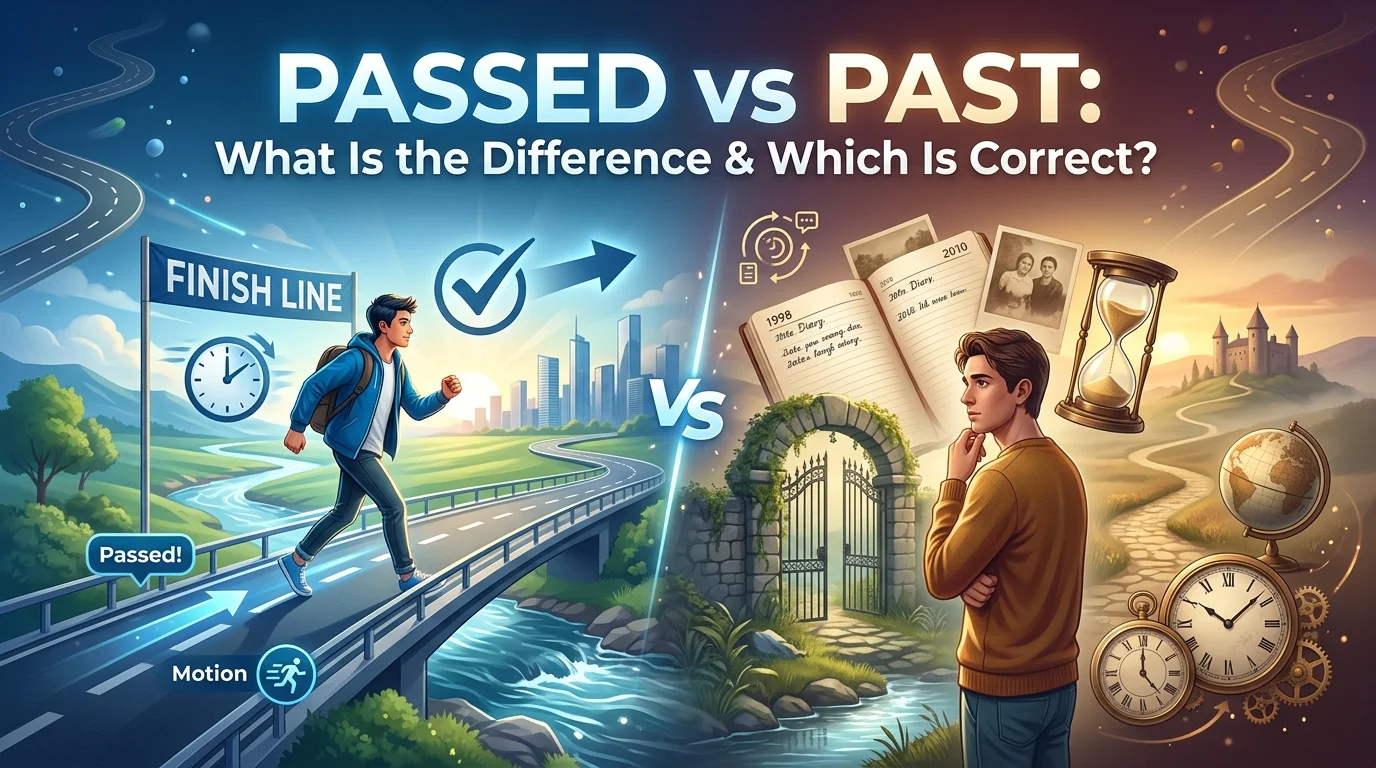
Many English learners confuse passed and past because they sound exactly the same. Although they are pronounced alike, they have different meanings and grammatical roles. Understanding the difference between passed vs past is important for writing and speaking correctly. This guide explains their definitions, usage, grammar rules, examples, and common mistakes in a simple and easy-to-understand way.
Comparison Overview
Passed and past are commonly confused words in English. They are homophones, meaning they sound the same but have different meanings and spellings.
- Passed is usually the past tense of the verb pass.
- Past is most often used as a noun, adjective, adverb, or preposition related to time or position.
Choosing the correct word depends on whether you need a verb action or a reference to time, position, or direction.
| Feature | Passed | Past |
| Part of Speech | Verb (past tense of pass) | Noun, adjective, adverb, preposition |
| Meaning | Moved by, succeeded, completed, transferred | Earlier time, beyond, gone by |
| Shows Action? | Yes | Usually No |
| Related to Time? | Sometimes | Frequently |
| Example | She passed the exam. | The past cannot be changed. |
Definition of Passed
Passed is the past tense and past participle form of the verb pass.
It describes an action that has already happened. The word can mean moving by something, succeeding in a test, giving something to another person, or reaching a certain point.
Examples:
- He passed the school on his way home.
- She passed the driving test.
- The teacher passed the papers around the room.
- Time passed quickly.
Definition of Past
Past refers to a previous time, a position beyond something, or something that has already happened.
Unlike passed, it is usually not a verb. It can function as several parts of speech depending on the sentence.
Examples:
- We cannot change the past.
- It is past midnight.
- Walk past the library.
- Her past experiences helped her succeed.
Main Differences Between Passed and Past
The primary difference is that passed is generally a verb, while past usually refers to time, direction, or position.
| Aspect | Passed | Past |
| Function | Action word | Time or position word |
| Grammar Role | Verb | Noun, adjective, adverb, preposition |
| Indicates Movement | Often | Sometimes |
| Indicates Previous Time | Rarely | Frequently |
| Example | He passed the ball. | We talked about the past. |
Meaning Difference
Passed focuses on an action.
- She passed the note.
- The car passed us.
Past focuses on a time or location.
- The past is important.
- Walk past the building.
Usage Difference
Use passed when describing something that happened.
Use past when referring to time, position, direction, or history.
Common Situations Where They Are Confused
Many people mistakenly write:
❌ He past the exam.
Correct:
✅ He passed the exam.
Many people also write:
❌ Walk passed the store.
Correct:
✅ Walk past the store.
The confusion occurs because both words sound identical when spoken.
Grammar Guide
How Each Term Is Used in Sentences
Passed
Pattern:
Subject + passed + object/complement
Examples:
- She passed the exam.
- The bus passed our house.
- He passed the salt.
Past
Patterns:
Past as a noun
- The past shapes our future.
Past as a preposition
- We walked past the museum.
Past as an adjective
- Past mistakes can teach valuable lessons.
Past as an adverb
- The car drove past.
Common Mistakes Learners Make
Mistake 1
❌ I past the test.
✅ I passed the test.
Mistake 2
❌ We walked passed the bank.
✅ We walked past the bank.
Mistake 3
❌ It is passed noon.
✅ It is past noon.
Mistake 4
❌ Her passed experiences helped her.
✅ Her past experiences helped her.
Simple Rules to Remember
- If it shows an action, use passed.
- If it refers to time, use past.
- If you can replace it with “went by,” use passed.
- If you can replace it with “earlier” or “beyond,” use past.
- Remember that passed comes from the verb pass.
Quick Tips for Writing and Speaking
- Think “action = passed.”
- Think “time or position = past.”
- Check whether the word acts as a verb.
- When discussing history or earlier events, choose past.
- When describing movement or completion, choose passed.
When to Use Each One
Use Passed When
- Someone succeeds in an exam.
- Something moves by another object.
- An object is handed to someone.
- Time progresses.
- A law or proposal is approved.
Examples:
- She passed her chemistry exam.
- The train passed the station.
- He passed me the book.
- Several hours passed.
- The bill passed in parliament.
Use Past When
- Talking about earlier times.
- Referring to history.
- Showing movement beyond a place.
- Indicating a position beyond something.
- Describing previous experiences.
Examples:
- The past can teach us lessons.
- It is past bedtime.
- Walk past the school.
- The event is now past.
- His past achievements are impressive.
When NOT to Use Each One
Do Not Use Passed
- When discussing historical periods.
- When referring to earlier experiences as adjectives.
- When talking about locations beyond something.
Incorrect:
❌ The passed is gone forever.
Correct:
✅ The past is gone forever.
Do Not Use Past
- When describing passing an exam.
- When showing completed movement.
- When describing handing something to someone.
Incorrect:
❌ She past the test.
Correct:
✅ She passed the test.
Which One to Use (Decision Guide)
Ask yourself these questions:
Is there an action happening?
- Yes → Use passed.
- No → Continue.
Are you referring to an earlier time?
- Yes → Use past.
Are you talking about a location beyond something?
- Yes → Use past.
Are you talking about succeeding, moving by, or handing over something?
- Yes → Use passed.
Quick shortcut:
- Passed = did something
- Past = time or place
Real-World Practical Examples
Passed Examples
- The student passed the final examination with excellent marks.
- The package passed through customs without delay.
- The teacher passed out worksheets before class started.
- Several months passed before the software update arrived.
- The company passed all safety inspections successfully.
Past Examples
- The scientist studied data from the past decade.
- It is already past lunchtime.
- Walk past the pharmacy and turn left.
- Her past experience helped solve the problem.
- We should learn from mistakes made in the past.
Self-Assessment (Fill in the Blanks)
- I will use ______ when referring to successfully completing an exam. The correct word is ______ because it describes an action.
- I will use ______ when discussing history. The correct word is ______ because it refers to earlier time.
- I will use ______ when a car moved by another vehicle. The correct word is ______ because movement occurred.
- I will use ______ when talking about childhood memories. The correct word is ______ because it relates to previous time.
- I will use ______ when giving someone a document. The correct word is ______ because it is an action.
- I will use ______ when describing events that already happened years ago. The correct word is ______ because it refers to time.
- I will use ______ when someone succeeded in a driving test. The correct word is ______ because it is a completed action.
- I will use ______ when saying it is beyond midnight. The correct word is ______ because it indicates time.
- I will use ______ when a train moved by a station. The correct word is ______ because it describes movement.
- I will use ______ when talking about former experiences. The correct word is ______ because it describes previous events.
- I will use ______ when a law received approval. The correct word is ______ because an action occurred.
- I will use ______ when discussing a previous era. The correct word is ______ because it refers to earlier time.
- I will use ______ when someone handed me a pen. The correct word is ______ because it is an action.
- I will use ______ when referring to life before today. The correct word is ______ because it means earlier time.
- I will use ______ when several hours went by. The correct word is ______ because time progressed.
- I will use ______ when describing something beyond a building. The correct word is ______ because it indicates position.
- I will use ______ when a candidate succeeded in an interview stage. The correct word is ______ because it is a completed action.
- I will use ______ when discussing old traditions. The correct word is ______ because it refers to earlier times.
- I will use ______ when a vehicle moved beyond another vehicle. The correct word is ______ because movement occurred.
- I will use ______ when referring to previous achievements. The correct word is ______ because it describes something earlier.
Answers
- Passed
- Past
- Passed
- Past
- Passed
- Past
- Passed
- Past
- Passed
- Past
- Passed
- Past
- Passed
- Past
- Passed
- Past
- Passed
- Past
- Passed
- Past
Final Verdict
The difference between passed and past is straightforward once you understand their grammatical roles. Passed is the past tense of the verb pass and describes an action such as moving by, succeeding, transferring, or progressing. Past, on the other hand, refers to an earlier time, a position beyond something, or previous experiences and events. Whenever you are describing something that happened or an action that was completed, choose passed. Whenever you are referring to time, history, direction, or position, choose past. Remember the simple rule: action equals passed, time or place equals past. Following this guideline will help you use both words accurately and confidently in everyday writing and conversation.
Conclusion About Passed vs Past
Understanding the difference between passed vs past is essential for clear and accurate English communication. While these two words sound exactly alike, they serve very different purposes in a sentence. Passed is a verb that describes an action, such as moving by something, completing a test, or handing an item to another person. Past, on the other hand, relates to time, position, or experiences that have already happened.
Many writers and learners mix them up because of their identical pronunciation, but remembering their grammatical roles makes choosing the correct word much easier. If you are describing an action, passed is usually the right choice. If you are referring to an earlier time, history, or a location beyond something, past is the correct word. With regular practice and attention to context, you can confidently use both words correctly in writing, speaking, academic work, and everyday conversations.
FAQs
What is the difference between passed and past?
Passed is the past tense of the verb pass and describes an action that has already happened. Past usually refers to an earlier time, a previous experience, or a position beyond something. The key difference is that passed is generally a verb, while past serves other grammatical functions.
Is passed a verb or a noun?
Passed is primarily a verb. It is the past tense and past participle form of the verb pass. It is used to describe actions such as moving by something, succeeding in a test, transferring an object, or allowing time to go by.
Is past a verb?
Past is generally not used as a verb in modern everyday English. It most commonly functions as a noun, adjective, adverb, or preposition. It is used when discussing time, previous experiences, or movement beyond a particular place or point.
Which is correct: passed away or past away?
Passed away is the correct expression. It is a common phrase used to politely refer to someone’s death. Since the phrase describes an action that occurred, the verb form passed must be used rather than past.
Which is correct: past midnight or passed midnight?
Both can appear in English, but they have different meanings. Past midnight refers to a time later than midnight, while passed midnight means the act of moving beyond the midnight point in time.
Why do people confuse passed and past?
People often confuse these words because they are homophones, meaning they sound exactly the same when spoken. Their similar pronunciation can make it difficult to distinguish between them in writing unless the grammatical role is carefully considered.
Can I say I past the exam?
No, that sentence is incorrect. The correct form is I passed the exam. Since succeeding in an exam is an action, the verb passed must be used. Past would not fit grammatically in this context.
How can I remember when to use passed?
A simple trick is to associate passed with action. If someone moved, succeeded, transferred something, or completed an activity, passed is usually the correct choice. Since it comes from the verb pass, it often indicates that something happened.
When should I use past in a sentence?
Use past when referring to earlier times, previous experiences, historical events, or positions beyond something. Examples include the past year, past mistakes, and walk past the building. In each case, no action verb is being expressed.
Are passed and past interchangeable?
No, passed and past are not interchangeable. Even though they sound alike, they have different meanings and grammatical functions. Using the wrong word can make a sentence grammatically incorrect or change its intended meaning.