
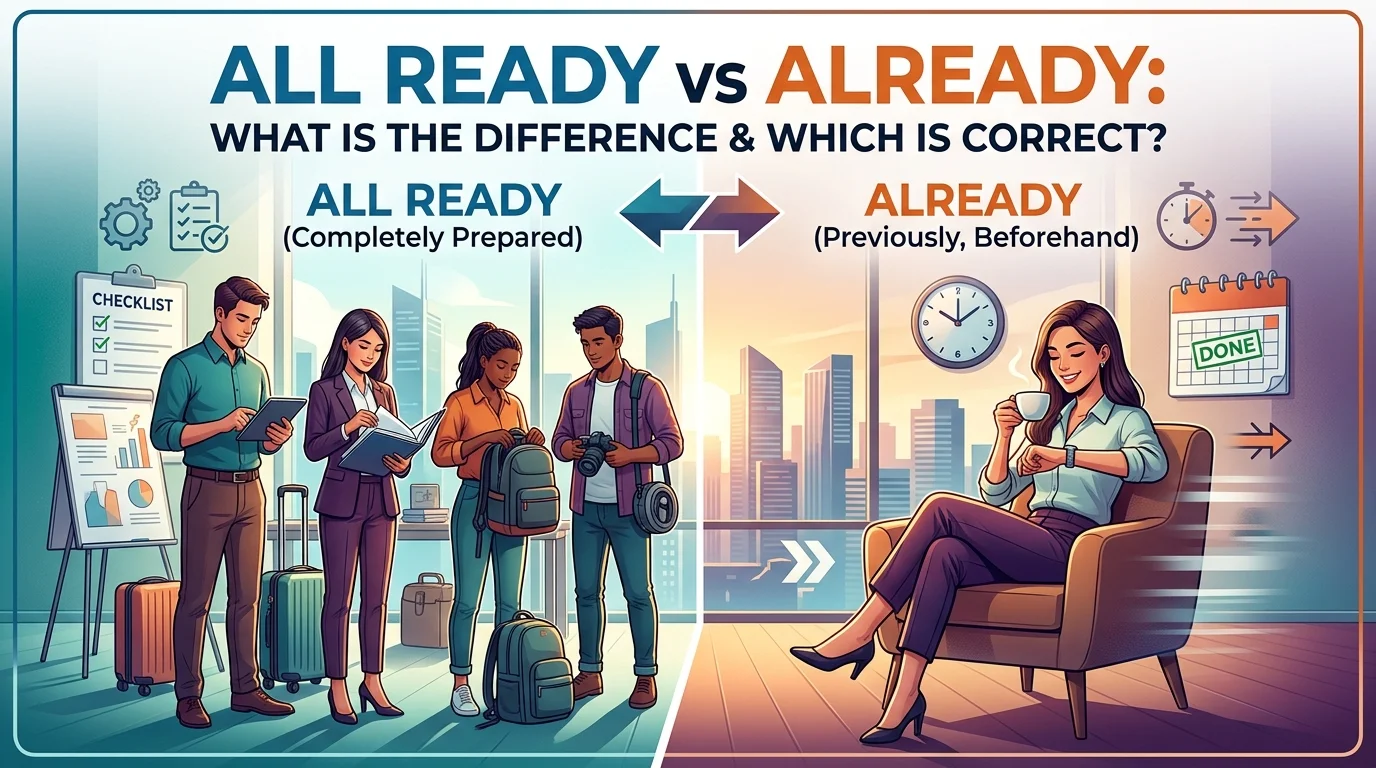
Many English learners confuse all ready and already because they look and sound similar. However, these two expressions have completely different meanings and grammatical functions. Understanding the difference can help you write and speak more accurately. In this guide, you’ll learn their definitions, usage rules, examples, common mistakes, and practical tips for choosing the correct form every time.
Comparison Overview
All ready and already may appear nearly identical, but they serve different purposes in English grammar.
| Feature | All Ready | Already |
| Type | Phrase | Adverb |
| Meaning | Completely prepared | Before now or earlier than expected |
| Usage | Describes readiness | Describes time |
| Example | We are all ready to leave. | We have already left. |
| Grammar Role | Adjective phrase | Adverb |
The key difference is simple: all ready refers to being prepared, while already refers to something happening before a particular time.
Definition of All Ready
All ready is a phrase made up of two separate words:
- All means completely or entirely.
- Ready means prepared.
When used together, all ready means fully prepared or completely ready for something.
Examples
- We are all ready for the presentation.
- The students were all ready for the exam.
- She is all ready to begin her speech.
- The team is all ready for the competition.
- They were all ready when the bus arrived.
Definition of Already
Already is an adverb that means before now, previously, or earlier than expected.
It is used to show that an action has happened before a certain time.
Examples
- I have already completed my homework.
- She already knows the answer.
- They already left the office.
- We have already discussed this topic.
- The package has already arrived.
Main Differences Between All Ready and Already
Although they sound alike, their meanings are entirely different.
| Aspect | All Ready | Already |
| Meaning | Fully prepared | Previously or before now |
| Function | Describes readiness | Describes timing |
| Part of Speech | Phrase (all + adjective) | Adverb |
| Answers Question | “Prepared for what?” | “When?” |
| Example | We are all ready. | We already finished. |
Key Difference
- Use all ready when talking about preparation.
- Use already when talking about time.
Compare:
- We are all ready for the trip. ✅
- We have already started the trip. ✅
Why Learners Confuse These Words
Several factors cause confusion:
- They sound very similar.
- Both contain the word “ready.”
- They are often used in everyday conversation.
- Fast speech can make them sound identical.
- Many learners assume they are interchangeable.
Understanding their grammatical roles helps eliminate this confusion.
Comparison Table with Examples
| Sentence | Correct Word |
| We are ______ for the meeting. | All ready |
| The meeting has ______ started. | Already |
| The children were ______ to go home. | All ready |
| She had ______ submitted the report. | Already |
| Everyone is ______ for the game. | All ready |
| They have ______ eaten dinner. | Already |
Grammar Guide
How Each Term Is Used in Sentences
All Ready
Pattern:
Subject + be verb + all ready + for/to + something
Examples:
- We are all ready to begin.
- The workers are all ready for the project.
- She was all ready to leave.
Already
Pattern:
Subject + already + verb
or
Subject + has/have/had + already + past participle
Examples:
- I already know the answer.
- She has already called me.
- They had already finished the work.
Common Mistakes Learners Make
Mistake 1
❌ We are already for the trip.
✅ We are all ready for the trip.
Mistake 2
❌ I have all ready finished my homework.
✅ I have already finished my homework.
Mistake 3
❌ They are already to start.
✅ They are all ready to start.
Mistake 4
❌ She is all ready completed the task.
✅ She has already completed the task.
Simple Rules to Remember
- If you mean prepared, use all ready.
- If you mean earlier than expected, use already.
- Already usually relates to time.
- All ready usually follows a form of the verb “be.”
- Replace already with “previously.” If the sentence still makes sense, use already.
Quick Tips for Writing and Speaking
- Think “prepared” = all ready.
- Think “before now” = already.
- Check whether you’re discussing readiness or timing.
- In formal writing, proofread carefully because spell-checkers may not catch the mistake.
- Practice by creating your own example sentences.
When to Use Each One
Use All Ready When:
- Talking about preparation.
- Describing people ready for an event.
- Explaining readiness for tasks.
- Discussing planned activities.
- Showing complete preparedness.
Examples:
- The athletes are all ready.
- We are all ready for takeoff.
- The class is all ready to begin.
Use Already When:
- Referring to completed actions.
- Talking about previous events.
- Indicating something happened sooner than expected.
- Describing past completion.
- Discussing existing knowledge.
Examples:
- I already know that.
- She has already arrived.
- They already completed the project.
When NOT to Use Each One
Do Not Use All Ready When:
- Referring to past completion.
- Talking about earlier events.
- Expressing previous actions.
Incorrect:
- I have all ready finished the report. ❌
Correct:
- I have already finished the report. ✅
Do Not Use Already When:
- Describing preparation.
- Talking about readiness.
- Explaining whether someone is prepared.
Incorrect:
- We are already for the exam. ❌
Correct:
- We are all ready for the exam. ✅
Which One to Use (Decision Guide)
Ask yourself this question:
Are you talking about being prepared?
If yes, use all ready.
Example:
- The players are all ready for the match.
Are you talking about something happening before now?
If yes, use already.
Example:
- The match has already started.
Quick Decision Chart
| Question | Use |
| Does it mean prepared? | All Ready |
| Does it mean before now? | Already |
| Refers to readiness? | All Ready |
| Refers to timing? | Already |
Real-World Practical Examples
All Ready Examples
- Education: The students are all ready for the final exam.
- Daily Life: We are all ready to leave for dinner.
- Business: The staff is all ready for the conference.
- Technology: The system is all ready for deployment.
- Conversation: I’m all ready whenever you are.
- Sports: The team is all ready for the tournament.
- Travel: The passengers are all ready to board.
Already Examples
- Education: The teacher has already graded the papers.
- Daily Life: I already cleaned my room.
- Business: The company already approved the budget.
- Technology: The software has already been updated.
- Science: Researchers already collected the data.
- Conversation: I already told you that.
- Travel: We already booked the hotel.
Self-Assessment (Fill in the Blanks)
- We are ______ for the school trip.
- The train has ______ departed.
- The students were ______ for the test.
- She has ______ submitted her assignment.
- They are ______ to begin the meeting.
- I ______ know the answer.
- The athletes are ______ for the race.
- We have ______ completed the project.
- Everyone is ______ for the ceremony.
- The guests have ______ arrived.
- The workers were ______ to start construction.
- He had ______ left when I called.
- The class is ______ for the presentation.
- I have ______ seen that movie.
- The passengers are ______ for boarding.
- The report has ______ been sent.
- The children are ______ for bed.
- She ______ finished her lunch.
- The performers were ______ before the show.
- We have ______ discussed this issue.
Answers
- all ready
- already
- all ready
- already
- all ready
- already
- all ready
- already
- all ready
- already
- all ready
- already
- all ready
- already
- all ready
- already
- all ready
- already
- all ready
- already
Final Verdict
The distinction between all ready and already comes down to one simple idea: all ready means fully prepared, while already means before now or earlier than expected. Although they sound similar, they serve completely different grammatical purposes. Use all ready when discussing readiness, preparation, or being prepared for an activity. Use already when referring to actions or situations that have happened previously. If you remember that all ready = prepared and already = earlier, you’ll avoid one of the most common spelling and grammar mistakes in English. With regular practice and attention to context, choosing the correct form becomes easy and natural.
Conclusion About All Ready vs Already
Understanding the difference between all ready and already can significantly improve your English writing and speaking skills. While these terms may sound almost identical, their meanings are completely different. All ready refers to being fully prepared for something, whereas already indicates that an action has happened before now or sooner than expected. Knowing this distinction helps you avoid common grammar mistakes and communicate more clearly in everyday conversations, academic writing, business communication, and professional settings. Whenever you are unsure which form to use, ask yourself whether you are talking about readiness or timing. If the sentence relates to preparation, choose all ready. If it refers to something that has happened previously, choose already. With a little practice and attention to context, using these words correctly becomes simple. Mastering this pair will make your English more accurate, natural, and confident.
FAQs
What is the main difference between all ready and already?
The main difference is that all ready means fully prepared, while already means before now or earlier than expected. One refers to readiness and preparation, while the other refers to time. Understanding this distinction helps prevent one of the most common word usage mistakes in English.
Is all ready one word or two words?
All ready is always written as two separate words. It combines the word all, meaning completely, with ready, meaning prepared. Together, they describe someone or something that is fully prepared for an activity, event, or task.
Is already a verb or an adverb?
Already is an adverb. It modifies a verb by indicating that an action has happened before a certain time or sooner than expected. It often appears with present perfect and past perfect verb forms, but it can also be used in simple tenses.
How can I remember when to use all ready?
A simple trick is to think about the word ready. If the sentence is about preparation or being prepared, use all ready. If you can replace the phrase with “fully prepared” and the sentence still makes sense, all ready is likely correct.
How can I remember when to use already?
Think about time. If the sentence means something happened earlier than expected or before now, use already. You can often replace it with words like “previously” or “by now” to check whether it fits the context.
Can all ready and already be used interchangeably?
No, they cannot be used interchangeably because they have different meanings and grammatical functions. Using one in place of the other can make a sentence incorrect or confusing. Always determine whether you are talking about readiness or timing.
Which word is more common in everyday English?
Already is generally more common because it is frequently used in conversations about completed actions and previous events. However, all ready is also common when discussing preparation, especially before meetings, trips, performances, or important activities.
Is it correct to say “We are already for the meeting”?
No, that sentence is incorrect. Since the sentence is about preparation, the correct phrase is all ready. The correct version is: “We are all ready for the meeting.” Already would not make sense in that context.
Can already be used in questions?
Yes, already can be used in questions, especially when expressing surprise or seeking confirmation. For example: “Have you already finished your homework?” In this sentence, already suggests that the speaker thinks the action may have happened sooner than expected.
Why do English learners confuse all ready and already?
Many learners confuse them because they sound very similar when spoken. Additionally, both contain the word ready, which makes them appear related. Learning their meanings, grammatical roles, and common sentence patterns helps eliminate this confusion quickly.

Daniel Brooks is an English educator with a passion for explaining similes and word comparisons in plain language. He covers topics like versus meanings, correct usage, and figurative language to help writers avoid common mistakes and improve clarity in everyday writing.