
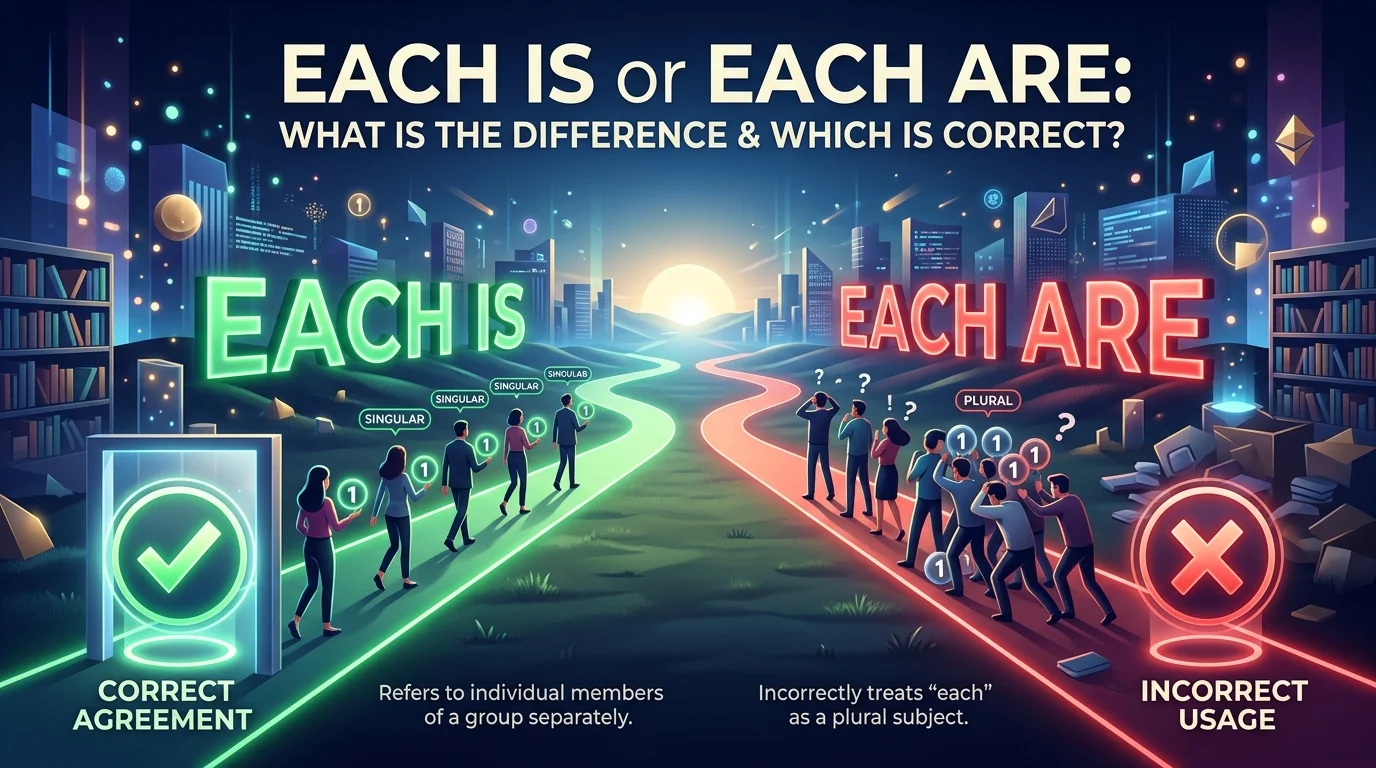
Understanding whether to use “each is” or “each are” can be confusing for many English learners. These phrases look similar but follow different grammatical rules. This comparison will help you clearly understand which form is correct, why it matters, and how to use them confidently in everyday writing and speaking.
Comparison Overview
“Each is” and “each are” both relate to the word “each,” which refers to individual items in a group. However, English grammar treats “each” as singular, even when talking about multiple things. Because of this, these expressions are often used differently depending on sentence structure, context, and agreement rules.
Definition of Each Is
“Each is” is a grammatically correct phrase used when referring to individual items one by one. The word “each” is singular, so it takes a singular verb like “is.”
It emphasizes separate consideration of every item in a group.
Definition of Each Are
“Each are” is generally considered grammatically incorrect in standard English. However, it sometimes appears in informal speech or in sentences where “each of” is followed by a plural noun, which can confuse learners.
In formal writing, “each are” should be avoided.
Main Differences Between Each Is and Each Are
The main difference lies in grammatical agreement.
“Each is” follows correct subject-verb agreement because “each” is singular. For example, “Each student is responsible for their homework.”
“Each are” appears incorrect because “each” does not take a plural verb on its own.
In some cases, confusion arises when “each of them” or “each of the students” is used, but even then, the verb usually agrees with “each” as singular.
Key Comparison Table
| Feature | Each Is | Each Are |
| Grammar correctness | Correct | Incorrect (standard usage) |
| Subject type | Singular | Incorrect pairing |
| Verb agreement | Singular verb (is) | Plural verb (are) |
| Usage style | Formal and standard | Informal or incorrect |
Grammar Guide
“Each” is always treated as singular in formal grammar. Therefore, it pairs with singular verbs like “is,” “was,” or “has.”
a = singular(\text{each}) \Rightarrow \text{verb} = \text{is}
This rule helps maintain subject-verb agreement in sentences where individual items are being considered separately.
How each term is used in sentences
“Each is” is used when describing items individually:
- Each book is on the table.
- Each student is ready for the exam.
- Each answer is correct.
“Each are” is not standard, but learners sometimes mistakenly use it when they see plural nouns nearby.
Common mistakes learners make
Many learners mistakenly match “each” with plural verbs because they focus on the noun that follows, not the word “each” itself. For example:
- Incorrect: Each of the boys are happy.
- Correct: Each of the boys is happy.
Another mistake is assuming “each” changes depending on context. It does not; it remains singular.
Simple rules to remember
Think of “each” as “one by one.” Even if there are many items, you are still talking about one at a time.
If you can replace “each” with “every single one,” then use a singular verb.
Quick tips for writing and speaking
Always check the subject first, not the noun after “of.” Focus on “each” as the true subject. When in doubt, use “is” instead of “are” after “each.”
When to Use Each One
Use “each is” when referring to individual items in a group being considered separately. This applies in education, daily life, business instructions, and descriptions.
Avoid using “each are” in any formal context. If you see it, it is likely a grammatical error or informal usage.
When NOT to Use Each One
Do not use “each are” in academic writing, professional emails, exams, or formal communication.
Also avoid matching verbs with plural nouns that follow “each of.” The word “each” controls the verb, not the noun after “of.”
Which One to Use (Decision Guide)
If the subject contains the word “each,” choose a singular verb.
If you see “each of,” still treat it as singular in most formal cases.
Ask yourself: Am I referring to individuals one by one? If yes, use “each is.”
Real-World Practical Examples
Each Is Examples
- Each student is required to submit homework on time.
- Each phone is checked before shipping.
- Each employee is trained before starting work.
- Each answer is reviewed carefully by the teacher.
- Each product is tested for quality control.
Each Are Examples
- Each are available in different colors. (Incorrect usage)
- Each are important for success. (Incorrect usage)
- Each are placed on the shelf. (Incorrect usage)
- Each are ready for delivery. (Incorrect usage)
- Each are selected carefully. (Incorrect usage)
Self-Assessment (Fill in the Blanks)
- Each student ______ responsible for their work.
- Each of the apples ______ fresh.
- Each book ______ placed on the desk.
- Each of the players ______ ready.
- Each item ______ checked twice.
- Each of the cars ______ new.
- Each employee ______ trained properly.
- Each of the answers ______ correct.
- Each box ______ labeled clearly.
- Each of the teams ______ competing well.
- Each device ______ tested before shipping.
- Each of the chairs ______ comfortable.
- Each problem ______ solved carefully.
- Each of the students ______ present today.
- Each machine ______ inspected regularly.
- Each of the bags ______ heavy.
- Each lesson ______ easy to understand.
- Each of the windows ______ open.
- Each task ______ completed on time.
- Each of the workers ______ skilled.
Answers
- is
- is
- is
- is
- is
- is
- is
- is
- is
- is
- is
- is
- is
- is
- is
- is
- is
- is
- is
- is
Final Verdict
“Each is” is the correct and standard form in English grammar because “each” is always treated as singular. The phrase “each are” is generally incorrect and should be avoided in formal communication. Understanding this rule helps improve sentence accuracy and clarity. Whenever you see “each,” think singular and choose “is” for correct usage in most cases.
Conclusion About Each Is or Each Are
Understanding the difference between each is and each are is essential for building strong English grammar skills and improving overall communication clarity. The main rule is simple: “each” is always treated as singular, even when it refers to multiple items in a group. Because of this, it naturally pairs with singular verbs like “is.” Many learners get confused when they see plural nouns in the same sentence, but the agreement rule depends on “each,” not the noun that follows it. Using each is correctly helps create clear, accurate, and professional sentences in both writing and speaking. Whether you are preparing academic work, writing emails, or speaking in daily conversations, this rule ensures better confidence and correctness. With regular practice, this concept becomes easy to remember and greatly improves your English fluency over time.
FAQs About Each Is or Each Are
Why is each is correct in English grammar?
“Each is” is correct because “each” is always singular. Even though it refers to multiple items, it treats them individually, so it requires a singular verb like “is” for proper subject verb agreement.
Is each are ever correct in any situation?
In standard English, “each are” is not correct. It does not follow grammar rules. However, it may appear in informal speech or writing errors, but it should be avoided in formal communication.
Why do learners get confused with each of the?
Learners often focus on the plural noun after “of” and mistakenly use a plural verb. However, the true subject is “each,” which remains singular, so the verb must also be singular.
Should I use is or are with each of the students?
You should use “is” because “each of the students” is still singular in grammar. The word “each” controls the verb, not the plural noun “students.”
Can each refer to more than one item?
Yes, “each” can refer to multiple items, but it considers them one by one. That is why it still takes a singular verb even when describing a group.
What is the easiest rule to remember for each?
A simple rule is to think of “each” as meaning “one by one.” Since it focuses on individuals, it always pairs with singular verbs like “is,” “was,” or “has.”
Why is verb agreement important with each?
Verb agreement ensures sentences are grammatically correct and easy to understand. Using the correct form with “each” prevents confusion and improves clarity in communication.
Is each used differently in spoken English?
No, the rule stays the same in spoken and written English. “Each is” remains correct in all situations, whether formal or informal speech.
What mistake happens most with each?
The most common mistake is matching the verb with the nearest noun instead of “each.” This leads to incorrect forms like “each are,” which should be avoided.
How can I practice using each correctly?
You can practice by writing simple sentences and focusing on “each” as the subject. Repetition and reading correct examples help reinforce proper usage over time.

Sarah Mitchell is an experienced writer and grammar teacher with over 10 years of expertise in English language education. She helps learners improve their grammar, writing, and communication skills through clear explanations and practical examples. Sarah creates learner-friendly content focused on real-life English, making language learning simple, effective, and confidence-building.