
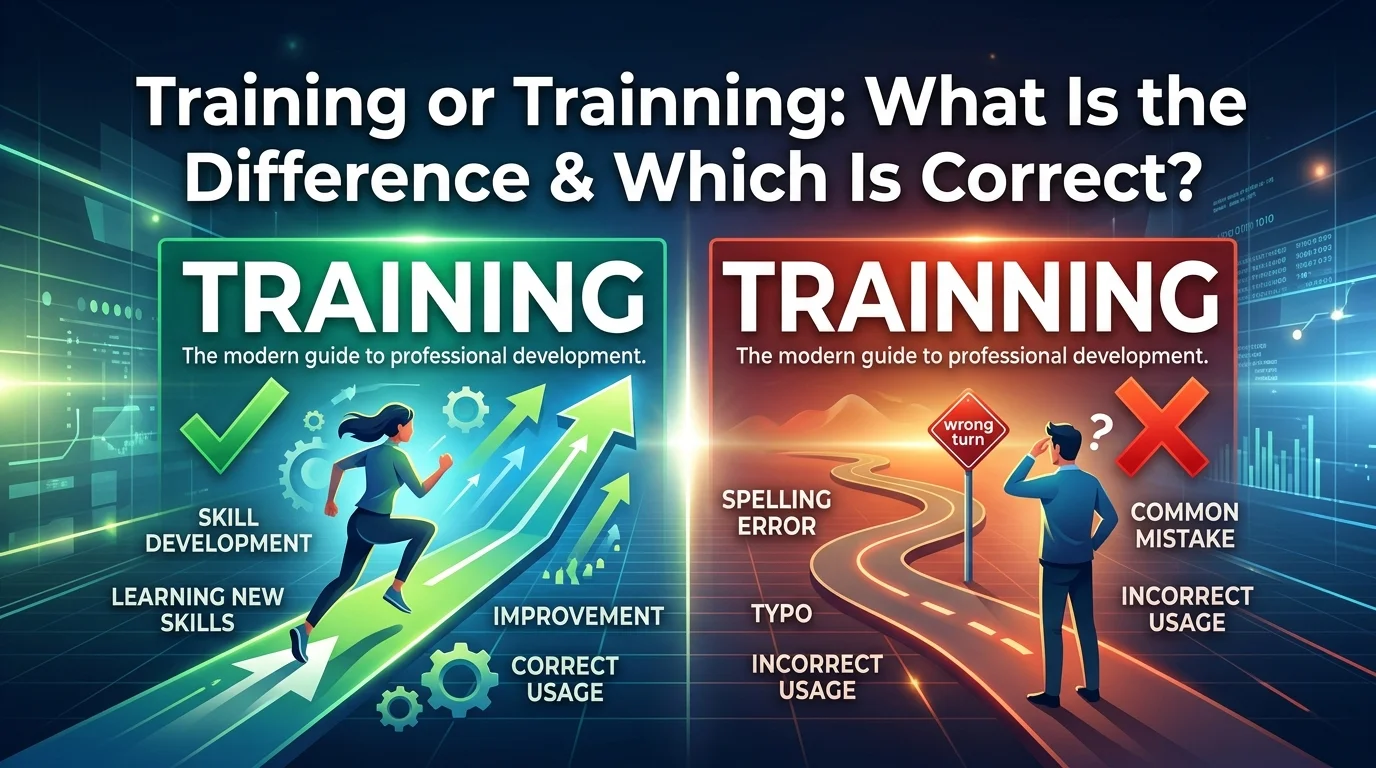
Have you ever wondered whether you should write training or trainning? This is a common spelling confusion, especially for English learners and writers who are unsure about spelling rules when adding suffixes to words. Understanding the difference is important because one form is correct English, while the other is considered a spelling mistake.
Comparison Overview
The terms training and trainning look very similar, but they are not equally accepted in English. Training is the correct spelling and is widely used in education, business, sports, technology, and everyday communication. Trainning, on the other hand, is a misspelling and does not exist as a standard English word.
| Feature | Training | Trainning |
| English Word | Yes | No |
| Correct Spelling | Yes | No |
| Dictionary Entry | Yes | No |
| Common Usage | Very Common | Incorrect Usage |
| Recommended for Writing | Yes | No |
Definition of Training
Training is a noun that refers to the process of learning skills, gaining knowledge, or improving abilities through practice, instruction, or experience.
It can be used in many contexts such as education, employment, sports, military activities, technology, and personal development.
Examples:
- Employee training improves workplace performance.
- The athlete completed intense training before the competition.
- Safety training is mandatory for new workers.
- The software training session lasted two hours.
- Teacher training helps educators develop new skills.
Definition of Trainning
Trainning is not a recognized English word.
It is simply a spelling error that occurs when people incorrectly double the letter “n” while adding the suffix “-ing” to the verb train.
Examples of incorrect usage:
- ❌ I attended a trainning session.
- ❌ The company provides trainning programs.
Correct versions:
- ✅ I attended a training session.
- ✅ The company provides training programs.
Main Differences Between Training and Trainning
The primary difference is simple:
| Aspect | Training | Trainning |
| Meaning | Learning or skill development process | No meaning |
| Grammar Status | Correct | Incorrect |
| Dictionary Recognition | Yes | No |
| Professional Writing | Accepted | Not Accepted |
| Academic Writing | Accepted | Not Accepted |
Key points:
- Training is the standard English spelling.
- Trainning is a spelling mistake.
- Dictionaries, style guides, and grammar references recognize only training.
- Professional and academic writing should always use training.
Why People Confuse Training and Trainning
Many learners mistakenly believe that the final consonant should be doubled before adding -ing.
For example:
- Run → Running
- Sit → Sitting
However, not all verbs follow this rule.
With train, the vowel pattern does not require doubling the final consonant.
Correct formation:
Train + ing = Training
Incorrect formation:
Train + n + ing = Trainning
Comparison Table
| Word | Correct? | Part of Speech | Meaning |
| Training | Yes | Noun | Process of learning skills |
| Trainning | No | None | Misspelling |
Grammar Guide
How Each Term Is Used in Sentences
Training
Pattern:
Subject + training + additional information
Examples:
- The company offers training programs.
- Training helps employees improve performance.
- She completed leadership training.
- Training is necessary for safety.
- The team started training early.
Trainning
Incorrect in all sentence structures.
Examples:
- ❌ We attended trainning.
- ❌ Trainning improves skills.
Common Mistakes Learners Make
- Adding an extra “n” before “-ing.”
- Assuming all verbs double the final consonant.
- Copying incorrect spellings from social media.
- Using trainning in academic assignments.
- Using trainning in business communication.
Simple Rules to Remember
- The correct spelling is always training.
- Never double the “n” in train.
- Think of the base word: train.
- Add “-ing” directly to create training.
- If you see trainning, it is incorrect.
Quick Tips for Writing and Speaking
- Use spell-check tools.
- Remember that dictionaries list only training.
- Proofread professional documents carefully.
- Practice writing the word correctly.
- Associate training with learning and development.
When to Use Each One
Use Training When:
- Referring to skill development.
- Talking about employee education.
- Discussing sports preparation.
- Mentioning educational programs.
- Describing practice activities.
Examples:
- Staff training begins Monday.
- The athlete’s training paid off.
- Training improved customer service.
- First aid training is required.
- Technical training helps new users.
Use Trainning When:
Never.
It should not be used in formal or informal English because it is a spelling mistake.
When NOT to Use Each One
Do Not Use Training
Only when another word better fits the context.
Examples:
- Education
- Coaching
- Teaching
- Practice
- Instruction
Do Not Use Trainning
In:
- Academic papers
- Business emails
- Reports
- Websites
- Social media posts
- Job applications
- Professional documents
Which One to Use (Decision Guide)
Ask yourself these questions:
- Are you talking about learning, practice, or skill development?
- Use training.
- Is the word spelled with two “n” letters?
- Correct it to training.
- Are you writing for school, work, or publication?
- Always use training.
Decision Summary:
| Situation | Correct Choice |
| Learning new skills | Training |
| Workplace development | Training |
| Sports preparation | Training |
| Educational programs | Training |
| Any use of Trainning | Incorrect |
Real-World Practical Examples
Training Examples
Education
- Teacher training improves classroom effectiveness.
- Student training workshops teach research skills.
- Online training supports remote learning.
- Training sessions help teachers use technology.
- Professional training enhances qualifications.
Daily Life
- Driving training increases road safety.
- Fitness training improves health.
- Pet training helps animals learn commands.
- Cooking training develops culinary skills.
- Self-defense training builds confidence.
Science
- Laboratory training reduces mistakes.
- Research training improves data collection.
- Training helps scientists use equipment safely.
- Medical training prepares healthcare workers.
- Environmental training promotes awareness.
Business
- Employee training boosts productivity.
- Leadership training develops managers.
- Sales training improves performance.
- Customer service training increases satisfaction.
- Training programs reduce workplace errors.
Technology
- Software training helps users learn applications.
- Cybersecurity training protects organizations.
- Technical training improves IT skills.
- AI training enhances system performance.
- Digital training supports modernization.
Trainning Examples
Since trainning is incorrect, the following examples demonstrate errors:
- ❌ Employee trainning
- ❌ Safety trainning
- ❌ Leadership trainning
- ❌ Technical trainning
- ❌ Sports trainning
Correct versions:
- ✅ Employee training
- ✅ Safety training
- ✅ Leadership training
- ✅ Technical training
- ✅ Sports training
Self-Assessment (Fill in the Blanks)
- Employee ______ improves workplace performance.
- The correct word is ______ because it is recognized in dictionaries.
- Safety ______ is required for all staff.
- The athlete completed intensive ______ before the event.
- The company organized a leadership ______ course.
- The correct spelling is ______ not trainning.
- Technical ______ helps employees use new software.
- New workers receive safety ______.
- The teacher attended professional ______.
- Cybersecurity ______ protects organizations.
- The correct word is ______ because trainning is incorrect.
- Medical ______ prepares healthcare professionals.
- Fitness ______ improves physical health.
- Research ______ develops scientific skills.
- Customer service ______ increases satisfaction.
- The correct word is ______ because English spelling rules support it.
- Online ______ helps remote learners.
- Driver ______ improves road awareness.
- Workplace ______ reduces mistakes.
- The accepted English spelling is ______.
Answers
- Training
- Training
- Training
- Training
- Training
- Training
- Training
- Training
- Training
- Training
- Training
- Training
- Training
- Training
- Training
- Training
- Training
- Training
- Training
- Training
Final Verdict
When comparing training and trainning, the answer is straightforward. Training is the only correct English spelling and is used to describe the process of learning, practicing, and developing skills. It appears in dictionaries, academic writing, business communication, education, sports, and everyday English. Trainning is simply a spelling mistake created by incorrectly doubling the letter “n.” Whenever you need to refer to instruction, practice, skill development, or professional learning, choose training with confidence. Remember the simple rule: add -ing directly to train, resulting in training, never trainning.
Conclusion About Training or Trainning
Understanding the difference between training and trainning is much easier once you know the basic spelling rule. Training is the correct and accepted English word used to describe the process of learning, practicing, or developing skills in areas such as education, business, sports, technology, and personal growth. In contrast, trainning is simply a misspelling and should be avoided in both formal and informal writing. Whether you are preparing a report, sending a professional email, completing schoolwork, or creating online content, using the correct spelling helps improve clarity and credibility. Remember that the verb train becomes training by adding -ing without doubling the final letter. Keeping this simple rule in mind will help you avoid common mistakes and communicate more effectively. When in doubt, choose training, as it is always the correct form recognized by standard English grammar and dictionaries.
FAQs
Is training the correct spelling?
Yes, training is the correct spelling. It is a standard English noun that refers to the process of learning, practicing, or improving skills. It is recognized by dictionaries and widely used in professional, academic, and everyday communication.
Is trainning a real word?
No, trainning is not a real English word. It is a spelling mistake that occurs when people incorrectly add an extra letter “n” while forming the word from the verb train.
Why do people write trainning instead of training?
Many learners assume that the final consonant should be doubled before adding -ing. While some words follow that rule, train does not. Therefore, the correct form is training, not trainning.
What does training mean?
Training refers to the process of gaining knowledge, skills, or experience through instruction, practice, or guidance. It can apply to education, sports, workplace development, technology, and many other fields.
Can I use trainning in formal writing?
No, you should never use trainning in formal writing. Since it is a misspelling, using it in reports, essays, business documents, or professional communication can reduce credibility and create confusion.
How do you spell employee training correctly?
The correct phrase is employee training. It refers to programs or activities designed to help workers develop skills, improve performance, and understand workplace responsibilities more effectively.
Is training a noun or a verb?
Training is primarily a noun that describes the act or process of learning skills. The related verb is train, which means to teach, instruct, or prepare someone for a specific activity or role.
What are common examples of training?
Common examples include employee training, leadership training, fitness training, safety training, software training, teacher training, and sports training. All of these involve learning or improving specific skills and knowledge.
How can I remember the correct spelling of training?
A simple way to remember it is to start with the base word train and add -ing. Since the word does not require a doubled consonant, the correct result is always training.
Does spell check recognize trainning?
Most modern spell-check tools identify trainning as an error and suggest training as the correct spelling. However, proofreading is still important to ensure accuracy in your writing.

Ethan Clarke is a language writer who specializes in breaking down similes, word meanings, and commonly confused terms. His work focuses on clear explanations, practical examples, and simple comparisons that help readers understand how English