
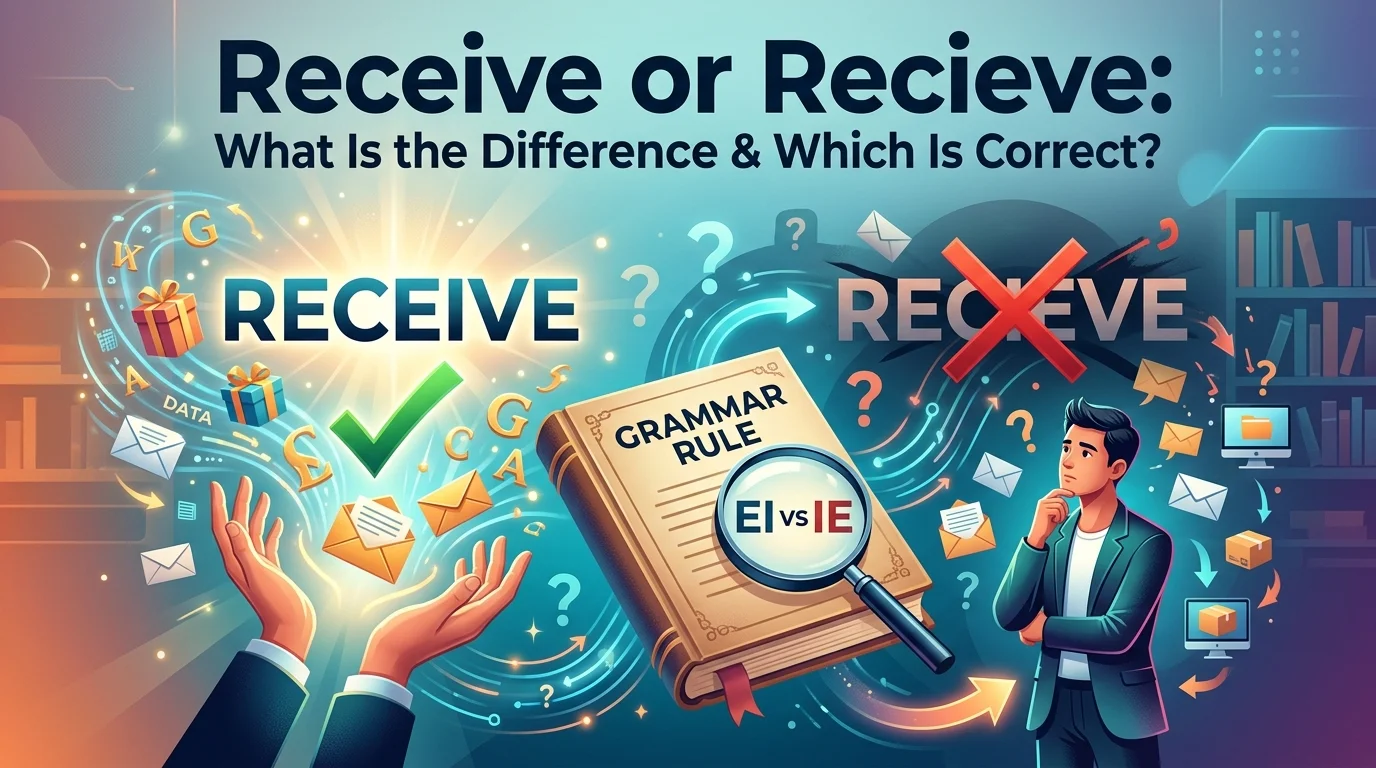
Many English learners and even native speakers get confused between receive and recieve because the spelling looks very similar. However, only one of these forms is correct in standard English. Understanding the difference helps improve spelling, writing accuracy, and overall communication skills. This guide explains everything you need to know about receive vs recieve.
Comparison Overview
The words receive and recieve are often compared because they differ by only two letters. The confusion comes from the placement of “ei” and “ie” within the word. While one is the accepted spelling used in English dictionaries, the other is a common misspelling. Knowing which version to use can help you avoid grammar and spelling mistakes in academic, professional, and everyday writing.
| Term | Meaning | Correct or Incorrect |
| Receive | To get, accept, or be given something | Correct |
| Recieve | Common misspelling of receive | Incorrect |
Definition of Receive
Receive is a verb that means to get, obtain, accept, or take something that is given, sent, or delivered.
It is commonly used when talking about receiving messages, gifts, payments, information, awards, or instructions.
Examples:
- I received a package this morning.
- She will receive the results tomorrow.
- We received helpful feedback from customers.
Definition of Recieve
Recieve is not a recognized English word.
It is simply a spelling mistake of receive. The error usually happens because many people mistakenly apply the “i before e” rule and place the letters in the wrong order.
Examples of incorrect usage:
- Incorrect: I will recieve your email.
- Incorrect: Did you recieve the package?
- Incorrect: She hopes to recieve an award.
Correct versions:
- I will receive your email.
- Did you receive the package?
- She hopes to receive an award.
Main Differences Between Receive and Recieve
The primary difference is that receive is the correct spelling, while recieve is incorrect.
| Feature | Receive | Recieve |
| Dictionary Word | Yes | No |
| Correct English Spelling | Yes | No |
| Used in Formal Writing | Yes | No |
| Used in Exams | Yes | No |
| Accepted Grammar | Yes | No |
Other differences include:
- Receive follows standard English spelling conventions.
- Recieve is considered a spelling error.
- Spell checkers usually flag “recieve” as incorrect.
- Professional and academic writing always use “receive.”
Why People Confuse Receive and Recieve
Many learners remember the phrase:
“i before e except after c.”
Since receive comes after the letter c, the correct spelling becomes ei rather than ie.
This spelling rule explains why receive is written correctly as:
- r-e-c-e-i-v-e
and not:
- r-e-c-i-e-v-e
Common Words Similar to Receive
The same spelling pattern appears in other words:
| Correct Word | Incorrect Form |
| Receive | Recieve |
| Perceive | Percieve |
| Conceive | Concieve |
| Deceive | Decieve |
These words also use ei after the letter c.
Grammar Guide
How Each Term Is Used in Sentences
Receive
Pattern:
Subject + receive/receives/received + object
Examples:
- I receive newsletters weekly.
- She receives many emails.
- They received an invitation yesterday.
- We will receive updates soon.
- The company received payment.
Recieve
This form should not be used in any sentence because it is misspelled.
Common Mistakes Learners Make
- Writing recieve instead of receive.
- Applying the “i before e” rule incorrectly.
- Typing quickly and reversing the letters.
- Not proofreading written content.
- Repeating the error after seeing it online.
Simple Rules to Remember
- After the letter c, use ei in receive.
- Think: “Receive has C before EI.”
- If you see “recieve,” it is wrong.
- Dictionaries only recognize “receive.”
Quick Tips for Writing and Speaking
- Double-check spelling before submitting documents.
- Use spell-check tools.
- Memorize the phrase “receive after c uses ei.”
- Practice writing the word several times.
- Read professionally written content regularly.
When to Use Each One
Use receive when referring to getting, accepting, obtaining, or being given something.
Examples:
- Receive an email.
- Receive a gift.
- Receive instructions.
- Receive treatment.
- Receive an award.
Use recieve never, because it is not a correct English word.
When NOT to Use Each One
Do not use receive if you are trying to describe giving something. In that case, use verbs such as:
- send
- give
- deliver
- provide
Do not use recieve under any circumstance because it is always considered a spelling error.
Which One to Use (Decision Guide)
Ask yourself these questions:
- Are you talking about getting or accepting something?
- Use receive.
- Are you writing “recieve”?
- Correct it to receive.
- Is the word appearing in formal, academic, business, or professional writing?
- Always use receive.
- Does the word follow the “after c, use ei” pattern?
- Yes, then use receive.
Decision:
✅ Receive = Correct
❌ Recieve = Incorrect
Real-World Practical Examples
Receive Examples
Education
- Students receive report cards every semester.
- She received excellent grades.
Daily Life
- I received a birthday gift from my friend.
- We receive mail every morning.
Science
- Plants receive energy from sunlight.
Business
- The company received customer feedback.
- Employees receive monthly salaries.
Technology
- Users receive notifications instantly.
- I received a password reset email.
Conversation
- Did you receive my message?
Recieve Examples
The following examples are incorrect:
- I will recieve the package tomorrow.
- She did not recieve the email.
- We hope to recieve approval.
- Did you recieve the document?
- They recieve updates weekly.
Correct all of these by replacing recieve with receive.
Self-Assessment (Fill in the Blanks)
- I will ______ the package tomorrow.
- She hopes to ______ an award.
- The correct spelling is ______.
- We ______ emails every day.
- Students ______ feedback from teachers.
- The incorrect spelling is ______.
- I did not ______ your message.
- Employees ______ salaries monthly.
- The company will ______ payment soon.
- Scientists ______ data from experiments.
- The correct word is ______ because it follows the spelling rule after c.
- Please ______ the attached file.
- Customers ______ support from the company.
- I hope to ______ good news.
- The teacher will ______ the assignment.
- The correct word is ______ because it is found in dictionaries.
- We ______ instructions before beginning.
- Hospitals ______ medical supplies regularly.
- The correct word is ______ because “recieve” is misspelled.
- You should ______ confirmation shortly.
Answers
- receive
- receive
- receive
- receive
- receive
- recieve
- receive
- receive
- receive
- receive
- receive
- receive
- receive
- receive
- receive
- receive
- receive
- receive
- receive
- receive
Final Verdict
When comparing receive and recieve, the answer is straightforward. Receive is the only correct spelling recognized in English grammar, dictionaries, schools, workplaces, and professional writing. It means to get, accept, or obtain something. Recieve, on the other hand, is simply a common spelling mistake caused by confusion over the order of the letters “i” and “e.” Whenever you need to talk about getting a message, gift, payment, award, or information, always use receive. Remember the helpful rule: after the letter c, the spelling becomes ei. Keeping this simple rule in mind will help you avoid one of the most common spelling mistakes in English and write with greater confidence and accuracy.
Conclusion About Receive or Recieve
Understanding the difference between receive and recieve is essential for accurate English writing. While the two spellings may look very similar, only receive is considered correct in standard English. It is a common verb that means to get, accept, or obtain something, whether it is a message, gift, payment, instruction, or information. In contrast, recieve is simply a misspelling that should be avoided in academic, professional, and everyday communication.
One of the easiest ways to remember the correct spelling is the familiar rule: “i before e except after c.” Since the word contains the letter c before the vowel pair, the correct form is receive. By practicing this spelling and recognizing common mistakes, you can write with greater confidence and avoid errors that may affect clarity and credibility. Whenever in doubt, choose receive and you’ll be using the correct English form.
FAQs
Is receive the correct spelling?
Yes, receive is the correct spelling in English. It is a verb that means to get, accept, or obtain something. This spelling is recognized by dictionaries, grammar guides, educational institutions, and professional writing standards worldwide.
Is recieve a real word?
No, recieve is not a real English word. It is a common spelling mistake caused by reversing the letters “i” and “e.” Whenever you see “recieve,” it should be corrected to receive.
Why do people spell receive as recieve?
Many people confuse the order of the letters because English spelling rules can be difficult to remember. The mistake often happens when writers incorrectly apply the “i before e” rule without considering the exception that follows the letter “c.”
What does receive mean?
Receive means to get, accept, obtain, or be given something. It can refer to physical items, messages, payments, information, awards, instructions, or any other thing that comes to a person or organization.
How can I remember the spelling of receive?
A helpful trick is to remember that receive follows the pattern “ei” after the letter “c.” Thinking of the phrase “after c comes ei” can make the correct spelling easier to recall when writing.
Is receive a verb or a noun?
Receive is a verb. It describes an action of getting or accepting something. The noun form is usually related words such as “reception” or “receipt,” depending on the context in which the word is used.
Can receive be used in formal writing?
Yes, receive is commonly used in formal writing, including academic papers, business documents, emails, reports, and professional communication. It is the standard and accepted spelling in all formal contexts.
What are some examples of receive in a sentence?
Examples include: “I received your email yesterday,” “Students receive grades at the end of the term,” and “The company received positive feedback from customers.” In each case, the word refers to obtaining something.
Are there other words similar to receive?
Yes, words such as perceive, conceive, and deceive follow a similar spelling pattern. Like receive, these words use “ei” after the letter “c,” which helps reinforce the spelling rule.
Should spell-check catch the word recieve?
Most modern spell-check tools recognize recieve as incorrect and suggest receive as the correction. However, it is still important to proofread your work carefully because spelling mistakes can occasionally go unnoticed.