
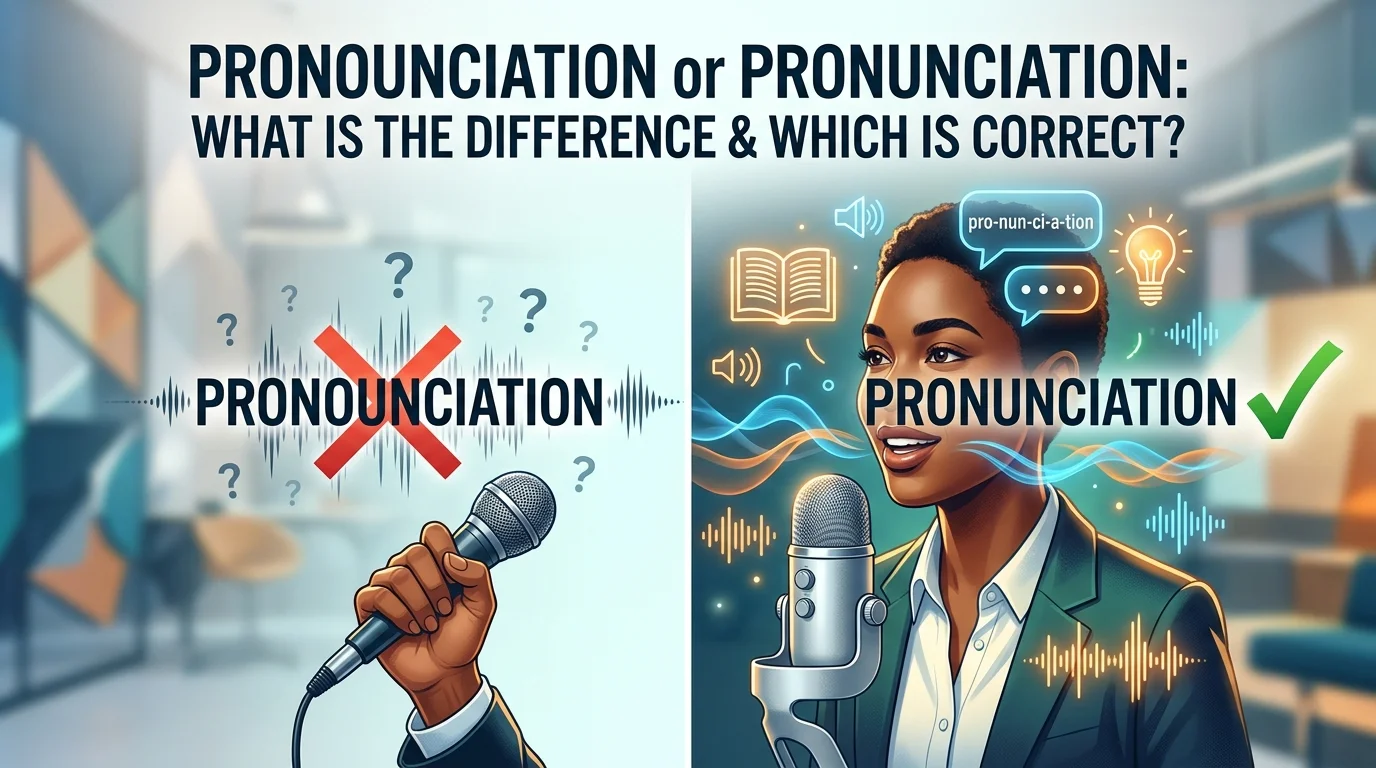
Many English learners and even native speakers sometimes confuse Pronounciation and Pronunciation because the words look and sound similar. This spelling mistake is extremely common in writing, education, and online communication. Understanding the difference is important because only one form is accepted in standard English. This guide explains the meanings, grammar, usage, examples, and practical rules so you can confidently choose the correct word every time.
Comparison Overview
The confusion between Pronounciation and Pronunciation comes from the verb pronounce. Many people assume the noun should contain the letters “ou” because they appear in the verb. However, English spelling does not always follow predictable patterns.
| Term | Status | Meaning |
| Pronounciation | Incorrect spelling | Not recognized in standard English |
| Pronunciation | Correct spelling | The way a word is spoken |
In modern English, pronunciation is the only correct spelling.
Definition of Pronounciation
Pronounciation is a common misspelling of the word pronunciation.
It is often created because people connect it directly to the verb pronounce. Although the spelling may seem logical, it is not accepted in dictionaries, academic writing, professional communication, or formal English.
Key Points
- Considered a spelling error
- Not a standard English word
- Should be avoided in formal and informal writing
- Often appears due to confusion with “pronounce”
Definition of Pronunciation
Pronunciation is the correct noun form that refers to the way a word, sound, or language is spoken.
It describes how sounds are produced and organized when speaking.
Key Points
- Correct English spelling
- Functions as a noun
- Used in education, linguistics, communication, and everyday speech
- Refers to spoken word sounds
Example:
“The pronunciation of this word is difficult for beginners.”
Main Differences Between Pronounciation and Pronunciation
| Feature | Pronounciation | Pronunciation |
| Correct English Word | No | Yes |
| Dictionary Recognition | No | Yes |
| Formal Writing | Incorrect | Correct |
| Academic Usage | Incorrect | Correct |
| Everyday Usage | Should be avoided | Recommended |
| Part of Speech | None | Noun |
The main difference is simple: Pronunciation is correct, while Pronounciation is a spelling mistake.
Why Do People Confuse These Words?
The confusion happens because of the verb pronounce.
People naturally expect the noun to be spelled:
Pronounce → Pronounciation
However, English developed differently, and the accepted noun became:
Pronounce → Pronunciation
This irregular spelling pattern causes mistakes among learners worldwide.
Historical Background of Pronunciation
The word pronunciation comes from Latin roots related to speaking and declaring. Over time, English standardized the spelling without the extra “ou” found in pronounce.
Although many people still write pronounciation, dictionaries and language authorities recognize only pronunciation.
Grammar Guide
How Each Term Is Used in Sentences
Pronounciation
Incorrect:
- Your pronounciation is excellent.
- I need help with my pronounciation.
These examples contain a spelling error.
Pronunciation
Correct:
- Your pronunciation is excellent.
- I need help with my pronunciation.
- The teacher corrected my pronunciation.
- Good pronunciation improves communication.
Common Mistakes Learners Make
Mistake 1
Writing:
“pronounciation”
Correct:
“pronunciation”
Mistake 2
Assuming the noun must match the spelling of “pronounce.”
English often changes spelling between related words.
Mistake 3
Using the misspelling in academic assignments.
Teachers and editors usually mark it as incorrect.
Simple Rules to Remember
- Pronunciation is always correct.
- Pronounciation is always incorrect.
- Remember that the noun drops the extra “ou.”
- Check spelling carefully in formal writing.
- Use dictionary verification when unsure.
Quick Tips for Writing and Speaking
- Always write pronunciation.
- Proofread educational documents.
- Use spell-check tools.
- Practice spelling alongside speaking.
- Remember: the correct noun does not match the spelling of “pronounce” exactly.
When to Use Each One
Use Pronunciation When
- Talking about how words sound
- Discussing language learning
- Teaching English
- Writing academic papers
- Giving speech advice
- Studying phonetics
Examples:
- Her pronunciation is clear.
- The pronunciation guide is helpful.
- Students practiced pronunciation today.
Use Pronounciation When
Never.
It is considered a spelling mistake and should be replaced with pronunciation.
When NOT to Use Each One
Do Not Use Pronounciation
Incorrect:
- In essays
- In business documents
- In books
- In presentations
- In professional emails
Do Not Misuse Pronunciation
Avoid using pronunciation when discussing:
- Grammar rules
- Sentence structure
- Vocabulary meaning
Pronunciation specifically relates to spoken sounds.
Which One to Use (Decision Guide)
Ask yourself:
Are you referring to how a word is spoken?
If yes:
✅ Use Pronunciation
Are you writing “Pronounciation”?
If yes:
❌ Replace it with Pronunciation
Quick Decision Chart:
| Situation | Correct Choice |
| English class | Pronunciation |
| Dictionary entry | Pronunciation |
| Speech training | Pronunciation |
| Academic writing | Pronunciation |
| Online article | Pronunciation |
| Pronounciation | Never use |
Real-World Practical Examples
Pronounciation Examples
The following examples show common spelling mistakes:
- My pronounciation needs improvement. ❌
- Her pronounciation is clear. ❌
- Check your pronounciation carefully. ❌
- The teacher corrected his pronounciation. ❌
- Good pronounciation helps communication. ❌
Correct form in every case: pronunciation
Pronunciation Examples
- The teacher praised my pronunciation during class.
- Good pronunciation makes communication easier.
- The dictionary provides pronunciation guides.
- Scientists study pronunciation patterns across languages.
- Her pronunciation improved after daily practice.
Additional contexts:
- The business trainer focused on pronunciation skills.
- Accurate pronunciation helps customer service workers.
- The language app teaches pronunciation through audio.
- Children develop pronunciation gradually.
- Actors practice pronunciation before performances.
Self-Assessment (Fill in the Blanks)
- I will use ______ when referring to how a word is spoken.
- The correct word is ______ because it is the accepted English spelling.
- I improved my ______ after language practice.
- The dictionary includes a ______ guide.
- Good ______ helps listeners understand you.
- The teacher corrected my ______.
- The spelling ______ should be avoided.
- Students often confuse ______ with pronunciation.
- Speech coaches focus on ______.
- Clear ______ improves communication.
- The correct word in academic writing is ______.
- Language learners practice ______ daily.
- The word ______ is considered incorrect.
- Scientists analyze ______ patterns.
- Actors work on ______ before performances.
- English learners benefit from better ______.
- The spelling ______ is not found in standard dictionaries.
- The teacher explained proper ______.
- Good ______ supports public speaking.
- The accepted noun form is ______.
Answers
- Pronunciation
- Pronunciation
- Pronunciation
- Pronunciation
- Pronunciation
- Pronunciation
- Pronounciation
- Pronounciation
- Pronunciation
- Pronunciation
- Pronunciation
- Pronunciation
- Pronounciation
- Pronunciation
- Pronunciation
- Pronunciation
- Pronounciation
- Pronunciation
- Pronunciation
- Pronunciation
Final Verdict
The comparison between Pronounciation and Pronunciation is straightforward. Pronunciation is the only correct English spelling and is recognized by dictionaries, teachers, editors, and language professionals worldwide. Pronounciation is a very common misspelling that arises because people associate it with the verb pronounce, but it is not considered a valid word in standard English. Whenever you are discussing the way a word is spoken, always choose pronunciation. Remembering this simple rule will help you write more accurately, communicate more professionally, and avoid one of the most common spelling mistakes in English.
Conclusion About Pronounciation or Pronunciation
Understanding the difference between Pronounciation and Pronunciation is easier once you know that only pronunciation is recognized as the correct spelling in standard English. While many people mistakenly write pronounciation because it seems to follow the spelling of the verb pronounce, dictionaries, educators, and language experts consistently use pronunciation. Whether you are writing an academic paper, improving your English skills, preparing a presentation, or communicating professionally, using the correct spelling helps you appear more confident and credible. This comparison highlights how a small spelling difference can have a big impact on writing accuracy. By remembering that pronunciation is the accepted noun referring to the way words are spoken, you can avoid a very common mistake. With regular reading, writing, and language practice, choosing the correct form will soon become natural and automatic.
FAQs
Is pronounciation a real English word?
No, pronounciation is not considered a standard English word. It is a common misspelling of pronunciation. Major dictionaries, style guides, and educational resources recognize only pronunciation as the correct spelling when referring to the way a word is spoken.
Why do people write pronounciation instead of pronunciation?
Many people assume the noun should follow the spelling of the verb pronounce, which contains the letters “ou.” This logical assumption leads to the misspelling pronounciation, even though the accepted noun form is pronunciation.
Which spelling is correct: pronounciation or pronunciation?
Pronunciation is the correct spelling. It is the standard noun used in English to describe how a word, phrase, or language is spoken. Pronounciation should be avoided in all forms of writing.
What does pronunciation mean?
Pronunciation refers to the way a word or language is spoken. It includes the correct sounds, stress patterns, and speech characteristics that help others understand spoken communication accurately.
Is pronunciation a noun or a verb?
Pronunciation is a noun. It names the act or result of speaking words in a particular way. The related verb is pronounce, which means to say or articulate a word.
Can using pronounciation affect my writing?
Yes, using pronounciation can make your writing appear less accurate because it is considered a spelling mistake. In academic, professional, and formal contexts, it is important to use pronunciation instead.
How can I remember the correct spelling of pronunciation?
A simple rule is to memorize pronunciation as a complete word rather than trying to build it from pronounce. Repeated reading and writing will help reinforce the correct spelling over time.
Is pronunciation important when learning English?
Yes, pronunciation plays a major role in communication. Clear pronunciation helps listeners understand your message more easily and improves confidence in speaking, listening, and everyday conversations.
Do dictionaries include the word pronounciation?
Most modern dictionaries list pronounciation only as a misspelling or incorrect variant. The official and accepted entry is pronunciation, which is the standard form used worldwide.
Where is the word pronunciation commonly used?
The word pronunciation is commonly used in education, language learning, linguistics, public speaking, dictionaries, speech training, business communication, and everyday conversations involving spoken language.

Daniel Brooks is an English educator with a passion for explaining similes and word comparisons in plain language. He covers topics like versus meanings, correct usage, and figurative language to help writers avoid common mistakes and improve clarity in everyday writing.
