
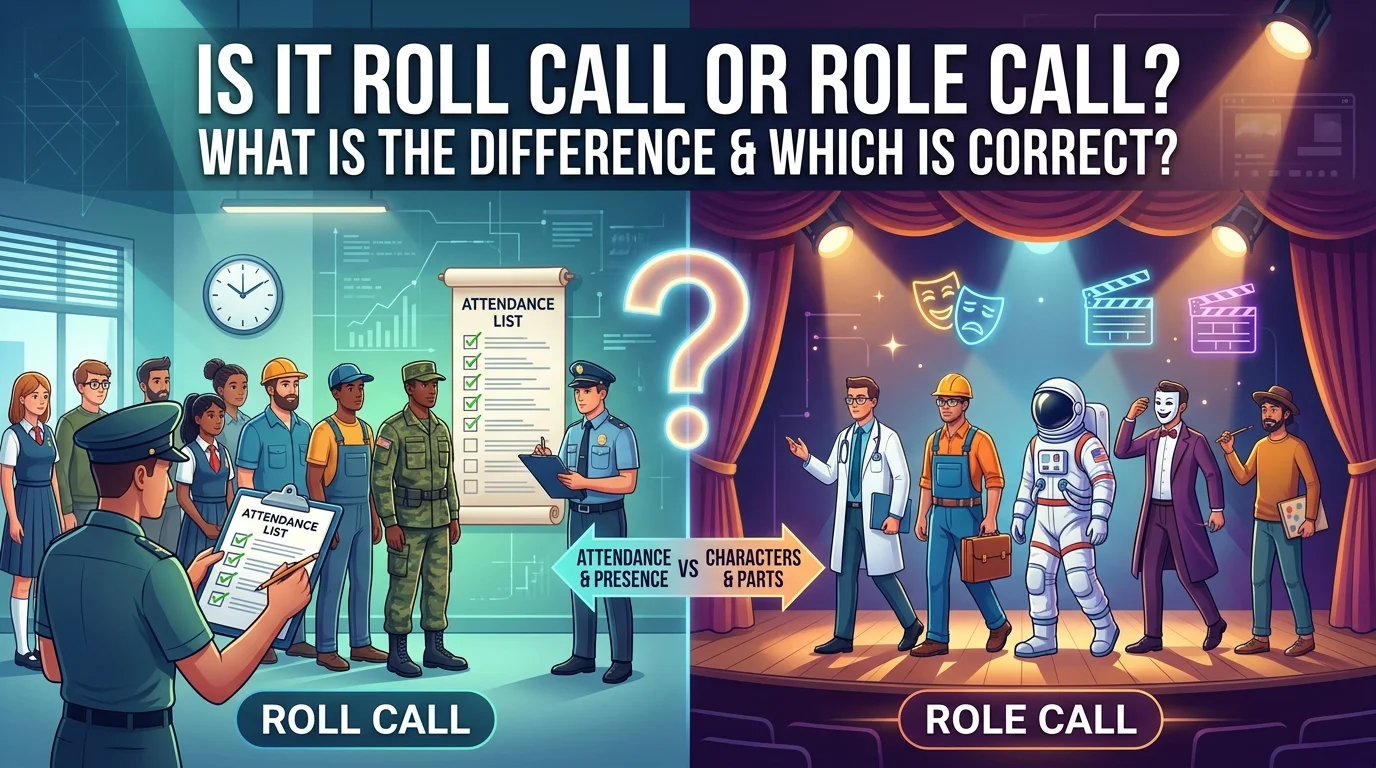
Many English learners and even native speakers confuse Roll Call and Role Call because they sound almost identical. However, these two phrases have very different meanings and uses. Understanding the difference helps you avoid common writing mistakes and use the correct term confidently in school, business, and everyday communication.
Comparison Overview
Roll Call and Role Call are often confused because they are homophones, which means they sound alike but have different meanings and spellings.
Roll Call is the correct and commonly used phrase when referring to checking attendance or calling names from a list.
Role Call is much less common and usually refers to calling or assigning a role, often in theater, business, or character-based contexts.
The confusion happens because both use the word “call,” but the first word changes the meaning entirely.
| Term | Meaning | Common Usage | Correct in Most Situations? |
| Roll Call | Calling names from a list | Schools, meetings, military | Yes |
| Role Call | Calling or assigning roles | Theater, job duties, character roles | Sometimes |
Definition of Roll Call
Roll Call means calling out names from a list to check who is present.
The word roll here refers to a list or register of names. Historically, names were written on a rolled document, which is where the phrase comes from.
Common purposes of roll call include:
- Checking classroom attendance
- Confirming employee presence
- Military headcounts
- Meeting attendance verification
Example:
“The teacher took roll call before starting the lesson.”
Definition of Role Call
Role Call refers to calling, assigning, or discussing specific roles or responsibilities.
The word role means a function, character, or duty performed by someone.
It is usually used in:
- Theater and acting
- Workplace responsibility discussions
- Team management
- Character assignments
Example:
“The director held a role call to assign characters.”
Main Differences Between Roll Call and Role Call
The biggest difference is meaning.
| Feature | Roll Call | Role Call |
| Main Meaning | Attendance check | Assigning/discussing roles |
| Related To | Presence | Responsibility |
| Common Context | School, office, military | Theater, management |
| Frequency | Very common | Rare |
| Common Mistake | Often confused with Role Call | Mistakenly used instead of Roll Call |
Key difference:
If you are checking who is present, use Roll Call.
If you are discussing who does what, use Role Call.
Why People Confuse Roll Call and Role Call
These phrases sound exactly alike in spoken English.
Reasons for confusion:
- Same pronunciation
- Similar spelling
- Fast speech hides the difference
- Spellcheck may not catch the mistake
Example confusion:
Incorrect: “The teacher started role call.”
Correct: “The teacher started roll call.”
Grammar Guide
Both are noun phrases, but they function differently.
How each term is used in sentences
Roll Call
Pattern:
Subject + perform/take + roll call
Examples:
- The teacher took roll call.
- We had roll call at 9 AM.
Role Call
Pattern:
Subject + conduct/hold + role call
Examples:
- The director held a role call.
- The manager organized a role call for duties.
Common mistakes learners make
Common errors:
- Writing role call when meaning attendance
- Assuming both phrases are interchangeable
- Using roll and role incorrectly because they sound alike
Wrong:
“Office role call starts at 8.”
Correct:
“Office roll call starts at 8.”
Simple rules to remember
Use Roll for Roster.
Both start with R.
Use Role for Responsibility.
Both relate to what someone does.
Memory trick:
Roll = list
Role = duty
Quick tips for writing and speaking
- Think “attendance” → Roll Call
- Think “job or character” → Role Call
- Proofread homophones carefully
- Say the full sentence mentally before writing
When to Use Each One
Use Roll Call when:
- Taking attendance
- Calling names
- Checking presence
- Verifying participation
Use Role Call when:
- Assigning duties
- Casting actors
- Discussing responsibilities
- Defining team roles
When NOT to Use Each One
Do not use Roll Call when discussing:
- Job responsibilities
- Character assignments
- Team functions
Do not use Role Call when discussing:
- School attendance
- Meeting attendance
- Military headcounts
Incorrect:
“The teacher began role call.”
Correct:
“The teacher began roll call.”
Which One to Use (Decision Guide)
Ask yourself:
Are you checking who is here?
→ Use Roll Call
Are you deciding who does what?
→ Use Role Call
Easy shortcut:
Presence = Roll
Responsibility = Role
Real-World Practical Examples
Roll Call Examples
- The teacher completed roll call before class.
- The manager began the meeting with roll call.
- Military roll call happens every morning.
- The online class uses digital roll call software.
- Camp leaders conduct roll call every night.
Role Call Examples
- The theater director held a role call for actors.
- The manager conducted a role call to assign tasks.
- During the game, players selected their roles through role call.
- The team meeting included a role call of responsibilities.
- The script reading started with role call for each character.
Self-Assessment (Fill in the Blanks)
- The teacher used ______ to check attendance.
- The director used ______ to assign characters.
- Morning school attendance requires ______.
- A theater production may need ______.
- The army performs daily ______.
- Team duties may begin with ______.
- The classroom starts with ______.
- Assigning responsibilities is a type of ______.
- Calling names from a register is ______.
- Defining each employee’s duty is ______.
- The professor completed ______ before the lecture.
- The manager reviewed job titles during ______.
- Attendance software automates ______.
- Casting actors often begins with ______.
- Students hear their names during ______.
- Workers may discuss duties during ______.
- School morning checks involve ______.
- Character assignment requires ______.
- The correct word for attendance is ______.
- The correct word for responsibility assignment is ______.
Answers
- Roll Call
- Role Call
- Roll Call
- Role Call
- Roll Call
- Role Call
- Roll Call
- Role Call
- Roll Call
- Role Call
- Roll Call
- Role Call
- Roll Call
- Role Call
- Roll Call
- Role Call
- Roll Call
- Role Call
- Roll Call
- Role Call
Final Verdict
Roll Call and Role Call may sound the same, but their meanings are completely different. Roll Call is the correct phrase when talking about attendance, presence, or calling names from a list. It is far more common and is the phrase most people need in daily life. Role Call, on the other hand, is used when discussing roles, duties, or character assignments and appears much less often. If your sentence is about who is present, choose Roll Call. If it is about who is responsible for what, choose Role Call. Remember this simple rule: Roll means list, Role means duty.
Conclusion About Roll Call Or Role Call
Understanding the difference between Roll Call and Role Call becomes much easier once you focus on their meanings. Roll Call refers to calling names from a list to check attendance, making it the correct choice in classrooms, offices, meetings, and military settings. Role Call, on the other hand, relates to assigning or discussing duties, responsibilities, or character roles, which makes it useful in specific contexts like theater or team management. Since both phrases sound identical, they often create confusion in writing, but remembering one simple rule can help: Roll means list, Role means responsibility. By learning this distinction, you can improve your grammar, write more accurately, and communicate with greater confidence. Whether you are a student, writer, or professional, knowing when to use Roll Call or Role Call ensures your English sounds natural, clear, and correct every time.
FAQs
Is roll call or role call correct?
Roll Call is the correct phrase when referring to attendance or calling names from a list. Role Call is only correct when discussing roles, duties, or character assignments in specific contexts like theater or workplace responsibilities.
What does roll call mean?
Roll Call means calling names from a list to confirm who is present. It is commonly used in schools, offices, meetings, and military settings to check attendance quickly and accurately.
What does role call mean?
Role Call means discussing, assigning, or identifying specific roles or responsibilities. It is often used in workplaces, drama productions, team projects, or situations where duties need to be clearly assigned.
Why do people confuse roll call and role call?
People confuse them because they are homophones, meaning they sound the same when spoken. Their identical pronunciation often causes spelling mistakes, especially in writing.
Is role call wrong?
Not always. Role Call is correct when talking about roles or responsibilities. However, it is wrong if you are talking about attendance, where Roll Call should be used instead.
How do you use roll call in a sentence?
A simple example is: “The teacher completed roll call before starting the lesson.” Here, it clearly means checking which students are present in class.
How do you use role call in a sentence?
An example is: “The director held a role call to assign parts for the play.” In this case, it refers to assigning acting roles.
Is roll call one word or two words?
Roll Call is written as two separate words. Writing it as one word is incorrect in standard English usage.
Which phrase is more common?
Roll Call is far more common because attendance checks happen regularly in schools, offices, and organizations. Role Call is much less common and used only in specific situations.
How can I remember the difference easily?
Use this memory trick: Roll = roster or list, which helps you remember attendance. Role = responsibility, which helps you remember duties or assigned tasks.

Amelia Wright focuses on making figurative language easy to understand. Her writing explains similes, metaphors, and word meanings using relatable examples. She aims to help readers recognize subtle differences in usage and apply them correctly in both academic and casual writing.