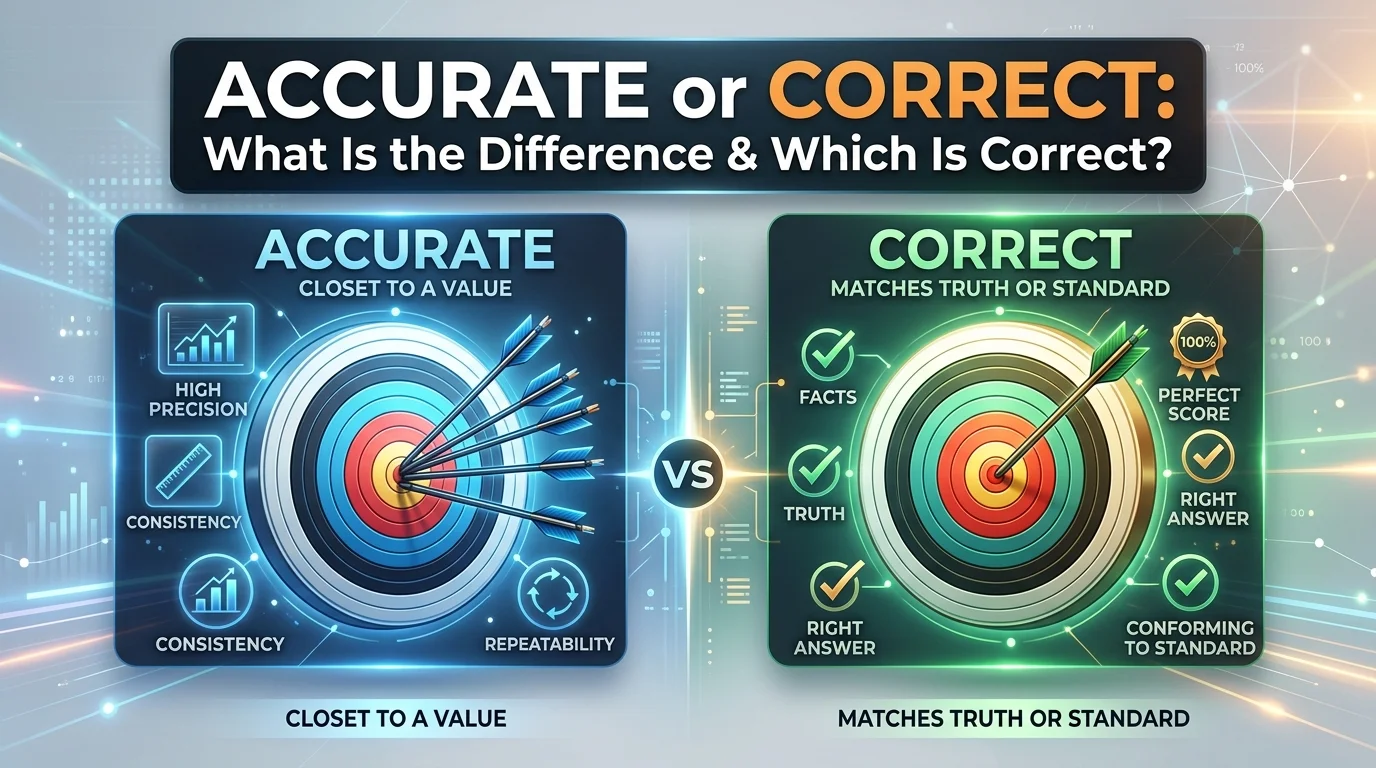
Many English learners get confused between accurate and Correct, especially because they seem related in meaning. However, one of these words is a proper English word, while the other is simply a spelling mistake. Understanding the difference helps improve your writing, grammar, and confidence in everyday English communication.
Comparison Overview
The comparison between accurate and Correct is unique because they are not true alternatives. Accurate is a valid English adjective used to describe something precise or exact. Correct, however, is not a correct English word at all. It is a common misspelling of correct. Learning this distinction helps avoid spelling errors and improves grammar.
| Word | Is it Correct? | Meaning | Usage |
| Accurate | Yes | Exact, precise, free from error | Used for precision |
| Correct | No | Not a valid word | Misspelling of “correct” |
Definition of Accurate
Accurate means something is exact, precise, and free from mistakes. It is used when describing facts, measurements, information, or actions that match reality or truth.
Examples:
- The scientist made an accurate measurement.
- Her answer was accurate.
Definition of Correct
Correct is not an English word. It is a spelling mistake.
People usually type Correct when they actually mean correct.
Example:
- Wrong: This answer is Correct.
- Right: This answer is correct.
Main Differences Between Accurate and Correct
The biggest difference is validity and meaning.
| Feature | Accurate | Correct |
| Valid English word | Yes | No |
| Meaning | Precise or exact | None |
| Part of speech | Adjective | Invalid spelling |
| Common use | Describing precision | Typing mistake |
| Should you use it? | Yes | No |
Why Do People Confuse Accurate and Correct?
The confusion usually happens because:
- Correct looks similar to correct
- Typing fast causes spelling errors
- English learners may not notice the extra “o”
- Spellcheck is often ignored
Grammar Guide
How each term is used in sentences
Accurate is used as an adjective:
- The map is accurate.
- His prediction was accurate.
Correct should never be used:
- Incorrect: Your answer is Correct.
- Correct: Your answer is correct.
Common mistakes learners make
- Adding an extra “o” in correct
- Confusing accurate with correct
- Using accurate when they mean “right”
Wrong:
- Your spelling is accurate.
Better:
- Your spelling is correct.
Simple rules to remember
- Accurate = precise
- Correct = right
- Correct = wrong spelling
Easy memory trick:
“Double o” in Correct means “double mistake.”
Quick tips for writing and speaking
- Use accurate for exact information.
- Never write Correct.
- Use spellcheck tools when typing.
- Read your writing before submitting.
When to Use Each One
Use accurate when talking about:
- measurements
- facts
- data
- timing
- directions
Examples:
- The clock is accurate.
- The report is accurate.
Never use Correct in any situation because it is incorrect.
When NOT to Use Each One
Do not use accurate when you mean:
- right answer
- proper spelling
- correct grammar
Wrong:
- Your grammar is accurate.
Better:
- Your grammar is correct.
Do not use Correct ever.
Which One to Use (Decision Guide)
Ask yourself:
- Are you talking about precision or exactness?
→ Use accurate - Are you trying to write “correct”?
→ Spell it correct, not Correct - Did you type an extra “o”?
→ Fix it immediately.
Real-World Practical Examples
Accurate Examples
- The GPS gave an accurate location.
- The doctor made an accurate diagnosis.
- The weather forecast was accurate.
- The student provided an accurate summary.
- The machine delivers accurate results.
Correct Examples
These are incorrect examples showing the mistake:
- Wrong: That is Correct.
- Wrong: Your answer looks Correct.
- Wrong: Please spell it Correct.
- Wrong: Is this Correct?
- Wrong: The sentence is Correct.
Corrected versions:
- correct
- correct
- correct
- correct
- correct
Self-Assessment (Fill in the Blanks)
- The scientist made an ______ measurement.
- The word ______ is a spelling mistake.
- The map gave an ______ direction.
- Never write ______ in formal writing.
- The data was highly ______.
- The spelling ______ should be avoided.
- Her calculations were ______.
- The GPS remained ______.
- ______ is not a dictionary word.
- The report was ______ and clear.
- The teacher wants ______ spelling, not ______ spelling.
- This clock is very ______.
- The medical test result was ______.
- Avoid typing ______ in emails.
- His timing was perfectly ______.
- The answer is ______, not Correct.
- The machine gives ______ readings.
- Do not confuse precision with ______ spelling.
- ______ describes exactness.
- ______ should never be used.
Answers
- accurate
- Correct
- accurate
- Correct
- accurate
- Correct
- accurate
- accurate
- Correct
- accurate
- correct, Correct
- accurate
- accurate
- Correct
- accurate
- correct
- accurate
- correct
- accurate
- Correct
Final Verdict
Between accurate and Correct, the correct choice depends on what you mean, but only one of these is actually a valid word. Accurate is a proper English adjective that means exact, precise, and free from error. Correct is not a word at all. It is simply a misspelling of correct. If you want clear and professional English, use accurate for precision and always avoid Correct. A small spelling mistake can change how your writing is perceived, so paying attention to details matters.
Conclusion About Accurate or Correct
Understanding the difference between Accurate or Correct helps improve both writing accuracy and spelling confidence in English. Accurate is a valid word used to describe something precise, correct, or free from errors, while Correct is simply a common misspelling of correct. Many learners mix them up due to typing habits or lack of attention to spelling details. However, using the right word in the right context can make your communication clearer, more professional, and easier to understand. Whether you are writing academic content, business emails, or everyday messages, choosing accurate terms shows strong language skills. Always remember that accuracy refers to precision, while correct refers to being right, and Correct should be avoided completely. With practice and awareness, you can easily eliminate this confusion and write more confidently in English. Small improvements in spelling and grammar can make a big difference in overall communication quality over time.
FAQs
What is the difference between accurate and Correct?
Accurate is a real English adjective that means precise, exact, or free from mistakes. It is used for information, measurements, or facts that are correct in detail. Correct is not an English word; it is simply a common spelling mistake of correct. Understanding this helps improve grammar accuracy and prevents writing errors in English communication effectively in daily writing.
Is Correct a real English word?
No, Correct is not a real English word. It is simply a typographical error made when trying to spell correct. The correct spelling is correct, which means right, accurate, or free from error. Using Correct in writing is considered incorrect in both formal and informal English, so it should always be avoided to maintain proper spelling standards in communication.
When should I use accurate?
Use accurate when you want to describe something that is exact, precise, or free from errors. It is commonly used for data, measurements, scientific results, reports, and information. For example, an accurate calculation or accurate data means it is correct in detail. It focuses more on precision rather than general correctness in everyday usage in practical real world situations.
When should I use correct vs Correct?
Correct should be used when something is right, true, or free from mistakes, such as correct answers or correct spelling. Correct should never be used because it is an incorrect spelling of correct. Always choose correct in writing, speaking, and formal communication to ensure clarity and proper English usage in all contexts across academic and professional settings consistently.
Why do people type Correct?
People often type Correct because of fast typing, keyboard errors, or lack of attention while writing. It is usually a simple mistake where an extra letter is added unintentionally. Since it looks similar to correct, many users do not notice the error. Spellcheck tools usually correct it automatically, but manual writing can still lead to confusion in everyday use.
Can accurate and correct mean same?
Accurate and correct are related but not exactly the same. Correct means something is right or without mistakes, while accurate means something is precise and exact in detail. In many cases they overlap, but accurate is more about precision and measurement, whereas correct focuses on general rightness or truth in language and answers in communication and understanding overall usage.
How to avoid spelling mistakes like Correct?
To avoid spelling mistakes like Correct, practice careful typing and always review your writing before sending or publishing it. Using spellcheck tools can help catch errors automatically. Learning common spelling patterns and improving vocabulary also reduces mistakes. Slow and mindful writing is especially helpful when you are learning English or writing important content for better accuracy and clarity overall.
Is accurate more formal than correct?
Accurate is often used in more technical or formal contexts such as science, research, and data reporting, because it emphasizes precision. Correct is more general and can be used in both formal and informal situations. Neither word is strictly more formal, but accurate tends to appear in specialized or professional writing where exactness is important for detailed information usage.
Examples of accurate usage?
Examples of accurate usage include accurate measurements in science, accurate weather forecasts, accurate data analysis, accurate reporting in journalism, and accurate calculations in mathematics. In each case, the word accurate shows precision and correctness in detail. It is mainly used when exactness matters and small errors can affect results or understanding significantly in practical real world scenarios overall use.
What is easiest way to remember difference?
An easy way to remember is that accurate means precise and detailed, while correct means right or without mistakes. Correct is always wrong spelling, so ignore it completely. Think of accurate as measuring exactly and correct as giving the right answer. Practicing examples and reading carefully helps you remember the difference easily over time with regular practice and attention.

Sarah Mitchell is an experienced writer and grammar teacher with over 10 years of expertise in English language education. She helps learners improve their grammar, writing, and communication skills through clear explanations and practical examples. Sarah creates learner-friendly content focused on real-life English, making language learning simple, effective, and confidence-building.