
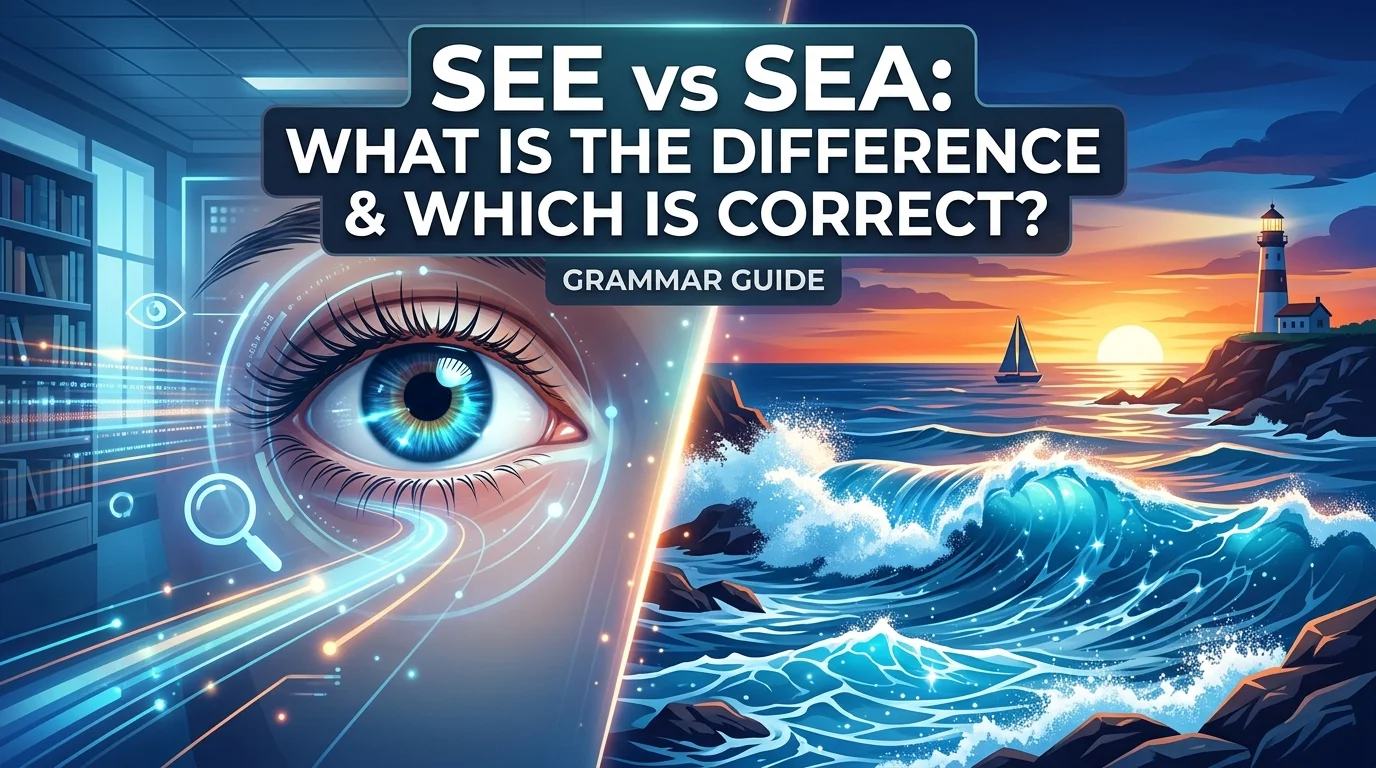
The words see and sea sound exactly the same, which makes them easy to confuse, especially for English learners. However, their meanings are completely different. Understanding when to use see versus sea helps improve your grammar, spelling, and communication skills in both writing and speaking.
Comparison Overview
See and sea are examples of homophones, which means they sound alike but have different meanings and spellings.
See is mainly a verb, used when talking about vision, understanding, or meeting someone.
Sea is a noun, used to describe a large body of salt water connected to an ocean.
Although they sound identical, their meanings and usage are entirely unrelated.
Definition of See
The word see is a verb.
It usually means to look at something with your eyes or to understand something mentally.
Common meanings of see include:
- To notice visually
- To understand or realize
- To meet or visit someone
- To imagine or predict something
Examples:
- I can see the mountains from my window.
- Now I see what you mean.
- She will see her doctor tomorrow.
Definition of Sea
The word sea is a noun.
It refers to a large area of salt water, smaller than an ocean but larger than a lake.
Common meanings of sea include:
- A large body of salt water
- A symbolic expression for something vast
Examples:
- The ship crossed the sea.
- We spent our vacation near the sea.
- There was a sea of people at the concert.
Main Differences Between See and Sea
| Feature | See | Sea |
| Part of Speech | Verb | Noun |
| Meaning | To look, understand, or meet | Large body of salt water |
| Usage | Actions and understanding | Places and geography |
| Context | Daily conversation, grammar | Nature, travel, geography |
| Example | I can see you. | The sea is calm today. |
The biggest difference is simple: see is an action, while sea is a place or thing.
Grammar Guide
How each term is used in sentences
See is used as a verb.
Sentence patterns:
- I see the bird.
- Can you see that?
- We will see him later.
Sea is used as a noun.
Sentence patterns:
- The sea is blue.
- They sailed across the sea.
- The sea looks beautiful.
Common mistakes learners make
Many learners write:
- I can sea the stars. ❌
- We went to the see yesterday. ❌
Correct versions:
- I can see the stars. ✅
- We went to the sea yesterday. ✅
The confusion happens because both words sound identical.
Simple rules to remember
Remember this:
- See = related to your eyes
- Sea = related to water
Memory trick:
“See with your eyes, sea with the waves.”
Quick tips for writing and speaking
Always ask yourself:
- Am I talking about vision or understanding? Use see.
- Am I talking about water or the ocean? Use sea.
Proofread carefully because spellcheck may not catch this mistake.
When to Use Each One
Use see when:
- Talking about looking at something
- Talking about understanding
- Talking about visiting someone
- Talking about noticing something
Examples:
- I see a rainbow.
- Do you see the problem?
- I will see my friend tonight.
Use sea when:
- Talking about oceans or beaches
- Describing marine environments
- Discussing geography
- Referring to large water bodies
Examples:
- The sea is rough today.
- Fish live in the sea.
- We walked beside the sea.
When NOT to Use Each One
Do not use see when discussing water.
Incorrect:
- The see was beautiful. ❌
Correct:
- The sea was beautiful. ✅
Do not use sea when discussing sight or understanding.
Incorrect:
- I can sea your house. ❌
Correct:
- I can see your house. ✅
Which One to Use (Decision Guide)
Use this quick guide:
If you mean:
- looking → see
- understanding → see
- visiting → see
- ocean water → sea
- beach or coast → sea
Quick test:
Can you replace the word with “look at”?
If yes, use see.
Is it about water?
Use sea.
Real-World Practical Examples
See Examples
- Education: I see the answer on the board.
- Daily life: Can you see my keys?
- Technology: I can see the error on the screen.
- Business: We see growth in sales this year.
- Conversation: I see what you are saying.
Sea Examples
- Travel: We swam in the sea during vacation.
- Science: Many species live in the sea.
- Geography: The Mediterranean Sea is famous.
- Writing: The poem described the endless sea.
- Daily life: Our hotel overlooked the sea.
Self-Assessment (Fill in the Blanks)
- I can ______ the moon tonight.
- We sailed across the ______.
- Do you ______ the difference?
- The fish lives in the ______.
- I will ______ my teacher tomorrow.
- The children played near the ______.
- Can you ______ that bird?
- The storm made the ______ dangerous.
- I finally ______ your point.
- The ship disappeared into the ______.
- I cannot ______ clearly without glasses.
- The ______ was calm this morning.
- Let me ______ what happens.
- Dolphins live in the ______.
- Did you ______ that message?
- The blue ______ looked beautiful.
- I ______ your mistake now.
- Pirates crossed the ______.
- Come ______ me later.
- The ______ waves were strong.
Answers
- see
- sea
- see
- sea
- see
- sea
- see
- sea
- see
- sea
- see
- sea
- see
- sea
- see
- sea
- see
- sea
- see
- sea
Final Verdict
The difference between see and sea is easy once you know their meanings. See is a verb connected to vision, understanding, and meeting people. Sea is a noun referring to large saltwater bodies like oceans and coastal waters. Even though they sound the same, their meanings are completely different. If you remember “see with your eyes, sea with water,” you’ll choose the correct word every time.
Conclusion About See vs Sea
The difference between see and sea becomes simple once you understand their meanings and usage. Although they sound the same, one is a verb related to vision and understanding, while the other is a noun describing vast saltwater bodies on Earth. Many learners confuse them because of pronunciation, but context always gives the correct clue. With practice, you can easily choose the right word in writing and conversation. Remembering small tricks like seeing with your eyes and sea being water can help avoid mistakes. Improving these basics strengthens your grammar and boosts confidence in communication. Whether you are writing essays, speaking English, or learning for exams, mastering such homophones makes your language more accurate and natural. Keep practicing with real examples and soon the difference will feel effortless and automatic in everyday use over time.
FAQs About See vs Sea
What is the main difference between see and sea
See is a verb used for vision, understanding, or perception, while sea is a noun that refers to large bodies of salt water. The confusion comes from their identical pronunciation, but their meanings and uses are completely different in English grammar and everyday communication.
Why do see and sea sound the same
See and sea sound the same because they are homophones. Homophones are words that share pronunciation but have different meanings and spellings. This happens due to language evolution. Even though they sound identical, their usage depends on context, making it easy to distinguish them in communication skills.
How can I easily remember see vs sea
To remember see vs sea, connect see with eyes and vision, and sea with water and oceans. Visualization helps a lot. Think of seeing something with your eyes and sea as a place filled with water. Practicing examples regularly also strengthens memory in daily learning practice.
Is see always a verb in English
See is primarily a verb in English language. It describes actions like looking, noticing, or understanding something. It is not used as a noun in standard grammar. It plays an important role in expressing perception, awareness, and communication in both spoken and written English.
Is sea only related to oceans
Sea is not only related to oceans but refers to large saltwater bodies that are partially enclosed by land. It is smaller than an ocean but still very large. Seas are important for ecosystems, climate, trade, and human life along coastal regions across the world.
What are common mistakes with see and sea
Common mistakes include mixing see and sea due to similar pronunciation. Learners often use sea in place of see when talking about vision or understanding. Another issue is relying on sound instead of meaning. Understanding context and practicing sentences helps avoid such errors for better accuracy.
Can see mean to understand something
Yes, see can mean to understand or realize something. In conversations, saying I see often means comprehension rather than physical sight. This usage is common in English and helps express understanding clearly in communication, making it an important part of everyday speech naturally.
Where is sea used in geography
Sea is used in geography to describe large saltwater bodies connected to oceans or surrounded by land. It is important in studying maps, climate, and ecosystems. Seas influence weather patterns, trade routes, and human settlements, making them essential geographical features studied in physical geography.
Are see and sea homophones
Yes, see and sea are homophones in English. They sound the same but have different meanings and spellings. See relates to vision or understanding, while sea relates to water bodies. Learning homophones improves spelling, clarity, and overall language skills in communication practice.
What is the simplest trick to use see or sea correctly
A simple trick is to link see with eyes and sight, and sea with water and oceans. If the sentence involves vision or understanding, use see. If it involves geography or water, use sea. Regular practice makes this distinction natural in real life usage practice.

Sarah Mitchell is an experienced writer and grammar teacher with over 10 years of expertise in English language education. She helps learners improve their grammar, writing, and communication skills through clear explanations and practical examples. Sarah creates learner-friendly content focused on real-life English, making language learning simple, effective, and confidence-building.