
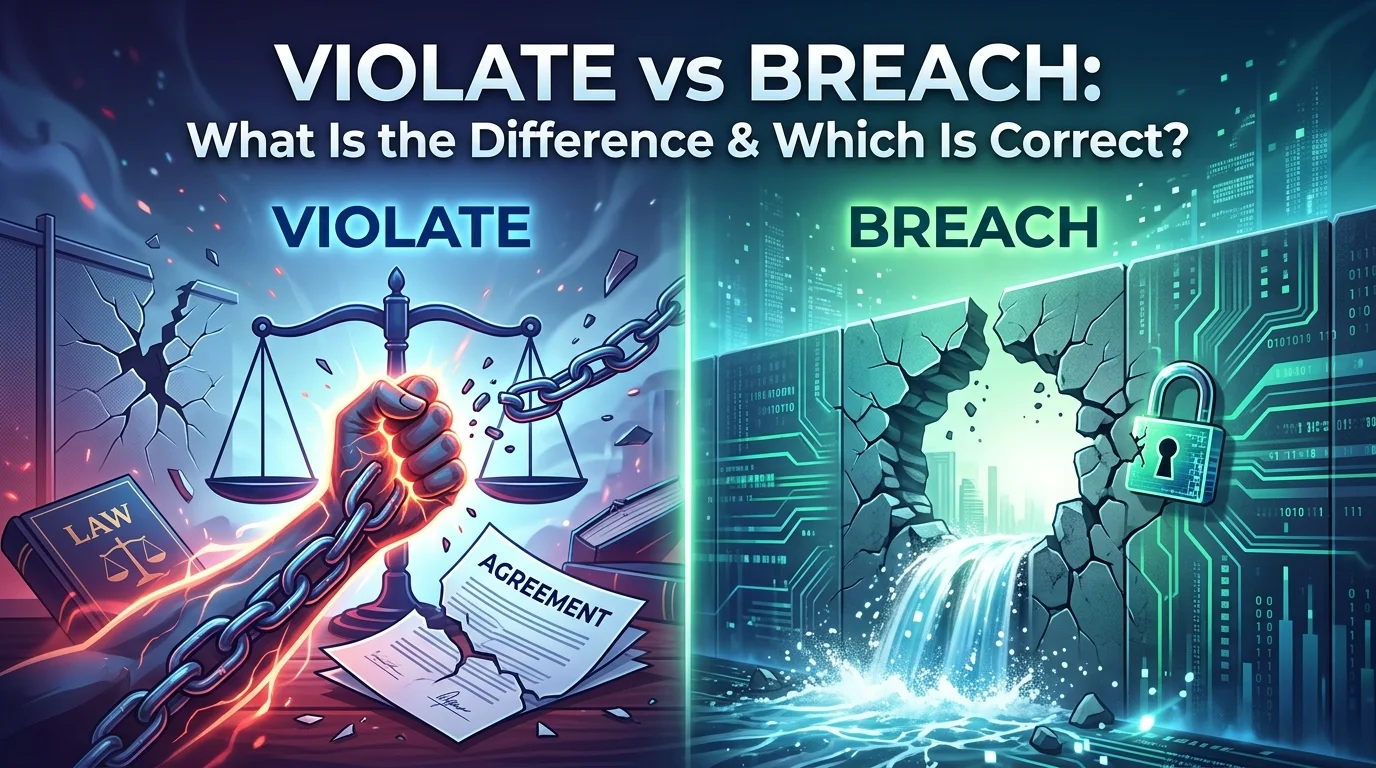
Many English learners and writers confuse violate and breach because both suggest that a rule, agreement, or boundary has been broken. However, these two words are not always interchangeable. Understanding their differences helps you communicate more accurately in writing, speaking, business, law, and everyday conversation.
Comparison Overview
Violate and breach both describe breaking something, but they are used in different contexts and carry slightly different meanings.
Violate usually means breaking a rule, law, right, or principle, often in a serious or ethical sense.
Breach usually refers to breaking an agreement, contract, security, trust, or barrier, often in formal, legal, or technical contexts.
Although both involve “breaking,” the object being broken and the tone of the word are often different.
Definition of Violate
Violate means to break or act against a rule, law, right, or standard.
It often suggests wrongdoing and can imply moral, legal, or social consequences.
Examples:
• violate a law
• violate human rights
• violate school rules
Core meaning: to act against something that should be respected
Definition of Breach
Breach means to break an agreement, security system, promise, or barrier.
It is commonly used in legal, business, military, and technology contexts.
Examples:
• breach a contract
• breach data security
• breach trust
Core meaning: to break through or fail to maintain something expected
Main Differences Between Violate and Breach
| Feature | Violate | Breach |
| Main meaning | Break a rule, law, or right | Break an agreement, barrier, or trust |
| Tone | Ethical/legal | Formal/legal/technical |
| Common use | Laws, morals, rules | Contracts, security, trust |
| Verb only? | Mostly verb | Verb and noun |
| Example | violate the law | breach the contract |
Key difference: You violate rules; you breach agreements or security.
Grammar Guide
How Each Term Is Used in Sentences
Violate is usually used as a verb.
Pattern:
Subject + violate + object
Examples:
• They violated the rules.
• He violated the agreement.
Breach can be a verb or a noun.
Verb pattern:
Subject + breach + object
Example:
• The company breached the contract.
Noun pattern:
There was a breach + of + noun
Example:
• There was a breach of security.
Common Mistakes Learners Make
Using breach with laws:
❌ He breached the law.
✅ He violated the law.
Using violate with data security:
❌ Hackers violated the database.
✅ Hackers breached the database.
Using breach when talking about rights:
❌ They breached human rights.
✅ They violated human rights.
Simple Rules to Remember
Use violate for:
• laws
• rules
• rights
• principles
Use breach for:
• contracts
• security
• trust
• barriers
Memory trick:
Violate = values and laws
Breach = barriers and agreements
Quick Tips for Writing and Speaking
Choose violate when discussing ethics or law.
Choose breach in business, cybersecurity, or legal contracts.
If unsure, ask: What is being broken?
If it is a rule, use violate.
If it is an agreement or protection, use breach.
When to Use Each One
Use violate when:
• someone breaks a rule
• someone ignores laws
• someone disrespects rights
• ethical boundaries are crossed
Use breach when:
• a contract is broken
• data is stolen
• trust is broken
• a wall or defense is crossed
When NOT to Use Each One
Do not use violate for:
• contracts (usually)
• cybersecurity attacks
• technical system failures
Incorrect:
❌ violate a firewall
Correct:
✅ breach a firewall
Do not use breach for:
• school rules
• laws
• human rights
Incorrect:
❌ breach school policy
Better:
✅ violate school policy
Which One to Use (Decision Guide)
Ask yourself these questions:
- Is it a law, rule, or right?
→ Use violate - Is it a contract, trust, or security system?
→ Use breach - Is it moral or ethical wrongdoing?
→ Use violate - Is it technical or formal/legal?
→ Use breach
Quick decision:
Rule broken? = Violate
Agreement broken? = Breach
Real-World Practical Examples
Violate Examples
- Education: Students who cheat violate school rules.
- Daily life: Parking here violates city regulations.
- Science: Ignoring lab safety rules violates protocol.
- Business: The company violated labor laws.
- Conversation: Interrupting others violates social etiquette.
Breach Examples
- Business: The supplier breached the contract.
- Technology: Hackers breached the company’s servers.
- Daily life: Lying to a friend can breach trust.
- Law: The tenant breached the lease agreement.
- Military: Soldiers breached the enemy wall.
Self-Assessment (Fill in the Blanks)
- Driving too fast may ______ traffic laws.
- The hacker managed to ______ the security system.
- Breaking school rules means you ______ them.
- The company ______ the contract by missing deadlines.
- Sharing private data may ______ customer trust.
- The government should not ______ human rights.
- The soldier helped ______ the fortress wall.
- Cheating during an exam will ______ school policy.
- The cyberattack caused a major security ______.
- Failing to honor the agreement is a contract ______.
- Speaking loudly in a library may ______ the rules.
- Hackers tried to ______ the firewall.
- That action may ______ ethical principles.
- The employee ______ confidentiality rules.
- Their actions caused a trust ______.
- Breaking international law means you ______ it.
- Attackers ______ the database.
- Ignoring privacy rights may ______ personal freedom.
- The vendor ______ the signed agreement.
- Crossing the castle wall was a successful ______.
Answers
- violate
- breach
- violate
- breached
- breach
- violate
- breach
- violate
- breach
- breach
- violate
- breach
- violate
- violated
- breach
- violate
- breached
- violate
- breached
- breach
Final Verdict
Both violate and breach mean “to break,” but they are used differently. Use violate when talking about rules, laws, rights, or moral principles. Use breach when discussing contracts, trust, security, or physical barriers. Remember this simple rule: you violate what should be respected, and you breach what should be maintained or protected. Once you understand that difference, choosing the correct word becomes much easier in both writing and speaking.
Conclusion About Violate vs Breach
Understanding the difference between violate and breach helps you use English more accurately in real situations. While both words describe breaking something, they apply to different contexts and carry different tones. Violate is commonly used for laws, rules, and rights, often reflecting ethical or legal wrongdoing. Breach is more formal and technical, used for contracts, trust, security systems, and agreements. Knowing when to choose each word improves your writing, speaking, and professional communication. It also helps avoid common mistakes that can confuse readers or change meaning. With simple practice, you can quickly decide whether a situation involves violating a rule or breaching an agreement. Mastering this difference not only strengthens grammar skills but also makes your English sound more natural and precise in business, academic, and everyday contexts.
FAQs
What is the main difference between violate and breach
The main difference is that violate is used for breaking rules, laws, or rights, while breach is used for breaking agreements, contracts, trust, or security systems. Violate usually carries a moral or legal sense, whereas breach is more formal and often used in legal, business, or technical situations where something is improperly accessed or failed.
Can violate and breach be used interchangeably
No, they are not fully interchangeable. Although both mean breaking something, their usage depends on context. Violate is correct for laws and rules, while breach fits contracts, trust, or security. Using them interchangeably can lead to incorrect grammar or unclear meaning, especially in formal writing or professional communication.
When should I use violate in a sentence
Use violate when referring to laws, rules, regulations, or human rights. It is commonly used in legal, ethical, and social contexts. For example, someone violates traffic laws or school policies. It emphasizes improper or illegal behavior that goes against established standards or principles in society.
When should I use breach in professional writing
Use breach in professional writing when talking about contracts, agreements, data security, or trust. It is widely used in legal, corporate, and cybersecurity contexts. For example, a company may breach a contract or hackers may breach a system. It indicates failure to protect or uphold an agreement or barrier.
Is breach a verb or noun
Breach can be used as both a verb and a noun. As a verb, it means to break or fail to follow something, such as breaching a contract. As a noun, it refers to the act of breaking or a gap, such as a breach of security or trust.
What are examples of violate in daily life
In daily life, violate is used when someone breaks rules or expectations. For example, parking in a no parking zone violates traffic rules. Cheating in exams violates school policies. Speaking loudly in quiet places violates social etiquette. It is commonly used in situations involving rules or acceptable behavior.
What are examples of breach in real situations
Breach is used in situations involving security, trust, or agreements. For example, a company may experience a data breach when hackers access information. Breaking a lease agreement is a breach of contract. Lying to a close friend can be seen as a breach of trust in personal relationships.
What mistakes do learners make with these words
A common mistake is using breach for laws or violate for contracts. For example, saying breach the law is incorrect. Another mistake is using violate in technical contexts like cybersecurity. These errors happen because both words mean “break,” but their contexts are different and must be carefully distinguished.
How can I easily remember the difference
A simple way to remember is: violate is for rules, laws, and rights, while breach is for contracts, trust, and security. Think of violate as moral or legal breaking, and breach as breaking through protection or agreements. This mental shortcut helps choose the correct word quickly.
Which word is used in cybersecurity contexts
In cybersecurity, breach is the correct term. It refers to unauthorized access to systems, networks, or data. For example, a hacker breaching a database means they have broken security protections. Violate is not typically used in this technical context, making breach the standard and accurate term in digital security.

Ethan Clarke is a language writer who specializes in breaking down similes, word meanings, and commonly confused terms. His work focuses on clear explanations, practical examples, and simple comparisons that help readers understand how English