
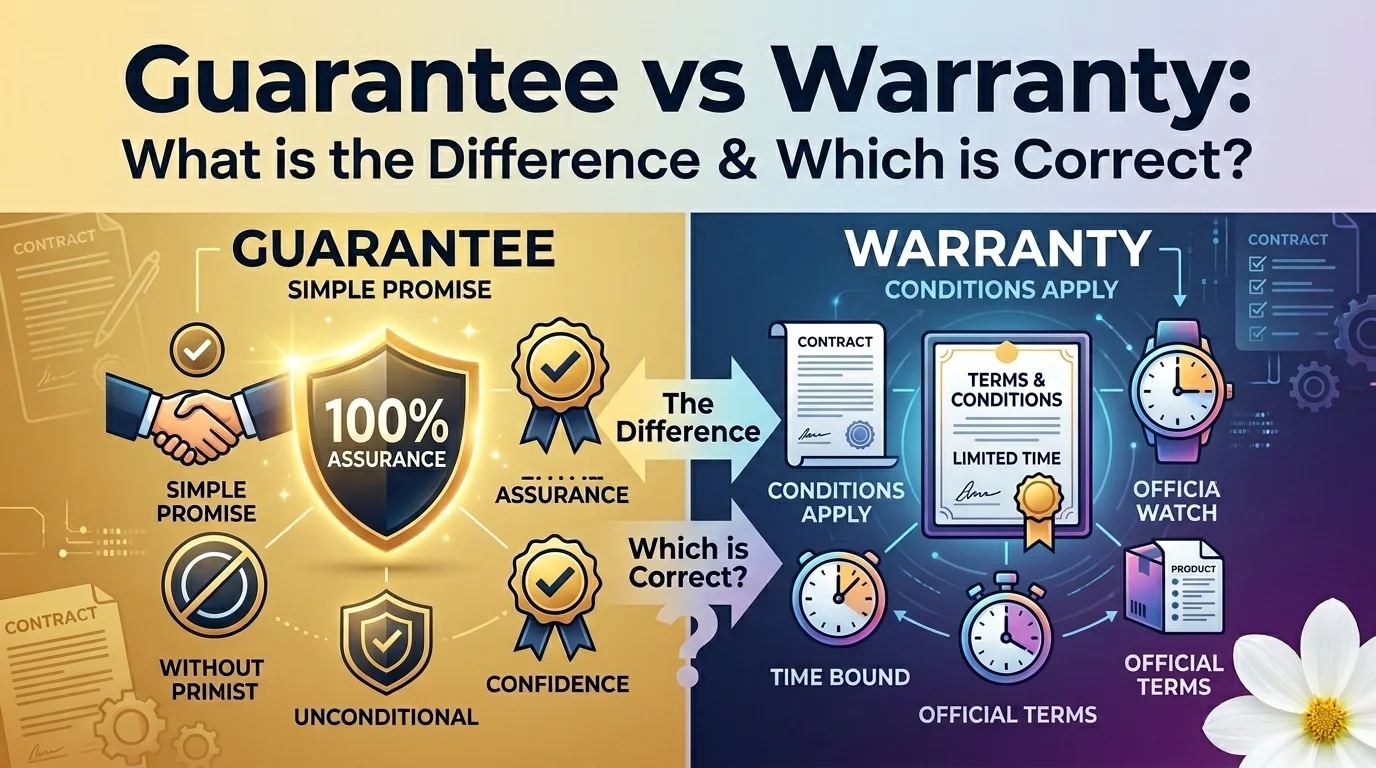
When buying products or services, people often hear the terms guarantee and warranty used interchangeably. While they seem similar, they are not exactly the same. Understanding the difference between guarantee vs warranty helps consumers make better decisions, know their rights, and use these terms correctly in everyday communication, business, and writing.
Comparison Overview
A guarantee and a warranty both provide assurance to customers about a product or service, but they differ in meaning, legal strength, duration, and application. A guarantee is usually a promise of satisfaction or quality, while a warranty is a formal written agreement covering repairs or replacements under specific conditions.
Definition of Guarantee
A guarantee is a promise made by a seller or manufacturer that a product or service will meet certain standards or expectations.
Its main purpose is to assure customers that if something goes wrong, they will receive a refund, replacement, or correction.
Examples:
- Satisfaction guaranteed
- Money-back guarantee
- Quality guarantee
A guarantee is often broader and less technical than a warranty.
Definition of Warranty
A warranty is a formal written agreement that promises repair, replacement, or service if a product fails within a specified period.
Its purpose is to protect buyers from defects in materials or workmanship.
Examples:
- One-year warranty
- Extended warranty
- Manufacturer’s warranty
A warranty usually includes specific terms and conditions.
Main Differences Between Guarantee and Warranty
| Feature | Guarantee | Warranty |
| Meaning | Promise of satisfaction or quality | Written repair/replacement agreement |
| Legal form | Often informal or broad | Usually formal and contractual |
| Coverage | May include refunds or replacements | Usually repairs or replacements |
| Duration | Sometimes unspecified | Usually fixed time period |
| Conditions | Often simpler | Often detailed terms apply |
| Common use | Marketing and customer trust | Product protection |
Grammar Guide
How each term is used in sentences
Guarantee is often used as both a noun and a verb.
Examples:
- This phone comes with a two-year guarantee.
- We guarantee customer satisfaction.
Warranty is mostly used as a noun.
Examples:
- The laptop includes a one-year warranty.
- Please read the warranty terms carefully.
Common mistakes learners make
- Using guarantee and warranty as exact synonyms in all contexts.
- Saying “I warranty this” instead of “I guarantee this.”
- Assuming both always provide refunds.
- Ignoring warranty conditions and limitations.
- Using guarantee when referring to a legal written service contract.
Simple rules to remember
- Use guarantee for a promise.
- Use warranty for a written product agreement.
- Guarantee often sounds broader.
- Warranty sounds more formal and legal.
Quick tips for writing and speaking
- In business documents, use warranty for contracts.
- In advertisements, guarantee is more common.
- In casual speech, guarantee is easier to use.
- Always check the context before choosing.
When to Use Each One
Use guarantee when:
- Talking about customer satisfaction
- Promising quality
- Offering refunds
- Making broad assurances
Use warranty when:
- Referring to product coverage
- Discussing repair terms
- Talking about legal agreements
- Mentioning time-limited protection
When NOT to Use Each One
Do not use guarantee when:
- Referring to a detailed legal repair contract
- Discussing official manufacturer coverage terms
Do not use warranty when:
- Making a simple promise
- Talking about guaranteed satisfaction
- Using it as a verb in normal speech
Which One to Use (Decision Guide)
Ask yourself:
- Is it a promise about quality or satisfaction? → Use Guarantee
- Is it a written repair agreement? → Use Warranty
- Is it legal product coverage? → Use Warranty
- Is it a marketing promise? → Use Guarantee
Quick formula:
Promise = Guarantee
Protection contract = Warranty
Real-World Practical Examples
Guarantee Examples
- The store offers a 30-day money-back guarantee.
- We guarantee your satisfaction with our service.
- This paint has a quality guarantee.
- The company guarantees delivery within 24 hours.
- Our training course comes with a success guarantee.
Warranty Examples
- My laptop has a two-year warranty.
- The car’s warranty covers engine repairs.
- Always register your appliance warranty online.
- The phone screen is not covered under the warranty.
- I bought an extended warranty for my television.
Self-Assessment (Fill in the Blanks)
- This product comes with a one-year ______.
- Customer satisfaction is fully ______.
- The refrigerator’s ______ covers parts replacement.
- Our service quality is ______.
- Please read the ______ before purchasing.
- The company offers a money-back ______.
- My laptop is still under ______.
- We ______ fast delivery.
- The phone repair is covered by ______.
- The store gives a satisfaction ______.
- The product’s ______ expires next month.
- They ______ premium quality.
- Extended ______ costs extra.
- The seller offers a refund ______.
- This damage is outside the ______ terms.
- We ______ excellent customer support.
- The car’s ______ lasts five years.
- Their results are not ______.
- A written repair agreement is called a ______.
- A promise of satisfaction is called a ______.
Answers
- warranty
- guaranteed
- warranty
- guaranteed
- warranty
- guarantee
- warranty
- guarantee
- warranty
- guarantee
- warranty
- guarantee
- warranty
- guarantee
- warranty
- guarantee
- warranty
- guaranteed
- warranty
- guarantee
Final Verdict
The difference between guarantee vs warranty is simple once you understand the purpose of each word. A guarantee is a broad promise that builds trust and assures satisfaction, often used in marketing and everyday speech. A warranty is a formal written agreement that protects buyers through repairs or replacements under specific terms. If you are talking about a promise, choose guarantee. If you mean official product coverage, choose warranty. Knowing this distinction improves your grammar, writing, and consumer awareness.
Conclusion About Guarantee vs Warranty
Understanding guarantee vs warranty makes a real difference when you are buying products or services or even writing about them. A guarantee is mainly a promise of satisfaction, confidence, or quality, often used in marketing to build trust with customers. A warranty, on the other hand, is more formal and legally structured, offering repair or replacement if something goes wrong within a set time period. Both are designed to protect the buyer, but they work in different ways and situations. When you know how each term functions, you can make smarter purchasing decisions and avoid confusion. In simple terms, a guarantee gives reassurance, while a warranty gives protection. Keeping this difference in mind helps in both everyday communication and professional writing.
FAQs
What is the main difference between guarantee and warranty
A guarantee is a promise of satisfaction or quality, often informal, while a warranty is a formal written agreement that covers repairs or replacements for a specific period under defined conditions. Both protect consumers but differ in structure, legal strength, and application in real-world buying situations.
Is a guarantee better than a warranty
Neither is better because they serve different purposes. A guarantee focuses on customer satisfaction and trust, while a warranty provides legal protection for repairs or replacements. The value depends on what you need, whether it is reassurance or formal product coverage over time.
Can a product have both guarantee and warranty
Yes, many products offer both. A guarantee may promise satisfaction or quality, while a warranty covers technical faults or repairs. For example, a company may guarantee performance and also provide a one-year warranty for manufacturing defects, giving customers dual protection.
Which is legally stronger guarantee or warranty
A warranty is generally legally stronger because it is a written agreement with specific terms and conditions. A guarantee is often a broader promise and may not always have strict legal backing. Warranties are enforceable, especially when included in purchase contracts or product documentation.
Is money back guarantee the same as warranty
No, a money back guarantee is not the same as a warranty. A money back guarantee allows customers to return a product for a refund if they are not satisfied. A warranty, however, usually focuses on repairing or replacing defective products rather than offering refunds.
Do all products come with a warranty
Not all products include a warranty. Many electronics and appliances do, but some low cost or consumable items may not. It depends on the manufacturer and product type. Always check product details before purchasing to understand what coverage, if any, is provided.
Can guarantee be written or verbal
A guarantee can be either written or verbal. In advertisements and marketing, it is often written for clarity. However, verbal guarantees may also be given during sales discussions. Written guarantees are always more reliable because they clearly define terms and reduce misunderstandings.
What happens if a warranty expires
Once a warranty expires, the manufacturer is no longer responsible for free repairs or replacements. After expiration, any repair costs are usually paid by the customer. Some people choose extended warranties to continue protection beyond the original coverage period.
Why do companies use guarantees in advertising
Companies use guarantees in advertising to build trust and attract customers. A guarantee makes buyers feel more confident about quality and reduces purchase hesitation. It acts as a psychological reassurance that the product or service will meet expectations or offer compensation if it does not.
Are warranty terms the same worldwide
No, warranty terms vary by country, brand, and product type. Some regions offer stronger consumer protection laws, while others depend more on manufacturer policies. It is important to read warranty details carefully because coverage duration and conditions are not universal.

Daniel Brooks is an English educator with a passion for explaining similes and word comparisons in plain language. He covers topics like versus meanings, correct usage, and figurative language to help writers avoid common mistakes and improve clarity in everyday writing.