
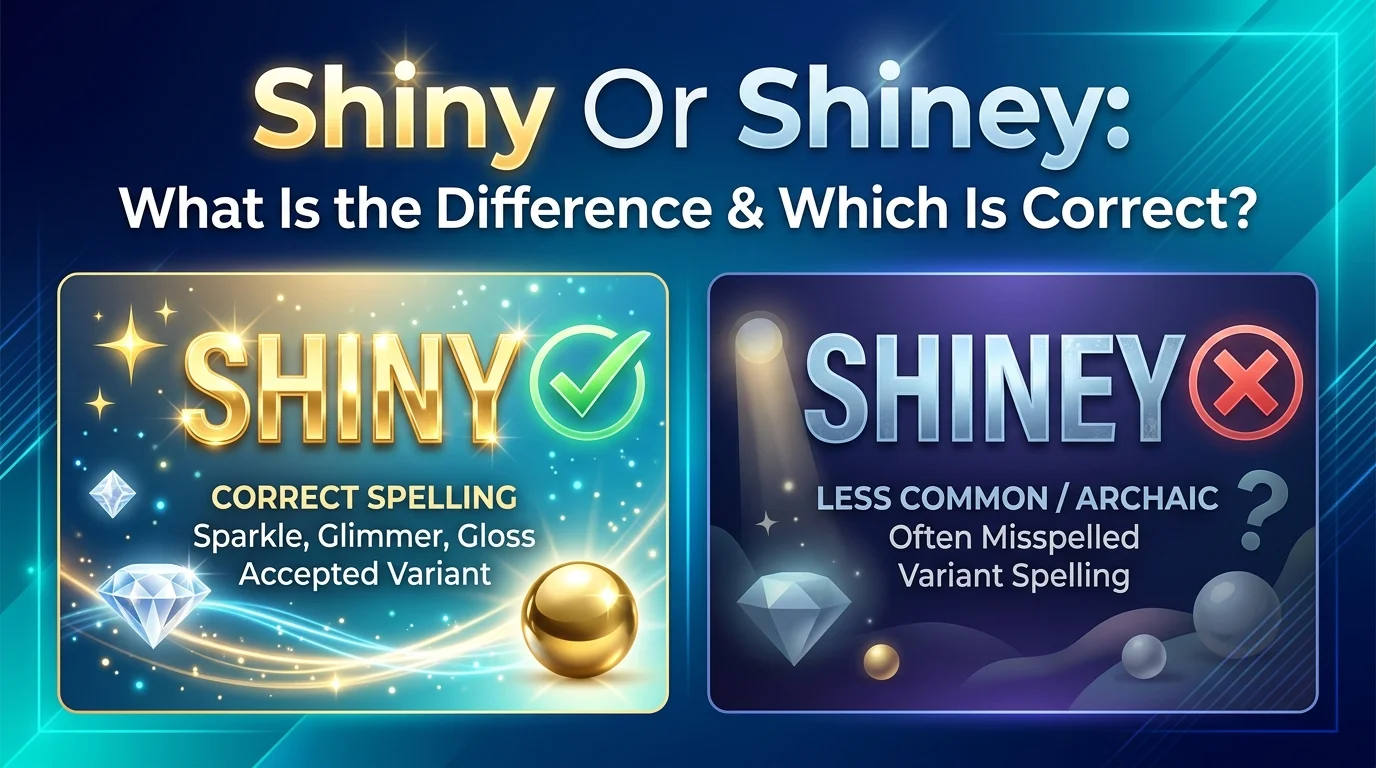
Many English learners get confused between shiny and shiney because both look similar and sound almost the same. However, only one is correct in standard English. Understanding the difference matters because using the wrong spelling can make your writing look unprofessional. Let’s break it down clearly and simply.
Comparison Overview
Shiny and shiney appear to be alternative spellings of the same word, but they are not equally correct.
| Term | Meaning | Correct? | Common Usage |
| Shiny | Something that reflects light or looks bright | Yes | Standard English |
| Shiney | Misspelling of “shiny” | No | Incorrect in formal writing |
The confusion usually happens because people connect the word with the verb shine, which makes shiney seem logical. However, English spelling rules do not work that way here.
Definition of Shiny
Shiny is an adjective used to describe something that reflects light or has a bright, polished appearance.
Examples:
• a shiny car
• shiny hair
• shiny shoes
It can also describe something new, attractive, or visually impressive.
Definition of Shiney
Shiney is not a standard English word. It is considered a misspelling of shiny.
People often write shiney by mistake because they think it should follow the base word shine, but dictionaries and grammar guides recognize only shiny as correct.
Main Differences Between Shiny and Shiney
| Feature | Shiny | Shiney |
| Spelling | Correct | Incorrect |
| Dictionary entry | Yes | No |
| Used in formal writing | Yes | No |
| Accepted in exams | Yes | No |
| Recommended usage | Always | Never |
The biggest difference is simple: use “shiny” every time.
Why Do People Confuse Shiny and Shiney?
The confusion comes from the base verb shine.
Examples:
• shine + ing = shining
• shine + s = shines
This makes some learners assume:
• shine + y = shiney ❌
But English changes the spelling:
• shiny ✅
This is just one of those spelling exceptions you need to memorize.
Grammar Guide
How Each Term Is Used in Sentences
Shiny is used as an adjective before a noun or after linking verbs.
Examples:
• The table is shiny.
• She bought shiny earrings.
Shiney should not be used in any sentence.
Incorrect:
• The table is shiney. ❌
Common Mistakes Learners Make
- Adding extra e from “shine”
- Assuming both spellings are accepted
- Using shiney in essays or emails
- Copying incorrect spellings from social media
Simple Rules to Remember
Rule 1: If you mean bright or reflective, use shiny.
Rule 2: Never add an extra e.
Rule 3: Think: tiny, rainy, shiny all end in -y.
Quick Tips for Writing and Speaking
• Always spell-check for shiney
• Remember: dictionaries list shiny, not shiney
• Practice writing “shiny” several times
When to Use Each One
Use shiny when describing:
• polished metal
• glossy surfaces
• bright objects
• attractive new things
• sparkling appearances
Examples:
• shiny coins
• shiny phone screen
• shiny floor
Use shiney: never.
When NOT to Use Each One
Do not use shiny when:
• you need a verb like “shine”
Example: “The stars shine brightly.” not “The stars shiny.”
Do not use shiney:
• in school assignments
• in business emails
• in published writing
• in exams
• anywhere formal
Which One to Use (Decision Guide)
Ask yourself:
Does the word describe something bright, polished, or reflective?
Yes → use shiny ✅
Are you thinking of adding an extra e because of “shine”?
Stop → still use shiny ✅
Need standard English spelling?
Always → shiny ✅
Real-World Practical Examples
Shiny Examples
- Education: The student used a shiny gold sticker on her project.
- Daily life: He bought shiny black shoes for the wedding.
- Science: The shiny surface reflected sunlight clearly.
- Business: The company launched a shiny new logo design.
- Technology: My laptop screen looks shiny after cleaning.
Shiney Examples
- “Her shoes are shiney.” ❌ incorrect
- “This table looks shiney.” ❌ incorrect
- “Buy a shiney phone case.” ❌ incorrect
- “The stars look shiney tonight.” ❌ incorrect
- “He likes shiney objects.” ❌ incorrect
All should be replaced with shiny.
Self-Assessment (Fill in the Blanks)
- My new shoes look ______.
- The correct spelling is ______.
- The mirror looks very ______ today.
- Never write ______ in formal English.
- Her hair looks smooth and ______.
- The coin is bright and ______.
- The incorrect spelling is ______.
- That car looks clean and ______.
- We should use ______ in essays.
- The table surface is very ______.
- The wrong form of the word is ______.
- The polished floor looks ______.
- This ring is small but very ______.
- Always choose ______ in professional writing.
- The stars looked ______ in the sky.
- My phone screen became ______ after cleaning.
- Dictionaries accept only ______.
- Never type ______ in exams.
- The metal object appears ______.
- The correct answer is ______.
Answers
- shiny
- shiny
- shiny
- shiney
- shiny
- shiny
- shiney
- shiny
- shiny
- shiny
- shiney
- shiny
- shiny
- shiny
- shiny
- shiny
- shiny
- shiney
- shiny
- shiny
Final Verdict
The comparison between shiny and shiney is very straightforward. Shiny is the only correct spelling in modern English and should always be used when describing something bright, polished, or reflective. Shiney is simply a misspelling and should be avoided in all formal and informal writing. If you remember one rule from this guide, let it be this: always choose “shiny” and never “shiney.” This simple habit will instantly improve your spelling accuracy and make your writing look more professional.
Conclusion About Shiny Or Shiney
In the end, the difference between shiny and shiney is simple but important for anyone learning English or improving writing skills. Shiny is the only correct spelling used in standard English to describe something bright, smooth, or reflective, while shiney is just a common spelling mistake. Understanding this small detail helps you write more confidently in school, work, and everyday communication. Many learners get confused because of the word shine, but remembering the rule that adjectives like shiny end with y can save you from errors. With practice, choosing the correct form becomes natural and automatic. Whether you are writing essays, emails, or social posts, using shiny correctly will always make your English look more polished and professional. Keep this rule in mind, and you will never mix them up again.
FAQs
What is correct spelling shiny or shiney?
The correct spelling is shiny. Shiney is not accepted in standard English and is considered a spelling mistake. Shiny is used to describe something that reflects light or looks bright and polished. You will find shiny in dictionaries, books, exams, and professional writing, while shiney should always be avoided in all contexts.
Why is shiney incorrect?
Shiney is incorrect because it does not follow standard English spelling rules. The correct adjective derived from shine is shiny, not shiney. Dictionaries do not recognize shiney as a valid word. Using shiney in writing is considered a spelling error, especially in academic, professional, or formal contexts where correct grammar is important.
What does shiny mean?
Shiny is an adjective that describes something that reflects light, appears bright, or has a smooth polished surface. It can refer to objects like metal, glass, or clean surfaces. It is also used metaphorically to describe new or attractive things. Shiny is widely used in everyday English to show brightness or cleanliness.
Can shiney ever be used?
Shiney should not be used in standard English writing. It is considered a misspelling of shiny. Even in informal communication, it is better to avoid it because it can reduce clarity and correctness. The correct form is always shiny, regardless of context, audience, or writing style.
Why do people write shiney instead of shiny?
Many people write shiney because they associate it with the verb shine. They mistakenly think adding y makes sense, similar to other English words. However, English spelling rules do not work that way here. The correct formation is irregular, and shiny is the accepted spelling, not shiney.
How do I remember correct spelling?
A simple way to remember is to connect shiny with words like tiny and rainy, which also end in y without an extra e. Think of it as shine becoming shiny by dropping the extra vowel sound. Practicing the correct spelling often will help you avoid the mistake naturally over time.
Is shiny used in formal writing?
Yes, shiny is fully acceptable in formal writing such as essays, reports, emails, and academic work. It is a standard English adjective listed in dictionaries and grammar references. Using shiny correctly shows strong language skills, while using shiney would be considered an error and should be avoided in all formal situations.
What are examples of shiny?
Examples of shiny include shiny coins, shiny shoes, shiny metal surfaces, shiny hair, and shiny glass windows. It can describe anything that reflects light or looks polished and clean. The word is commonly used in daily conversation, writing, and descriptions of objects that appear bright or well maintained.
Does shiny describe only objects?
No, shiny does not only describe physical objects. While it often refers to surfaces like metal or glass, it can also describe abstract ideas like a shiny new opportunity or a shiny idea meaning attractive or impressive. However, its primary use is still for physical appearance and visual brightness.
Is shiny an adjective?
Yes, shiny is an adjective in English grammar. It is used to describe nouns by showing that something is bright, reflective, or polished. It modifies objects, people, or ideas depending on context. For example, a shiny car or shiny surface. It helps give clear visual description in sentences.

Ethan Clarke is a language writer who specializes in breaking down similes, word meanings, and commonly confused terms. His work focuses on clear explanations, practical examples, and simple comparisons that help readers understand how English