
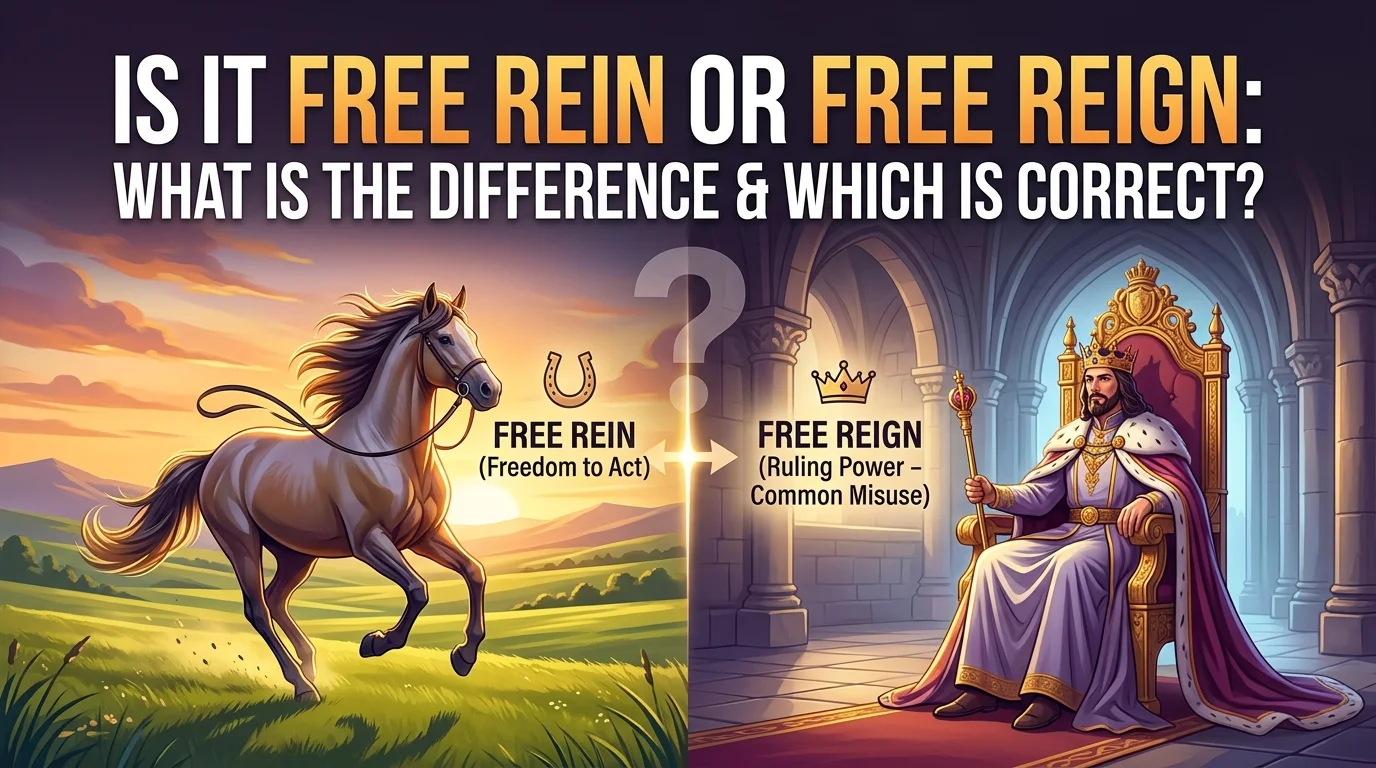
Many English learners and native speakers alike get confused between free rein and free reign because both phrases sound exactly the same when spoken. However, only one of them is considered correct in standard English. Understanding the difference can help you write more accurately and avoid a very common mistake. This guide explains the meanings, usage, grammar, examples, and practical tips for choosing the right phrase.
Comparison Overview
The confusion between free rein and free reign comes from their identical pronunciation. While they sound alike, they have different origins and only one is accepted as the standard expression in modern English.
| Term | Status | Meaning | Correct Usage |
| Free Rein | Correct | Freedom to act or make decisions without restrictions | Yes |
| Free Reign | Common Mistake | Often mistakenly used instead of free rein | No |
The phrase originated from horse riding, where a rider loosens the reins and allows the horse greater freedom of movement.
Definition of Free Rein
Free rein is the correct English expression. It means giving someone the freedom or authority to act, decide, or behave as they wish without strict control.
The phrase comes from horseback riding. When a rider gives a horse a loose rein, the horse has more freedom to move.
Meaning
- Freedom to make decisions
- Permission to act independently
- Lack of restrictions or control
Example
The manager gave her team free rein to develop new marketing strategies.
Definition of Free Reign
Free reign is generally considered an incorrect spelling of free rein. People often assume it is correct because the word “reign” relates to ruling or governing, which seems similar to having authority.
Meaning
There is no officially recognized idiomatic meaning for free reign in standard English.
Example of Incorrect Usage
❌ The teacher gave students free reign to choose their projects.
Correct Form
✅ The teacher gave students free rein to choose their projects.
Main Differences Between Free Rein and Free Reign
| Feature | Free Rein | Free Reign |
| Correct Expression | Yes | No |
| Origin | Horse riding | Royal rule and kingship |
| Meaning | Freedom to act | Usually a mistaken spelling |
| Standard English | Accepted | Not accepted |
| Recommended for Writing | Yes | No |
The key difference is that free rein refers to freedom and independence, while free reign is simply a spelling mistake resulting from confusion with the word “reign.”
Origin and History of the Expression
The phrase dates back to horseback riding traditions. A rider controls a horse using reins. When the reins are loosened, the horse gains more freedom to move and choose its direction.
Over time, the expression became a metaphor for allowing people freedom in decision-making, creativity, and leadership.
Because “rein” is less commonly used today than “reign,” many writers mistakenly replace it with “reign.”
Why People Confuse These Terms
Several factors contribute to the confusion:
- Both phrases sound identical.
- The word “reign” is more familiar to many people.
- Authority and freedom seem connected to ruling.
- The original horse-riding meaning is not widely known.
Understanding the phrase’s origin makes the correct choice easier to remember.
Grammar Guide
How each term is used in sentences
Free Rein Pattern
- Give someone free rein to do something.
- Allow free rein in a situation.
- Have free rein over a project.
Examples:
- The company gave employees free rein to innovate.
- Parents gave their children free rein during the holiday.
- The designer had free rein over the new product line.
Free Reign Pattern
This form should generally be avoided in formal and standard writing.
Common mistakes learners make
- Writing free reign instead of free rein.
- Assuming reign means authority and therefore must be correct.
- Using the phrase without understanding its horse-riding origin.
- Replacing rein with reign in professional writing.
Simple rules to remember
- Think of horse reins, not kings’ reigns.
- If you mean freedom, use free rein.
- The correct phrase always contains rein.
Quick tips for writing and speaking
- Double-check spelling before publishing.
- Remember that reins control horses.
- Associate rein with freedom of movement.
- Avoid free reign in academic or professional writing.
When to Use Each One
Use Free Rein When
- Giving permission
- Allowing creativity
- Granting independence
- Delegating authority
- Discussing freedom of action
Examples:
- The editor gave writers free rein.
- The coach gave players free rein during practice.
- Scientists received free rein to conduct experiments.
Use Free Reign When
In standard English, you generally should not use free reign.
The only exception would be if you are discussing the common mistake itself or quoting someone who used it incorrectly.
When NOT to Use Each One
Do Not Use Free Rein
- When discussing actual royal rule or kingship.
- When the context specifically involves governing monarchs.
Do Not Use Free Reign
- In essays
- In business writing
- In academic papers
- In professional emails
- In published content
Which One to Use (Decision Guide)
Ask yourself this question:
Are you talking about freedom, independence, or permission?
If yes, use free rein.
Are you referring to kings, queens, or ruling power?
Use the word reign separately, but not in the phrase “free reign.”
Quick Decision Chart
| Situation | Correct Choice |
| Freedom to decide | Free Rein |
| Creative control | Free Rein |
| Independence | Free Rein |
| Leadership freedom | Free Rein |
| Royal rule | Reign |
| Phrase “Free Reign” | Usually Incorrect |
Real-World Practical Examples
Free Rein Examples
- The teacher gave students free rein to choose research topics.
- The company gave engineers free rein to design new software.
- The chef had free rein over the restaurant menu.
- Parents allowed their children free rein during summer activities.
- The author had free rein when creating fictional characters.
Free Reign Examples
- Free reign is often seen in online comments but is usually incorrect.
- Many students mistakenly write free reign in essays.
- Spellcheck may not always catch free reign.
- Editors frequently correct free reign to free rein.
- Grammar guides classify free reign as a common error.
Self-Assessment (Fill in the Blanks)
- The manager gave employees ______ when developing new ideas.
- The correct word is ______ because it refers to freedom of action.
- The teacher allowed students ______ during the project.
- The phrase ______ comes from horse riding.
- Writers should avoid using ______ in formal English.
- The designer had ______ over the company’s branding.
- The correct expression is ______ not free reign.
- The coach gave athletes ______ during training.
- The word ______ refers to horse straps used for control.
- The mistaken form is ______.
- The scientist received ______ to conduct research.
- The editor gave the writer ______ over the article.
- The company offered employees ______ in decision-making.
- The phrase originates from loosening a horse’s ______.
- Professional writers use ______.
- Students commonly confuse ______ and free reign.
- The principal gave teachers ______ to organize events.
- Freedom and independence are expressed by ______.
- Standard grammar accepts ______.
- The incorrect version is ______ because it confuses rein with reign.
Answers
- free rein
- free rein
- free rein
- free rein
- free reign
- free rein
- free rein
- free rein
- rein
- free reign
- free rein
- free rein
- free rein
- rein
- free rein
- free rein
- free rein
- free rein
- free rein
- free reign
Final Verdict
When comparing free rein and free reign, the correct choice is clear. Free rein is the standard English expression used to describe freedom, independence, and the ability to act without restrictions. It originates from horseback riding, where loosening the reins allows a horse greater freedom of movement. Free reign, although commonly seen online and in casual writing, is generally considered a spelling mistake rather than a valid alternative. If you want your writing to be accurate, professional, and grammatically correct, always choose free rein when talking about giving someone freedom or authority. Remember the simple rule: freedom comes from the horse’s rein, not a king’s reign.
Conclusion About Is It Free Rein or Free Reign
Understanding the difference between free rein and free reign can help you avoid one of the most common spelling mistakes in English. Although both phrases sound identical when spoken, only free rein is considered correct in standard English. The expression comes from horseback riding and refers to giving someone the freedom to act, decide, or create without strict limitations. On the other hand, free reign is a widely used misspelling that results from confusion with the word reign, which relates to ruling or governing. Whether you are writing an essay, business document, email, or social media post, choosing the correct phrase improves clarity and professionalism. Remember the simple connection between rein and horse reins, which symbolize control and freedom. Once you understand its origin and meaning, selecting the correct expression becomes easy and natural in both writing and everyday communication.
FAQs
Is free rein or free reign correct?
Free rein is the correct phrase. It means giving someone freedom or authority to act without restrictions. Free reign is a common spelling mistake that occurs because both phrases sound the same when spoken, but it is not considered standard English usage.
What does free rein mean?
Free rein means allowing someone to make decisions, take action, or express creativity without close supervision or limitations. The phrase originally came from horseback riding, where loosening the reins gave a horse greater freedom to move.
Why do people say free reign?
People often use free reign because the word reign is more familiar and is associated with power or authority. Since the two phrases are pronounced the same way, many writers mistakenly assume that reign is the correct spelling.
Where did the phrase free rein come from?
The phrase originated from horse riding. A rider controls a horse using reins. When the reins are loosened, the horse has more freedom to choose its movement. This idea later became a metaphor for giving people independence and flexibility.
Is free reign ever correct?
In most situations, no. Standard dictionaries and grammar references recognize free rein as the correct expression. Free reign may appear in informal writing, but it is generally treated as an error rather than an accepted alternative.
How do you use free rein in a sentence?
You can use it when describing freedom or independence. For example, “The manager gave her team free rein to develop new ideas.” In this sentence, the team is allowed to work with minimal restrictions or direct control.
Is free rein an idiom?
Yes, free rein is an English idiom. Its meaning goes beyond the literal idea of horse reins and is commonly used to describe freedom, authority, or flexibility in personal, academic, and professional situations.
Can free rein be used in business writing?
Yes, free rein is commonly used in business communication. It can describe situations where employees, managers, or teams are trusted to make decisions independently and carry out projects without excessive oversight.
How can I remember the correct spelling?
A simple trick is to think about horse reins. The phrase comes from horseback riding, so the correct word is rein, not reign. Connecting the expression to horses makes it much easier to remember.
Why is this mistake so common?
This mistake is common because free rein and free reign are homophones, meaning they sound exactly alike. Since many people are unfamiliar with the phrase’s equestrian origin, they often replace rein with the more familiar word reign.

Sarah Mitchell is an experienced writer and grammar teacher with over 10 years of expertise in English language education. She helps learners improve their grammar, writing, and communication skills through clear explanations and practical examples. Sarah creates learner-friendly content focused on real-life English, making language learning simple, effective, and confidence-building.