
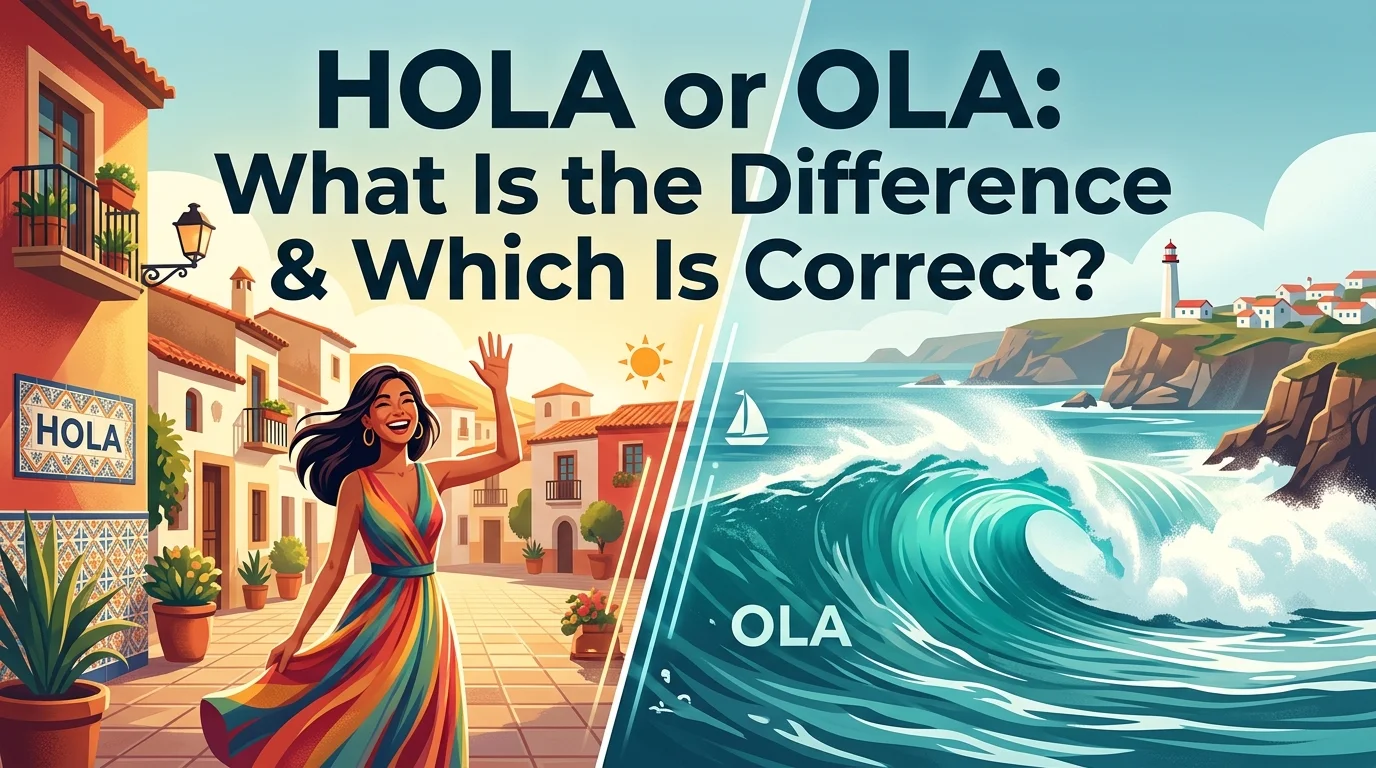
When people see the words Hola and Ola, they often wonder whether they mean the same thing or if one is correct and the other is a mistake. Although these words look very similar, they belong to different languages and contexts. Understanding the difference between Hola and Ola can help you communicate more accurately and avoid common language misunderstandings.
Comparison Overview
Hola and Ola are greetings used in different languages. While both can be translated as “hello” in certain situations, they come from different linguistic backgrounds and are used by different groups of speakers.
| Feature | Hola | Ola |
| Language | Spanish | Portuguese (informal spelling often appears as “Olá”) |
| Meaning | Hello | Hello |
| Usage | Spanish-speaking countries | Portuguese-speaking countries |
| Correct Accent | No accent | Usually written as “Olá” |
| Pronunciation | OH-lah | oh-LAH |
Definition of Hola
Hola is a Spanish greeting that means “hello.” It is one of the most common words used when meeting someone, starting a conversation, or greeting a group of people.
Spanish speakers use Hola in both formal and informal situations. It is simple, friendly, and appropriate for nearly any conversation.
Examples:
- Hola, ¿cómo estás?
- Hola, buenos días.
- Hola, amigos.
- Hola, profesora.
- Hola, ¿puedo ayudarte?
Definition of Ola
Ola is generally associated with Portuguese, although the standard Portuguese greeting is written as Olá with an accent mark. It means “hello” and is used to greet people in everyday conversations.
Without the accent, ola can also mean “wave” in Spanish and Portuguese depending on the context.
Examples:
- Olá, tudo bem?
- Olá, amigos.
- Olá, como vai?
- Olá, prazer em conhecê-lo.
- Olá, pessoal.
Main Differences Between Hola and Ola
The primary difference between Hola and Ola is the language in which they are used.
| Aspect | Hola | Ola / Olá |
| Language Origin | Spanish | Portuguese |
| Meaning as Greeting | Hello | Hello |
| Standard Spelling | Hola | Olá |
| Countries | Spain, Mexico, Argentina, Colombia, etc. | Portugal, Brazil, Angola, Mozambique, etc. |
| Pronunciation Style | Spanish pronunciation | Portuguese pronunciation |
Another important difference is that Hola is always the standard Spanish greeting, while Portuguese normally uses Olá rather than Ola.
Language Origins and Cultural Usage
Hola in Spanish Culture
Spanish speakers use Hola as the most basic greeting. It can be used at work, school, home, and social events.
Olá in Portuguese Culture
Portuguese speakers commonly use Olá when greeting friends, coworkers, customers, or strangers. It serves the same general purpose as Hola but follows Portuguese spelling and pronunciation rules.
Common Confusion Between Hola and Ola
Many learners confuse these words because they look almost identical. The confusion increases because both are greetings and both are used in Romance languages.
Remember:
- Spanish = Hola
- Portuguese = Olá
- Spanish word ola can also mean “wave”
Grammar Guide
Both words function primarily as interjections or greetings rather than nouns, verbs, or adjectives when used to say hello.
How Each Term Is Used in Sentences
Hola
- Hola, ¿qué tal?
- Hola, María.
- Hola a todos.
- Hola, necesito ayuda.
- Hola, bienvenidos.
Olá/Ola
- Olá, tudo bem?
- Olá, João.
- Olá a todos.
- Olá, obrigado pela ajuda.
- Olá, seja bem-vindo.
Common Mistakes Learners Make
- Using Hola when writing Portuguese.
- Using Olá when writing Spanish.
- Assuming both belong to the same language.
- Forgetting the accent mark in Portuguese.
- Thinking ola always means hello.
Simple Rules to Remember
- If you are writing Spanish, use Hola.
- If you are writing Portuguese, use Olá.
- Spanish ola often means a wave in the ocean.
- Portuguese greetings usually use the accented form Olá.
- Match the greeting to the language being spoken.
Quick Tips for Writing and Speaking
- Learn which language your audience speaks.
- Use Hola for Spanish conversations.
- Use Olá for Portuguese conversations.
- Check spelling carefully.
- Listen to native pronunciation for better accuracy.
When to Use Each One
Use Hola When
- Speaking Spanish.
- Greeting Spanish-speaking friends.
- Writing Spanish emails.
- Traveling in Spanish-speaking countries.
- Learning beginner Spanish.
Use Olá/Ola When
- Speaking Portuguese.
- Greeting Portuguese speakers.
- Writing Portuguese messages.
- Traveling in Brazil or Portugal.
- Learning Portuguese.
When NOT to Use Each One
Do Not Use Hola When
- Writing Portuguese.
- Greeting someone exclusively in Portuguese.
- Creating Portuguese educational content.
- Translating Portuguese conversations.
- Using standard Portuguese grammar.
Do Not Use Olá/Ola When
- Writing Spanish.
- Greeting someone in a Spanish-language document.
- Creating Spanish educational materials.
- Translating Spanish conversations.
- Following standard Spanish spelling rules.
Which One to Use (Decision Guide)
Ask yourself these questions:
- Am I speaking Spanish?
- Use Hola.
- Am I speaking Portuguese?
- Use Olá.
- Am I referring to an ocean wave in Spanish?
- Use ola.
- Is the audience from a Spanish-speaking country?
- Use Hola.
- Is the audience from Brazil or Portugal?
- Use Olá.
In short, neither word is universally “more correct.” The correct choice depends entirely on the language being used.
Real-World Practical Examples
Hola Examples
- Education: Hola, profesor. Tengo una pregunta.
- Daily Life: Hola, mamá. Ya llegué a casa.
- Business: Hola, gracias por su correo electrónico.
- Technology: Hola, necesito ayuda con esta aplicación.
- Conversation: Hola, ¿cómo estuvo tu día?
Ola Examples
- Education: Olá, professora. Tenho uma dúvida.
- Daily Life: Olá, mãe. Cheguei em casa.
- Business: Olá, obrigado pelo seu e-mail.
- Technology: Olá, preciso de ajuda com este software.
- Conversation: Olá, como foi o seu dia?
Self-Assessment (Fill in the Blanks)
- I will use ______ when greeting someone in Spanish.
- The correct word is ______ because the conversation is in Portuguese.
- I will use ______ when writing a Spanish email.
- The correct word is ______ because the audience is from Brazil.
- I will use ______ when learning beginner Spanish.
- The correct word is ______ because it belongs to Portuguese.
- I will use ______ when greeting people in Mexico.
- The correct word is ______ because the language is Spanish.
- I will use ______ when speaking with someone from Portugal.
- The correct word is ______ because it is the standard Spanish greeting.
- I will use ______ when starting a Spanish conversation.
- The correct word is ______ because the text is written in Portuguese.
- I will use ______ when traveling in Spain.
- The correct word is ______ because it is commonly used in Brazil.
- I will use ______ when addressing a Spanish-speaking teacher.
- The correct word is ______ because Portuguese grammar is being used.
- I will use ______ when greeting friends in Argentina.
- The correct word is ______ because the message is in Portuguese.
- I will use ______ when writing to a Spanish customer.
- The correct word is ______ because Spanish speakers commonly use it as hello.
Answers
- Hola
- Olá
- Hola
- Olá
- Hola
- Olá
- Hola
- Hola
- Olá
- Hola
- Hola
- Olá
- Hola
- Olá
- Hola
- Olá
- Hola
- Olá
- Hola
- Hola
Final Verdict
The comparison between Hola and Ola comes down to language and context. Hola is the standard Spanish word for “hello” and is used throughout the Spanish-speaking world. Olá is the Portuguese equivalent and is commonly used in countries such as Portugal and Brazil. Although the words look very similar and share the same greeting function, they are not interchangeable when writing correctly in their respective languages. If you are communicating in Spanish, choose Hola. If you are communicating in Portuguese, choose Olá. By matching the greeting to the language, you can communicate naturally, accurately, and confidently in both written and spoken situations.
Conclusion About Hola or Ola
Understanding the difference between Hola and Ola helps you communicate more confidently in Spanish and Portuguese conversations. While both words are commonly used as greetings, they belong to different languages and follow different spelling rules. Hola is the standard Spanish greeting used across many countries, while Olá is the correct Portuguese form for saying hello. Even though they look similar, using the right one shows respect for language and culture. Whether you are traveling, learning a new language, or chatting online, choosing the correct greeting improves clarity and connection. With this simple knowledge, you can avoid confusion and sound more natural in everyday communication across both languages.
FAQs
Is Hola used in Spanish or Portuguese?
Hola is used in Spanish as the standard way to say hello. It is not used in Portuguese. In Portuguese, the correct greeting is Olá. Both serve the same purpose of greeting someone, but each belongs to its own language system and cultural usage.
What does Ola mean in Spanish?
In Spanish, ola (without an accent) does not mean hello. It usually means a wave, like an ocean wave. Many learners confuse it with greetings, but it is important to remember that Hola is the correct Spanish greeting for hello.
Is Olá the same as Ola?
Olá and Ola are not exactly the same. Olá is the correct Portuguese greeting meaning hello, while ola without the accent is generally incorrect in greetings and can have different meanings depending on context. The accent mark is important in Portuguese grammar.
Can Hola be used in Brazil?
No, Hola is not used in Brazil because Portuguese is the official language. In Brazil, people use Olá or informal greetings like Oi. Using Hola in Brazil would sound foreign or incorrect in everyday communication.
Why do Hola and Ola look similar?
They look similar because Spanish and Portuguese both come from Latin and share many linguistic roots. Over time, they developed different spelling and pronunciation rules, which is why their greetings look alike but are used differently today.
Which is more formal Hola or Ola?
Both Hola and Olá can be used in formal and informal situations depending on context. In Spanish, Hola is neutral and widely accepted. In Portuguese, Olá is also neutral and suitable for most greetings in both casual and professional settings.
Is Ola ever correct in Spanish?
Yes, but not as a greeting. In Spanish, ola means a wave, like in the sea or ocean. It is only correct when referring to that meaning and should not be used instead of Hola for greeting people.
Do Spanish speakers understand Ola as hello?
Spanish speakers do not recognize ola as hello. They understand Hola as the correct greeting. Using ola instead of Hola may lead to confusion, so it is important to use the correct spelling when speaking or writing Spanish.
What is the easiest way to remember Hola vs Ola?
A simple way to remember is that Hola belongs to Spanish and starts with an H, while Portuguese uses Olá with an accent. Linking each word to its language helps avoid mistakes and ensures correct usage in conversation.
Can Hola and Ola be used interchangeably?
No, they should not be used interchangeably. Each word belongs to a specific language system. Using the correct form helps maintain proper grammar and shows respect for Spanish and Portuguese communication rules.

Amelia Wright focuses on making figurative language easy to understand. Her writing explains similes, metaphors, and word meanings using relatable examples. She aims to help readers recognize subtle differences in usage and apply them correctly in both academic and casual writing.