
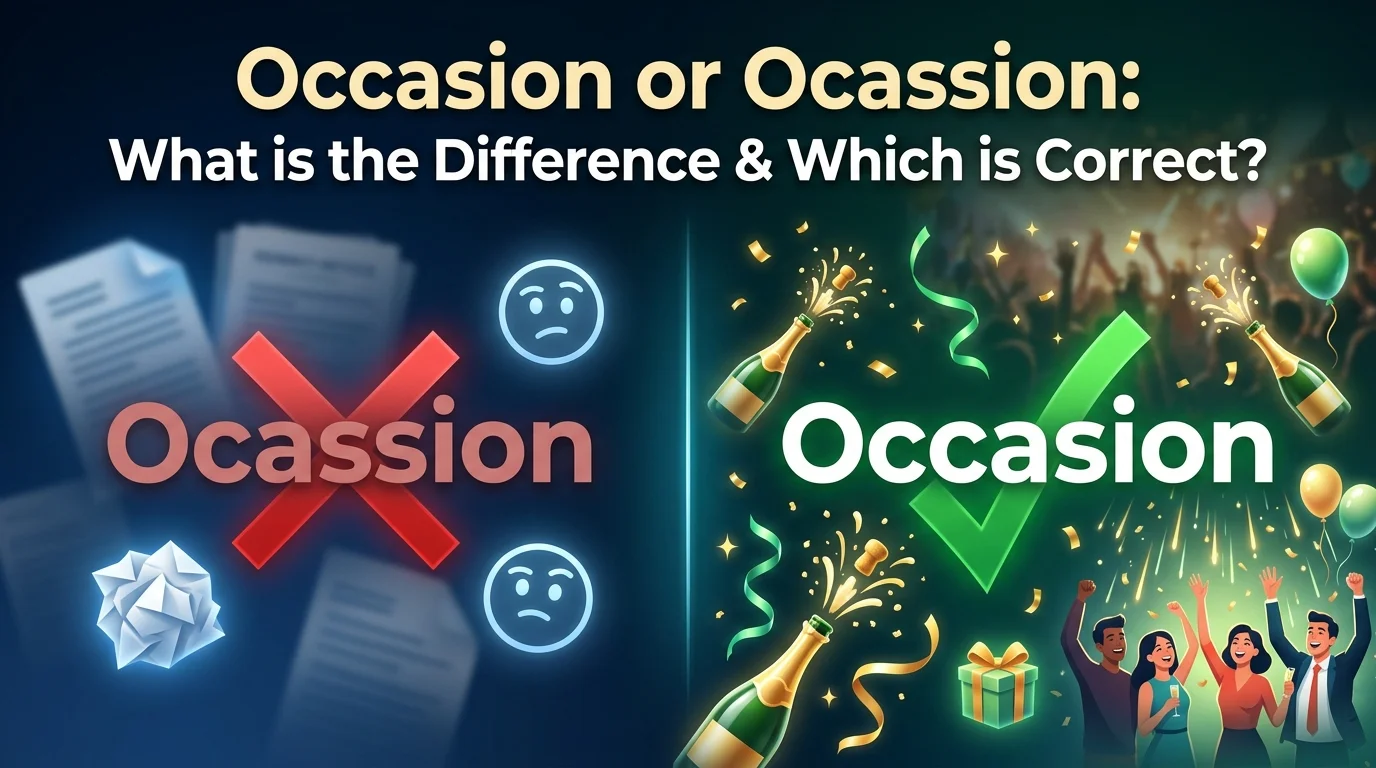
Many English learners get confused between occasion and ocassion because the two words look very similar. However, only one of them is a correct English spelling. Understanding the difference is important for writing accurately in school, business, emails, and everyday communication. This guide explains the meanings, grammar, usage rules, examples, and common mistakes in a simple and beginner-friendly way.
Comparison Overview
The comparison between occasion and ocassion is actually a comparison between the correct spelling and an incorrect spelling of the same word.
| Term | Status | Meaning |
| Occasion | Correct | A particular event, time, or reason for something |
| Ocassion | Incorrect | Misspelling of “occasion” |
The confusion usually happens because many people mistakenly add an extra “a” after the first “c.” In standard English, the accepted spelling is always occasion.
Definition of Occasion
Occasion is a noun that refers to a special event, a particular time, or a reason for something to happen.
Meaning
An occasion can be:
- A special event or celebration
- A specific time when something happens
- A reason or opportunity for an action
Examples
- Her birthday was a special occasion.
- On one occasion, I met a famous author.
- The award ceremony was an important occasion.
- We had no occasion to complain.
- The holiday provided an occasion for family gatherings.
Definition of Ocassion
Ocassion is not a recognized English word.
Meaning
Ocassion has no official meaning because it is simply a spelling mistake of occasion.
Examples
Incorrect:
- We celebrated the ocassion.
- It was a special ocassion.
Correct:
- We celebrated the occasion.
- It was a special occasion.
Main Differences Between Occasion and Ocassion
| Feature | Occasion | Ocassion |
| Spelling | Correct | Incorrect |
| Dictionary Entry | Yes | No |
| Accepted in Formal Writing | Yes | No |
| Academic Usage | Yes | No |
| Professional Usage | Yes | No |
| Exam Usage | Yes | No |
Key Difference
The only difference is spelling.
- Occasion is the correct English word.
- Ocassion is a common spelling error.
Common Contexts Where Occasion Is Used
Special Events
- Wedding occasion
- Birthday occasion
- Graduation occasion
Particular Times
- On one occasion
- On several occasions
Reasons or Opportunities
- No occasion for concern
- An occasion to celebrate
Spelling Pattern Breakdown
The correct spelling is:
O C C A S I O N
A simple memory trick:
Two C’s + one A + one S = Occasion
Many learners incorrectly write:
O C C A S S I O N
or
O C A S S I O N
These versions are incorrect.
Grammar Guide
Part of Speech
Occasion is primarily a noun.
Examples:
- The occasion was memorable.
- This is a happy occasion.
It can also appear in expressions:
- On occasion
- On several occasions
How Each Term Is Used in Sentences
Occasion
Pattern:
- Occasion + verb
- Adjective + occasion
- On occasion
Examples:
- The occasion was celebrated nationwide.
- It was a joyful occasion.
- We visit them on occasion.
Ocassion
This form should not be used in sentences because it is a misspelling.
Common Mistakes Learners Make
Mistake 1
Writing:
- Ocassion
Correct:
- Occasion
Mistake 2
Using double “s”
Incorrect:
- Occassion
Correct:
- Occasion
Mistake 3
Dropping a “c”
Incorrect:
- Ocasion
Correct:
- Occasion
Simple Rules to Remember
- Always write occasion.
- Remember: two C’s and one S.
- Never use ocassion in formal or informal writing.
- Check spelling carefully before publishing content.
Quick Tips for Writing and Speaking
- Use spell check tools.
- Remember the spelling pattern.
- Read the word slowly: oc-ca-sion.
- Practice writing it several times.
- Proofread important documents.
When to Use Each One
Use Occasion When
- Referring to a special event
- Referring to a specific time
- Referring to a reason for something
- Writing essays
- Sending professional emails
- Creating business documents
Examples:
- The wedding was a beautiful occasion.
- On one occasion, she visited Paris.
- This is an occasion worth celebrating.
Use Ocassion When
Never.
It is always considered a spelling mistake.
When NOT to Use Each One
Do Not Use Occasion Incorrectly
Avoid using occasion when you mean:
- Opportunity
- Eventual result
- Frequency
Choose words carefully according to context.
Do Not Use Ocassion
Never use it in:
- School assignments
- Professional writing
- Blog posts
- Academic papers
- Business communication
- Social media captions intended to be error-free
Which One to Use (Decision Guide)
Ask yourself:
Are you referring to an event, time, celebration, or reason?
If yes:
→ Use occasion
Are you thinking about writing ocassion?
→ Correct it to occasion
Decision:
- Occasion = Correct
- Ocassion = Incorrect
Real-World Practical Examples
Occasion Examples
Education
- The graduation ceremony was a memorable occasion.
Daily Life
- Her birthday was a special occasion.
Science
- On one occasion, the experiment produced unusual results.
Business
- The company anniversary was an important occasion.
Writing
- The author described the occasion in detail.
Technology
- The product launch was a major occasion.
Conversation
- This is a great occasion to meet old friends.
Ocassion Examples
The following are incorrect examples:
- The wedding ocassion was beautiful.
- It was a special ocassion.
- We celebrated the ocassion together.
- The ocassion was memorable.
- This ocassion deserves recognition.
Correct all of them by replacing ocassion with occasion.
Self-Assessment (Fill in the Blanks)
- Her birthday was a special ______.
- The correct spelling is ______ because it appears in dictionaries.
- We gathered for the wedding ______.
- The word ______ is a spelling mistake.
- On one ______, I visited London.
- The correct word is ______ because it refers to an event.
- This is an ______ worth celebrating.
- The incorrect spelling is ______.
- The graduation ______ was unforgettable.
- We had no ______ to worry.
- The correct word is ______ because it is accepted in formal writing.
- The holiday provided an ______ for family reunions.
- The word ______ should never appear in academic papers.
- On several ______, she helped the team.
- This is a joyful ______.
- The correct word is ______ because it follows standard English spelling.
- The award ceremony was a significant ______.
- The misspelled form is ______.
- Every special event can be called an ______.
- The correct word is ______ because it is grammatically valid.
Answers
- occasion
- occasion
- occasion
- ocassion
- occasion
- occasion
- occasion
- ocassion
- occasion
- occasion
- occasion
- occasion
- ocassion
- occasions
- occasion
- occasion
- occasion
- ocassion
- occasion
- occasion
Final Verdict
The comparison between occasion and ocassion is straightforward. Occasion is the only correct spelling recognized in modern English. It refers to a special event, a particular time, or a reason for something to happen. Ocassion, on the other hand, is simply a spelling error and should never be used in formal or informal writing. Whenever you are writing about celebrations, events, opportunities, or memorable moments, always choose occasion. Remember the simple rule: if you are unsure, use occasion because it is the correct and accepted form in dictionaries, schools, workplaces, and professional communication.
Conclusion About Occasion or Ocassion
Understanding the difference between occasion and ocassion is much simpler once you know that only one of these spellings is correct. Occasion is the standard English word used to describe a special event, a particular time, or a reason for something to happen. In contrast, ocassion is a common spelling mistake that should be avoided in both formal and informal writing. Whether you are writing an email, preparing an academic assignment, creating business content, or simply improving your English skills, using the correct spelling helps make your communication clearer and more professional. Remember that dictionaries, style guides, and grammar experts all recognize occasion as the correct form. By learning the proper spelling and practicing it regularly, you can avoid common writing errors and communicate with greater confidence in every situation.
FAQs
Is occasion or ocassion the correct spelling?
Occasion is the correct spelling. It is the standard English word found in dictionaries and used in professional, academic, and everyday writing. Ocassion is a spelling mistake and should be corrected whenever it appears in written communication.
What does occasion mean?
The word occasion refers to a special event, a particular time, or a reason for something to happen. It is commonly used when talking about celebrations, memorable moments, opportunities, or specific situations.
Is ocassion a real English word?
No, ocassion is not a recognized English word. It does not appear as a valid entry in standard dictionaries. It is simply a misspelling of the word occasion.
Why do people misspell occasion as ocassion?
Many people confuse the spelling because of the word’s pronunciation. The placement of letters can be difficult to remember, leading writers to accidentally replace or rearrange letters and create the incorrect form ocassion.
How can I remember the correct spelling of occasion?
A helpful trick is to remember that occasion contains two C’s and one S. Repeating the word while writing it and using spell-check tools can also help reinforce the correct spelling.
Can occasion be used in formal writing?
Yes, occasion is perfectly acceptable in formal writing. It is commonly used in academic papers, business reports, professional emails, invitations, and official documents when referring to events or specific situations.
What part of speech is occasion?
Occasion is primarily a noun. It can describe an event, a moment in time, or a reason for an action. It is often used with adjectives such as special, important, memorable, or formal.
Can occasion refer to a reason and not an event?
Yes, occasion can also mean a reason or cause for something. For example, the phrase “no occasion for concern” means there is no reason to be worried about a situation.
Is occasion commonly used in everyday conversation?
Yes, the word is frequently used in daily speech and writing. People often use it when discussing celebrations, holidays, gatherings, achievements, or memorable experiences.
Should I ever use the spelling ocassion?
No, you should never intentionally use ocassion. The correct spelling is always occasion, regardless of whether you are writing formally, casually, academically, or professionally.

Daniel Brooks is an English educator with a passion for explaining similes and word comparisons in plain language. He covers topics like versus meanings, correct usage, and figurative language to help writers avoid common mistakes and improve clarity in everyday writing.