
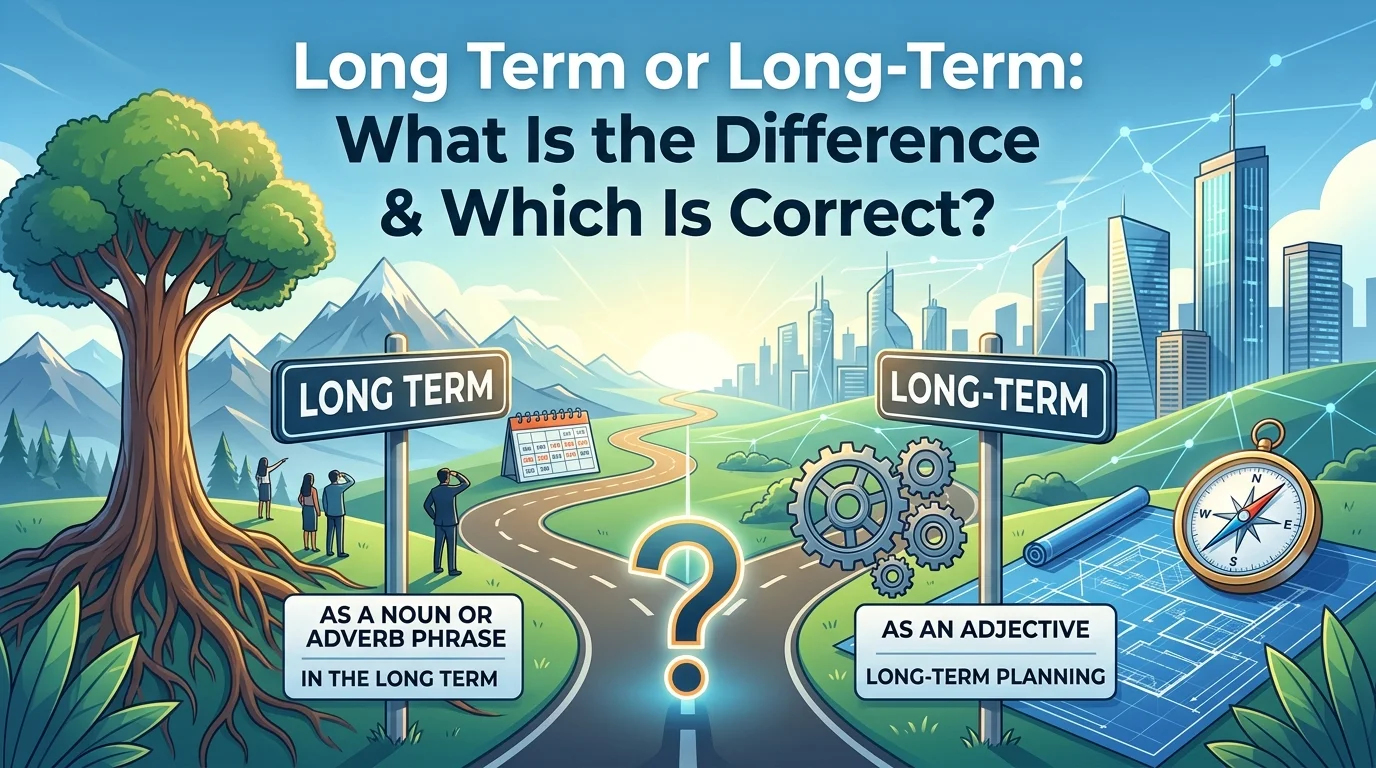
Many English learners and writers get confused between long term and long-term because the words look almost identical. However, their grammatical roles are different. Knowing when to use the hyphenated form and when to use the open form can improve your writing accuracy and make your communication clearer in both formal and informal contexts.
Comparison Overview
The terms long term and long-term are closely related and share the same basic meaning of something that lasts for an extended period. The difference lies in how they function within a sentence. One acts primarily as a noun phrase, while the other functions as a compound adjective.
| Term | Part of Speech | Main Use |
| Long Term | Noun Phrase | Refers to an extended period of time |
| Long-Term | Compound Adjective | Describes something lasting a long time |
Definition of Long Term
Long term is a noun phrase that refers to a lengthy period of time in the future or over an extended duration.
It is commonly used after prepositions such as “in the,” “over the,” or “for the.”
Examples:
- We need to think about the long term.
- The company focuses on growth in the long term.
- Success often comes in the long term.
Definition of Long-Term
Long-term is a compound adjective. It is used before a noun to describe something that lasts, develops, or remains effective for a long period.
The hyphen connects the two words so they work together as a single modifier.
Examples:
- She has a long-term investment plan.
- They signed a long-term contract.
- Long-term success requires patience.
Main Differences Between Long Term and Long-Term
| Feature | Long Term | Long-Term |
| Grammatical Role | Noun Phrase | Compound Adjective |
| Hyphen | No | Yes |
| Used Before a Noun | No | Yes |
| Refers to Time Period | Yes | Indirectly |
| Describes a Noun | No | Yes |
Key Difference
- Use long term when referring to the time period itself.
- Use long-term when describing a noun.
Examples:
- We are planning for the long term. ✔
- We have a long-term strategy. ✔
- We are planning for the long-term. ✘
- We have a long term strategy. ✘
Long Term vs Long-Term in Professional Writing
In business, education, science, and academic writing, the distinction is especially important.
Examples:
- Long-term planning improves business performance.
- Researchers study long-term environmental effects.
- Investors focus on the long term.
- Governments often create policies for the long term.
Using the correct form helps maintain professional credibility and grammatical accuracy.
Comparison Table
| Situation | Correct Choice |
| Describing a strategy | Long-Term |
| Describing a relationship | Long-Term |
| Talking about future outcomes | Long Term |
| Discussing a time horizon | Long Term |
| Modifying a noun | Long-Term |
| Referring to a duration | Long Term |
Grammar Guide
How Each Term Is Used in Sentences
Long Term Pattern
- in the long term
- over the long term
- for the long term
Examples:
- The benefits appear in the long term.
- We are investing for the long term.
Long-Term Pattern
- long-term plan
- long-term goal
- long-term project
Examples:
- She developed a long-term strategy.
- They signed a long-term agreement.
Common Mistakes Learners Make
- Omitting the hyphen before a noun.
- Adding a hyphen when referring to the time period itself.
- Assuming both forms are interchangeable.
- Using long-term as a standalone noun phrase.
- Forgetting that compound adjectives often require hyphens.
Incorrect:
- We need a long term plan.
- We are thinking in the long-term.
Correct:
- We need a long-term plan.
- We are thinking in the long term.
Simple Rules to Remember
- Before a noun = use long-term.
- Referring to a period of time = use long term.
- If the phrase describes something, use a hyphen.
- If the phrase names the duration itself, do not use a hyphen.
Quick Tips for Writing and Speaking
- Check whether a noun follows the phrase.
- If a noun follows immediately, use long-term.
- If discussing future duration generally, use long term.
- Proofread business and academic documents carefully.
- Remember that hyphens often create compound modifiers.
When to Use Each One
Use Long Term When:
- Talking about future outcomes.
- Discussing extended periods.
- Referring to long-range effects.
- Speaking about future planning generally.
- Comparing short-term and long-term results.
Examples:
- Think about the long term.
- The policy benefits society in the long term.
Use Long-Term When:
- Modifying a noun.
- Describing plans or goals.
- Describing contracts or projects.
- Discussing investments.
- Explaining lasting effects.
Examples:
- We need a long-term solution.
- They developed a long-term strategy.
When NOT to Use Each One
Do Not Use Long Term
Incorrect:
- A long term investment.
- A long term solution.
Reason: It modifies a noun and therefore requires a hyphen.
Do Not Use Long-Term
Incorrect:
- We are thinking about the long-term.
- Success comes in the long-term.
Reason: The phrase refers to a period of time and does not modify a noun.
Which One to Use (Decision Guide)
Ask yourself one question:
Does the phrase directly describe a noun?
If YES:
- Use long-term.
Examples:
- long-term plan
- long-term project
- long-term relationship
If NO:
- Use long term.
Examples:
- in the long term
- over the long term
- for the long term
Real-World Practical Examples
Long Term Examples
- The investment paid off in the long term.
- Good study habits help in the long term.
- Scientists examine effects over the long term.
- The policy benefits citizens in the long term.
- Healthy eating improves wellness in the long term.
Long-Term Examples
- The company created a long-term business plan.
- They signed a long-term lease agreement.
- She follows a long-term fitness program.
- Researchers conducted a long-term study.
- The government introduced a long-term development strategy.
Self-Assessment (Fill in the Blanks)
- I will use ______ when referring to a future time period.
- The correct word is ______ because it modifies the noun “plan.”
- I will use ______ when discussing future outcomes.
- The correct word is ______ because it describes “investment.”
- We should think about the ______.
- They created a ______ strategy.
- Success often appears in the ______.
- The company needs a ______ solution.
- Researchers studied effects over the ______.
- She signed a ______ contract.
- Investors focus on the ______.
- A ______ relationship requires commitment.
- We must plan for the ______.
- They launched a ______ project.
- Benefits become clear in the ______.
- A ______ goal takes patience.
- The organization is preparing for the ______.
- Scientists completed a ______ research project.
- Growth happens in the ______.
- They developed a ______ policy.
Answers
- Long term
- Long-term
- Long term
- Long-term
- Long term
- Long-term
- Long term
- Long-term
- Long term
- Long-term
- Long term
- Long-term
- Long term
- Long-term
- Long term
- Long-term
- Long term
- Long-term
- Long term
- Long-term
Final Verdict
The difference between long term and long-term is grammatical rather than semantic. Both relate to an extended period of time, but they perform different functions in a sentence. Use long term when referring to the duration itself, such as “in the long term” or “for the long term.” Use long-term when the phrase directly modifies a noun, such as “long-term goal” or “long-term strategy.” Remembering this simple rule will help you write more accurately and confidently in academic, professional, and everyday English. When in doubt, check whether a noun follows immediately after the phrase. If it does, use the hyphenated form. If not, use the open form.
Conclusion About Long Term or Long-Term
Understanding the difference between long term and long-term is a small but important step toward improving your English writing. Although both expressions relate to an extended period of time, they serve different grammatical purposes. Long term is used as a noun phrase when referring to the future or an extended duration, while long-term functions as a compound adjective that describes a noun. This distinction is especially valuable in academic, business, professional, and everyday communication, where proper grammar helps convey your message clearly and confidently. By remembering the simple rule that long-term comes before a noun and long term refers to the time period itself, you can avoid one of the most common writing mistakes. Whether you’re creating reports, writing essays, making plans, or improving your language skills, choosing the correct form will make your writing more polished, natural, and grammatically accurate.
FAQs
Is long term or long-term correct?
Both are correct, but they are used differently. Long term is a noun phrase that refers to an extended period of time, while long-term is a compound adjective used before a noun. The correct choice depends on the sentence structure and grammatical function.
What is the main difference between long term and long-term?
The main difference is grammar. Long term names a period of time, whereas long-term describes a noun. For example, “in the long term” is correct, while “a long-term strategy” uses the hyphenated form because it modifies the noun strategy.
Why does long-term need a hyphen?
The hyphen helps combine two words into a single adjective before a noun. It shows that both words work together to describe something. Without the hyphen, the phrase may appear grammatically incorrect or unclear in formal writing.
Is long term a noun?
Yes, long term is generally treated as a noun phrase. It refers to a lengthy period of time in the future or over an extended duration. It often appears in expressions such as “for the long term” or “in the long term.”
Is long-term an adjective?
Yes, long-term is a compound adjective. It is placed before a noun to describe something that lasts, develops, or remains important over a long period. Examples include long-term goals, long-term investments, and long-term plans.
Can I use long-term at the end of a sentence?
Usually, no. When referring to a time period at the end of a sentence, long term without a hyphen is typically correct. The hyphenated form is mainly used before nouns as a descriptive adjective.
Which form is more common in business writing?
Both forms are common in business writing because they serve different purposes. Companies discuss growth “in the long term” and create “long-term strategies.” Professional writers use whichever form fits the grammatical structure of the sentence.
How can I easily remember the difference?
A simple rule is to look at the word that follows. If a noun comes immediately after the phrase, use long-term. If you are simply talking about a period of time, use long term without a hyphen.
Are long term and long-term interchangeable?
No, they are not fully interchangeable. Although they share a related meaning, each has a specific grammatical role. Replacing one with the other can make a sentence grammatically incorrect or less natural.
Do style guides recommend using long-term?
Most major style guides recommend using long-term when it functions as a compound adjective before a noun. They also recommend using long term without a hyphen when referring to the duration itself rather than describing a noun.

Ethan Clarke is a language writer who specializes in breaking down similes, word meanings, and commonly confused terms. His work focuses on clear explanations, practical examples, and simple comparisons that help readers understand how English