
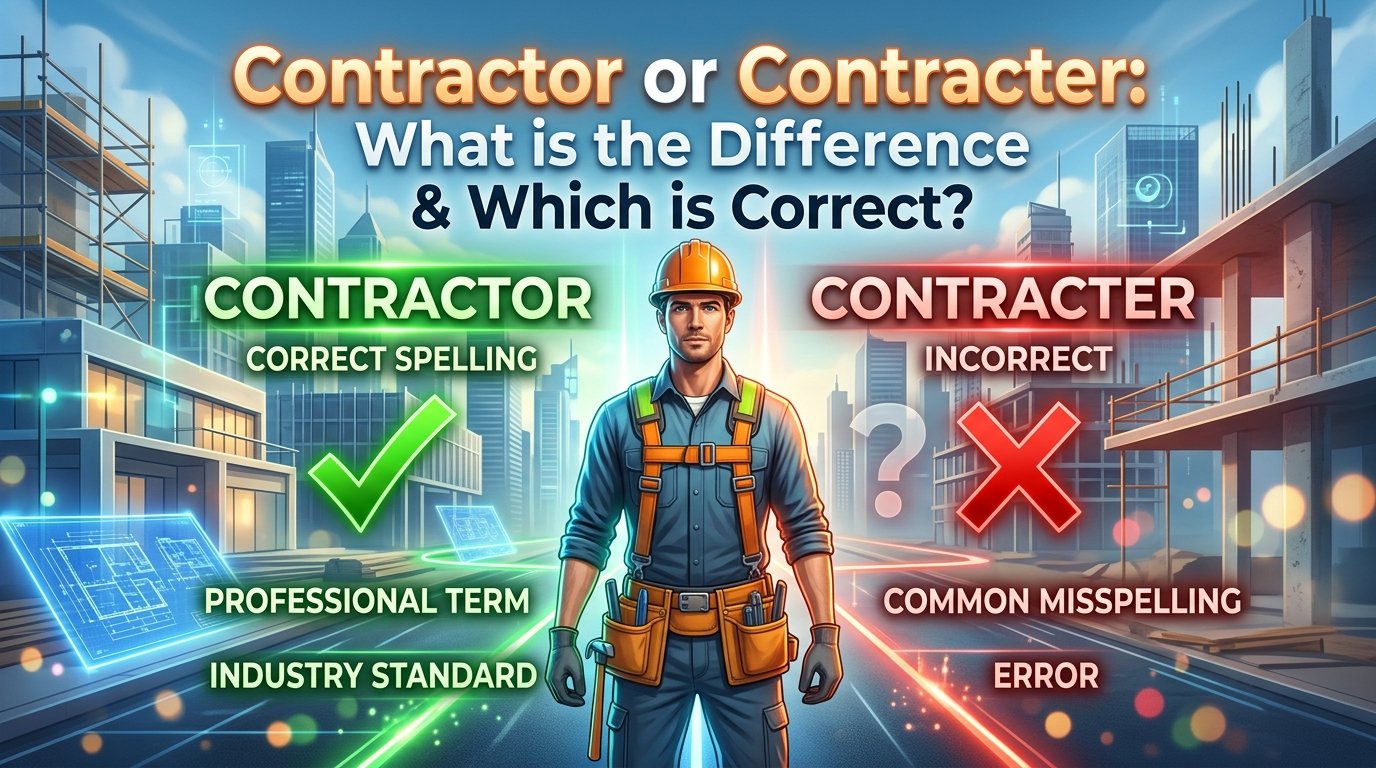
Choosing between Contractor and Contracter can be confusing, especially for English learners and writers who encounter both spellings online. While the two words look similar, only one is considered correct in standard English. Understanding the difference helps improve spelling accuracy, professional writing, and everyday communication. This guide explains their meanings, usage, grammar, examples, and how to choose the correct term confidently.
Comparison Overview
Contractor and Contracter are often treated as variations of the same word, but they are not equally accepted in modern English.
| Term | Status | Meaning | Correct Usage |
| Contractor | Correct | A person or company hired to perform work under a contract | Yes |
| Contracter | Incorrect/Nonstandard | Misspelling of contractor | No |
In modern English, contractor is the accepted spelling used in business, construction, law, and everyday communication. Contracter is generally considered a spelling mistake.
Definition of Contractor
A contractor is a person, business, or organization that agrees to perform specific work under the terms of a contract.
Contractors are commonly found in industries such as construction, technology, consulting, transportation, and maintenance. They provide services for a set period or project rather than working as permanent employees.
Examples:
- A building contractor manages construction projects.
- An IT contractor develops software for clients.
- A government contractor performs work for public agencies.
Definition of Contracter
Contracter is generally considered an incorrect spelling of contractor.
Although some people accidentally write “contracter” because it seems to follow the spelling pattern of words ending in “-er,” standard English dictionaries, style guides, and professional writing conventions recognize only contractor as correct.
Examples:
- Incorrect: The contracter completed the renovation.
- Correct: The contractor completed the renovation.
Main Differences Between Contractor and Contracter
| Feature | Contractor | Contracter |
| Spelling Status | Correct | Incorrect |
| Dictionary Recognition | Yes | Generally No |
| Professional Use | Yes | No |
| Academic Writing | Yes | No |
| Business Documents | Yes | No |
| Construction Industry | Yes | No |
The primary difference is spelling accuracy. Both are intended to refer to the same concept, but only contractor is accepted in standard English.
Why Contractor Is the Correct Form
The word contractor comes from the noun contract plus the suffix -or, which forms a person who performs an action.
Similar examples include:
- Creator
- Educator
- Operator
- Generator
Because of its historical development and accepted usage, contractor became the standard spelling.
Common Industries That Use Contractors
Construction
Building homes, offices, roads, and infrastructure.
Technology
Software development, cybersecurity, and IT consulting.
Business Consulting
Providing specialized expertise to companies.
Government Services
Performing work for public agencies and departments.
Maintenance and Repairs
Handling plumbing, electrical work, landscaping, and renovations.
Grammar Guide
How each term is used in sentences
Contractor
Pattern:
Subject + contractor + verb
Examples:
- The contractor finished the project.
- Our contractor submitted a proposal.
- The contractor repaired the roof.
- A contractor inspected the building.
- The contractor signed the agreement.
Contracter
Examples of incorrect usage:
- The contracter repaired the office.
- We hired a contracter yesterday.
These should be written using contractor.
Common mistakes learners make
- Writing “contracter” because it sounds similar.
- Assuming all occupation nouns end in “-er.”
- Using spell-check-disabled documents.
- Copying incorrect online spellings.
- Confusing pronunciation with spelling.
Simple rules to remember
- Always use contractor.
- Never use contracter in formal writing.
- If referring to someone hired through a contract, choose contractor.
- Business documents should always contain contractor.
Quick tips for writing and speaking
- Think of words like operator and creator.
- Double-check construction and business documents.
- Use dictionary-approved spelling.
- Enable spelling and grammar checking tools.
- Remember that professional industries use contractor.
When to Use Each One
Use Contractor When
- Writing business reports.
- Discussing construction projects.
- Talking about freelance professionals.
- Creating contracts and legal documents.
- Writing academic papers.
- Describing service providers.
Examples:
- The contractor completed the bridge.
- We hired an independent contractor.
- The contractor submitted a bid.
Use Contracter When
You generally should not use contracter because it is considered a misspelling.
When NOT to Use Each One
Do Not Use Contractor
- When referring to a permanent employee if a contractor relationship does not exist.
- When describing someone without a contractual arrangement.
Do Not Use Contracter
- In business communication.
- In legal agreements.
- In academic writing.
- In professional emails.
- In resumes or job applications.
- In published content.
Which One to Use (Decision Guide)
Use this simple guide:
| Question | Choice |
| Are you referring to a person hired through a contract? | Contractor |
| Are you writing professionally? | Contractor |
| Are you writing academically? | Contractor |
| Are you writing legally? | Contractor |
| Are you considering using “contracter”? | Use Contractor Instead |
The correct choice is always contractor.
Real-World Practical Examples
Contractor Examples
- The contractor built a new school building.
- Our contractor upgraded the company’s network.
- The contractor repaired the damaged bridge.
- The government contractor won a large project.
- The contractor installed solar panels.
Contracter Examples
The following examples demonstrate incorrect usage:
- The contracter completed the repairs.
- We hired a contracter last month.
- The contracter submitted a quote.
- The contracter inspected the property.
- Our contracter finished the work early.
Correct each sentence by replacing contracter with contractor.
Self-Assessment (Fill in the Blanks)
- We hired a ______ to renovate our kitchen.
- The correct word is ______ because it is the standard spelling.
- The building ______ completed the project on time.
- A government ______ won the bid.
- The ______ repaired the electrical system.
- The correct spelling is ______ in business writing.
- An independent ______ may work for multiple clients.
- The school hired a ______ for construction work.
- The legal document referred to the ______.
- The software ______ developed the application.
- The correct word is ______ because dictionaries recognize it.
- The bridge ______ submitted a proposal.
- A freelance ______ often works on projects.
- The company paid the ______ after completion.
- The office renovation was managed by a ______.
- The correct business term is ______.
- The roofing ______ inspected the house.
- The city selected a ______ for road repairs.
- Professional writers use ______ instead of contracter.
- The accepted English spelling is ______.
Answers
- Contractor
- Contractor
- Contractor
- Contractor
- Contractor
- Contractor
- Contractor
- Contractor
- Contractor
- Contractor
- Contractor
- Contractor
- Contractor
- Contractor
- Contractor
- Contractor
- Contractor
- Contractor
- Contractor
- Contractor
Final Verdict
The comparison between Contractor and Contracter is straightforward. Contractor is the correct and universally accepted spelling used in professional, academic, legal, and everyday English. It refers to a person or company that performs work under a contract. Contracter, on the other hand, is generally considered a misspelling and should be avoided in formal and informal writing. Whenever you need to describe someone hired through a contractual agreement, choose contractor with confidence. Using the correct spelling improves credibility, professionalism, and communication accuracy.
Conclusion About Contractor or Contracter
Understanding the difference between Contractor or Contracter is much simpler once you know that only one spelling is recognized in standard English. Contractor is the correct term used to describe a person or company that performs work under a contract, while Contracter is generally considered a spelling mistake. Whether you are writing a business document, preparing a construction proposal, updating a resume, or simply improving your English skills, using the correct spelling helps you communicate more clearly and professionally. Since contractor is the accepted form in dictionaries, academic writing, legal documents, and everyday communication, it should always be your preferred choice. By remembering this distinction, you can avoid common spelling errors and write with greater confidence. Whenever you encounter these two forms, choose contractor to ensure your writing remains accurate, credible, and aligned with modern English usage.
FAQs
Is contractor the correct spelling?
Yes, contractor is the correct spelling in standard English. It is widely used in business, construction, legal, and professional contexts to refer to a person or company hired to perform work under a contract. Dictionaries and style guides recognize contractor as the accepted form.
Is contracter a real word?
Contracter may occasionally appear in writing, but it is generally regarded as a misspelling of contractor. It is not the preferred spelling in modern English and should be avoided in professional, academic, and formal communication.
What does contractor mean?
A contractor is an individual or organization that agrees to complete specific work or provide services according to the terms of a contract. Contractors are commonly found in industries such as construction, technology, consulting, and maintenance.
Why do people write contracter instead of contractor?
Many people write contracter because the pronunciation can make the spelling seem logical. Others may assume it follows the pattern of words ending in “er.” However, the standard and accepted spelling remains contractor.
Can I use contracter in formal writing?
No, using contracter in formal writing is not recommended. Professional documents, business communications, legal agreements, and academic papers should always use contractor to maintain accuracy and credibility.
Is contractor a noun or a verb?
Contractor is a noun. It refers to a person or company performing work under a contract. It is not used as a verb. The related noun contract and verb contract have different grammatical functions.
Are contractor and employee the same thing?
No, a contractor and an employee are different. Contractors usually work independently under a contract for specific projects, while employees typically work directly for an employer on a more permanent basis.
Is contractor used outside the construction industry?
Yes, contractor is used in many industries. Technology consultants, freelance professionals, government service providers, and maintenance specialists may all be referred to as contractors when they work under contractual agreements.
How can I remember the correct spelling?
A simple way to remember is to think of similar words such as creator, operator, and educator. Like those words, contractor ends with “or,” making it easier to recall the correct spelling when writing.
Which word should I always choose: contractor or contracter?
You should always choose contractor. It is the accepted spelling recognized by dictionaries and used in professional, educational, and everyday contexts. Using contractor ensures your writing is correct and easily understood.

Sophia Turner is a grammar-focused writer who covers similes, word-versus-word meanings, and correct English usage. Her content is designed for learners who want quick answers, logical explanations, and practical guidance for improving writing accuracy and style.