
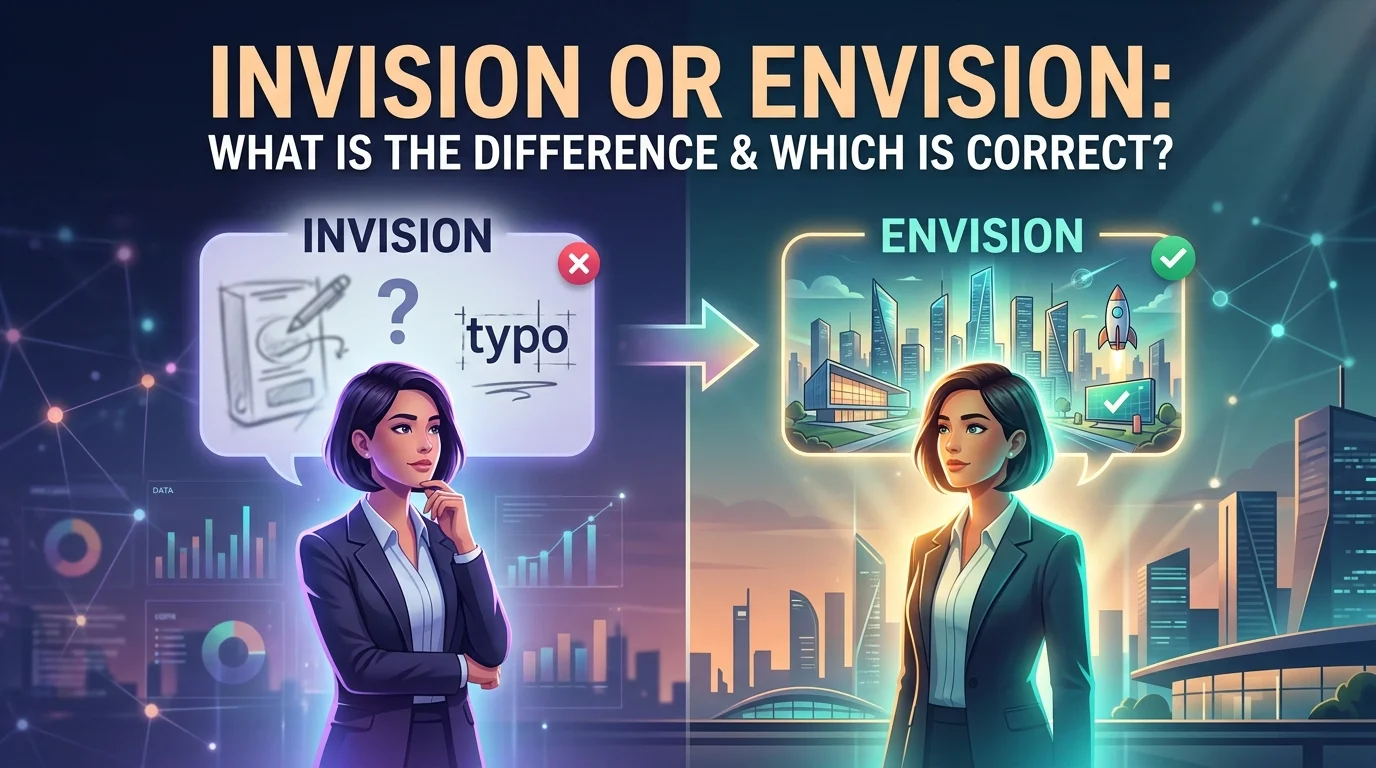
Many English learners and writers get confused between Invision and Envision because the words look and sound somewhat similar. However, they have very different meanings and uses. One is a common English verb used to describe imagining the future, while the other is primarily recognized as a brand name. Understanding the distinction helps you write more accurately and avoid common mistakes in professional, academic, and everyday communication.
Comparison Overview
Although Invision and Envision appear similar, they serve different purposes. Envision is a standard English verb that means to imagine, visualize, or picture something in the future. Invision, on the other hand, is generally not recognized as a standard English word and is most commonly associated with the digital product design platform called InVision. Because of this similarity, many people accidentally write “Invision” when they actually mean “Envision.”
| Feature | Invision | Envision |
| Word Type | Primarily a brand name | English verb |
| Dictionary Word | Generally No | Yes |
| Meaning | Design software/company name | To imagine or visualize |
| Grammar Use | Not normally used as a verb | Commonly used as a verb |
| Common Context | Technology and design | Writing, business, education, conversation |
| Correct in Standard English Sentences | Usually No | Yes |
Definition of Invision
Invision is most commonly known as a company and design collaboration platform used by designers, developers, and businesses. It helps teams create prototypes, collaborate on designs, and manage digital product development.
In standard English grammar, Invision is generally not used as a regular verb. When people write “invision” in everyday sentences, it is often a spelling mistake for “envision.”
Purpose of Invision
- Design collaboration
- Product prototyping
- User interface design
- Team communication
- Digital workflow management
Definition of Envision
Envision is a standard English verb that means to imagine, visualize, foresee, or picture something mentally, especially something that may happen in the future.
People use envision when discussing plans, goals, possibilities, innovations, and future outcomes.
Purpose of Envision
- Imagining future events
- Visualizing goals
- Planning projects
- Describing possibilities
- Expressing expectations
Main Differences Between Invision and Envision
The biggest difference is that Envision is a recognized English verb, while Invision is generally a brand name rather than a standard dictionary word.
| Aspect | Invision | Envision |
| Function | Brand/company name | Action verb |
| Meaning | Design platform | Imagine or visualize |
| Grammar Role | Proper noun | Verb |
| Future Planning Context | Incorrect | Correct |
| Professional Writing | Rarely used | Frequently used |
| Academic Writing | Rarely used | Frequently used |
For example:
❌ I can invision our future success.
✅ I can envision our future success.
In this sentence, envision is the correct choice because the writer is talking about imagining future success.
Why People Confuse Invision and Envision
Several factors contribute to the confusion:
- Similar pronunciation
- Similar spelling
- Typing mistakes
- Brand familiarity
- Lack of awareness of the actual meaning of “envision”
People who frequently work in design may see the name InVision and accidentally use it where the verb envision should appear.
Envision in Everyday Communication
The word envision appears frequently in:
- Business presentations
- Academic writing
- Goal setting
- Motivational speaking
- Strategic planning
- Daily conversations
Examples:
- I envision a better future.
- She envisions expanding the company.
- We envision significant growth next year.
Grammar Guide
How Each Term Is Used in Sentences
Invision
As a company name:
- Our design team uses InVision for collaboration.
- The prototype was created using InVision.
- We reviewed the project in InVision.
Envision
As a verb:
- I envision a successful career.
- She envisions new opportunities.
- They envision a modern workplace.
- We envision faster growth.
- He envisions positive change.
Common Mistakes Learners Make
- Using “Invision” instead of “Envision.”
- Assuming both words are interchangeable.
- Treating Invision as a regular verb.
- Using the brand name when discussing imagination.
- Misspelling envision in formal writing.
Incorrect:
- I invision myself becoming a doctor.
Correct:
- I envision myself becoming a doctor.
Simple Rules to Remember
- If you mean “imagine,” use envision.
- If referring to the software platform, use InVision.
- Envision is a verb.
- InVision is generally a proper noun.
- Future planning usually requires envision.
Quick Tips for Writing and Speaking
- Think of envision as “visualize.”
- Use envision in essays and reports.
- Double-check spelling in professional documents.
- Remember that brand names are not always dictionary words.
- When discussing future goals, choose envision.
When to Use Each One
Use Invision When
- Referring to the design platform.
- Discussing product design tools.
- Talking about UI/UX collaboration.
- Mentioning software workflows.
- Referring to the company itself.
Use Envision When
- Imagining future events.
- Describing goals.
- Discussing plans.
- Visualizing outcomes.
- Predicting possibilities.
When NOT to Use Each One
Do Not Use Invision
- When you mean imagine.
- In academic writing about future plans.
- In business forecasts.
- In personal goal statements.
- In standard grammar exercises.
Do Not Use Envision
- When referring specifically to the design software.
- As a company name.
- As a product title.
- When naming the design platform.
- When discussing software branding.
Which One to Use (Decision Guide)
Ask yourself a simple question:
Are you talking about imagining or visualizing something?
If yes, use Envision.
Example:
- I envision becoming an engineer.
Are you talking about the design platform or company?
If yes, use InVision.
Example:
- Our team uses InVision to review prototypes.
Quick Decision Formula:
- Imagine = Envision
- Software Platform = InVision
Real-World Practical Examples
Invision Examples
- Our designers collaborated through InVision.
- The prototype was uploaded to InVision.
- We shared feedback using InVision.
- The UX team preferred InVision for mockups.
- The project manager reviewed designs in InVision.
Envision Examples
- I envision earning a degree next year. (Education)
- Scientists envision cleaner energy solutions. (Science)
- The company envisions global expansion. (Business)
- She envisions writing a bestselling novel. (Writing)
- We envision smarter technology in the future. (Technology)
Self-Assessment (Fill in the Blanks)
- I will use ______ when referring to imagining future success.
- The correct word is ______ because it means visualize.
- Our design team uses ______ for collaboration.
- I can ______ a better future.
- The correct word is ______ because it is a verb.
- We ______ major growth next year.
- The prototype was reviewed in ______.
- She can easily ______ new opportunities.
- The design files were stored in ______.
- I ______ becoming a successful entrepreneur.
- The software platform is called ______.
- Scientists ______ future discoveries.
- The correct word is ______ because it refers to imagination.
- We use ______ for interface design reviews.
- Leaders often ______ long-term success.
- The company ______ stronger performance.
- Our project was shared through ______.
- Writers often ______ future storylines.
- The correct English verb is ______.
- Designers collaborate using ______.
Answers
- Envision
- Envision
- InVision
- Envision
- Envision
- Envision
- InVision
- Envision
- InVision
- Envision
- InVision
- Envision
- Envision
- InVision
- Envision
- Envision
- InVision
- Envision
- Envision
- InVision
Final Verdict
When comparing Invision and Envision, the correct choice depends entirely on context. Envision is the standard English verb that means to imagine, visualize, or picture something in the future. It is widely used in business, education, science, writing, and everyday communication. InVision, however, is primarily known as a design and collaboration platform rather than a standard English verb. If you are talking about goals, dreams, plans, or future possibilities, envision is almost always the correct word. If you are discussing the design software or company, then InVision is appropriate. Remembering this simple distinction will help you write more accurately, communicate more clearly, and avoid one of the most common spelling and usage mistakes involving these two similar-looking terms.
Conclusion About Invision or Envision
Understanding the difference between Invision and Envision can help you communicate more clearly and confidently in both professional and everyday writing. While these terms may look similar at first glance, they serve completely different purposes. Envision is a widely accepted English verb that means to imagine, visualize, or picture something in the future. InVision, by contrast, is primarily recognized as a design and collaboration platform used by creative teams. Many writers mistakenly use “Invision” when they actually mean “Envision,” making this one of the more common word confusion issues in English. By remembering that envision relates to imagination and future thinking, while InVision refers to a specific software brand, you can easily choose the correct term. Whether you’re writing an essay, business proposal, email, or casual message, using the right word will make your communication more accurate, professional, and effective.
FAQs
Is envision a real English word?
Yes, envision is a standard English verb. It means to imagine, visualize, or mentally picture something, especially a future event, goal, or possibility. It is commonly used in business, education, personal development, and everyday conversations.
Is invision a correct word in English?
In standard English, invision is generally not recognized as a regular dictionary word. Most often, it refers to the brand name InVision or is used mistakenly when someone intends to write envision.
What does envision mean?
Envision means to form a mental picture of something or imagine a future situation. People often use it when discussing goals, plans, innovations, dreams, or expected outcomes in both personal and professional contexts.
Why do people confuse Invision and Envision?
People confuse these terms because they look and sound similar. The popularity of the InVision design platform also contributes to the confusion, causing some writers to accidentally replace the correct verb envision with InVision.
Can I use invision instead of envision?
No, you should not use invision when you mean to imagine or visualize something. In formal and standard English writing, envision is the correct word for expressing future ideas or mental images.
How do I remember the difference between Invision and Envision?
A simple trick is to connect envision with the word “vision.” If you’re picturing something in your mind or imagining the future, use envision. If you’re talking about the software platform, use InVision.
Is envision commonly used in business writing?
Yes, envision is frequently used in business communication. Companies often use it when describing future goals, strategic plans, growth opportunities, and long-term objectives to communicate a vision for success.
Can envision be used in academic writing?
Absolutely. Academic writers use envision when discussing theories, future research, potential developments, and projected outcomes. It is considered appropriate and professional in educational and scholarly contexts.
What part of speech is envision?
Envision is a verb. It describes the action of imagining, visualizing, or mentally creating a picture of something. It can be used in different tenses, such as envision, envisioned, and envisioning.
When should I use InVision with a capital letter?
You should use InVision with a capital letter when referring to the specific design and collaboration platform or company. As a proper noun and brand name, it should always be capitalized correctly.

Sophia Turner is a grammar-focused writer who covers similes, word-versus-word meanings, and correct English usage. Her content is designed for learners who want quick answers, logical explanations, and practical guidance for improving writing accuracy and style.