
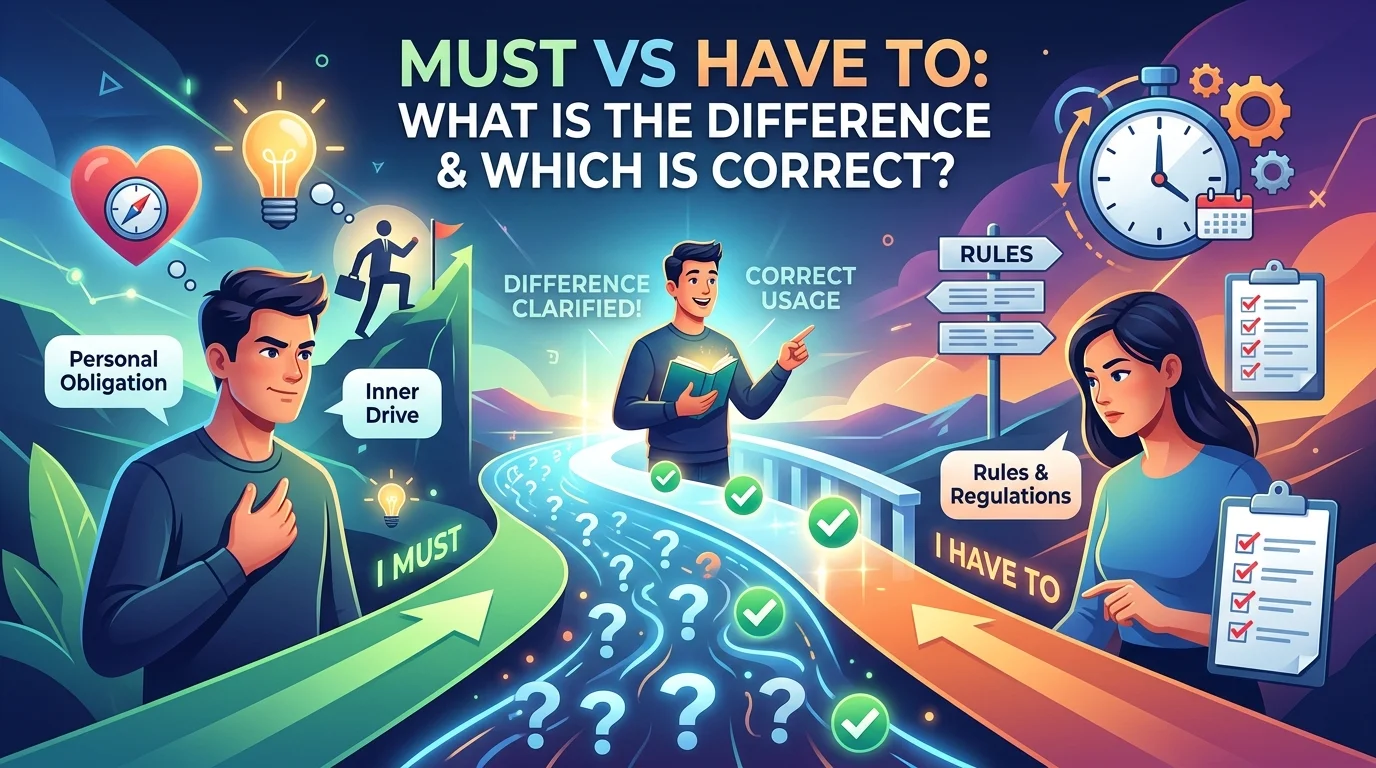
Understanding the difference between must and have to is important for anyone learning English. Both expressions talk about obligation, necessity, or something that is required, but they are not always used in the same way. Knowing when to use must and when to use have to can make your speaking and writing sound more natural and accurate.
Comparison Overview
Must and have to are modal expressions used to express necessity, obligation, rules, duties, and requirements.
Although they often have similar meanings, they differ in tone, source of obligation, grammar, and usage. Generally, must expresses a stronger personal or official obligation, while have to often refers to external requirements or circumstances.
| Feature | Must | Have To |
| Type | Modal verb | Verb phrase |
| Meaning | Strong necessity or obligation | Necessity caused by circumstances or rules |
| Source of obligation | Usually speaker’s opinion or authority | Usually external situation |
| Past form | No direct past form | Had to |
| Future form | Limited use | Will have to |
| Formality | More formal | More common in everyday speech |
Definition of Must
Must is a modal verb used to express strong obligation, necessity, certainty, or importance.
It often reflects the speaker’s personal judgment, recommendation, or authority. When someone says “must,” they usually believe something is very important or required.
Examples:
- You must wear a seatbelt.
- I must finish this report today.
- Students must follow school rules.
- You must be careful.
The word emphasizes that something is necessary and should not be ignored.
Definition of Have To
Have to is a verb phrase used to express necessity or obligation that comes from external circumstances, rules, laws, schedules, or situations.
It is very common in everyday English and often sounds more natural in conversation.
Examples:
- I have to go to work tomorrow.
- We have to pay taxes.
- She has to attend the meeting.
- They had to leave early.
The phrase usually suggests that circumstances require the action.
Main Differences Between Must and Have To
Although both expressions show obligation, several important differences exist.
| Aspect | Must | Have To |
| Obligation source | Internal or personal | External or situational |
| Strength | Usually stronger | Slightly less forceful |
| Everyday usage | Less common in casual speech | Very common |
| Past tense | Not commonly used | Had to |
| Future tense | Rare | Will have to |
| Negative meaning | Must not = prohibition | Don’t have to = not necessary |
Source of Obligation
Must
- Comes from the speaker’s authority, belief, or opinion.
- Example: You must apologize.
Have To
- Comes from outside requirements.
- Example: I have to follow company policy.
Formality
Must often sounds more formal.
Have to sounds more conversational and natural.
Negative Forms
This is one of the biggest differences.
Must not (mustn’t) = prohibited.
Example:
- You must not smoke here.
Don’t have to = not necessary.
Example:
- You don’t have to come if you’re busy.
Must vs Have To in Everyday English
Native speakers frequently use have to in daily conversations because it sounds more natural.
Examples:
- I have to leave now.
- We have to study for the exam.
- She has to pick up her children.
Meanwhile, must is common in:
- Rules
- Instructions
- Formal notices
- Strong recommendations
Examples:
- Passengers must show identification.
- Visitors must register at reception.
Must vs Have To in Formal and Informal Situations
Formal Situations
Must is often preferred.
Examples:
- Employees must wear identification badges.
- Applicants must submit all documents.
Informal Situations
Have to is usually preferred.
Examples:
- I have to call my friend.
- We have to catch the bus.
Comparison Table
| Situation | Must | Have To |
| Personal opinion | ✓ | Sometimes |
| Government rules | ✓ | ✓ |
| Company policies | ✓ | ✓ |
| Daily conversation | Less common | Very common |
| Past obligations | ✗ | ✓ |
| Future obligations | Limited | ✓ |
| Strong warnings | ✓ | Rare |
Grammar Guide
How Each Term Is Used in Sentences
Must Structure
Subject + must + base verb
Examples:
- I must study.
- You must listen.
- They must leave.
Have To Structure
Subject + have/has to + base verb
Examples:
- I have to study.
- She has to work.
- They have to leave.
Past Form
Subject + had to + base verb
Examples:
- I had to wait.
- We had to cancel the trip.
Future Form
Subject + will have to + base verb
Examples:
- I will have to travel.
- They will have to decide soon.
Common Mistakes Learners Make
Using Must for Past Obligations
Incorrect:
- I must finish it yesterday.
Correct:
- I had to finish it yesterday.
Confusing Must Not and Don’t Have To
Incorrect understanding:
- You don’t have to smoke.
This means smoking is optional.
Different meaning:
- You must not smoke.
This means smoking is forbidden.
Adding “To” After Must
Incorrect:
- You must to study.
Correct:
- You must study.
Simple Rules to Remember
- Use must for strong obligation.
- Use have to for everyday necessities.
- Use had to for past obligations.
- Use will have to for future obligations.
- Remember that must not means prohibited.
- Remember that don’t have to means unnecessary.
Quick Tips for Writing and Speaking
- Use have to in casual conversations.
- Use must for rules and strong advice.
- Use had to when discussing past necessities.
- Be careful with negative forms.
- Choose must when emphasizing importance.
When to Use Each One
Use Must When
- Giving strong advice.
- Making official rules.
- Expressing personal conviction.
- Giving warnings.
- Emphasizing importance.
Examples:
- You must wear a helmet.
- You must save your work frequently.
Use Have To When
- Talking about schedules.
- Discussing external requirements.
- Describing daily responsibilities.
- Referring to past obligations.
- Referring to future necessities.
Examples:
- I have to attend class.
- We had to change our plans.
- You will have to wait.
When NOT to Use Each One
Avoid Must When
- Talking about past obligations.
- Using casual everyday speech repeatedly.
- Describing external requirements when a natural conversation tone is preferred.
Avoid Have To When
- Writing strict rules where stronger emphasis is needed.
- Giving formal instructions that require authority.
- Expressing prohibition with “don’t have to.”
Incorrect:
- You don’t have to enter this room.
If entry is forbidden, use:
- You must not enter this room.
Which One to Use (Decision Guide)
Ask yourself these questions:
Is it your personal opinion or strong recommendation?
Use must.
Example:
- You must see this movie.
Is the obligation caused by circumstances or rules?
Use have to.
Example:
- I have to submit the form by Friday.
Is it in the past?
Use had to.
Example:
- We had to leave early.
Is it in the future?
Use will have to.
Example:
- You will have to make a decision.
Are you expressing prohibition?
Use must not.
Example:
- You must not park here.
Are you saying something is optional?
Use don’t have to.
Example:
- You don’t have to attend.
Real-World Practical Examples
Must Examples
- Students must submit assignments before the deadline.
- Drivers must obey traffic laws.
- Scientists must record accurate data.
- Employees must complete safety training.
- Writers must check grammar before publishing.
Have To Examples
- I have to wake up at 6 a.m. for work.
- Businesses have to pay taxes annually.
- Developers have to update software regularly.
- We had to postpone the event because of rain.
- Students will have to complete the project next semester.
Self-Assessment (Fill in the Blanks)
- I ______ follow the laboratory safety rules.
The correct word is ______ because it is a strict rule. - We ______ leave early because our flight is at 6 a.m.
The correct word is ______ because circumstances require it. - Employees ______ wear identification badges.
The correct word is ______ because it is an official requirement. - I ______ finish my homework before playing games.
The correct word is ______ because it is a personal obligation. - She ______ attend the meeting due to company policy.
The correct word is ______ because the requirement comes externally. - Visitors ______ not enter this restricted area.
The correct word is ______ because it expresses prohibition. - I ______ pay my electricity bill today.
The correct word is ______ because it is a necessity. - Drivers ______ stop at red lights.
The correct word is ______ because it is a rule. - We ______ cancel the trip yesterday.
The correct word is ______ because it refers to a past obligation. - You ______ worry about the test.
The correct word is ______ because it is not necessary. - Students ______ complete the exam honestly.
The correct word is ______ because it is a strict expectation. - I ______ catch the train before 8 a.m.
The correct word is ______ because of a schedule. - Researchers ______ report accurate findings.
The correct word is ______ because it is an important requirement. - She ______ work late tomorrow.
The correct word is ______ because it refers to future necessity. - You ______ smoke inside the hospital.
The correct word is ______ because it is prohibited. - We ______ submit the application today.
The correct word is ______ because it is strongly required. - They ______ follow government regulations.
The correct word is ______ because it is an external requirement. - I ______ study harder if I want better grades.
The correct word is ______ because it is a strong personal necessity. - The technician ______ repair the system yesterday.
The correct word is ______ because it refers to a past requirement. - You ______ bring your own laptop if one is provided.
The correct word is ______ because it is unnecessary.
Answers
- must, must
- have to, have to
- must, must
- must, must
- has to, has to
- must, must
- have to, have to
- must, must
- had to, had to
- don’t have to, don’t have to
- must, must
- have to, have to
- must, must
- will have to, will have to
- must not, must not
- must, must
- have to, have to
- must, must
- had to, had to
- don’t have to, don’t have to
Final Verdict
Both must and have to express obligation and necessity, but they are not identical. Must is generally used for strong personal opinions, formal rules, warnings, and important obligations. Have to is more common in everyday English and usually refers to obligations created by external circumstances, schedules, laws, or requirements. For past and future obligations, have to is usually the correct choice through forms like had to and will have to. Understanding this distinction will help you communicate more naturally, accurately, and confidently in both speaking and writing.
Conclusion About Must vs Have To
Understanding the difference between must vs have to can make your English clearer, more natural, and more accurate. While both expressions are used to talk about obligation and necessity, they are not always interchangeable. Must is typically used for strong personal obligations, important instructions, formal rules, and situations where the speaker wants to emphasize importance. Have to, on the other hand, is commonly used for everyday obligations that come from external circumstances, schedules, laws, or requirements.
Learning when to use each expression helps you avoid common grammar mistakes and communicate with greater confidence. A useful rule to remember is that must often reflects the speaker’s viewpoint, while have to usually reflects outside demands. In everyday conversation, native speakers frequently choose have to, whereas must appears more often in formal writing, instructions, and regulations. By mastering these differences, you can choose the right expression for any situation and improve both your spoken and written English.
FAQs
What is the main difference between must and have to?
The main difference is the source of obligation. Must often expresses a personal opinion, strong recommendation, or authority from the speaker. Have to usually describes obligations created by external factors such as rules, schedules, laws, or circumstances. Both show necessity, but the reason behind the obligation is often different.
Can must and have to be used interchangeably?
In many situations, yes. Both can express necessity or obligation. However, they may carry slightly different meanings depending on context. Must often sounds stronger and more formal, while have to is more common in everyday speech. Choosing the right one depends on the source and strength of the obligation.
Which is more common in everyday English, must or have to?
Have to is generally more common in everyday conversation. Native speakers often use it when talking about work, school, appointments, responsibilities, and daily routines. Must is still used regularly but tends to appear more often in formal instructions, rules, and strong recommendations.
Can I use must for past obligations?
No. Must does not normally have a past tense form for obligations. Instead, English uses had to when referring to something that was necessary in the past. For example, “I had to leave early yesterday” is correct, while “I must leave early yesterday” is incorrect.
What does must not mean?
Must not means that something is forbidden or not allowed. It expresses prohibition rather than simple advice. For example, “You must not enter this area” means entering is prohibited. This is very different from “don’t have to,” which means something is not necessary.
What is the difference between must not and don’t have to?
Must not means you are not allowed to do something. Don’t have to means there is no obligation to do something. For example, “You must not park here” means parking is forbidden, while “You don’t have to park here” means parking is optional.
Is must more formal than have to?
Yes, in many situations must sounds more formal than have to. It is commonly used in official notices, regulations, instructions, and formal writing. Have to is usually preferred in casual conversations because it sounds more natural and conversational.
Can I use have to in future sentences?
Yes. One advantage of have to is that it can easily be used in different tenses. For future obligations, use will have to. For example, “You will have to complete the training next week” clearly expresses a future requirement.
Which expression is stronger, must or have to?
In many contexts, must sounds stronger because it emphasizes urgency, importance, or authority. It often reflects the speaker’s determination or instruction. Have to also expresses necessity but usually sounds more practical and less forceful in everyday communication.
How can I remember when to use must and have to?
A simple memory tip is to think of must as an internal or strongly emphasized obligation and have to as an external requirement. If the obligation comes from your own judgment or a strict rule, use must. If it comes from circumstances, schedules, or outside demands, use have to.

Daniel Brooks is an English educator with a passion for explaining similes and word comparisons in plain language. He covers topics like versus meanings, correct usage, and figurative language to help writers avoid common mistakes and improve clarity in everyday writing.