
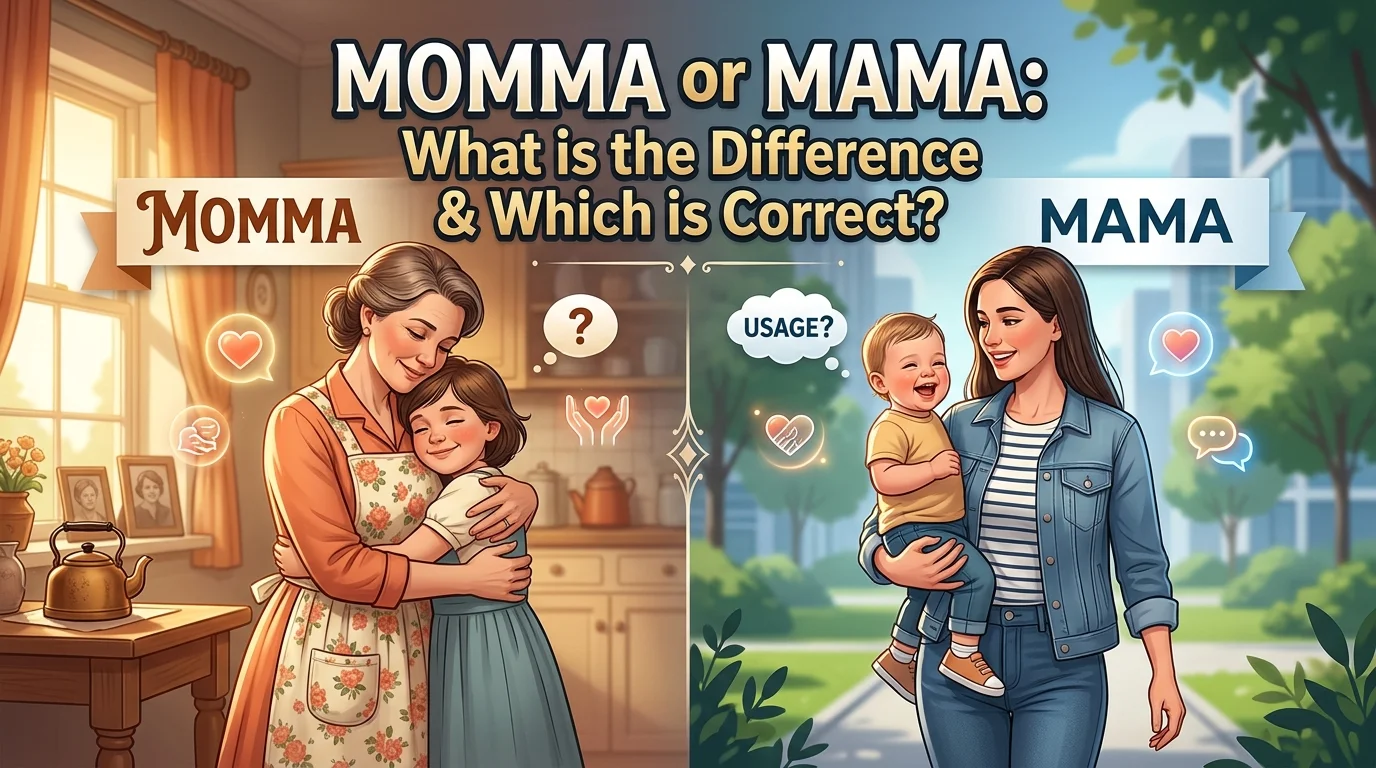
Many English learners and native speakers alike wonder whether they should use “Momma” or “Mama.” Both words refer to a mother, but they are not always used in the same way. Understanding the difference can help you choose the right term for conversations, writing, cultural contexts, and everyday communication. This guide explains their meanings, usage, grammar, and practical examples.
Comparison Overview
“Momma” and “Mama” are affectionate terms used to refer to a mother. Both express warmth, love, and familiarity. However, their usage often depends on regional preferences, cultural traditions, personal style, and the context in which they appear. While they share a similar meaning, subtle differences make each term appropriate in different situations.
| Feature | Momma | Mama |
| Meaning | Affectionate term for mother | Affectionate term for mother |
| Formality | Very informal | Informal |
| Common Usage | Southern U.S. dialects and family speech | Widely used worldwide |
| Tone | Warm, rustic, conversational | Loving, universal, familiar |
| Writing Frequency | Less common | More common |
Definition of Momma
“Momma” is an informal and affectionate word for mother. It is often associated with family conversations, regional dialects, especially in the southern United States, and emotional expressions.
People use “Momma” to show closeness, affection, and respect toward their mother.
Examples:
- My momma taught me how to cook.
- I called my momma after work.
- Momma always knows the answer.
Definition of Mama
“Mama” is an affectionate term for mother used across many English-speaking regions and cultures worldwide. It is often one of the first words children learn to say.
“Mama” can refer directly to a mother or be used as a loving form of address.
Examples:
- Mama helped me with my homework.
- The baby called out for Mama.
- Mama always supports our family.
Main Differences Between Momma and Mama
Although both terms mean “mother,” they differ in style and usage.
| Aspect | Momma | Mama |
| Regional Influence | Common in Southern American English | Common internationally |
| Tone | Folksy and regional | Universal and affectionate |
| Popularity | Less widespread | More widespread |
| Written Usage | Often appears in dialogue and storytelling | Appears in both speech and writing |
| Cultural Reach | Mostly regional | Global |
Key differences include:
- “Mama” is generally more common worldwide.
- “Momma” often reflects regional speech patterns.
- Both are grammatically acceptable in informal contexts.
- Neither is usually preferred in formal academic writing.
Historical and Cultural Usage
The word “Mama” has existed for centuries and appears in many languages. It is one of the most natural sounds for infants to produce.
“Momma” developed primarily as a spelling variation reflecting spoken pronunciation in certain English dialects. It often appears in literature, songs, and conversations that emphasize regional identity.
Popularity in Modern English
Today, “Mama” remains the more widely recognized term across different countries and cultures.
“Momma” continues to be popular in family settings, country music, regional storytelling, and informal speech.
Both remain acceptable when used appropriately.
Grammar Guide
Both “Momma” and “Mama” function primarily as nouns.
Examples:
- Mama is making dinner.
- My momma loves gardening.
They are not verbs. They serve as names or references for a mother.
How Each Term Is Used in Sentences
Direct Address:
- Mama, can you help me?
- Momma, where are my keys?
Reference to a Mother:
- My mama works at a hospital.
- His momma enjoys painting.
Possessive Forms:
- Mama’s advice was helpful.
- Momma’s cooking is amazing.
Common Mistakes Learners Make
- Using them in formal reports.
- Assuming one is grammatically wrong.
- Capitalizing them incorrectly.
- Confusing them with official titles.
Incorrect:
- My Momma is employed at the company. (Formal business report)
Better:
- My mother is employed at the company.
Simple Rules to Remember
- Use “Mama” for broad, general communication.
- Use “Momma” when reflecting family speech or regional style.
- Use “mother” in formal writing.
- Capitalize the word when used as a name.
Quick Tips for Writing and Speaking
- Formal essay → mother.
- Casual conversation → mama or momma.
- International audience → mama.
- Regional storytelling → momma.
When to Use Each One
Use “Momma” when:
- Reflecting Southern American speech.
- Writing realistic dialogue.
- Expressing strong family affection.
- Quoting family members.
Use “Mama” when:
- Speaking affectionately to your mother.
- Writing informal messages.
- Referring to mothers generally.
- Communicating with a broad audience.
When NOT to Use Each One
Do not use “Momma” when:
- Writing academic papers.
- Preparing legal documents.
- Creating professional reports.
Do not use “Mama” when:
- A highly formal tone is required.
- Official documentation requires “mother.”
Incorrect examples:
- The applicant’s mama signed the contract.
- My momma submitted the legal affidavit.
Preferred:
- The applicant’s mother signed the contract.
Which One to Use (Decision Guide)
Choose “Mama” if:
- You want the most widely understood option.
- You are speaking affectionately.
- You are communicating with diverse audiences.
Choose “Momma” if:
- You want a regional or family-centered tone.
- You are representing authentic dialogue.
- You are reflecting personal family traditions.
If unsure, “Mama” is usually the safer choice for general informal communication.
Real-World Practical Examples
Momma Examples
- My momma taught me how to ride a bicycle.
- The student thanked his momma after graduation.
- Momma always reminds us to be kind.
- The author wrote a story about her momma’s childhood.
- My momma helped me set up my new computer.
Mama Examples
- Mama packed lunch for school.
- The baby smiled when Mama entered the room.
- Mama encouraged me before the interview.
- The scientist thanked her mama during the award ceremony.
- Mama helped me understand the new software.
Self-Assessment (Fill in the Blanks)
- I called my ______ after arriving home safely.
- The baby cried for ______ during the night.
- In a formal essay, I should use ______ instead of mama.
- My ______ baked cookies for the school event.
- Southern speakers may prefer ______ in conversation.
- The child shouted, “______!”
- Academic papers usually use ______.
- My ______ helped me study for exams.
- Regional storytelling often includes ______.
- The toddler learned to say ______ first.
- The correct word is ______ because the sentence is informal and affectionate.
- The correct word is ______ because the context is a legal document.
- I thanked my ______ for supporting my business.
- Country songs often mention ______.
- The baby reached for ______.
- Formal writing prefers ______.
- My ______ taught me valuable life lessons.
- The dialogue sounds natural with ______.
- The report should say ______ rather than mama.
- Many children first learn the word ______.
Answers
- mama
- Mama
- mother
- momma
- momma
- Mama
- mother
- mama
- momma
- mama
- mama
- mother
- mama
- momma
- Mama
- mother
- momma
- momma
- mother
- mama
Final Verdict
Both “Momma” and “Mama” are correct informal terms for a mother. The main difference lies in style and regional preference rather than meaning. “Mama” is the more universally recognized and widely used option, while “Momma” often reflects regional speech, particularly in parts of the United States. Neither word is typically appropriate for formal writing, where “mother” remains the preferred choice. For everyday conversations, family interactions, and affectionate communication, either term works well. If you want a broadly accepted term, choose “Mama.” If you want a warm, regional, or conversational tone, “Momma” may be the better fit. Understanding the context and audience will help you select the most natural and effective word every time.
Conclusion About Momma or Mama
Understanding the difference between Momma and Mama is easier once you recognize that both words refer to a mother and are generally correct in informal English. The choice often comes down to personal preference, family tradition, cultural background, or regional usage. Mama is the more widely recognized and commonly used term across different countries and communities, while Momma often carries a warmer, more regional feel, especially in parts of the United States. Neither word is typically used in formal writing, where mother remains the standard choice. In everyday conversations, however, both expressions convey affection, closeness, and respect. Whether you say Momma or Mama, the meaning remains rooted in family, love, and connection. By understanding the context, audience, and tone of your communication, you can confidently choose the term that feels most natural and appropriate for the situation.
FAQs
Is Momma or Mama more correct?
Both Momma and Mama are correct informal terms for mother. Neither is grammatically wrong. The choice depends on personal preference, regional traditions, and the style of communication you want to use.
What is the main difference between Momma and Mama?
The primary difference is usage and tone. Mama is more widely used around the world, while Momma is often associated with regional speech patterns and a more conversational or family-centered style.
Is Mama more common than Momma?
Yes, Mama is generally more common internationally. It is widely recognized across different cultures and languages, making it the more universal option in everyday communication.
Can I use Momma in formal writing?
No, Momma is considered informal. In professional, academic, legal, or business writing, the word mother is usually the preferred and most appropriate choice.
Why do some people spell it Momma instead of Mama?
Momma often reflects how the word is pronounced in certain dialects and regions. The spelling helps capture a particular speaking style and can add personality to dialogue and storytelling.
Is Mama a real dictionary word?
Yes, Mama is a recognized dictionary word. It is commonly defined as an affectionate or informal term used to refer to one’s mother.
Do children usually say Mama first?
Many children learn to say Mama very early because the sounds are simple to pronounce. It is one of the most common early words spoken by infants around the world.
Can Momma and Mama be used interchangeably?
In most informal situations, yes. Both words refer to a mother and express affection. However, some families or regions may strongly prefer one form over the other.
Which term sounds more affectionate?
Both terms are affectionate. Mama often sounds universally warm and caring, while Momma may feel especially personal or emotionally expressive depending on cultural and regional influences.
Should I use Momma or Mama in a story?
Either can work, but the choice should match the character, setting, and tone. Mama often fits general audiences, while Momma can help create a more regional or distinctive voice.

Ethan Clarke is a language writer who specializes in breaking down similes, word meanings, and commonly confused terms. His work focuses on clear explanations, practical examples, and simple comparisons that help readers understand how English