
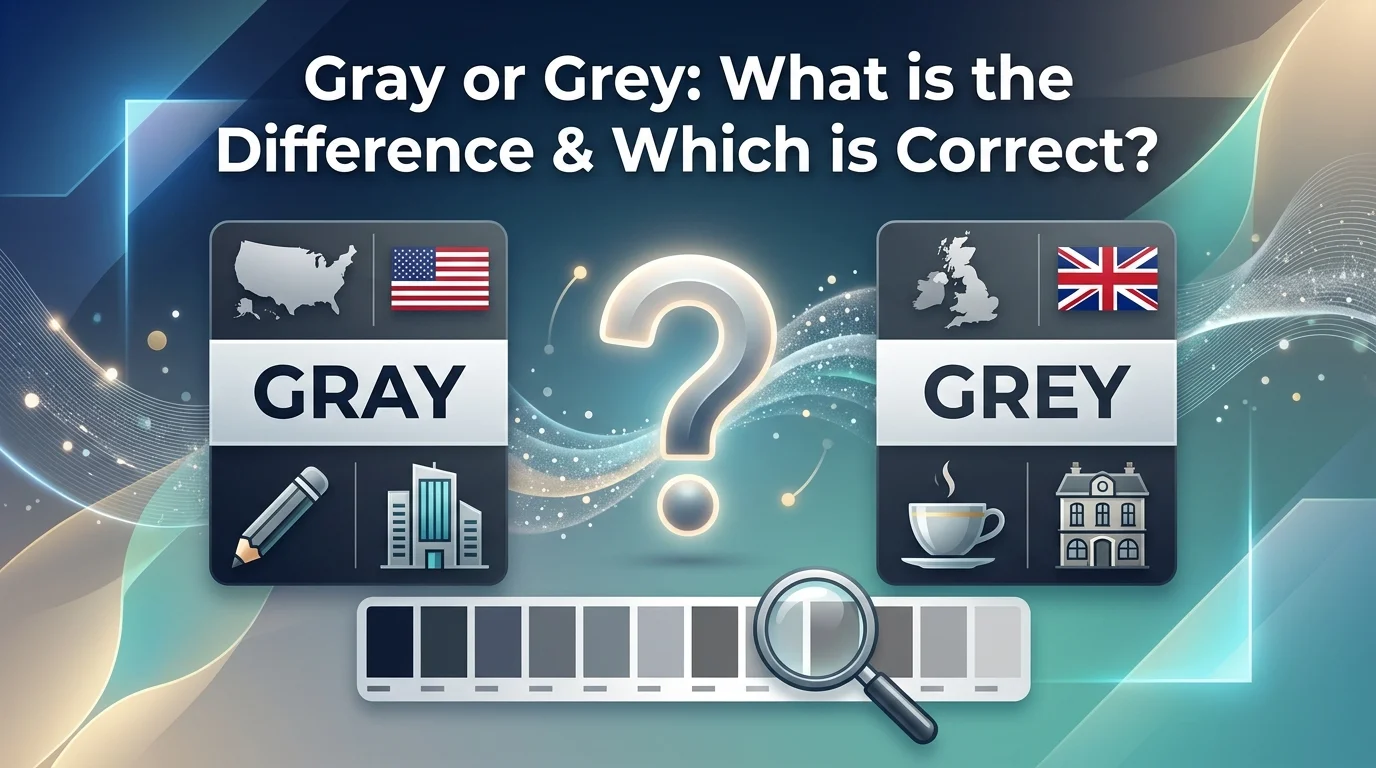
Gray and grey are two spellings of the same color, and they often confuse English learners and writers. While both words refer to the color between black and white, their usage depends mainly on regional spelling conventions. Understanding the difference helps improve writing accuracy, especially when communicating with audiences in different English-speaking countries.
Comparison Overview
Both gray and grey describe the same color. There is no difference in meaning, pronunciation, or grammatical function. The distinction comes from geography and writing standards.
| Feature | Gray | Grey |
| Meaning | Color between black and white | Color between black and white |
| Pronunciation | Same as grey | Same as gray |
| American English | Preferred spelling | Less common |
| British English | Less common | Preferred spelling |
| Grammar Role | Noun, adjective, verb | Noun, adjective, verb |
| Meaning Difference | None | None |
Definition of Gray
Gray is the preferred American English spelling of the color that falls between black and white on the color spectrum.
As a noun:
- Gray is my favorite color.
As an adjective:
- She wore a gray jacket.
As a verb:
- His hair began to gray with age.
In the United States, gray is considered the standard spelling in most publications, schools, and professional writing.
Definition of Grey
Grey is the preferred British English spelling of the same color between black and white.
As a noun:
- Grey is often associated with balance.
As an adjective:
- The sky turned grey before the storm.
As a verb:
- His beard started to grey.
In the United Kingdom, Canada, Australia, and many other countries that follow British English conventions, grey is generally preferred.
Main Differences Between Gray and Grey
Although the meanings are identical, there are several practical differences.
| Aspect | Gray | Grey |
| Region | United States | United Kingdom and Commonwealth countries |
| Dictionary Preference | American dictionaries | British dictionaries |
| Academic Usage | Standard in US schools | Standard in UK schools |
| Professional Writing | Common in America | Common in Britain |
| Meaning | Same | Same |
The key point is that neither spelling is incorrect. The correct choice depends on the variety of English you are using.
History and Origin of the Spellings
The words come from Old English and Germanic language roots. Over time, spelling variations developed as English spread across different regions.
American English gradually standardized gray, while British English retained grey. This pattern is similar to other spelling differences such as:
- Color vs Colour
- Favorite vs Favourite
- Center vs Centre
Gray vs Grey in Different English Varieties
American English
Use gray.
Examples:
- Gray clouds covered the city.
- The walls are painted gray.
British English
Use grey.
Examples:
- Grey clouds covered the city.
- The walls are painted grey.
International Writing
If writing for a global audience, choose one spelling and remain consistent throughout the document.
Grammar Guide
Both gray and grey function in exactly the same grammatical ways.
How each term is used in sentences
As Nouns
- Gray is often associated with professionalism.
- Grey is commonly seen in modern architecture.
As Adjectives
- The gray car is parked outside.
- The grey building overlooks the river.
As Verbs
- Her hair started to gray.
- His beard began to grey.
Common Mistakes Learners Make
- Mixing both spellings in one document.
- Assuming one spelling is wrong.
- Using gray in British assignments.
- Using grey in formal American writing.
- Thinking the spellings represent different shades.
Simple Rules to Remember
- Gray = America
- Grey = Britain
- Same pronunciation.
- Same meaning.
- Stay consistent in a single piece of writing.
Quick Tips for Writing and Speaking
- Match your audience’s English style.
- Use gray for US readers.
- Use grey for UK readers.
- Do not switch spellings within the same article.
- Pronounce both words exactly the same way.
When to Use Each One
Use Gray When:
- Writing in American English.
- Creating content for US audiences.
- Following American style guides.
- Completing assignments in US schools.
- Writing for American businesses.
Use Grey When:
- Writing in British English.
- Creating content for UK audiences.
- Following British style guides.
- Completing assignments in UK schools.
- Writing for British organizations.
When NOT to Use Each One
Do Not Use Gray When:
- Following strict British English standards.
- Writing for UK educational institutions.
- Maintaining a British spelling style.
Do Not Use Grey When:
- Following American English conventions.
- Writing for US academic institutions.
- Maintaining an American spelling style.
Avoid These Errors
❌ The gray sky looked beautiful, and the grey mountains were stunning.
✔ The gray sky looked beautiful, and the gray mountains were stunning.
✔ The grey sky looked beautiful, and the grey mountains were stunning.
Which One to Use (Decision Guide)
Ask yourself these questions:
- Are you writing in American English?
- Use gray.
- Are you writing in British English?
- Use grey.
- Is your audience mostly American?
- Use gray.
- Is your audience mostly British or Commonwealth?
- Use grey.
- Unsure about the audience?
- Choose one spelling and use it consistently.
Real-World Practical Examples
Gray Examples
- The teacher used a gray marker during class.
- My laptop has a sleek gray finish.
- Scientists observed gray clouds before the storm.
- The company redesigned its logo using gray tones.
- He bought a gray suit for the interview.
Grey Examples
- The grey castle stood on the hill.
- She painted her bedroom walls grey.
- Grey clouds signaled incoming rain.
- The report used a grey background for charts.
- The elderly man’s hair had turned grey.
Self-Assessment (Fill in the Blanks)
- I will use ______ when writing for an American audience.
- I will use ______ when following British spelling rules.
- The correct word is ______ because the document uses American English.
- The correct word is ______ because the report follows UK standards.
- The car is painted ______ according to American spelling.
- The sky looks ______ according to British spelling.
- I should choose ______ for a US university essay.
- I should choose ______ for a British newspaper article.
- The correct word is ______ because the audience is American.
- The correct word is ______ because the audience is British.
- The office walls were painted ______ in an American brochure.
- The office walls were painted ______ in a British brochure.
- The correct spelling is ______ for a US business website.
- The correct spelling is ______ for a UK business website.
- My hair began to ______ according to American spelling.
- My beard began to ______ according to British spelling.
- The correct word is ______ because consistency matters in US English.
- The correct word is ______ because consistency matters in British English.
- The color between black and white is called ______ in American English.
- The color between black and white is called ______ in British English.
Answers
- Gray
- Grey
- Gray
- Grey
- Gray
- Grey
- Gray
- Grey
- Gray
- Grey
- Gray
- Grey
- Gray
- Grey
- Gray
- Grey
- Gray
- Grey
- Gray
- Grey
Final Verdict
Gray and grey are simply two accepted spellings of the same word. There is no difference in meaning, pronunciation, or grammatical function. The main distinction is regional preference: gray is the standard spelling in American English, while grey is the preferred spelling in British English and many Commonwealth countries. To use the correct form, consider your audience and the style guide you are following. Once you choose a spelling, remain consistent throughout your writing. By remembering that gray is American and grey is British, you can confidently use the right version in academic, professional, and everyday communication.
Conclusion About Gray or Grey
Choosing between gray and grey becomes simple once you understand that both spellings are correct. They refer to the same color, have the same pronunciation, and serve the same grammatical purpose. The only real difference is regional preference. Gray is the standard spelling in American English, while grey is more commonly used in British English and many Commonwealth countries.
Whether you are writing an academic paper, creating website content, preparing a business document, or simply communicating in everyday situations, selecting the spelling that matches your audience can make your writing look more polished and professional. The key is consistency. Once you choose either gray or grey, stick with that spelling throughout your content.
Understanding this small but important distinction helps avoid confusion and improves writing accuracy. By remembering where each spelling is preferred, you can confidently use the right version in any context and communicate more effectively with readers around the world.
FAQs
Is gray or grey correct?
Both gray and grey are correct spellings of the same word. The choice depends on the variety of English you are using. Gray is preferred in American English, while grey is more common in British English and several other English-speaking regions.
What is the difference between gray and grey?
There is no difference in meaning, pronunciation, or grammar. Both words refer to the color between black and white. The only distinction is the regional spelling preference used by different English-speaking countries.
Is gray used in American English?
Yes, gray is the standard spelling in American English. It is widely used in schools, newspapers, books, websites, and professional writing throughout the United States.
Is grey used in British English?
Yes, grey is the preferred spelling in British English. It appears commonly in British publications, educational materials, business documents, and everyday communication.
Do gray and grey represent different colors?
No, they do not. Both spellings refer to exactly the same color. The spelling variation is based on language conventions rather than any difference in shade or appearance.
Can I use gray and grey in the same article?
It is best to avoid mixing the two spellings in one article. Choose the version that matches your audience and use it consistently throughout the content for clarity and professionalism.
Which spelling should students use?
Students should follow the spelling conventions required by their school or curriculum. American institutions generally prefer gray, while British institutions typically prefer grey.
Are gray and grey pronounced differently?
No, both words are pronounced exactly the same way. The difference exists only in written form and does not affect pronunciation.
Which spelling is better for international readers?
Either spelling can work for international readers. The most important thing is maintaining consistency and choosing the version that best matches your intended audience.
Can gray and grey be used as nouns and adjectives?
Yes, both words can function as nouns and adjectives. They can name the color itself or describe something that has that color, making them flexible and commonly used words in English.

Sarah Mitchell is an experienced writer and grammar teacher with over 10 years of expertise in English language education. She helps learners improve their grammar, writing, and communication skills through clear explanations and practical examples. Sarah creates learner-friendly content focused on real-life English, making language learning simple, effective, and confidence-building.