
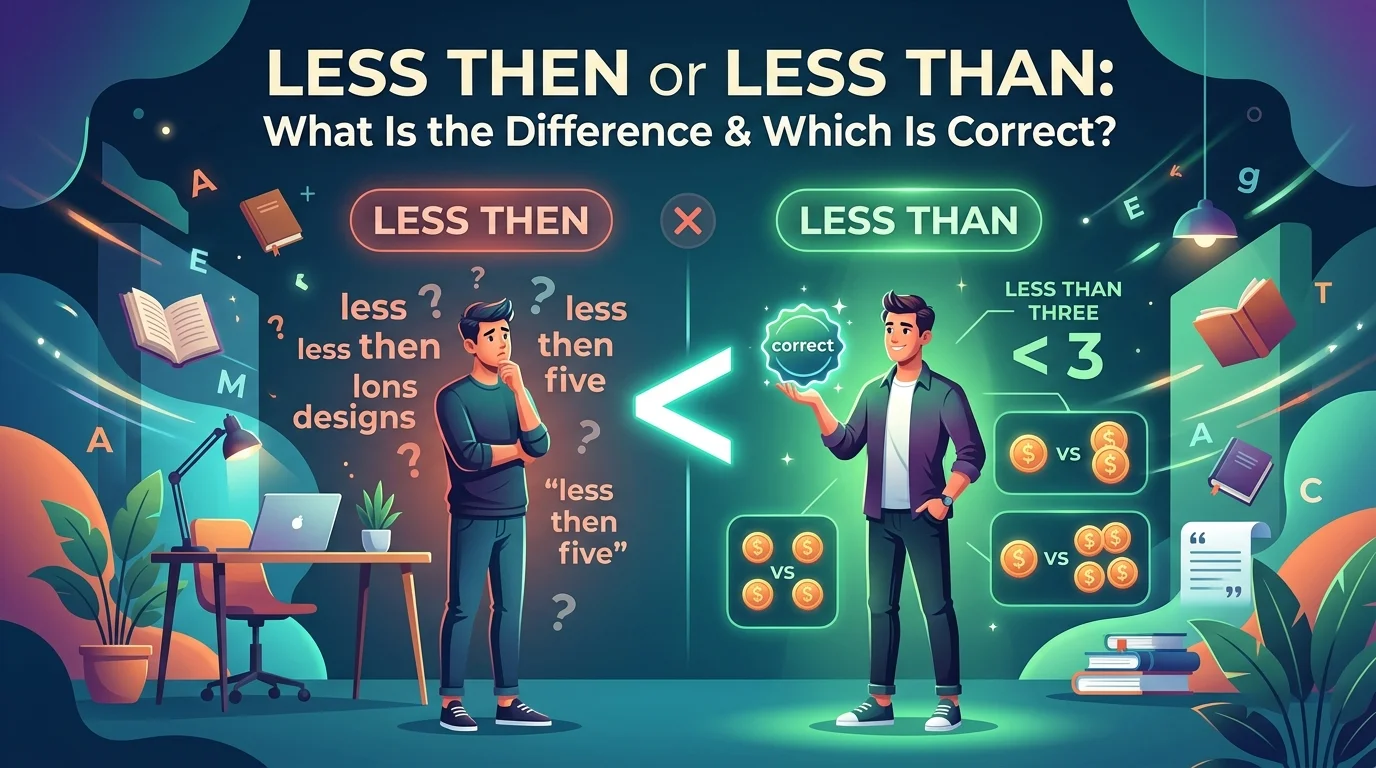
Many English learners confuse less then and less than because the words look and sound similar. However, only one is grammatically correct in most situations. Understanding this difference matters because using the wrong phrase can make your writing look incorrect. This guide explains both clearly so you can use them confidently.
Comparison Overview
The comparison between less then and less than is mainly about correct grammar and word choice.
“Less than” is a standard English phrase used to compare amounts, numbers, quantities, and degrees.
“Less then” is usually a grammatical mistake caused by confusion between then and than. In very rare cases, the words may appear together in separate meanings, but not as a comparison phrase.
So, while they look similar, they serve very different purposes.
Definition of Less Then
“Less then” is generally considered incorrect when used in comparisons.
People often write “less then” by mistake when they actually mean “less than.”
Example of incorrect usage:
I have less then five dollars. ❌
Correct form:
I have less than five dollars. ✅
The word then usually relates to time, sequence, or what happens next, not comparison.
Example:
Finish your homework, then go outside.
So “less then” only makes sense if “less” and “then” are serving separate roles in a sentence, which is uncommon.
Example:
The rain became less, then stopped completely. ✅
Definition of Less Than
“Less than” is the correct phrase used for comparison.
It shows that one amount, number, degree, or quantity is smaller than another.
Examples:
She has less than ten books.
The meeting lasted less than an hour.
This laptop costs less than that one.
This phrase is very common in speaking, writing, math, and formal English.
Main Differences Between Less Then and Less Than
| Feature | Less Then | Less Than |
| Grammar correctness | Usually incorrect | Correct |
| Main purpose | Rarely valid | Used for comparison |
| Meaning | “Less” + “then” (sequence) | Smaller amount or degree |
| Common use | Mistake | Standard English |
| Example | Less then five ❌ | Less than five ✅ |
Why This Confusion Happens
The confusion happens because then and than sound similar in many accents.
People often mix them because:
- Both are short words.
- Their pronunciation can sound alike.
- Typing errors are common.
- Spell-check sometimes misses the mistake.
Remember:
Than = comparison
Then = time/order
Grammar Guide
How each term is used in sentences
Less than follows this pattern:
less than + number/amount/object
Examples:
less than 20 minutes
less than three miles
less than expected
Less then is not used this way.
If “then” appears, it usually means “after that.”
Example:
It became less, then disappeared.
Common mistakes learners make
Incorrect:
He earns less then me. ❌
Correct:
He earns less than me. ✅
Incorrect:
The trip took less then two hours. ❌
Correct:
The trip took less than two hours. ✅
Simple rules to remember
Use than when comparing.
Use then when talking about time or sequence.
Easy memory trick:
Than = comparison
Then = next
Quick tips for writing and speaking
Read your sentence aloud.
Ask:
“Am I comparing something?” → use than
“Am I talking about what happens next?” → use then
When to Use Each One
Use less than when discussing:
Numbers:
Less than 100 people attended.
Money:
It costs less than $50.
Time:
Less than an hour remains.
Quantity:
There is less than a cup left.
Measurement:
The box weighs less than 2 kg.
Use less then only when “then” truly means “after that.”
Example:
The noise became less, then stopped.
When NOT to Use Each One
Do not use less then for comparisons.
Wrong:
She has less then five pens. ❌
Do not use less than for sequence.
Wrong:
Eat dinner less than go to sleep. ❌
Correct:
Eat dinner, then go to sleep. ✅
Which One to Use (Decision Guide)
Ask yourself:
Are you comparing two amounts, numbers, or levels?
→ Use less than
Are you describing what happens next in time?
→ Use then
In 99% of situations where people write “less then,” they actually need less than.
Real World Practical Examples
Less Then Examples
- The wind grew less, then the storm ended.
- Her pain became less, then disappeared.
- Traffic became less, then stopped entirely.
- The noise got less, then faded away.
- The tension became less, then everyone relaxed.
Less Than Examples
- Education: The exam took less than 30 minutes.
- Daily life: I have less than $10 left.
- Science: Water boils in less than five minutes here.
- Business: Profits were less than expected.
- Technology: The file size is less than 2 MB.
Self-Assessment (Fill in the Blanks)
- I have ______ five apples.
- This task takes ______ ten minutes.
- She earns ______ her brother.
- Finish your work, ______ go home.
- The class lasted ______ one hour.
- The pain became ______, ______ disappeared.
- We spent ______ $20.
- There were ______ 50 guests.
- Call me, ______ leave.
- The package weighs ______ 1 kg.
- This costs ______ expected.
- Wait here, ______ enter.
- He has ______ experience than me.
- The event lasted ______ two days.
- It became quieter, ______ silent.
- She owns ______ books than her sister.
- There is ______ water in this bottle.
- Study first, ______ rest.
- The temperature is ______ normal.
- My phone battery is ______ 20%.
Answers
- than
- than
- than
- then
- than
- less, then
- than
- than
- then
- than
- than
- then
- less
- than
- then
- fewer
- less
- then
- less than
- less than
Final Verdict
The correct phrase for comparison is less than. It is used when discussing smaller amounts, numbers, time, or degree. Less then is usually a grammar mistake caused by confusing than with then. If your sentence compares something, choose less than. If your sentence describes what happens next, use then separately. In nearly every case, less than is the right choice.
Conclusion About less then or less than
Understanding the difference between less then and less than is essential for clear and correct English communication. Although they look similar, only less than is used for making comparisons in numbers, quantity, time, and degree. Less then is generally a spelling or grammar mistake, except when then is used separately in a time sequence. By learning this simple rule, you can avoid common errors in writing and speaking. The key is to remember that than is always linked with comparison, while then refers to order or time. With practice, choosing the correct form becomes automatic. Whether you are writing essays, emails, or everyday sentences, using less than correctly will make your English more natural and professional. Keep this guide in mind, and you will never confuse these two expressions again.
FAQs
What is correct less then or less than?
The correct phrase is less than when making comparisons between numbers, amounts, or quantities. Less then is usually incorrect in standard English and appears due to spelling confusion. The word than is specifically used for comparison, while then is related to time or sequence. Always choose less than in proper writing.
Why is less then wrong?
Less then is wrong because then refers to time or sequence, not comparison. Grammar rules require than when comparing two values or amounts. Using less then instead of less than is considered a common error in writing and should be avoided in academic, professional, and everyday communication.
When should I use less than?
Use less than when comparing quantities, numbers, time, or size. It is commonly used in mathematics, daily speech, and formal writing. Whenever you want to show that something is smaller or lower in value compared to another, less than is the correct and standard expression to use.
Is less then ever correct?
Less then is not correct as a comparison phrase. However, the word then can appear separately in sentences to show sequence or time. In most cases where people write less then, they actually need less than. It is best to avoid using it in comparative contexts.
What is difference between then and than?
Then refers to time, order, or what happens next in a sequence. Than is used for comparisons between two things. This difference is the main reason many learners confuse the phrases less then and less than in writing and speaking, especially when spelling or typing quickly.
Can less then be used in sentences?
Less then should not be used as a comparison phrase. It may only appear when then is part of a separate idea in a sentence showing sequence. For comparisons involving numbers or quantities, less than is always the correct and grammatically accepted choice.
How do I remember less than vs less then?
Remember that than is for comparison and then is for time. A simple trick is to link than with “bigger or smaller” comparisons and then with “what happens next.” This memory rule helps you quickly choose the correct form in writing and speaking.
Is less than used in formal writing?
Yes, less than is widely used in formal writing, academic papers, business documents, and exams. It is the standard phrase for comparing amounts, numbers, and measurements. Using it correctly improves clarity and makes your writing sound more professional and grammatically accurate.
What are examples of less than?
Examples include less than ten minutes, less than five dollars, and less than expected. It is used in everyday communication, education, science, and business to show smaller amounts or values. These examples demonstrate how commonly the phrase appears in real life usage.
Why do people confuse less then and less than?
People confuse them because then and than sound very similar when spoken. In fast conversation, the difference is not always clear, leading to spelling mistakes. This confusion is very common among learners, but understanding the rule makes it easy to use correctly.

Amelia Wright focuses on making figurative language easy to understand. Her writing explains similes, metaphors, and word meanings using relatable examples. She aims to help readers recognize subtle differences in usage and apply them correctly in both academic and casual writing.
