
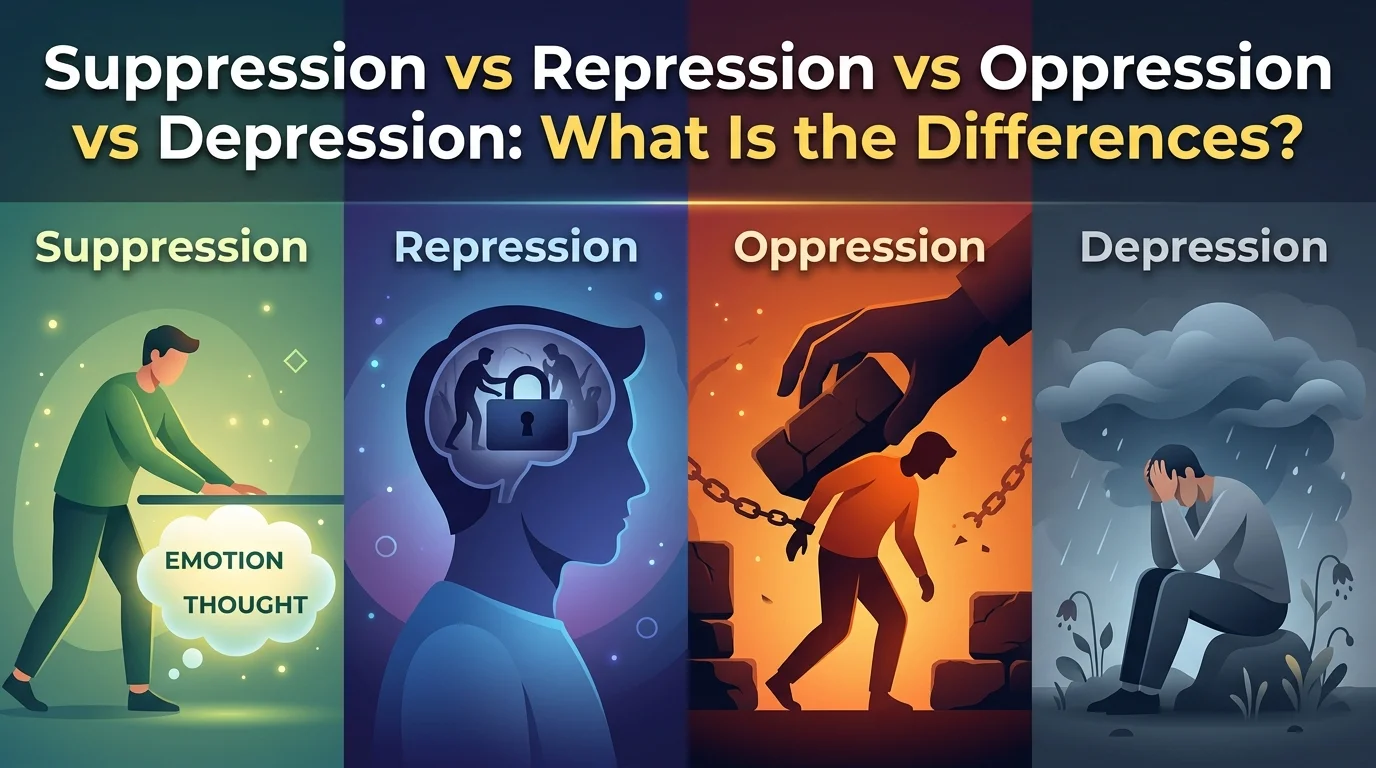
Many people confuse suppression, repression, oppression, and depression because they sound similar and all relate to limiting, controlling, or reducing something. However, each word has a very different meaning and is used in different contexts such as psychology, society, emotions, and everyday communication. Understanding these differences helps you use each word correctly and confidently.
Comparison Overview
Although these four words share similar roots and may seem related, they describe very different ideas.
Suppression usually means consciously stopping or controlling something.
Repression often means unconsciously blocking thoughts or feelings.
Oppression refers to unfair control or cruelty toward people or groups.
Depression generally describes a state of emotional sadness or a medical mental health condition.
The key difference is who or what is being controlled, and whether it is intentional, psychological, social, or emotional.
| Term | Main Meaning | Common Context |
| Suppression | Conscious control or stopping | Psychology, emotions, law |
| Repression | Unconscious blocking | Psychology, memory |
| Oppression | Unfair domination | Society, politics |
| Depression | Emotional or mental illness | Mental health, medicine |
Definition of Suppression
Suppression means intentionally stopping, hiding, or controlling something.
A person is aware they are doing it.
It often refers to deliberately pushing away emotions, thoughts, or actions.
Examples:
- suppress anger
- suppress a cough
- suppress evidence
- suppress emotions
It is a conscious act.
Definition of Repression
Repression means unconsciously blocking painful thoughts, memories, or emotions.
The person usually does not realize this is happening.
It is a psychological defense mechanism.
Examples:
- repressed childhood memories
- repressed trauma
- emotional repression
It is an unconscious process.
Definition of Oppression
Oppression means unfair or cruel treatment by a stronger person, group, or system.
It usually involves power imbalance.
Examples:
- political oppression
- racial oppression
- economic oppression
- social oppression
It is a social or political condition.
Definition of Depression
Depression is a mental health condition involving ongoing sadness, low energy, and loss of interest.
It affects emotions, thoughts, and daily functioning.
Examples:
- clinical depression
- seasonal depression
- depression symptoms
- depression treatment
It is a medical and emotional condition.
Main Differences Between Suppression, Repression, Oppression, and Depression
| Feature | Suppression | Repression | Oppression | Depression |
| Awareness | Conscious | Unconscious | External | Internal |
| Type | Action | Psychological defense | Social injustice | Mental health condition |
| Focus | Controlling something | Hiding emotions/memories | Controlling people | Emotional suffering |
| Common Field | Psychology | Psychology | Politics/Society | Medicine |
| Usually Temporary? | Often | Can last years | Can persist socially | May be short or long term |
Psychological Perspective
In psychology, suppression and repression are often confused.
Suppression = “I know I am avoiding this thought.”
Repression = “I do not realize this memory is hidden.”
Example:
A student ignores stress before an exam = suppression.
A trauma victim forgets painful childhood events = repression.
Social and Political Perspective
Oppression is different because it affects groups or communities.
Examples:
- gender oppression
- religious oppression
- workplace oppression
This is not about inner emotion. It is about external power and control.
Mental Health Perspective
Major Depressive Disorder involves:
- persistent sadness
- hopelessness
- fatigue
- sleep changes
- loss of motivation
Unlike suppression or repression, depression is a health condition, not a choice.
Grammar Guide
All four words are nouns.
| Word | Word Type | Related Verb |
| Suppression | Noun | suppress |
| Repression | Noun | repress |
| Oppression | Noun | oppress |
| Depression | Noun | depress |
How Each Term Is Used in Sentences
Suppression
- The government ordered suppression of the protest.
Repression
- Childhood repression can affect adult behavior.
Oppression
- The novel explores social oppression.
Depression
- She sought help for depression.
Common Mistakes Learners Make
Using suppression instead of repression in psychology.
Wrong: He has suppression of childhood trauma.
Correct: He has repression of childhood trauma.
Using depression when meaning sadness only.
Not all sadness is Depression.
Using oppression for personal sadness.
Wrong: I feel oppression today.
Correct: I feel depressed today.
Simple Rules to Remember
S in Suppression = Stop consciously
R in Repression = Remove unconsciously
O in Oppression = Others controlling you
D in Depression = Deep sadness
Quick Tips for Writing and Speaking
Use suppression for deliberate control.
Use repression for hidden memories.
Use oppression for injustice.
Use depression for emotional or medical contexts.
When to Use Each One
Use suppression when someone intentionally controls feelings or actions.
Use repression when discussing unconscious mental blocking.
Use oppression when discussing unfair treatment or domination.
Use depression when discussing emotional health or mental illness.
When NOT to Use Each One
Do not use suppression for unconscious behavior.
Do not use repression when the action is intentional.
Do not use oppression for ordinary sadness.
Do not use depression for temporary disappointment.
Which One to Use (Decision Guide)
Ask yourself:
Is it intentional control? → Suppression
Is it unconscious hiding? → Repression
Is it unfair external power? → Oppression
Is it emotional suffering or illness? → Depression
Real-World Practical Examples
Suppression Examples
- She used suppression to control her anger during the meeting.
- Doctors advised cough suppression medicine.
- The state attempted suppression of the report.
- He practiced emotional suppression at work.
- Noise suppression improved the audio quality.
Repression Examples
- Childhood trauma may lead to repression.
- The therapist discussed memory repression.
- Emotional repression harmed his relationships.
- Repression delayed healing.
- The novel explored psychological repression.
Oppression Examples
- The citizens fought political oppression.
- Economic oppression increased poverty.
- Workers protested labor oppression.
- The film shows racial oppression.
- History records colonial oppression.
Depression Examples
- She received treatment for Depression.
- Depression affected his work performance.
- Teen depression is a growing concern.
- Therapy helped manage depression.
- Seasonal depression appears in winter.
Self-Assessment (Fill in the Blanks)
- I will use ______ when referring to conscious emotional control.
- The correct word is ______ because the memory is unconsciously hidden.
- Political unfairness is called ______.
- Long-term sadness may indicate ______.
- Hiding anger intentionally is ______.
- Blocking trauma unconsciously is ______.
- Social injustice is ______.
- A diagnosed mental illness may be ______.
- Deliberately ignoring fear is ______.
- Forgotten trauma may involve ______.
- Cruel rule by a dictator is ______.
- Persistent hopelessness is ______.
- Controlling a cough is ______.
- Hidden painful memories are ______.
- Gender inequality may involve ______.
- Clinical treatment may address ______.
- Choosing not to cry is ______.
- Childhood defense mechanisms may include ______.
- Denying rights is ______.
- Emotional exhaustion may signal ______.
Answers
- Suppression
- Repression
- Oppression
- Depression
- Suppression
- Repression
- Oppression
- Depression
- Suppression
- Repression
- Oppression
- Depression
- Suppression
- Repression
- Oppression
- Depression
- Suppression
- Repression
- Oppression
- Depression
Final Verdict
Suppression, repression, oppression, and depression may sound similar, but they belong to very different areas of meaning. Suppression is conscious control, repression is unconscious blocking, oppression is unfair external domination, and Depression is a mental health condition involving deep emotional distress. Choosing the right word depends on whether you are talking about intentional action, hidden psychology, social injustice, or emotional health.
Conclusion About Suppression vs Repression vs Oppression vs Depression
Understanding the difference between suppression, repression, oppression, and depression helps you use these terms correctly in both writing and real-life conversations. While they may sound similar, each word belongs to a different context. Suppression is a conscious effort to control thoughts or actions, repression happens unconsciously in the mind, oppression refers to unfair treatment or control of people, and depression is a serious emotional and mental health condition. Knowing these distinctions not only improves your grammar and vocabulary but also deepens your understanding of psychology and society. When used correctly, these words make communication clearer, more accurate, and more meaningful in academic, professional, and everyday situations.
FAQs
What is the main difference between suppression and repression?
Suppression is a conscious decision to push away thoughts or feelings, while repression is an unconscious psychological process where the mind blocks painful memories or emotions without awareness. Suppression is intentional and temporary, whereas repression happens automatically and can influence behavior over time without the person realizing it.
Is oppression related to psychology or society?
Oppression is mainly a social and political concept, not a psychological one. It refers to unfair treatment, control, or discrimination of individuals or groups by those in power. It can involve systems, laws, or behaviors that limit freedom, rights, or equality within a society or community.
Is depression the same as sadness?
Depression is not the same as normal sadness. While sadness is temporary and usually caused by specific events, depression is a medical mental health condition involving long-term emotional distress, loss of interest, low energy, and difficulty functioning in daily life. It often requires professional treatment.
Can suppression affect mental health?
Yes, suppression can affect mental health if used excessively. Constantly pushing down emotions may lead to stress, anxiety, or emotional imbalance over time. While suppression can be useful in short situations, long-term emotional avoidance may prevent healthy emotional processing and self-expression.
What causes repression in psychology?
Repression is believed to occur as a defense mechanism in the mind, often triggered by traumatic or painful experiences. The brain unconsciously hides these memories to protect the individual from emotional distress. However, these repressed memories may still influence behavior, emotions, and relationships later in life.
How is oppression identified in society?
Oppression is identified through patterns of inequality, discrimination, and unfair control. It may appear in systems where certain groups are denied rights, opportunities, or respect based on race, gender, religion, or social status. It often involves long-term power imbalance and systemic injustice.
Can depression be treated?
Yes, depression can be treated effectively with therapy, medication, lifestyle changes, and support systems. Early diagnosis improves recovery outcomes. Professional help such as counseling or psychiatric care is often recommended to manage symptoms and restore emotional well-being.
Why do people confuse these four terms?
People confuse these terms because they sound similar and all involve the idea of “pushing down” or “controlling.” However, each belongs to a different field such as psychology, society, or mental health. Their meanings differ based on whether the cause is conscious, unconscious, or external.
Is repression always harmful?
Repression is not always immediately harmful because it helps the mind cope with trauma. However, long-term repression can lead to emotional difficulties, anxiety, or unresolved psychological issues. Addressing repressed memories through therapy can help improve emotional health and awareness.
How can I remember the difference easily?
A simple way is: suppression is conscious control, repression is unconscious blocking, oppression is external control over people, and depression is emotional or mental illness. Remembering these key contexts makes it easier to use each term correctly in writing and conversation.

Sophia Turner is a grammar-focused writer who covers similes, word-versus-word meanings, and correct English usage. Her content is designed for learners who want quick answers, logical explanations, and practical guidance for improving writing accuracy and style.